
Domestic & General

Quick Answer
Domestic & General is the UK’s largest appliance protection provider, trading since 1912 and covering millions of appliances through monthly-paid plans sold directly and under the names of manufacturers and retailers. It does not employ repair engineers: it authorises claims and sends contractors from an approved network. Its plans offer unlimited repairs with no callout, parts or labour charges, and replacement if an appliance cannot be fixed, but a £99 excess applies for the first 90 days if cover starts after the manufacturer’s guarantee has expired.
About this review
Every claim below is sourced to Domestic & General’s own published material, the Companies House register, or the Financial Conduct Authority, with the source and date stated. Whitegoods Help has not tested the service and makes no claim to have done so. Nothing on this page is a personal recommendation about any insurance product.
Domestic & General occupies a different position from the repair companies covered elsewhere in this section. It is an insurer and plan provider rather than a repairer, and it reaches most of its customers indirectly, through manufacturers and retailers who sell its cover under their own branding. A great many households hold a Domestic & General product without recognising the name.
Who is Domestic & General?
Domestic & General sells appliance protection plans and breakdown insurance covering domestic appliances, consumer electronics, boilers, heating, plumbing and drainage. It has traded since 1912 and now operates across 12 markets worldwide from its base at Swan Court, Worple Road, Wimbledon.
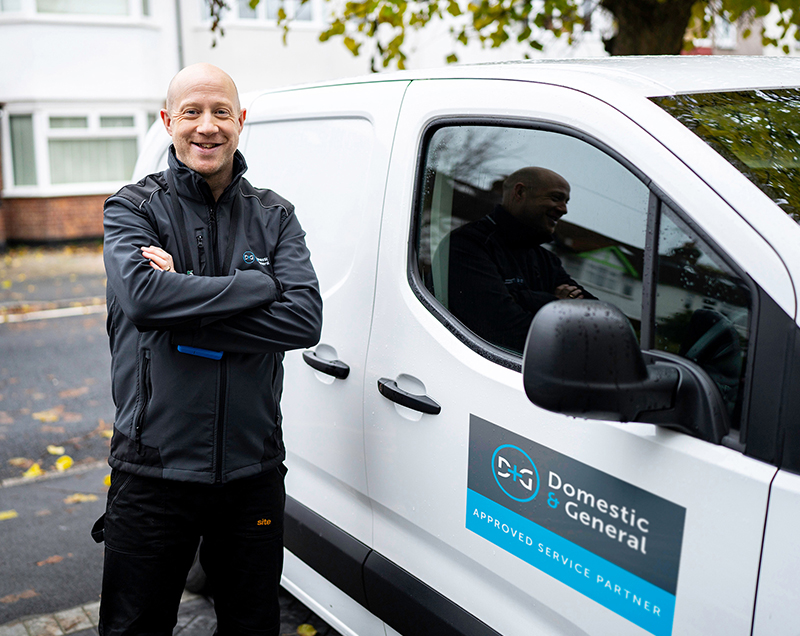
Its role in a repair is administrative rather than practical. When a covered appliance fails, Domestic & General authorises the claim and arranges for an engineer from its approved network to attend. Those engineers are contracted independents, manufacturer service teams and national repair operations, not employees.
The other thing to understand is how the cover is sold. A great deal of it is distributed through manufacturers and retailers, including partnerships the company names publicly with Whirlpool, Sky, Hoover Candy and John Lewis, often branded as the manufacturer’s own plan. If cover was offered by a manufacturer’s customer service team after a guarantee expired, it may well have been a Domestic & General product.
Year the business states it began trading
Repairs a year, per company figures
Claims approval rate the company reports
Excess in the first 90 days on late-started cover
What do the public records show about the company?
Two separate companies sit behind the brand, and which one you are dealing with depends on which product you hold. Insurance policies are provided by Domestic & General Insurance PLC, company number 485850, incorporated on 30 August 1950 and known as Domestic & General Insurance Co Limited until November 1998. Service plans and maintenance and support plans are provided by Domestic & General Services Limited, company number 1970780.
| Detail | Position as at July 2026 |
|---|---|
| Insurance entity | Domestic & General Insurance PLC, company number 485850, incorporated 30 August 1950 |
| Service plan entity | Domestic & General Services Limited, company number 1970780 |
| Group parent | Domestic & General Group Limited, company number 01156896 |
| Registered office | Swan Court, 11 Worple Road, Wimbledon, London, SW19 4JS |
| Regulation | Domestic & General Insurance PLC is authorised by the Prudential Regulation Authority and regulated by the FCA and PRA, financial services register number 202111 |
| Regulatory role | The company states it is the underwriter of its policies, not an intermediary, and does not give personal recommendations or advice |
| Business activity | Non-life insurance and non-life reinsurance |
| Ownership | CVC Capital Partners funds as majority holder with Luxinva S.A., an Abu Dhabi Investment Authority entity, holding a minority stake. A sale to Asurion was agreed in December 2025 |
| Repair model | Approved network of contracted engineers. Domestic & General does not employ the engineers who attend |
A note on the 1912 date
Domestic & General states that it has been in business since 1912, and that longevity is genuine. The registered insurance company dates from 1950 and the group parent from a later incorporation, which is normal for a business that has restructured several times across a century.
Both statements can be true at once. This page reports the company’s own account of its history and the public record separately rather than choosing between them.
Who owns Domestic & General, and has the Asurion deal completed?
This needs stating carefully, because the position is unresolved. On 2 December 2025, Asurion, the US technology care company, announced that it had reached a definitive agreement to acquire Domestic & General from CVC funds and from Luxinva S.A., an entity wholly owned by the Abu Dhabi Investment Authority.
The announcement stated that the transaction was expected to close in mid-2026 subject to regulatory approvals, and that the terms were not disclosed. Any purchase price in circulation is therefore press estimate rather than confirmed fact. Acquiring an insurance undertaking requires change in control approval from the regulators, which is not a formality.
When Domestic & General’s corporate news pages were checked on 26 July 2026, no completion announcement had been published. Readers should treat the ownership position as in transition and verify the current position directly. The announcement said that on closing Domestic & General would continue to operate under its own brand as a business unit of Asurion.
2013: CVC acquires the business
Advent International sells Domestic & General to CVC Capital Partners.
2019: ADIA takes a minority stake
The Abu Dhabi Investment Authority acquires a 30% holding alongside CVC as majority shareholder.
2024: Revenue passes £1 billion
The company reports surpassing £1 billion in revenue and reaching 250,000 US subscription customers.
December 2025: Asurion agrees to buy the business
A definitive agreement is announced, with closing expected in mid-2026 subject to regulatory approvals and terms undisclosed.
July 2026: no completion announced
No completion notice appeared on the company’s corporate news pages when checked. The position should be verified directly.
For existing customers, a change of ownership does not alter the terms of a policy already in force. Contractual rights sit with the insuring or contracting company, not with its shareholders. What can change over time, after any integration, is service delivery, pricing on renewal and the product range.
Insurance policy or service plan? The distinction matters
Domestic & General sells two legally different things, provided by two different companies, and the paperwork does not always make the difference obvious. This is the single most useful thing for a customer to establish about their own cover.
 Insurance policy
Provided by Domestic & General Insurance PLC, which is authorised by the PRA and regulated by the FCA and PRA under register number 202111. This is a regulated insurance contract, and the company states it acts as the underwriter rather than as an intermediary.
 Service plan
Provided by Domestic & General Services Limited. A service plan is a contract for services rather than a policy of insurance, and Domestic & General publishes a separate complaints process for service plans from the one that applies to insurance policies.
Check your documents for the company name and, where present, the register number. If you need to complain, the route depends on which product you hold, and the two routes are published separately by the company.

How to check any provider’s regulatory status
Any firm selling insurance in the UK must be authorised. You can confirm a firm’s authorisation, permissions and trading names on the Financial Services Register, which is free to search.
The FCA also publishes firm-level complaints data twice a year, and a separate general insurance value measures dataset showing claims frequency, claims acceptance rates and average payouts by product type. Both are more informative than marketing material when judging an insurance product.
What does an appliance plan cover, and what does it cost?
Taking the washing machine and fridge freezer products as published examples, the cover offered is broad. Domestic & General advertises unlimited repairs with nothing extra to pay for callouts, parts or labour, cover for breakdown and accidental damage, and replacement of the appliance if it cannot be repaired, though installation and delivery costs may apply to a replacement.
The entry requirements are unusually relaxed. The company states the appliance does not need to be new or within its manufacturer’s guarantee, and that proof of purchase is not required. Cover is paid by monthly Direct Debit with no fixed-term contract.

You cannot take out cover after a breakdown and get a free repair
Domestic & General’s product pages carry a footnote stating that if a policy starts after the end of the manufacturer’s guarantee, a £99 excess applies in the first 90 days.
That is the clause which prevents the plan being used as a cheap route to an immediate repair on an already broken appliance. Anyone considering signing up because something has just failed should compare that £99, plus the premiums, against the cost of simply paying an engineer.
Pricing is not published. Premiums are quoted per appliance after entering its details, so the only way to judge value is to obtain a quote for your own machine. Whitegoods Help does not estimate prices, and readers should be wary of any source that does.
Two further terms are worth locating in your own documents rather than assuming. Domestic & General’s help pages address a maximum value for a repair and a limit on the cost of repairs that can be booked, so a claim limit exists even where repairs are described as unlimited in number. Establish what that limit is before relying on the cover for an expensive appliance.
-
Work out the annual cost. Multiply the monthly premium by twelve, then by the number of years you expect to keep the appliance.
-
Compare it against one repair. Get a fixed-price quote from a repairer for the kind of fault the appliance is likely to develop, using the repair or replace guidance as a starting point.
-
Check what you already have. Statutory rights, the manufacturer’s guarantee and any free five year parts guarantee may already cover the fault at no cost.
-
Read the exclusions and limits. The claim limit, the excess position and the condition of the appliance on joining decide whether the cover will actually pay out.
Who actually carries out the repairs?
Domestic & General does not employ the engineers who attend. It reports a network of more than 8,000 engineers, and the December 2025 acquisition announcement described a growing repair network of more than 25,000 independent engineers. Those figures are not directly comparable and the company has not published a reconciliation, so both are reported here as stated rather than treated as one number.
Its published performance figures for the most recent year are 2.7 million repairs, 79% of appliances fixed on the first visit, a 99% claims approval rate, 86% subscription customer retention and a net promoter score of 61, up from 58. These are company-published figures, correct as displayed in July 2026.
A 99% claims approval rate is a strong number if it holds up, and the first-visit fix rate is respectable for work delivered through contractors. The practical consequence of the contractor model is the familiar one: the quality of your experience depends heavily on which firm is allocated your job, and that varies by area.
Domestic & General also allows repairs to be booked without a plan, so it can be used for one-off paid work as well as claims.
What are the genuine strengths and weaknesses?
The assessment below draws on the company’s published material, the Companies House register and FCA information. It is not based on testing the service.
 Strengths
- Very broad cover on paper: unlimited repairs, no callout, parts or labour charges, accidental damage included and replacement if unrepairable
- Older appliances accepted, with no proof of purchase required and no fixed-term contract
- A regulated insurer rather than an unregulated warranty seller, with a register number that can be verified independently
- Clear published separation between the insurance company and the service plan company, including separate complaints processes
- Discloses openly that its sales agents receive incentives linked to sales and quality targets
- Very large scale, with 2.7 million repairs a year and over a century of trading
- Published performance figures including first-visit fix rate, claims approval rate and retention
- Repairs can be booked without holding a plan
 Considerations
- A £99 excess applies for the first 90 days where cover starts after the manufacturer’s guarantee has ended
- No published pricing, so value cannot be assessed without requesting a quote per appliance
- A maximum repair value and a limit on bookable repair costs exist, so “unlimited repairs” refers to frequency rather than to cost
- Engineers are contracted rather than employed, so service quality varies by the firm allocated to your area
- Much of the cover is sold under manufacturer and retailer branding, so customers may not know who they are contracting with
- Two different companies and two different product types sit behind one brand, which complicates knowing your rights
- Sales agents are incentivised on sales targets, which is disclosed but is worth bearing in mind during a sales call
- Ownership is mid-transition, with a sale agreed in December 2025 and no completion announced as at July 2026
- For a single reliable appliance, premiums over several years frequently exceed the cost of the repairs actually needed
Is an appliance protection plan worth buying at all?
This is the real question behind most searches that reach this page, and it deserves a straight answer rather than a sales pitch from either direction. Appliance cover is not a scam, and it is not usually good value either. It is a product that transfers a risk you could probably carry yourself, at a price that includes the provider’s costs and margin.
The arithmetic is what matters. A modern washing machine from a mainstream brand will often run for years without a fault, and the most common failures on an out-of-warranty machine are repairable for a fixed sum. Set the monthly premium aside in a savings account instead and, across a household of several appliances, most people finish ahead.
The case for cover is stronger in three situations: where an unexpected bill would genuinely cause hardship, where an appliance is expensive to replace and awkward to live without, and where a household has a track record of heavy use and frequent faults.
Check the rights you already have before paying for cover
Under the Consumer Rights Act 2015 you may have a claim against the retailer for up to six years in England and Wales, and five years in Scotland, where goods were not of satisfactory quality. Manufacturers must also make functional spare parts available for years after a model was last sold under the Right to Repair rules.
Read the guidance on faulty appliances and the Consumer Rights Act, consumer rights on appliances and the Right to Repair rules. Many households pay for cover that duplicates protection they already had, as covered in why consumers do not use their consumer rights.
Whitegoods Help has looked at the extended warranty question repeatedly, and the conclusions are worth reading before committing to any monthly payment: should you buy a washing machine extended warranty, a reader’s five year extended warranty offer assessed, and the comparison of appliance insurance against subscription schemes. Terms can also carry restrictions that surprise people, as with a warranty clause limiting how much washing you can do.
Who might Domestic & General suit, and who might it not?
Likely a reasonable fitHouseholds for whom an unexpected repair bill would cause real difficulty and who value predictable monthly outgoings. Owners of older appliances that other providers will not cover, since no proof of purchase or in-guarantee status is required. Anyone who wants a regulated insurer with a verifiable register entry rather than an unregulated warranty. Households with a history of frequent breakdowns across several appliances.
Probably not the right choiceAnyone whose appliance is still in guarantee or within the statutory window against the retailer. Households able to absorb a one-off repair bill, who will usually do better setting the premium aside. Anyone signing up in response to a breakdown that has already happened, given the 90-day excess. Owners of cheap appliances where a few years of premiums would approach replacement cost.
How does a protection plan compare with the alternatives?
| Route | How you pay | Best suited to | Main consideration |
|---|---|---|---|
| Domestic & General plan | Monthly Direct Debit, no fixed term, price quoted per appliance | Households needing predictable costs across older appliances | 90-day £99 excess on late-started cover, and a claim value limit |
| One-off repair from a national network such as NAC or Pacifica | Fixed price agreed at booking, parts either included or quoted | Anyone able to pay when something breaks | You carry the risk of an expensive failure |
| Manufacturer service | Fixed repair price, or free while in guarantee | In-guarantee faults and premium brands | That brand only, and lead times can be longer |
| Local independent engineer | Callout plus labour and parts | Value, and a relationship with one engineer | Availability, and no fallback when unavailable |
| Self-insuring | Set the premium aside yourself each month | Households with several reliable appliances | Requires the discipline to leave the fund alone |
The wider question of who to call is covered in the comparison of manufacturer against independent engineers.
Cold calls, renewals and complaints
Appliance cover is sold heavily by telephone and post, both by Domestic & General and by unconnected companies using similar language. Domestic & General publishes guidance on rogue traders and on what to do about a suspicious call, which is a sensible page to read if you receive one.
The company also discloses that its sales agents receive periodic incentives such as bonus payments for meeting quality and sales targets. That is a legitimate arrangement and disclosing it is to the company’s credit, but it is worth remembering during a call that the person on the line has a target.
Never give payment details on an unsolicited call. Hang up and ring the number on your own paperwork instead.
Check the company name and register number on your documents, then verify it on the Financial Services Register.
Establish whether you hold an insurance policy or a service plan, because the complaints route differs.
Complain to the company first and in writing. If the answer is unsatisfactory, an insurance complaint can usually go to the Financial Ombudsman Service, which is free to use.
Keep a written record of visits, parts fitted and dates. See what to do when an engineer did not come and claiming compensation from a retailer or repairer.
Diagnosing the fault first
Whether or not an appliance is covered, working out what has gone wrong is worth ten minutes before anyone is called. A surprising proportion of reported faults are blocked filters, tripped safety devices, overloading or user error, and no plan is needed to fix those.
Start with the appliance error codes hub and the pre-repair checks worth doing first. For laundry faults specifically, the washing machine repair guides cover the common failures in detail.

Safety warning on DIY appliance repairs
Domestic appliances combine mains electricity with water, heat and moving parts. Always disconnect an appliance from the mains before removing any panel, and never work on a live appliance. Capacitors can retain a dangerous charge after disconnection.
Gas appliances must only be worked on by a Gas Safe registered engineer. If you smell gas, call the National Gas Emergency Service on 0800 111 999 immediately and check credentials on the Gas Safe Register. If in any doubt, use a qualified engineer. See the DIY repair safety guidance.
Note also that carrying out your own repair on a covered appliance may affect a claim. Check your policy first.
What about spare parts?
Where an appliance is out of cover and the fault is straightforward, fitting the part yourself is an option for the reasonably confident. Correct identification matters more than anything else, and the full model and serial number from the rating plate is what determines which version of a part will fit.
Whitegoods Help maintains guidance on sourcing Spare Parts Shop, the difference between genuine and pattern parts, and what to check before buying spares.
Appliance broken and not covered?
If an appliance has failed and no plan applies, a one-off repair at a price agreed before the visit is usually the cheaper route. Whitegoods Help can arrange a repair, or help you decide whether the machine is worth saving.
Frequently asked questions about Domestic & General
Does Domestic & General employ the engineers who carry out repairs?
No. Domestic & General authorises claims and arranges attendance from an approved network of contracted engineers, which includes independent firms, manufacturer service teams and national repair operations. The company reports a network of more than 8,000 engineers, while the December 2025 acquisition announcement referred to more than 25,000 independent engineers.
Is there an excess to pay on a Domestic & General plan?
The product pages state that where a policy starts after the end of the manufacturer’s guarantee, a £99 excess applies during the first 90 days. That clause prevents cover being used as a cheap route to an immediate repair on an appliance that has already failed. Check your own documents for the excess position that applies to you.
Does Domestic & General cover fridges and freezers?
Yes. Fridge freezer cover was being offered on the company’s own product pages when checked in July 2026, on the same basis as its other appliance cover, including unlimited repairs and replacement if the appliance cannot be fixed.
Has Asurion completed its purchase of Domestic & General?
A definitive agreement was announced on 2 December 2025, with closing expected in mid-2026 subject to regulatory approvals, and the terms were not disclosed. No completion announcement had been published on the company’s corporate news pages when they were checked on 26 July 2026. A change of shareholder does not alter the terms of a policy already in force.
Do I have an insurance policy or a service plan?
It depends which product you bought. Insurance policies are provided by Domestic & General Insurance PLC, register number 202111, while service plans and maintenance and support plans are provided by Domestic & General Services Limited. The company publishes separate complaints processes for the two, so check the company name on your documents.
Are appliance protection plans worth buying?
Sometimes, but not usually on a single reliable appliance. Premiums paid over several years frequently exceed the cost of the repairs a household actually needs, and setting the money aside instead leaves most people ahead. Cover makes more sense where an unexpected bill would cause real hardship, or where an appliance is costly to replace. Check your statutory rights and any manufacturer guarantee first.
How do I complain about a claim or a repair?
Complain to the company in writing first, using the complaints process that matches your product. If the response is unsatisfactory and the product is an insurance policy, the complaint can usually be referred to the Financial Ombudsman Service free of charge. Keep a dated record of visits, parts fitted and what you were told.
Editorial summary
Domestic & General is the established incumbent of UK appliance cover, and on the evidence available it runs a competent operation: a regulated insurer with published performance figures, a claims approval rate it reports at 99%, a first-visit fix rate of 79%, and cover terms that are more generous than much of the market, particularly the willingness to insure older appliances without proof of purchase.
The reservations are about the product category more than the company. Appliance cover asks households to pay a monthly sum to avoid an occasional bill they could usually absorb, and the arithmetic works against most people who buy it. Three specific things deserve attention before signing anything: the £99 excess in the first 90 days on cover started after the guarantee expires, the existence of a maximum repair value behind the phrase “unlimited repairs”, and the fact that the engineer who attends works for a contractor rather than for Domestic & General.
Two structural points also matter. Because much of this cover is sold under manufacturer and retailer branding, a significant number of customers do not know that Domestic & General is their provider, which makes checking your paperwork worthwhile. And with a sale to Asurion agreed but not confirmed as completed, this is a business in transition; existing policy terms are unaffected, but service and pricing on renewal are worth watching over the next couple of years.
For households that value predictable outgoings across several ageing appliances, it is a credible product from a properly regulated provider. For most others, a fixed-price repair when something actually breaks will cost less over the life of the appliance.
Content disclaimer
This page provides general consumer information and does not constitute legal or financial advice, nor a personal recommendation about any insurance product. It reflects Domestic & General’s published information, the Companies House register and FCA information as at July 2026. Whitegoods Help has not tested the service. Cover terms, exclusions, excesses, limits, pricing, ownership and company details change over time, so verify current details and read the policy documents before buying.
Sources
Companies House register: Domestic & General Insurance PLC, company number 00485850; Domestic & General Group Limited, company number 01156896; persons with significant control filings. Financial Services Register entry for Domestic & General Insurance PLC, reference number 202111. The company’s own website at domesticandgeneral.com, including the about us, corporate news, appliance protection, repairs and product pages, and the regulatory and legal footer disclosures. Asurion’s announcement of a definitive agreement to acquire Domestic & General, dated 2 December 2025, as published on the company’s corporate news page. All web sources accessed 26 July 2026.
Ask the repair forum
Post the make, model and symptoms and get help from the Whitegoods Help community.
0 Comments