
What’s the difference between drum sizes in washing machines?
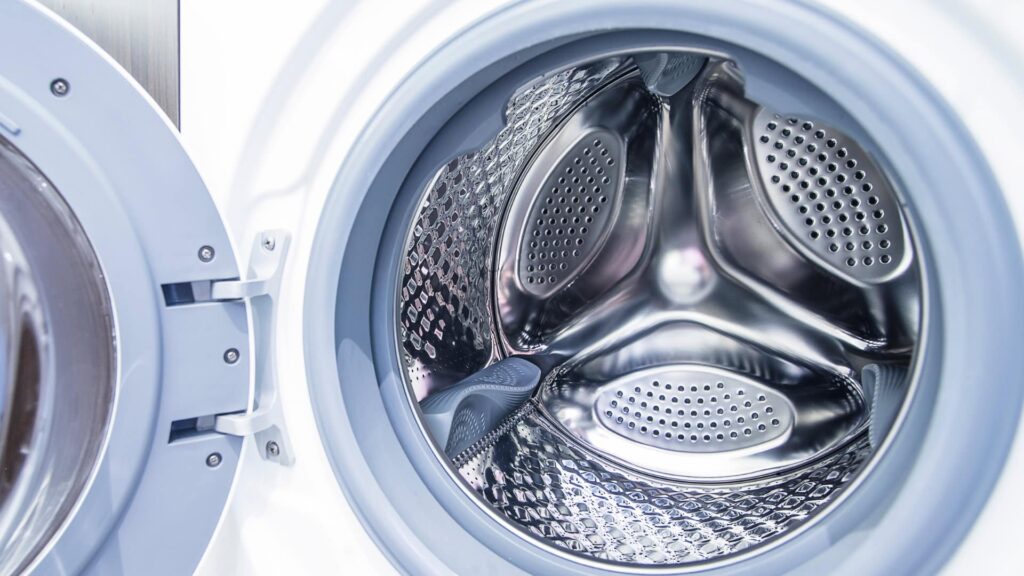
Not all washing machine drum capacities are equal – and this is an important point that is easy to miss when comparing specifications. A 7kg drum from one manufacturer may hold noticeably more or less laundry than a 7kg drum from another. Understanding why this happens, and what each capacity is realistically suited to, helps in choosing the right machine.

Drum capacity figures are not standardised in a way that guarantees the same usable space across brands. The shape of the drum, the size of the door glass opening, and the depth of the drum paddles all affect how much laundry can realistically fit inside – regardless of what the specification states. Two machines sold as the same capacity can have meaningfully different usable space.
Why Drum Capacity Figures Are Not Always Comparable
Manufacturers do not all use the same criteria when determining and specifying drum capacity. The published figure represents the physical volume of the drum in some form, but the actual usable space for laundry varies depending on drum geometry, paddle design, and door glass depth.
Some manufacturers use professional packers and specifically chosen items of laundry to physically demonstrate maximum capacity – in ways that ordinary users would not replicate. The practical result is that a drum labelled at one capacity can behave as though it is significantly larger or smaller than an identically labelled drum from a different brand.
The design of drum paddles is a particularly significant factor. Large, deep paddles take up usable space inside the drum. A drum with small, shallow paddles will fit more laundry even at the same nominal capacity.
6kg Drum Capacity
6kg is now the entry-level drum size for most mainstream washing machines, replacing the 4-5kg drums that were standard for many years. For most households with average washing demands, 6kg represents a practical balance – large enough to handle a typical family wash without the complications that come with very large drums.
A 6kg machine is unlikely to require compromises in terms of machine size, electrical supply, or water consumption. For households without regular need to wash very large items like duvets, or very large loads in one go, 6kg is a sensible choice.
7kg Drum Capacity
7kg drums are the most common size in mid-range washing machines. The key point about 7kg drums is that usable capacity varies significantly between models – more so than at other capacity ratings.
Testing and comparison carried out by Whitegoods Help highlighted an instructive example: the now-discontinued Dyson CR01 washing machine, which was sold as a 7kg machine, had a notably larger usable capacity than other 7kg machines tested subsequently. The Dyson’s unusually shallow door glass and particularly small drum paddles meant that considerably more laundry could be loaded than was possible with other 7kg machines. In practical terms, the Dyson CR01’s 7kg drum was closer in usable space to what might be expected from an 8kg machine on another brand.
This example illustrates why comparing specifications alone is not reliable. Where possible, comparing the door glass opening size and drum depth visually – whether in a showroom or via detailed product specifications – gives a more accurate picture of usable capacity than the kg rating alone.

A 5kg drum is generally too small to wash a standard double duvet satisfactorily – the duvet cannot move freely enough to wash properly. A 7kg drum with good usable space (such as the Dyson CR01 design) can accommodate a standard duvet comfortably. For most other 7kg machines, a duvet wash is possible but may be tight.
8kg Drum Capacity
8kg drums are genuinely large. For households that do a high volume of washing, or regularly need to wash large items, an 8kg machine can be more economical – fewer cycles needed for the same total laundry volume. The potential downside is that running a very large drum with a small load wastes water and energy.
To give a practical illustration of 8kg capacity, the following items were washed in a single load during testing of an 8kg Samsung washing machine:
- 10 pairs of underwear
- 8 pairs of socks
- 2 pairs of trousers
- 3 t-shirts
- 2 cotton shirts
- 4 pairs of jeans
- 1 pair of shorts
- 1 heavy hoody top
This represents a significant volume of laundry – more than most households would typically generate in a single wash. For reference, the full load when dried filled a standard rotary washing line plus a separate sock hanger with 32 socks. What amounted to one wash load appeared visually equivalent to two normal loads when hung out to dry.
Bigger Is Not Always Better
A very large drum capacity is only beneficial if it is regularly needed. Buying a machine with an 8kg or 9kg drum when the typical household load is 4-5kg means consistently running an oversized machine at below its optimal fill level, which is inefficient. Larger drums also tend to increase the physical depth of the machine and its weight.
See the companion guide for a full breakdown of the pros and cons of each drum size: washing machine drum sizes – pros and cons.
More washing machine guides
Frequently Asked Questions
Are all 7kg washing machine drums the same size?
No. Drum capacity figures are not standardised in a way that guarantees the same usable space across brands. The design of the door glass opening, the depth of the drum paddles, and the geometry of the drum all affect how much laundry will fit in practice. Two machines sold as 7kg can have noticeably different usable capacity.
What is the most practical drum size for a family?
For most households, 7kg or 8kg represents the practical range. A 6kg machine handles the typical daily wash for a small to medium household. An 8kg machine suits larger households or those who prefer to do fewer, larger loads. The right size depends on typical load volume rather than headline capacity figures. See: washing machine drum sizes – pros and cons.
Can I wash a double duvet in a 7kg washing machine?
It depends on the machine. Some 7kg drums have enough usable space to accommodate a standard double duvet satisfactorily – particularly those with a wide door glass opening and shallow paddles. Others may be too tight for the duvet to move freely enough to wash properly. A 5kg drum is generally not sufficient for a double duvet. Check the manufacturer’s guidance for the specific machine.
Is a bigger drum more economical to run?
Only if it is regularly filled close to its capacity. A larger drum uses more water and energy per cycle. If it is consistently run with a smaller load than its capacity, it will be less efficient than a smaller machine used at or near full capacity. The economic benefit of a large drum only materialises if the extra capacity is genuinely and regularly needed.
Why does my 7kg machine seem smaller than a friend’s 7kg machine?
This is a common experience and reflects the inconsistency in how drum capacities are measured and specified. Drum design – including paddle size and door glass depth – significantly affects usable space independently of the stated capacity. Machines from different brands can have noticeably different practical capacity despite identical kg ratings.
Ask the repair forum
Post the make, model and symptoms and get help from the Whitegoods Help community.
6 Comments
Grouped into 5 comment threads.
0 replies That's a good question. If it isn't written on the control panel you can't tell. You should be able to download a manual from here appliance instruction manuals. Your model number should be behind or on the back of the door or occasionally elsewhere where is model number on a washing machine?
0 replies How can I determine the drum size (Kg weight) on a failed washing machine so that I can replace it with like for like? Original manual with spec unfortunately mislaid. Thank you
How can I determine the drum size (Kg weight) on a failed washing machine so that I can replace it with like for like? Original manual with spec unfortunately mislaid. Thank you
1 reply I have a Samsung washing machine and a cotton wash takes 3 hours, I was thinking if I use cotton wash for towels and heavy items then I can use the daily wash for general everyday clothes, daily wash only takes 4 kg, however I weighed my washing without towels and it fills the drum, how can this be right, also can a machine handle a full load of towels or are they to heavy.
I have a Samsung washing machine and a cotton wash takes 3 hours, I was thinking if I use cotton wash for towels and heavy items then I can use the daily wash for general everyday clothes, daily wash only takes 4 kg, however I weighed my washing without towels and it fills the drum, how can this be right, also can a machine handle a full load of towels or are they to heavy.
Likely replying to Christine
Hello Christine. You really need to wash cottons and heavy items on the cut and wash. The reason it takes three hours is because modern washing machines employ various measures to reduce the amount of water and energy that they use in this inevitably increases wash times or the wash and rinse efficiency would be to adversely affected. Back when washing machines used only take about an hour or so to do a cottons wash they used to use probably more than twice the amount of water and therefore could rinse quite quickly but not these days.
The other washers that you mention are not designed to wash cottons properly. The thing about towels is that they are highly absorbent and when they are wet they become very heavy but ironically shrink in size. So dry towels that virtually fill a washing machine drum, once wet will shrink down to a more manageable size.
0 replies Amazing thank you
Amazing thank you
0 replies Thank you - helpful and useful advice :)
Thank you – helpful and useful advice :)
That’s a good question. If it isn’t written on the control panel you can’t tell. You should be able to download a manual from here appliance instruction manuals. Your model number should be behind or on the back of the door or occasionally elsewhere where is model number on a washing machine?