
Washing machine eco labels Part 4

This is Part 4 of the Whitegoods Help guide to washing machine energy labels, covering spin drying performance, water consumption, and noise ratings. All three figures have real limitations – the spin rating can actively mislead buyers of budget machines, water consumption figures say nothing about rinse quality, and decibel ratings require context to be useful.
The final three sections of the washing machine energy label cover spin drying efficiency, water consumption, and noise levels. Each provides some useful data – but in each case there is important context missing from the label itself that buyers need to understand before drawing conclusions.
Spin Drying Performance
Spin drying performance is rated on the familiar A to G scale, where A represents the most effective extraction of water from laundry. On the surface this looks useful, but the rating has a significant limitation: it tells you that one machine extracts more water than another, but not by how much. Without knowing the actual residual moisture content, the difference between a B and a C rating may be trivial or it may be meaningful – the label alone does not tell you.
To achieve an A spin efficiency rating, most washing machines need to spin at 1600rpm or above. This creates a problem for budget machines. High spin speeds place significant mechanical demands on a washing machine – the suspension system, out-of-balance detection, motor quality, drum bearings, and cabinet rigidity all need to be engineered to cope with those forces consistently over time. A budget machine that achieves an A spin rating by spinning at 1600rpm may do so at the cost of longevity, noise, and stability.

A budget washing machine with an A spin efficiency rating may be noisier, less stable, and shorter-lived than a higher-quality machine rated B. Build quality determines how well a machine handles high spin speeds over time – the label does not measure this at all.
In practice, the real-world difference in drying times between adjacent spin speeds is often small. For more detail on this, see our guides on whether washing machine spin speeds are a con and spin speed efficiency and tumble drying costs.
Water Consumption
Unlike the spin and wash performance ratings, the water consumption figure shown on the label is a direct, concrete number – the volume of water used during the rated wash cycle, expressed in litres. This makes it one of the more straightforward comparisons available, provided you compare like with like: an 8kg machine washing a full load will naturally use more water than a 6kg machine, but may still be more efficient per kilogram of laundry.
The limitation here is what the figure does not capture. A lower water consumption number tells you the machine uses less water – it says nothing about whether that reduction affects how well laundry is rinsed. Rinse performance is not independently assessed as part of the energy label.
Independent testing has consistently found that many modern washing machines perform poorly on rinsing. This is widely attributed to reduced water volumes. For more detail, see our guide on why modern washing machines rinse poorly. Note that Which? reviews that examine rinsing performance in detail require a subscription to access.
If water efficiency is a priority – for environmental or cost reasons – the consumption figure is the most directly useful number on the label. Just be aware that a lower figure does not automatically make a machine a better wash.
Noise Levels
Since the 2021 energy label reform, noise levels are now mandatory on washing machine labels. The label shows separate decibel ratings for the wash cycle and the spin cycle, which is genuinely useful information – spin noise in particular varies considerably between machines and matters significantly to households where the machine is installed in a living area or open-plan space.
The limitation of the decibel figures is one of context. Most people cannot intuitively judge the real-world difference between, say, 73dB and 76dB without a reference point. You can determine that the lower figure is quieter – but not whether the difference would be noticeable to you in everyday use, or whether either figure would be acceptable in your home.
 What the Decibel Figure Tells You
Which machine is quieter in relative terms. A lower number is always better, and larger differences – 5dB or more – are generally perceptible in normal use.
 What It Does Not Tell You
How the machine will sound in your home. Installation environment, flooring, cabinetry, and load balance all affect perceived noise significantly, and these cannot be tested in a laboratory.
Noise figures are also measured under standardised laboratory conditions. Real-world noise levels vary depending on how the machine is installed, what type of flooring it sits on, whether it is housed in a fitted unit, and how well balanced the load is. A machine that tests quietly in a lab can become noticeably louder if installed on a suspended timber floor or in a poorly damped cabinet.
As a general rule, a well-built machine with quality suspension, a rigid cabinet, and properly engineered drum bearings will be quieter in real use than a cheaper machine with a similar decibel rating achieved under test conditions. Build quality is the strongest predictor of long-term noise performance – and the energy label cannot measure build quality.
Need Help With a Washing Machine?
Whether you need a repair or are looking for genuine spare parts, Whitegoods Help can help.
Energy Label Series: All Parts
 Part 1: Energy Efficiency Ratings
What the A to G energy efficiency rating measures and how to interpret it when comparing machines.
 Part 2: Energy Consumption (kWh per Cycle)
How to read the energy consumption figure and what it means for your actual running costs.
 Part 3: Wash Performance Ratings
How washing performance is rated, what the test involves, and the limitations of the result.
 Are Eco Labels Misleading?
Why energy labels do not tell the full story about running costs, reliability, or environmental impact.
Frequently Asked Questions
Does an A-rated spin efficiency mean the machine spins better?
It means the machine extracts more water relative to the rating scale – but not necessarily that it is a better machine overall. To reach an A spin rating, most machines spin at 1600rpm or above, which places high demands on build quality. A budget machine achieving this rating may be noisier, less stable, and shorter-lived than a better-built machine with a lower spin rating.
Does lower water consumption mean better washing?
Not necessarily. Lower water use is better for efficiency, but it can compromise rinsing performance. Independent testing has consistently found that many modern machines with low water consumption figures rinse poorly – and rinsing is not assessed as part of the energy label.
Are noise ratings on washing machine labels compulsory?
Yes, since the 2021 energy label reform, noise ratings are mandatory on washing machine labels in the UK and EU. The label shows separate figures for wash noise and spin noise, both measured in decibels.
How much does a 3dB difference in noise rating actually matter?
A 3dB difference is perceptible in controlled conditions but may be difficult to notice in everyday use. As a rule of thumb, a 10dB difference is perceived as roughly twice as loud. Differences of 5dB or more are generally meaningful; differences of 1 to 2dB are unlikely to be noticeable in a typical home environment.
Why might a washing machine be noisier in my home than its label suggests?
Energy label noise ratings are measured in standardised laboratory conditions. In a real home, factors including flooring type, whether the machine is in a fitted unit, load balance, and the acoustic properties of the room all affect how loud the machine sounds. A machine on a suspended timber floor will typically sound louder than the same machine on a solid concrete base.
Washing performance ratings on eco labels
The washing performance rating on a washing machine energy label is one of its least useful figures. It is based on a single wash programme – a 60-degree cotton cycle – and virtually every machine on the market achieves the same top rating. It tells you almost nothing meaningful about how well a machine actually washes in everyday use.
This is Part 3 of the Whitegoods Help guide to washing machine energy labels, covering the washing performance rating – what it measures, how it is assessed, and why it has become largely redundant as a tool for comparing machines.
What Does the Washing Performance Rating Measure?
The washing performance rating appears on the energy label as a letter grade on a scale from A to G, where A represents the highest rated performance. The intention was straightforward: to give consumers a way to compare how effectively different machines clean laundry, in the same way the energy efficiency rating compares running costs.
In practice, the washing performance rating has a fundamental problem that makes it almost useless for comparison purposes – virtually every machine achieves the same rating, regardless of its actual washing quality.
Why the Rating Has Become Meaningless
Once manufacturers understood that achieving a top wash performance rating was commercially important, they designed their programmes to meet the test criteria. The result is that the overwhelming majority of washing machines – from premium models to the cheapest budget machines – now achieve the same top grade on the wash performance scale. A rating that was supposed to differentiate quality has instead become a marketing minimum that almost everyone meets.
The 2021 energy label reform reset the efficiency scale but did not fundamentally change the approach to wash performance testing. The structural problem – that the test is too narrow to meaningfully separate machines – remains.
Because virtually all machines achieve the same grade, the rating cannot be used to distinguish between them. A budget machine with a poor real-world reputation and a premium machine with an excellent one will typically carry identical wash performance ratings.
The Single Cycle Problem
The wash performance rating is not based on testing across a range of programmes. It is assessed using a single wash cycle – a 60-degree cotton wash – and the grade awarded applies to that one programme only. The rest of the machine’s wash cycles are not assessed as part of the rating.
This creates a significant gap between what the rating appears to say and what it actually means. Most consumers will reasonably assume that an A-rated machine has been assessed and found to wash well across its programmes. That is not the case. A machine could theoretically perform well on the rated 60-degree cycle and poorly on every other programme it offers, and the label would not reflect this at all.
 What the Rating Covers
A single 60-degree cotton wash programme, tested under standardised laboratory conditions. The grade reflects performance on this cycle only.
 What the Rating Does Not Cover
Every other programme the machine offers – quick washes, lower temperatures, delicate cycles, and the cycles most households use on a daily basis.
Why 60 Degrees Is a Poor Choice of Test Cycle
The 60-degree cotton wash was chosen as the basis for the washing performance test, but it is among the least commonly used programmes in most households. The majority of everyday washing is done at 30 or 40 degrees, on cycles most people use far more frequently than a hot cotton wash.
Basing the entire wash performance rating on a cycle that most people rarely run means the grade has very little bearing on the performance that matters most to most users.
There is a further complication: independent testing has found that a significant number of machines do not actually reach their advertised temperature on the 60-degree cycle. A machine that runs its 60-degree programme at only 43 to 50 degrees will use less energy during the test – which may help its energy efficiency rating – but is not delivering what the user expects. For more detail on this, see our guide on washing machines not delivering the right temperature.
Longer Cycles: A Better Rating, Not Better Washing
Some machines achieve a stronger wash performance rating by extending the duration of the rated programme – sometimes to two or three hours. A longer cycle at the same temperature can improve wash results on the test, but in practice it leads many users to avoid the programme entirely in favour of quicker options. This can result in lower wash temperatures, more residue left on laundry, and detergent build-up inside the machine over time.
Two machines can achieve an identical wash performance rating, but one may complete its rated cycle in 90 minutes while the other takes over two and a half hours. The label shows the same grade for both.
What Should You Use Instead?
Given the limitations of the wash performance rating, independent reviews and long-term reliability data from owners are more useful guides to real-world washing quality. Look for reviews that assess performance across a range of cycles and temperatures, not just the headline programme.
For broader context on what energy labels can and cannot tell you, see our companion article on how designing for eco labels can be misleading.
Need Help With a Washing Machine?
Whether you need a repair or genuine spare parts, Whitegoods Help can point you in the right direction.
Energy Label Series: All Parts
Part 1: Energy Efficiency RatingsWhat the A to G energy efficiency rating measures and how to interpret it when comparing machines.
Part 2: Energy Consumption (kWh per Cycle)How to read the energy consumption figure and what it means for your actual running costs.
 Part 4: Spin, Water Use and Noise
The remaining label data points – spin drying performance, water consumption, and noise ratings – explained.
Are Eco Labels Misleading?Why energy labels do not tell the full story about running costs, reliability, or environmental impact.
Frequently Asked Questions
What does the washing performance rating on an energy label actually measure?
It measures how well the machine performs on a single 60-degree cotton wash cycle under standardised test conditions. It does not assess performance on any other programme, and it does not measure rinsing quality, performance at lower temperatures, or how the machine performs on the cycles most people use every day.
Why do almost all washing machines have the same wash performance rating?
Because manufacturers optimise their products to pass the specific test used to generate the rating. Since the test uses only one cycle, it is straightforward to engineer a machine that scores well on that programme. The result is that virtually every machine – from budget to premium – achieves the same top grade, making the rating useless for comparison.
Does a top wash performance rating mean the machine washes well on all cycles?
No. The rating applies only to the 60-degree cotton programme used in the test. A machine with a top wash performance rating may perform quite differently on the programmes most households use daily – 30 and 40-degree cycles, quick washes, and delicate programmes are not assessed.
Why is the 60-degree wash used as the test cycle?
It was chosen as a standardised, reproducible test. However, it is one of the least commonly used cycles in most households, which means the rating has limited relevance to everyday washing performance. Most people wash at 30 or 40 degrees far more frequently than at 60 degrees.
Should I pay attention to the wash performance rating when buying?
Not in isolation. Because virtually all machines achieve the same rating, it cannot be used to differentiate between them. Independent reviews that test performance across multiple cycles and temperatures will give you far more useful information about real-world washing quality.
Energy Labels: Energy consumption kWh/Cycle
The energy consumption figure on a washing machine label shows how many kilowatt hours (kWh) the machine uses on its rated 60-degree cotton cycle. Multiply this figure by your electricity unit rate to calculate the cost per wash. However, since most people wash at 30 or 40 degrees, your actual costs will typically be lower than the label suggests – and some machines achieve a better figure by not properly reaching 60 degrees at all.
This is Part 2 of the Whitegoods Help guide to washing machine energy labels, covering the energy consumption figure – what it means, how to use it to calculate running costs, and why it tells only part of the story.
What Does the Energy Consumption Figure Show?
The energy consumption section of the washing machine label shows the number of kilowatt hours (kWh) the machine uses during a single wash cycle. Like the other ratings on the label, this is based on the 60-degree cotton programme – a cycle most households use infrequently. The figure gives you a way to compare the relative energy use of different machines, but it is not a direct measure of what your electricity bill will actually look like.
Because most everyday washing is done at 30 or 40 degrees, the actual energy your machine uses per cycle will typically be lower than the figure shown. Heating water accounts for the majority of a washing machine’s electricity consumption, so lower-temperature washes use significantly less energy than the rated 60-degree cycle.
Why Some Figures May Not Be Reliable
The energy consumption figure is only as accurate as the test conditions that produced it. Independent testing has found that a significant number of washing machines do not actually heat water to anywhere near 60 degrees on their 60-degree cycle – in some cases reaching only 43 to 50 degrees. A machine that runs its rated cycle at a lower temperature will use less electricity during the test, producing a better label figure – but it is not delivering what the user would expect.
This means the energy consumption figure for some machines may be artificially low, and the comparison between machines less reliable than it appears. For more detail on this issue, see our guide on washing machines not delivering the right temperature.
Understanding kWh: A Plain English Explanation
Electricity is charged in kilowatt hours, abbreviated to kWh. One kWh – sometimes called one unit of electricity – is the amount of electricity consumed by a 1,000-watt appliance running for one hour.
The same amount of electricity is used whether you run a 1,000-watt appliance for one hour, a 2,000-watt appliance for half an hour, or a 500-watt appliance for two hours. It is the total consumption over time that counts, not the power rating alone.
A washing machine does not draw the same amount of power throughout a cycle. It uses the most electricity during the heating phase, much less during the wash and rinse stages, and a moderate amount during the spin. The kWh figure on the label represents the total consumption across the entire cycle.
How to Calculate the Cost Per Wash
To convert the kWh figure on the label into a cost, multiply it by your electricity unit rate. You can find your unit rate on your electricity bill or in your energy account online.
UK electricity prices vary considerably depending on your tariff and supplier. As a rough guide, the Ofgem price cap unit rate has been approximately 24p per kWh in recent periods, though your actual rate may be higher or lower – always check your own bill for an accurate figure.
| Energy Label Figure | At 24p per kWh | Cost per wash (approx) |
|---|---|---|
| 0.75 kWh | 0.75 × 24p | 18p |
| 0.95 kWh | 0.95 × 24p | 23p |
| 1.20 kWh | 1.20 × 24p | 29p |
| 1.50 kWh | 1.50 × 24p | 36p |
These figures apply to the rated 60-degree cycle only. Washing at 40 degrees will cost noticeably less; washing at 30 degrees less still. The label does not provide separate consumption figures for lower-temperature cycles.
Does a Lower Energy Figure Make a Better Buy?
Not necessarily. The energy consumption figure is one component of the total cost of running a washing machine over its lifetime – and often not the most significant one. Repair costs and the lifespan of the machine matter far more to the overall picture.
A machine that costs £10 more per year to run than a cheaper-to-run alternative will cost £100 more over ten years in electricity. But if the cheaper-to-run machine requires two expensive repairs in that period, or needs replacing after six years, the energy saving becomes irrelevant. Reliability and build quality have a much larger impact on lifetime running costs than the energy label figure alone.

Switching to a cheaper electricity tariff or changing how you use your machine – washing at lower temperatures, running full loads, using off-peak times – can save more money than choosing a machine based on a marginal difference in its energy consumption figure. See our guide on reducing the energy costs of running white goods.
Need Help With a Washing Machine?
Whether you need a repair or genuine spare parts, Whitegoods Help can point you in the right direction.
Energy Label Series: All Parts
Part 1: Energy Efficiency RatingsWhat the A to G energy efficiency rating measures and how to interpret it when comparing machines.
Part 3: Wash Performance RatingsHow washing performance is rated, what the test involves, and why the figure is largely meaningless for comparison.
Part 4: Spin, Water Use and NoiseThe remaining label data points – spin drying performance, water consumption, and noise ratings – explained.
Are Eco Labels Misleading?Why energy labels do not tell the full story about running costs, reliability, or environmental impact.
Frequently Asked Questions
What does the kWh figure on a washing machine label mean?
It shows the total electricity consumed during the machine’s rated 60-degree cotton cycle, measured in kilowatt hours. Multiply this figure by your unit electricity rate to calculate the approximate cost per wash on that cycle.
How do I calculate the cost per wash from the energy label?
Multiply the kWh figure shown on the label by your electricity unit rate. For example, a machine rated at 0.95 kWh at a rate of 24p per kWh would cost approximately 23p per 60-degree cotton wash. Check your electricity bill for your actual unit rate, as prices vary considerably between tariffs and suppliers.
Will my actual energy costs match the label figure?
Probably not exactly, for two reasons. First, the rated figure is based on a 60-degree cycle – if you wash mostly at 30 or 40 degrees your costs will be lower. Second, some machines do not actually reach 60 degrees on their rated cycle, which affects both the energy consumption figure and the wash result.
Is a lower energy consumption figure always better?
Not when considered in isolation. A small difference in energy use between two machines may save only a few pounds per year. If a more energy-efficient machine is less reliable or has a shorter lifespan, those savings are quickly outweighed by repair costs or the need for earlier replacement. Build quality and reliability have a larger impact on lifetime running costs than the label figure alone.
What is the current cost of electricity per kWh in the UK?
UK electricity prices change regularly and vary significantly by tariff and supplier. The Ofgem price cap unit rate has been approximately 24p per kWh in recent periods, but your actual rate may differ. Always check your electricity bill or energy account for the rate that applies to you.
What do the energy labels on washing machines mean?
The energy efficiency rating on a washing machine label runs from A to G. Following a major reform in 2021, the scale was reset so that most machines now sit in the C to E range – with A and B reserved for future, more efficient products. The rating tells you which machine uses less energy, but not by how much, and says nothing about washing quality, reliability, or real-world running costs.
This is Part 1 of the Whitegoods Help guide to washing machine energy labels. It covers the energy efficiency rating – how to read it, what it does and does not tell you, and the important question of why rinsing performance is missing from the picture entirely.

The washing machine energy label, showing the A to G efficiency rating alongside consumption, capacity, spin, water use, and noise figures.
What Does the Energy Efficiency Rating Tell You?
The energy efficiency rating is the most prominent figure on the washing machine energy label, presented as a letter grade from A to G. A is the most efficient, G the least. The rating gives a way to compare the relative energy use of different machines – but it has a significant limitation that is easy to overlook.
The scale tells you that one machine is more efficient than another, but not by how much. The gap between an A-rated and a B-rated machine might represent a meaningful saving over a year, or it might be negligible. Without knowing the actual difference in energy consumption – shown separately as a kWh figure – the letter grade alone is too vague to act on.
A machine rated one band lower might cost only £10 to £15 more per year to run. If a machine rated higher costs significantly more to buy, or proves less reliable over time, any energy saving is quickly overtaken by other costs.
How the Rating Scale Changed in 2021
The original A to G scale ran into problems almost immediately after it was introduced. Manufacturers quickly optimised their machines to achieve top ratings, and within a few years virtually every washing machine on the market held an A rating. To restore some differentiation, additional categories were introduced – A+, A++, and eventually A+++ – creating a confusing system that had lost its original purpose.
In March 2021, the energy label was reformed across the UK and EU. The A+ to A+++ categories were abolished and the scale returned to a straightforward A to G. Critically, the bar was reset: most machines on sale today sit in the C, D, or E range. The A and B bands are left empty for now, reserved for future products that go significantly further in efficiency.
This makes the current scale more transparent and easier to read than what preceded it – but the fundamental limitation remains. The rating still compares energy use on a single test cycle, under conditions that do not reflect everyday use for most households.
The Missing Measure: Why Rinsing Is Not Rated
The energy label assesses energy efficiency, spin efficiency, and wash efficiency. It does not assess how well a machine rinses. This is a significant omission – and one that has real consequences for a large number of washing machine owners.
Independent testing has consistently found that many modern washing machines perform poorly when it comes to rinsing laundry. Clothes come out with detergent residue remaining, which can cause skin irritation in people with sensitivities and leaves laundry feeling stiff or uncomfortable. For a detailed look at this issue and its causes, see our guide on why modern washing machines rinse poorly.
Why Do Modern Machines Rinse Poorly?
There are two likely explanations, and both relate directly to the priorities built into the energy labelling system.
The first is water use. Effective rinsing requires a generous volume of water to flush detergent from fabric thoroughly. The ongoing drive to reduce water consumption – which is measured and rated on the energy label – works directly against this. Modern detergents have been developed to wash effectively at lower temperatures and with less water, but no equivalent breakthrough has made thorough rinsing possible with significantly reduced water volumes.
The second is that the label creates no incentive to rinse well. Because rinse performance is not tested or rated, manufacturers face no competitive pressure to improve it. As long as laundry looks clean and stains are removed, the wash efficiency test is passed – regardless of how much detergent residue remains in the fabric after rinsing.
If you or someone in your household has a skin sensitivity or allergy to laundry detergent, poor rinsing is a practical concern rather than a theoretical one. Consider using a lower detergent dose, selecting an additional rinse cycle, or checking independent test results for rinsing performance before buying. Note that full Which? test data on rinsing requires a subscription to access.
Is Rinsing Performance Tested Independently?
Which? carries out independent washing machine tests that include an assessment of rinsing performance. Their findings have consistently shown that most modern machines rate poorly or very poorly for rinsing – across brands and price points. Which? is an independent consumer organisation that works solely in the interests of its subscribers and does not take advertising revenue from the brands it tests. Their subscription-only test results are the most thorough independent source available for rinsing performance data.
The absence of a rinsing measure from the official energy label means this information does not reach most buyers at the point of purchase. A machine could hold a top energy efficiency rating while rinsing poorly, and the label would give no indication of this.
What About White Streaks and Detergent Residue on Laundry?
Not all detergent residue on laundry is caused by poor machine rinsing. There are several common causes – including using too much detergent, washing at too low a temperature for the detergent type, or a build-up of limescale or product residue inside the machine. If laundry is coming out with white streaks or powder deposits, see our guide on white streaks on laundry after washing for a full list of causes and solutions.
Need Help With a Washing Machine?
Whether you need a repair or genuine spare parts, Whitegoods Help can point you in the right direction.
Energy Label Series: All Parts
Part 2: Energy Consumption (kWh per Cycle)How to read the energy consumption figure and calculate the cost per wash from your electricity unit rate.
Part 3: Wash Performance RatingsHow washing performance is rated on the label, why virtually every machine achieves the same grade, and what to use instead.
Part 4: Spin, Water Use and NoiseThe remaining label data points – spin drying efficiency, water consumption, and noise ratings – explained.
Are Eco Labels Misleading?Why energy labels do not tell the full story about running costs, reliability, or environmental impact.
Frequently Asked Questions
What does an A to G energy efficiency rating mean on a washing machine?
It shows where the machine sits on a scale from most efficient (A) to least efficient (G) in terms of electricity use. Following the 2021 label reform, most machines currently on sale sit in the C to E range. The A and B bands are reserved for future products that exceed current efficiency standards.
Did the energy label change – what happened to A+++ ratings?
Yes. In March 2021, the A+/A++/A+++ categories were abolished and the scale returned to a straightforward A to G. The previous system had broken down because virtually every machine achieved an A rating, making meaningful comparison impossible. The new scale was reset with a higher bar.
Does a higher energy efficiency rating always mean a better washing machine?
No. The energy efficiency rating only measures electricity use on a single test cycle. It says nothing about washing or rinsing quality, reliability, expected lifespan, or repair costs. A machine with a strong efficiency rating can still be a poor buy overall.
Why do modern washing machines rinse poorly?
The most likely cause is reduced water use. Thorough rinsing requires a generous volume of water to flush detergent from fabric, but the drive to reduce water consumption works directly against this. Rinse performance is also not tested or rated on the energy label, so manufacturers face no competitive pressure to improve it.
Why does my laundry have white streaks or detergent residue after washing?
This can be caused by poor machine rinsing, but also by using too much detergent, washing at too low a temperature for the detergent type, or product build-up inside the machine. See our guide on white streaks on laundry for a full breakdown of causes and solutions.
Washing machine depth specifications
Washing machine depth measurements do not always include the space taken up by hoses and cables at the back, or controls and door features at the front. If the machine has an overhanging lid, the hoses often tuck underneath it and depth specs are usually accurate. If it does not, you may need extra space beyond the quoted figure. When fitting is critical, always measure the actual machine in a showroom or confirm with the retailer before buying.
A washing machine listed as 60cm deep sounds straightforward – but whether that figure accounts for hoses, cables, and fittings at the back, or protruding controls and door handles at the front, is rarely made clear in the specifications. Getting this wrong can mean a machine that does not fit where intended.
Does the Quoted Depth Include the Hoses and Cables?
Manufacturer depth specifications cannot always be relied upon to include the space that inlet and drain hoses take up at the rear. Whether they do depends on the design of the machine – specifically, whether the lid overhangs the back of the casing.
If the lid extends further back than the rear casing, the hoses can often sit in the gap between the casing and the back edge of the lid, meaning they do not add to the overall depth required. In this case, the quoted depth measurement – which typically reflects the depth of the lid – will usually be accurate for fitting purposes.
If the lid does not overhang at the back, the hoses will project behind the machine and add to the space needed. In this situation, the quoted depth may understate the actual space required.
Machine With Overhanging LidHoses typically tuck under the lid overhang. The quoted depth spec is usually reliable for fitting purposes.
 Machine Without Overhanging Lid
Hoses project behind the rear casing and add to the depth needed. The quoted measurement may not account for this.
The Overhanging Lid: What to Look For
Many modern washing machines are designed with a lid that extends further back than the main casing. The images below show examples of this on a Miele washing machine and a John Lewis washer dryer – both with lids that overhang the rear, allowing the hoses to sit within the footprint of the lid rather than projecting beyond it.
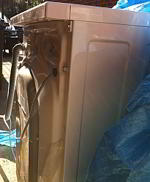
John Lewis washer dryer rear view – the lid extends beyond the casing, giving the hoses room to sit within the machine’s overall depth.

Miele washing machine rear view – similarly, the overhanging lid allows the inlet and drain hoses to route without adding to the machine’s depth footprint.
A wall socket or waste water standpipe behind the machine may also prevent it from pushing fully back under a worktop, even if the hoses fit within the lid footprint. Check what is on the wall behind the intended location before buying.
Watch Out for the Front: Doors, Drawers, and Protrusions
For most installations, not having quite enough depth simply means the machine sits slightly proud of the worktop edge. This is usually acceptable. The more practical problem with depth comes from what is at the front of the machine.
Many modern washing machines have bulkier front designs than older models, with the front casing bowing outwards. Door handles, control panels, knobs, and buttons can all project forward significantly. If a kitchen door or drawer opens across the path of the washing machine, these protrusions can cause it to catch – even if the machine appears to fit correctly in terms of the quoted depth measurement.
These front protrusions are not typically included in published depth measurements. If a kitchen door, drawer, or cupboard opens across the front of where the machine will sit, measure from the furthest projecting point at the front to the furthest projecting point at the back to get the true depth clearance needed.
Standard Kitchen Fitting Dimensions and Larger Drums
The standard space allocated for a washing machine in a fitted kitchen is 600mm (60cm). This worked well when washing machine drums were smaller and machines were shallower. The introduction of larger capacity drums – some machines now offer 10kg or 11kg loads – has pushed machine depths outward, with many modern models now reaching the full 600mm.
The extra depth needed for a larger drum typically comes from extending the drum from front to back, meaning the cabinet gets deeper rather than wider or taller. If you are working with a tight depth space, a machine with a smaller drum capacity may be shallower – though some manufacturers use the same cabinet depth across a range to reduce production costs, so this is worth checking on the specific model.
For further guidance on washing machine sizing, see our guides on washing machine size problems and issues, washing machine sizes compared, and how much space a washing machine needs round the sides.
Do not rely solely on published specifications. Physically inspect and measure the machine in a showroom, or get written confirmation from the retailer that the depth measurement accounts for hoses and rear fittings. Once delivered, a machine that does not fit is expensive and inconvenient to return.
Need Help Installing or Replacing a Washing Machine?
If you need a repair or are looking for a replacement, Whitegoods Help can point you in the right direction.
Related Guides
 Are All Washing Machines the Same Size?
Why washing machine sizes are not as standardised as they seem, and what to check before buying for a fitted space.
 How Much Space Does a Washing Machine Need Round the Sides?
Ventilation, clearance, and access requirements when fitting a washing machine into a tight space.
 Reducing the Height to Fit Under a Worktop
How to adjust the feet on a washing machine to clear a fitted worktop without affecting stability.
 Washing Machine Drum Sizes Explained
What drum capacity actually means in practice and how to choose the right size for your household.
Frequently Asked Questions
Does a washing machine’s quoted depth measurement include the hoses?
Not always. If the machine has an overhanging lid at the rear, the hoses typically tuck underneath it and the quoted depth is usually accurate. If the lid does not overhang, the hoses project behind the casing and the actual space needed may exceed the quoted figure. Check the design of the specific machine before buying.
What is the standard washing machine depth for a fitted kitchen?
The standard allocated space is 600mm (60cm). However, many modern machines – particularly those with larger drum capacities – now measure 60cm deep, meaning they fill the entire standard space. If depth is limited, look for machines with smaller drum capacities, though some manufacturers use the same cabinet depth across a range regardless of drum size.
Why won’t my washing machine push all the way back under the worktop?
Common causes include hoses or cables at the back taking up space the specifications did not account for, a wall socket or standpipe that prevents the machine going fully back, or a protruding lid design. Measure the space and the machine carefully, including any fittings on the wall behind.
Can a washing machine door or controls catch on kitchen drawers?
Yes. Many modern machines have bulkier front designs, with doors and control panels that project significantly from the main casing. These protrusions are not included in published depth measurements. If a kitchen drawer or door opens across the front of the machine’s location, measure the true front-to-back clearance needed including any protrusions before buying.
How do I check whether a washing machine will fit before buying?
Measure the available space carefully, including height, width, and depth. For depth, account for what is behind the machine – sockets, standpipes, or fixed pipework. If possible, inspect the machine in a showroom and measure the actual unit including any rear hose connections and front protrusions. If buying online, confirm with the retailer that the quoted depth is the true installed depth.
Washing machine spin speeds
Faster spin speeds do extract more water, but the real-world benefit diminishes significantly beyond around 1200 to 1400rpm. Many washing machines across a manufacturer’s range share the same motor – with speed electronically limited to create different price points. The premium charged for a faster spin rarely reflects the engineering difference involved.
Washing machine spin speeds have crept upward for decades, with each new generation offering a slightly higher rpm and a slightly higher price. But how much of this represents genuine engineering progress – and how much is marketing? The answer, based on decades of hands-on appliance engineering experience, is more complicated than manufacturers would have you believe.
A Brief History of Washing Machine Spin Speeds
When front-loading washing machines became common in the UK during the mid-1970s, most spun at around 700rpm or less. In the late 1970s, manufacturers began using spin speed as a key selling point, and the race upward began. By the early 1980s, 1100rpm machines were available. By the 2000s, 1600rpm had become a standard premium offering, and some machines now advertise 1800rpm or higher.
The introduction of intermediate speeds – 900, 1000, 1200rpm – followed a pattern that had less to do with engineering and more to do with pricing. There is no fabric type that specifically requires 1000rpm. But a 1000rpm machine can be priced between an 800 and an 1100 model, creating a convenient new price point with a perceived improvement in specification. This remains the primary commercial purpose of many intermediate spin speeds.
Are You Paying Extra for the Same Machine?
One of the less-discussed realities of washing machine manufacturing is that many machines across a range share exactly the same motor and speed control electronics. Unlike a car, where a larger engine is a physically different and more expensive component, a faster-spinning washing machine commonly uses the same motor as the slower model in the same range – just running at a higher speed.
In older machines, a common practice was to use the same control board throughout a range, with a physical link cut on the board to limit the maximum spin speed. A machine sold as a 1200rpm model had one link cut; the same board sold in a 1400rpm machine had a different link cut. The cost difference to manufacture was minimal. The price difference to the consumer could be £100 or more.
Modern machines with inverter motors use software rather than physical links to control maximum spin speed, but the principle is the same. The hardware is often identical across a range; the specification difference is a software setting. The manufacturing cost difference between speed tiers is typically far smaller than the retail price difference suggests.
There are also machines that only reach their advertised top spin speed for a very short time – in some cases as little as 30 seconds – or that only achieve maximum speed if the load happens to be perfectly balanced. A machine sold as a 1600rpm washer may spend the vast majority of every spin at a much lower speed.
Spin Speed Test: Does Faster Actually Make a Difference?
To cut through the claims, Whitegoods Help carried out a practical test using three identical towels, spun at 800rpm, 1100rpm, and 1400rpm, then assessed both by hand and by monitoring drying times on a washing line.
How the Test Was Done
-
Three identical towels were sourced. Each was washed with a full load of mixed towels on a rinse and spin programme at a manually set final spin speed.
-
The first towel was spun at 800rpm, then removed and set aside.
-
The second towel was spun at 1100rpm, then removed and set aside.
-
The third towel was spun at 1400rpm, then removed.
-
All three were assessed immediately by hand, then hung on a washing line on a sunny, calm day and monitored until dry.
Results: Hand Assessment
| Spin Speed | Feel Immediately After Spinning |
|---|---|
| 800rpm | Wet and damp to the touch, though no further water could be wrung out by hand |
| 1100rpm | Slightly less cold to the face – marginally drier, but very similar to the 800rpm towel |
| 1400rpm | Noticeably less wet – a more perceptible difference over the 800 and 1100rpm towels |
Results: Drying on the Line
| Spin Speed | After One Hour on the Line |
|---|---|
| 800rpm | Almost dry but noticeably damper than the others – approximately 10 minutes behind |
| 1100rpm | Almost dry – very little difference compared to the 1400rpm towel |
| 1400rpm | Virtually bone dry after one hour |
What the Test Shows – and What It Means for Buyers
The test found a real but modest difference between spin speeds. The gap between 800rpm and 1400rpm was perceptible – the faster-spun towel dried noticeably quicker on the line. But the gap between 1100rpm and 1400rpm was much smaller, and in practice amounts to a matter of minutes of drying time.
For households that routinely dry clothes outside, the faster spin speed offers limited practical benefit – laundry at any reasonable spin speed will dry fully given enough time. For households using a tumble dryer, a higher spin speed does reduce the energy cost of drying, and the saving is worth factoring in. Our companion article on spin speed efficiency and tumble drying costs covers this in more detail.
Higher spin speeds mean more noise, more vibration, and more mechanical stress on bearings, suspension, and the cabinet. A budget machine spinning at 1600rpm is placing significant demands on components that may not be engineered to cope with them long-term. For most households, the practical benefit above 1400rpm is small relative to the noise, wear, and cost involved.
What Is the Optimum Spin Speed?
Based on engineering experience and the evidence from spin efficiency data, the optimum spin speed for most households sits between 1200 and 1400rpm. Above this, the returns diminish – more water is technically extracted, but the practical difference in drying time is small, and the cost in noise, vibration, and mechanical wear increases.
A well-built machine spinning at 1200 or 1400rpm will typically be quieter, more reliable, and longer-lived than a cheaper machine rated at 1600rpm. The headline rpm figure is not a reliable guide to overall quality.
Need Help With a Washing Machine?
Whether you need a repair or genuine spare parts, Whitegoods Help can help.
Related Guides
 Spin Speed Efficiency and Tumble Drying Costs
Manufacturer data on residual moisture at different spin speeds, and what it means for tumble drying energy costs.
Spin Drying Performance on the Energy LabelWhat the spin efficiency rating on the energy label actually measures – and the limitations of using it to compare machines.
Washing Machine Noisy on Spin?Common causes of spin noise and what they indicate about the condition of the machine.
 Choosing the Best Washing Machine
What to look for beyond the headline spec – reliability, repairability, and the factors that matter most over the long term.
Frequently Asked Questions
Is a higher washing machine spin speed always better?
Not necessarily. A higher spin speed does extract more water, which reduces drying time. However, the benefit diminishes significantly above around 1200 to 1400rpm, and faster spins create more noise, vibration, and mechanical wear. A well-built machine at 1200rpm will often outperform a cheaper machine rated at 1600rpm in both reliability and noise over time.
Do washing machines across a range share the same motor?
Frequently, yes. Many manufacturers use the same motor and control electronics across multiple models in a range, with the maximum spin speed limited electronically rather than by a different or more powerful motor. The manufacturing cost difference between a 1200rpm and a 1400rpm version of the same machine is often very small relative to the retail price difference.
What is the optimum spin speed for a washing machine?
Based on engineering experience and spin efficiency data, most households will find that 1200 to 1400rpm offers the best balance of performance, noise, and longevity. Above this range, the reduction in drying time becomes increasingly marginal while the mechanical demands on the machine increase.
Does a faster spin speed save money on tumble drying?
Yes, to a degree. Laundry that has had more water extracted needs less time in the tumble dryer, which reduces energy costs. The saving is most meaningful for households that tumble dry regularly. For households that line dry, the practical difference between spin speeds is smaller – all loads will dry fully given enough time.
Why are there so many different spin speeds available?
Intermediate spin speeds – 900, 1000, 1200rpm and so on – serve a commercial purpose as much as a functional one. They allow manufacturers to create a tiered pricing structure with perceived specification differences at each level, even when the underlying hardware is similar or identical. Each new speed tier becomes a new price point rather than a new engineering achievement.