
Frosting up in fridge or freezer
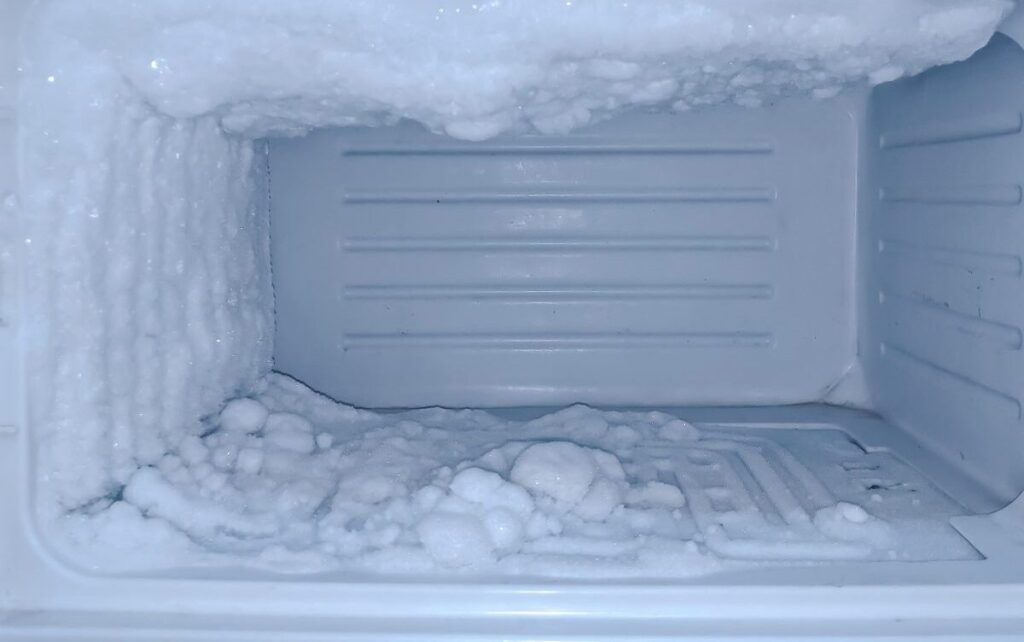

Excessive frost or snowy ice building up inside a fridge or freezer is almost always caused by warm, moist air getting in. The most common causes are a worn or damaged door seal and an unlevel appliance causing the door to distort. Check the seal and the level before concluding the appliance has a mechanical fault.
Frost is a normal by-product of refrigeration – moisture in the air freezes onto cold surfaces. In a correctly sealed and level appliance, frost formation is minimal and managed by defrost cycles. When frost builds up excessively, something is allowing more warm moist air into the cabinet than normal.
Cause 1: Worn or Damaged Door Seal
The door seal (gasket) creates the airtight barrier between the cabinet interior and the outside air. When it deteriorates, becomes distorted, or develops splits, warm moist air is drawn into the cabinet. This moisture freezes on the cold interior surfaces – appearing as snowy, fluffy frost on freezer shelves or on the back wall of a fridge.
-
Inspect the door seal visually.
Check the full perimeter of the seal for cracks, splits, flattened sections, or areas where the seal is pulling away from the door. Pay particular attention to the corners. A split on the face that contacts the door frame requires replacement. A split on the outer cosmetic edge is not a functional problem.
-
Test with the paper test.
Place a piece of paper between the seal and the door frame and close the door. Pull the paper gently – it should grip firmly and require noticeable resistance to remove. If it slides out easily, the seal is not creating an adequate barrier at that point. Repeat around the full perimeter.
-
Reshape a distorted seal with heat.
If the seal is intact but distorted rather than damaged, gentle heat can sometimes restore its shape. Use a hair dryer on a moderate setting to warm the affected section, then manually reshape it and close the door to let it cool in the correct position. Do not use excessive heat. Defrost the unit fully afterwards before normal use.
-
Replace the seal if worn or split.
A seal that is damaged rather than distorted needs replacing. Note that many modern fridges and freezers have seals that are not sold separately – only a complete replacement door is available. This is an industry-wide trend towards reduced repairability. Contact the manufacturer or a spare parts supplier with the model number to confirm what is available for your specific appliance. Supplies for your appliance may be available at Spares4Appliances.
Cause 2: Unlevel Appliance
If a fridge or freezer is not sitting level, the cabinet can twist slightly. This causes the door frame to distort – even if the door and seal themselves are in good condition, a distorted frame means the seal cannot sit evenly against it. Warm moist air enters through the gaps.
-

Check the appliance is level from front to back and left to right using a spirit level. Even a small tilt is enough to cause door distortion on some models. -
Adjust the feet – most fridges and freezers have adjustable levelling feet that screw in or out. If the feet are not adjustable or the floor is very uneven, use appropriate packing under the feet to achieve a level installation. -
After levelling, re-test the door seal with the paper test around the full perimeter to confirm the door is now sitting correctly.
Preventing Frost Buildup: Usage Tips

Use the fast freeze function when adding new food
When loading a significant quantity of fresh or warm food, activate the fast freeze function beforehand to bring the cabinet temperature down extra low. This reduces the temperature rise when the door is opened and the fresh food is loaded. Do not leave fast freeze active indefinitely after use – check the instruction manual for how long to run it.

Cover all food and keep doors open as briefly as possible
Warm or uncovered food introduces moisture into the cabinet directly. Store food in airtight containers. Keep the door open for the minimum time necessary when accessing or loading the appliance.

Open the door using the handle, not the frame
Curling fingers around the door frame to open the appliance gradually deforms and eventually splits the door seal along the edge closest to where it is gripped. Always use the door handle.
If the frost is forming inside the base of the appliance or water is collecting there, these are different issues from general frost buildup on the interior walls and shelves. See our guides on water in the base of a fridge and ice in the base of a freezer.
Need Parts or a Repair?
Related Guides
 Water in the Base of a Fridge
Why water collects in the base of a fridge compartment and how to resolve it.
Ice in the Base of a FreezerCauses of ice accumulation in the base of a freezer compartment and how to fix them.
 Frost-Free and Automatic Defrosting Explained
How frost-free technology works and what it means for maintenance and food storage.
 Can You Put a Fridge Freezer in a Garage?
Temperature extremes in garages and how they affect fridge freezer performance and efficiency.
Frequently Asked Questions
Why is my fridge or freezer frosting up excessively?
Excessive frost is almost always caused by warm moist air entering the cabinet. The most common causes are a worn, damaged, or distorted door seal and an unlevel appliance causing the door to sit out of alignment. Check the seal using the paper test around the full perimeter, and check the appliance is level from front to back and side to side.
Can a distorted fridge door seal be fixed without replacement?
Sometimes. If the seal is intact but has become distorted – perhaps from being caught or compressed – gentle heat from a hair dryer on a moderate setting can soften the rubber and allow it to be reshaped. Close the door to let it cool in the correct position. This does not work for seals that have splits, cracks, or significant wear. A damaged seal must be replaced.
What if the door seal is not available as a spare part?
Many modern fridges and freezers have seals that are bonded into the door rather than being separately replaceable – the only option from the manufacturer is a complete replacement door. This significantly increases the repair cost. Contact the manufacturer or a spare parts supplier with the exact model number to confirm what is available for your specific appliance before concluding the machine cannot be repaired.
Ask the repair forum
Post the make, model and symptoms and get help from the Whitegoods Help community.
10 Comments
Grouped into 10 comment threads.
0 replies There may be another fault which needs an engineer to investigate Marie. A sensor or fault on defrosting system possibly, or even a pcb.
0 replies I have a 3 year old frost free Beko fridge/freezer which has suddenly started freezing everything in the fridge compartment. I've had an engineer out who replaced a small circuit board at the back of the fridge and another one in temperature regulator housing. It was left running for a few hours but unfortunately it hasn't solved the problem, it's still freezing up. The freezer is still working, though it is freezing everything really solid! I would be really grateful for any info you could give me. Many thanks.
I have a 3 year old frost free Beko fridge/freezer which has suddenly started freezing everything in the fridge compartment. I’ve had an engineer out who replaced a small circuit board at the back of the fridge and another one in temperature regulator housing. It was left running for a few hours but unfortunately it hasn’t solved the problem, it’s still freezing up. The freezer is still working, though it is freezing everything really solid! I would be really grateful for any info you could give me. Many thanks.
0 replies There is a large lump of ice to the right of the drainage hole in my fridge(FF). I think the drainage hole is free but he back wall of of the fridge has white ice on it too. Water is getting into the veg compartments and under the boxes too. Help please. Thankyou
There is a large lump of ice to the right of the drainage hole in my fridge(FF). I think the drainage hole is free but he back wall of of the fridge has white ice on it too. Water is getting into the veg compartments and under the boxes too. Help please. Thankyou
0 replies janeinbushey: Sensors and pcb's shouldn't be too expensive to replace, a mid-price repair I would have thought. Reena Hepburn: The water from defrosting should run down the back wall and be channeled through a small hole at the bottom out to a small tray on top of the main compressor where it evaporates. If the hole is blocked the water can instead run into the base of the appliance.
janeinbushey: Sensors and pcb’s shouldn’t be too expensive to replace, a mid-price repair I would have thought.
Reena Hepburn: The water from defrosting should run down the back wall and be channeled through a small hole at the bottom out to a small tray on top of the main compressor where it evaporates. If the hole is blocked the water can instead run into the base of the appliance.
0 replies Our Hoover frost free Fridge/Freezer has developed a fault whereby the bottom of the freezer is forming ice - there was also a piece of ice (about 2" long) formed in the fridge at the side of the unit near where the drain hole is can you please help with what could be wrong or what to do to rectify the fault
Our Hoover frost free Fridge/Freezer has developed a fault whereby the bottom of the freezer is forming ice – there was also a piece of ice (about 2″ long) formed in the fridge at the side of the unit near where the drain hole is can you please help with what could be wrong or what to do to rectify the fault
0 replies Thank you so much for your speedy reply. If the fault were a sensor or pcb, are these costly things to repair, or in view of the age of the unit, should I be thinking about replacing it? Thank you.
Thank you so much for your speedy reply. If the fault were a sensor or pcb, are these costly things to repair, or in view of the age of the unit, should I be thinking about replacing it? Thank you.
0 replies If you have a recurring problem, which clears for a while after a full defrost but returns then either the issues I mention in my article are still present and the problem will reoccur indefinitely until fixed or there is another problem which needs investigating by a proper refrigeration engineer such as a faulty sensor or pcb.
If you have a recurring problem, which clears for a while after a full defrost but returns then either the issues I mention in my article are still present and the problem will reoccur indefinitely until fixed or there is another problem which needs investigating by a proper refrigeration engineer such as a faulty sensor or pcb.
0 replies Our 9 year old Hoover frost-free fridge/freezer has a recurring fault. The fridge section gets too cold and starts to freeze the contents. Changing the temp dial makes no difference. On 3 occasions we have defrosted the whole FF and the problem has gone, only to return after a time. Most recently, we only had two weeks before it started freezing produce again. Any ideas what the cause might be or is it time to invest in a new one? Thank you
Our 9 year old Hoover frost-free fridge/freezer has a recurring fault. The fridge section gets too cold and starts to freeze the contents. Changing the temp dial makes no difference. On 3 occasions we have defrosted the whole FF and the problem has gone, only to return after a time. Most recently, we only had two weeks before it started freezing produce again. Any ideas what the cause might be or is it time to invest in a new one? Thank you
0 replies Hi My John Lewis JLUCFZW6002 frost-free freezer sounded the high temp alarm the other day and after emptying it I discovered a large lump of ice under the element behind the rear internal panel (which I had to unscrew to obtain access). The general advice seemed to be to leave it 24h to defrost. However I picked up a tip on how to defrost it quickly - use a desk fan to blow room air into the freezer. It had defrosted enough to allow me to remove the large block within an hour. It seems to be Ok now, though I suspect (as mention in a comment on the other freezer page on this blog) that the drain hole isn't big enough as it was blocked with ice. Will have to monitor it over the next few weeks.
Hi
My John Lewis JLUCFZW6002 frost-free freezer sounded the high temp alarm the other day and after emptying it I discovered a large lump of ice under the element behind the rear internal panel (which I had to unscrew to obtain access). The general advice seemed to be to leave it 24h to defrost.
However I picked up a tip on how to defrost it quickly – use a desk fan to blow room air into the freezer. It had defrosted enough to allow me to remove the large block within an hour.
It seems to be Ok now, though I suspect (as mention in a comment on the other freezer page on this blog) that the drain hole isn’t big enough as it was blocked with ice. Will have to monitor it over the next few weeks.
0 replies Hi,hoping for an answer as this is becoming a pest.My Hotpoint fridge freezer appears to work fine but the drain hole gets blocked quite frequently.The only answer so far is a complete de frost but its not long before the fridge is full of water again.I believe its ice that is blocking the tube but I dont know why or what we are doing to cause the ice to form.its definitely not blocked by anything but ice. thanks
Hi,hoping for an answer as this is becoming a pest.My Hotpoint fridge freezer appears to work fine but the drain hole gets blocked quite frequently.The only answer so far is a complete de frost but its not long before the fridge is full of water again.I believe its ice that is blocking the tube but I dont know why or what we are doing to cause the ice to form.its definitely not blocked by anything but ice.
thanks
There may be another fault which needs an engineer to investigate Marie. A sensor or fault on defrosting system possibly, or even a pcb.