
Hotpoint dishwasher fire risk safety notice

The affected models are Hotpoint FDW20, FDW60, and FDW65A – manufactured between June 2006 and March 2007. Not all units are affected; specific serial number ranges apply. If the first five digits of the serial number fall between 60601 and 70331, the dishwasher is affected. Check the inside of the door for a green sticker – if one is present, the modification has already been carried out.

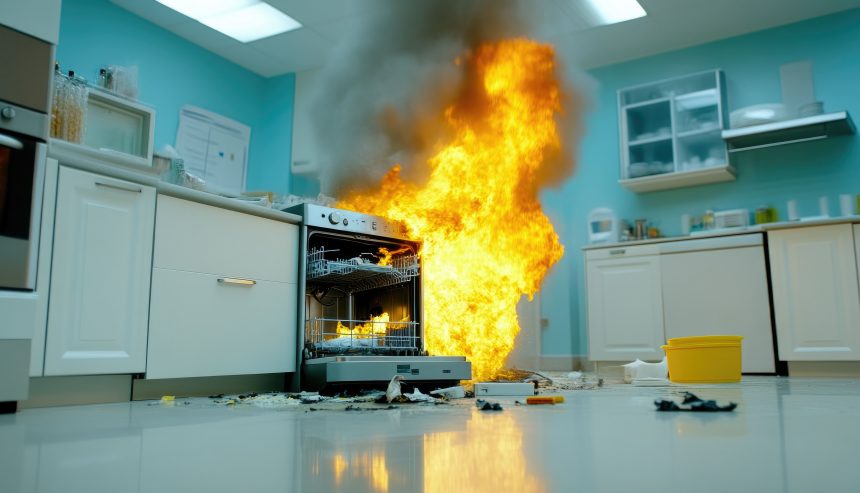
Certain Hotpoint dishwasher models have been identified as carrying a potential fire hazard caused by an electrical component that may overheat. If your dishwasher matches the model and serial number criteria below, stop using it and contact Hotpoint immediately.
Hotpoint has acknowledged awareness of cases where an electrical component in certain dishwasher models has failed, leading to overheating and in some cases a potential fire risk. Approximately 71,000 dishwashers were identified as potentially affected. For ITV News coverage including photographs of the internal heat damage that can occur, see the ITV News report on the Hotpoint safety notice.
How to Check If Your Dishwasher Is Affected

Step 1: Check the model number
The model number is usually on a sticker on the side of the door. The affected models are:
Hotpoint FDW60
Hotpoint FDW65A

Step 2: Check the manufacture date
The affected units were manufactured between June 2006 and March 2007. If your machine is from outside this period, it is not affected by this safety notice.

Step 3: Check the serial number
Not all units from this period are affected – only specific production batches. The serial number is 9 digits long. If the first 5 digits fall between S/N 60601 and S/N 70331, your appliance is affected.

Already modified?
If a green sticker is visible on the inside of the door, the modification has already been carried out and the appliance is safe to use. If there is no green sticker and your model and serial number are within the affected range, stop using the appliance and contact Hotpoint.

Hotpoint previously maintained a dedicated safety page and customer service line (08448 910094) for this notice. As is common with manufacturers after the initial publicity period, this page may have been removed from their website despite the likelihood that not all affected appliances have been modified. If you have any concerns, contact Hotpoint directly to confirm whether your appliance requires a modification.
What to Do If Your Dishwasher Is Affected
-
Stop using the dishwasher immediately. Do not use it again until Hotpoint have confirmed it has been inspected and modified.
-
Contact Hotpoint. Use Hotpoint’s current customer service contact details to report your appliance and arrange an engineer visit. Explain that your model and serial number fall within the affected range and that no green modification sticker is present.
-
Do not assume the risk is low enough to continue using it. Hotpoint’s description of the risk as “rare” does not mean it is acceptable to continue using an appliance with a known fire hazard – particularly one that may be left running unattended.
If a family member or neighbour has a Hotpoint dishwasher, pass this information on. The affected models are over 15 years old and owners may not be aware a safety notice was ever issued, or may not have taken action at the time.
More Appliance Safety Notices
Related Safety Guides
Bosch, Neff and Siemens Dishwasher Safety NoticeA separate fire risk safety notice affecting Bosch, Neff, and Siemens branded dishwashers.
 How Dangerous Are Our Appliances?
Fire, flood, and electrical risks from white goods – what the data shows and how to reduce your risk.
 8 Ways to Make Appliances Safer
Practical steps every household can take to reduce the risk of fire, flood, and electrical faults from large appliances.
Is It Safe to Leave Appliances On Unattended?The risks of running large appliances when no one is home – what the evidence shows.
Frequently Asked Questions
Which Hotpoint dishwasher models are affected by this safety notice?
The affected models are the Hotpoint FDW20, FDW60, and FDW65A, manufactured between June 2006 and March 2007. Not all units from this period are affected – the serial number must also fall within the affected range, with the first five digits between S/N 60601 and S/N 70331.
How do I find the model and serial number on my Hotpoint dishwasher?
The model and serial number are usually on a sticker on the side of the door – visible when the door is open. The serial number is 9 digits long. Check the first 5 digits against the range S/N 60601 to S/N 70331 to determine whether your unit is within the affected batch.
There is a green sticker inside my dishwasher door – is it safe?
Yes. A green sticker on the inside of the door indicates that Hotpoint has already carried out the necessary modification to the appliance. No further action is needed.
The Hotpoint safety page no longer seems to exist – what do I do?
Contact Hotpoint customer services directly, providing your model number and serial number and explaining that you are enquiring about the FDW series fire risk safety notice. Manufacturers sometimes remove dedicated safety pages after the initial publicity period despite not all affected appliances having been modified.
Ask the repair forum
Post the make, model and symptoms and get help from the Whitegoods Help community.
2 Comments
Grouped into 2 comment threads.
0 replies Very interesting Colin and thanks for posting your experience. It would be more relevant to the Bosch, Neff and Siemens dishwashers fire risk safety notice though I appreciate your point about hoping Hotpoint weren't the same. I didn't realise manufacturers were recruiting non-engineers especially to carry out modifications, though I suppose when many tens of thousands of appliances suddenly need urgently modifying their normal network of engineers can't possibly cope. I wouldn't expect the replacements weren't genuinely modified though. They may well look identical but the modification would be internal. Your experience is exactly the type of thing I talked about in my Why so many repair horror stories? article where many engineers are put under ridiculous pressure which results in some engineers abandoning safety checks and cutting many corners through sheer lack of time.
0 replies I was one of "experts" that Bosch sent out to replace the control units in their dishwashers, I can only hope that Hotpoint do not adopt the same cheapskate strategy. I applied for the job via Manpower at £9.33p an hour because no "experience necessary" and "full training given." I had no electrical experience but I could at least use a screwdriver. The "full training" amounted to a day in a hotel near Newbury where I was shown how to dismantle two types of dishwasher and replace the main control unit, i.e the bit behind the front panel buttons. Most of the day was spent explaining how to fill in the paperwork. Without exception, all of us on the course were professionals in other fields (plumbers, builders etc ) who due to the recession were unable to find work in their chosen occupations. This of course made us more plausible to the customer in that the guy at the door knew what he was doing and that alone seemed to be Manpower's sole selection criteria, I started work the following day with a basic toolkit and from day one I was assigned 8 jobs per day via email. Because of the incompetent dispatching system, I sometimes drove over 200 miles in a day with other engineers travelling to my own local area as I did to theirs, and so every job I did had to be completed in 15 minutes to give me any chance of finishing my day in time. Some days I simply couldn't complete the allotted jobs and that resulted in threats of the sack. My work was checked only once by my supervisor accompanying me on a call to check that I ran the correct post installation checks. Other engineers told me that due to the time pressures, they sometimes bluffed these tests to buy more time. I can say hand on heart that I never did this myself. I fixed over 400 dishwashers in my time working for Bosch and in around 50% of cases the control unit I removed and the fixed wiring showed obvious signs of over heating. We were told on pain of dismissal to either hide the old unit or if impossible, explain to the customers that the browning of the predominantly white plastic units was caused by "general aging" of the plastic rather than that they had been living with a time bomb incendiary device. I advised every customer to NEVER use the dishwasher unattended or overnight on the subterfuge that "sometimes it can carry on running and burn more electricity". My supervisor criticised me for this but I could do nothing else, I met many nice people who didn't deserve to be burned to death in their beds. The units themselves are in my opinion, cheap and shoddily made and there is no protection for the rest of the unit should as it has in so many tragic cases it burst into flames. The replacement units appeared to be identical to the units being replaced and so again in my opinion, all this exercise actually achieved was to give the customer a false sense of security and to delay what may well be the inevitable over time. There is a clear design fault and Bosch should have corrected the fault and replaced EVERY dishwasher they had sold, I do guess however that the shareholders wouldn't have liked that too much. HOTPOINT and MANPOWER take note. The safety of your customers is NOT negotiable to save money.
I was one of “experts” that Bosch sent out to replace the control units in their dishwashers, I can only hope that Hotpoint do not adopt the same cheapskate strategy.
I applied for the job via Manpower at £9.33p an hour because no “experience necessary” and “full training given.” I had no electrical experience but I could at least use a screwdriver.
The “full training” amounted to a day in a hotel near Newbury where I was shown how to dismantle two types of dishwasher and replace the main control unit, i.e the bit behind the front panel buttons. Most of the day was spent explaining how to fill in the paperwork. Without exception, all of us on the course were professionals in other fields (plumbers, builders etc ) who due to the recession were unable to find work in their chosen occupations. This of course made us more plausible to the customer in that the guy at the door knew what he was doing and that alone seemed to be Manpower’s sole selection criteria,
I started work the following day with a basic toolkit and from day one I was assigned 8 jobs per day via email.
Because of the incompetent dispatching system, I sometimes drove over 200 miles in a day with other engineers travelling to my own local area as I did to theirs, and so every job I did had to be completed in 15 minutes to give me any chance of finishing my day in time. Some days I simply couldn’t complete the allotted jobs and that resulted in threats of the sack. My work was checked only once by my supervisor accompanying me on a call to check that I ran the correct post installation checks. Other engineers told me that due to the time pressures, they sometimes bluffed these tests to buy more time. I can say hand on heart that I never did this myself.
I fixed over 400 dishwashers in my time working for Bosch and in around 50% of cases the control unit I removed and the fixed wiring showed obvious signs of over heating. We were told on pain of dismissal to either hide the old unit or if impossible, explain to the customers that the browning of the predominantly white plastic units was caused by “general aging” of the plastic rather than that they had been living with a time bomb incendiary device. I advised every customer to NEVER use the dishwasher unattended or overnight on the subterfuge that “sometimes it can carry on running and burn more electricity”. My supervisor criticised me for this but I could do nothing else, I met many nice people who didn’t deserve to be burned to death in their beds. The units themselves are in my opinion, cheap and shoddily made and there is no protection for the rest of the unit should as it has in so many tragic cases it burst into flames.
The replacement units appeared to be identical to the units being replaced and so again in my opinion, all this exercise actually achieved was to give the customer a false sense of security and to delay what may well be the inevitable over time.
There is a clear design fault and Bosch should have corrected the fault and replaced EVERY dishwasher they had sold, I do guess however that the shareholders wouldn’t have liked that too much.
HOTPOINT and MANPOWER take note. The safety of your customers is NOT negotiable to save money.
Very interesting Colin and thanks for posting your experience. It would be more relevant to the Bosch, Neff and Siemens dishwashers fire risk safety notice though I appreciate your point about hoping Hotpoint weren’t the same.
I didn’t realise manufacturers were recruiting non-engineers especially to carry out modifications, though I suppose when many tens of thousands of appliances suddenly need urgently modifying their normal network of engineers can’t possibly cope. I wouldn’t expect the replacements weren’t genuinely modified though. They may well look identical but the modification would be internal.
Your experience is exactly the type of thing I talked about in my Why so many repair horror stories? article where many engineers are put under ridiculous pressure which results in some engineers abandoning safety checks and cutting many corners through sheer lack of time.