
Gorenje Washing Machine Error Codes
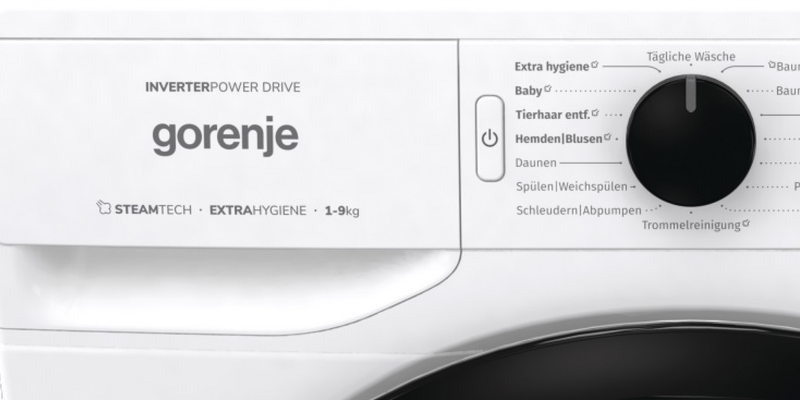

Gorenje washing machines display error codes as F followed by a single digit on most models – F1, F2, F3 and so on. Some Gorenje models also display E codes (E1, E3, E11, E12) for related faults. The most commonly seen Gorenje codes are F1 (temperature sensor), F2 (door lock fault), and F7 (drain time exceeded). Find your code in the tables below.
Codes covered on this page
F2 – Door lock
F3 – Heating element
F4 – Heating / NTC
F5 – Heating variant
F6 – Motor
F7 – Drain time
F8 – Motor or drain
F9 – Misc / model-dependent
E1 / E3 / E11 / E12
Which Gorenje washing machines does this guide cover?
This guide covers all Gorenje washing machines and washer dryers sold in the UK, including the W1E, WEI, and WaveActive series. For a wider look at the brand itself, see our Gorenje washing machines overview.
 Display models – F codes
Most Gorenje washing machines display fault codes as F followed by a single digit – F1, F2, F3 and so on. Use the F code table below as the primary reference.
 Some models – E codes
Some Gorenje models, particularly newer Hisense-platform models, display certain faults as E codes (E1, E3, E11, E12) rather than F codes. Where the codes overlap, the meaning is generally consistent – both E1 and F1 typically relate to temperature sensor faults.
Older models – flash patternsOlder Gorenje machines without a digital display use indicator light flash patterns to signal faults. The number of flashes typically corresponds to the F code number – one flash for temperature sensor failure (F1), two for door not closed (F2), and so on.
 Resetting after clearing a fault
To clear a Gorenje error code, press and hold the START/PAUSE button for approximately 3 seconds. For a deeper reset, switch off at the wall socket, wait 60 seconds, and switch back on. Clearing the code does not fix the underlying fault – if the same code reappears, the fault needs diagnosis and repair.
Which Gorenje codes are seen most often?
Across the field, four codes account for the large majority of Gorenje fault callouts. Knowing which they are helps narrow the diagnosis before you open anything up.
Drain time exceeded – almost always a blocked filter
Door lock fault – often the interlock at 5-10 years
Temperature sensor – often limescale in hard water
Heating element open circuit – the second-biggest age-related failure
Gorenje F codes – complete reference
| Code | Fault description | Most likely causes | Check first |
|---|---|---|---|
| F1 | Temperature sensor fault – NTC thermistor open or short circuit | Failed NTC thermistor. Wiring fault between thermistor and control board. Limescale on thermistor in hard water areas. Damaged sensor contacts. | Test the NTC thermistor with a multimeter. Inspect the wiring connector at both ends. In hard water areas, run a descaling cycle before testing – see how to descale a washing machine. |
| F2 | Door lock fault – machine not detecting door is closed and locked | Door not fully closed. Failed door interlock. Wiring fault to interlock. Obstruction in door seal. Broken door handle or catch. | Open and firmly close the door, ensuring nothing is trapped in the seal. Many F2 faults are resolved by closing the door more firmly. If F2 persists with the door correctly closed, test the door interlock – see also washing machine door won’t open. |
| F3 | Heating circuit fault – wash heater open circuit detected | Failed heating element with internal break. Loose or burnt-out element terminal connection. Wiring fault. Failed heating relay on control board. | Test the heating element for continuity with a multimeter – open circuit confirms element failure. Check element terminal connections for damage. See also washing machine not heating water. |
| F4 | Heating element / connection failure or NTC malfunction | Failed heating element. Connection failure between element and control board. Failed NTC producing incorrect readings. | Test both the heating element and NTC for continuity and resistance. Inspect wiring connectors. Run a descaling cycle in hard water areas before replacing components. |
| F5 | Heating circuit variant – heating system problem detected | Heating element fault. NTC fault. Wiring fault. Control board fault. Programme typically completes but water does not heat. | Same checks as F3 and F4 – test element and thermistor for continuity. Descale in hard water areas before replacing. |
| F6 | Motor fault (model dependent) | Worn carbon brushes on collector motor models (most common over five years old). Failed tachogenerator. Motor winding failure. Wiring fault. | With the machine unplugged, check the drum rotates freely. On collector motor models, inspect carbon brushes and replace if worn below 10mm – see our carbon brushes diagnostics guide. |
| F7 | Water drain time exceeded – machine unable to drain within expected time | Blocked pump filter (the most common cause). Kinked or blocked drain hose. Standpipe too high. Foreign object blocking the pump impeller. Failed drain pump motor. | Clean the pump filter behind the small panel at the bottom front of the machine. Place towels and a tray in front before opening – water will flow out. See our full guides: washing machine not draining and no blockage and still not draining. |
| F8 | Motor error or drain pump fault (model dependent) | On some Gorenje models F8 is a motor fault – same causes as F6. On others it relates to the drain pump – same causes as F7. | If the cycle stopped before the drain phase, check the motor and drum rotation. If during draining, clean the pump filter. Refer to your instruction manual for the specific meaning of F8 on your model. |
| F9 | Various – model dependent | Varies between models – typically communication faults between control modules, pressure switch faults, or secondary sensor errors. | Switch off at the mains for 60 seconds and restart. If F9 clears, the cause was transient. If it persists, engineer diagnosis is required. |
Gorenje E codes (some models) – additional reference
Some Gorenje models, particularly more recent Hisense-platform machines, display certain faults as E codes rather than F codes. If your machine is one of these, see also our Hisense washing machine error codes guide for cross-reference.
| Code | Fault description | Most likely causes | Check first |
|---|---|---|---|
| E1 | Open / short circuit of temperature sensor (equivalent to F1) | Failed NTC thermistor. Wiring fault to thermistor. Sensor connection broken. | Test the NTC with a multimeter. Inspect the wiring connector at both ends. |
| E3 | Water level error – pressure switch or water level sensor fault | Failed pressure switch. Blocked or kinked pressure switch hose. Soap suds blocking the pressure system. Wiring fault. | Check the pressure switch hose for blockage or kinks. Run a service wash to clear soap residue. Test pressure switch if hose checks are clear. |
| E11 | Pressure or water level fault variant | Same general causes as E3. | Same checks as E3 – pressure switch hose, then pressure switch test. |
| E12 | Motor error / motor control error | Failed motor speed sensor. Inverter board fault. Motor winding failure. Wiring fault. | Switch off at the mains for 60 seconds and restart. If E12 returns consistently, engineer diagnosis is required for motor and inverter board testing. |
What are the most common Gorenje washing machine faults?

The F7 drain time exceeded fault is one of the most common error codes on Gorenje washing machines, and the underlying cause is almost always a blocked pump filter rather than a failed pump. Coins, buttons, hair grips, and bra underwires accumulate in the filter over time. Cleaning takes five minutes and resolves most F7 faults without any parts. Treat it as routine maintenance every few months regardless of whether a code has appeared.

The door interlock is a common wear point on Gorenje washing machines, as on most brands. It locks the door during the cycle and releases it when safe – mechanical stress over thousands of cycles eventually leads to failure, typically between five and ten years of regular use. Replacement interlocks for most Gorenje models are widely available and the repair is practical for a confident DIY user.

Heating and temperature sensor codes on Gorenje machines typically point to either a failed NTC thermistor, a wiring fault, or limescale on the sensor. In hard water areas, descaling resolves a surprising proportion of these fault codes without any component replacement – see limescale in washing machines for the wider picture. The wiring connector at the thermistor is also a common failure point.

Heating circuit codes typically point to a failed heating element, which is one of the most common single-component failures across all washing machine brands. Testing the element with a multimeter takes a few minutes and is reliable. In hard water areas, limescale shortens element life significantly – running periodic descaling cycles extends element life and reduces the frequency of heating-related fault codes.
What should you check before calling an engineer?
-
Power cycle the machine. Switch off at the wall socket, wait 60 seconds, and switch back on. Many transient codes – particularly communication errors and some control board codes – clear on a power reset. If the same code returns consistently, it represents a real fault.
-
Clean the pump filter (F7 drain code). The filter is behind the small access panel at the bottom front of the machine. Place towels and a tray in front before opening. Unscrew anticlockwise, remove all debris including coins, check the pump cavity, and refit firmly. This single check resolves the majority of F7 faults.
-
Check the door closes correctly (F2 door code). Open and firmly close the door, ensuring nothing is caught in the door seal. If the door closes correctly and F2 persists, test the door interlock for continuity.
-
Test the heating element and thermistor (F1, F3, F4, F5 heating codes). With the machine unplugged, access the element and thermistor. Test continuity of the element and resistance of the thermistor with a multimeter.
-
Descale the machine (F1, F3, F4 in hard water areas). Run an empty cycle on the hottest programme with a proprietary descaler before testing or replacing the heating element or thermistor. Limescale on either component can produce false readings without anything actually failing – see how to descale a washing machine in hard water areas.
-
Check carbon brushes (F6 motor code on collector motor models). With the machine unplugged, check the drum rotates freely by hand. If it does, inspect the motor carbon brushes and replace if worn below 10mm. See also washing machine not spinning.
-
Check the pressure switch hose (E3, E11 water level codes). The narrow hose from the drum to the pressure switch should not be blocked, kinked, or disconnected at either end.
Safety notice

Always switch the machine off at the wall socket and unplug it before accessing the pump filter, opening any panels, or inspecting internal components. Never work on electrical components with the machine connected to the mains. Isolate the water supply at the inlet valve before disconnecting hoses.
A washing machine combines mains electricity with mains water – two of the most unforgiving things in a domestic setting. If you are not confident with electrical work or have any doubt about a fault, book a qualified engineer rather than attempt the repair yourself. See our full DIY appliance repair safety guide.
Always check the OPSS product safety database for any active recall on your appliance before continuing to use it.
Can you fix a Gorenje error code yourself?
 Straightforward to check or fix yourself
- Cleaning the pump filter (F7 drain code)
- Checking the door closes correctly and testing the interlock (F2)
- Replacing the door interlock on confirmed failure
- Power cycling to clear transient codes
- Descaling for heating and temperature codes in hard water areas (F1, F3, F4, E1)
- Replacing the heating element on confirmed failure (F3, F4, F5)
- Replacing the NTC thermistor on confirmed failure (F1, E1)
- Replacing motor carbon brushes on collector motor models (F6)
- Replacing the drain pump on confirmed failure (F7)
 Requires an engineer or advanced competence
- Inverter board faults on brushless motor models (E12)
- Pressure switch replacement (E3, E11) if hose checks are clear
- Communication faults that persist after power cycling (F9)
- Motor and tachogenerator faults if brushes are not the cause (F6, F8)
- Any control board fault
- Any fault that persists after all basic checks have been completed
Gorenje error code pointing to a fault you cannot resolve?
If basic checks have not cleared the fault, a qualified engineer is the right next step. We cover Gorenje washing machine repairs nationwide with genuine spare parts available for most models including door interlocks, drain pumps, heating elements, NTC thermistors, and motor components.
Who owns Gorenje, and what is the Hisense connection?
Gorenje is a Slovenian appliance manufacturer founded in 1950, with its main production facility in Velenje, Slovenia. In June 2018, Hisense, the Chinese white goods and electronics group, acquired a 95% majority stake in the Gorenje Group. Manufacturing has remained in Slovenia and the Gorenje brand identity, model ranges, and 5-year warranty positioning have been retained.
Since the acquisition, some newer Gorenje models share platform components with Hisense-branded machines, particularly in control board design and error code structure. This is why some recent Gorenje models display E codes (similar to the Hisense E and F system) alongside the traditional Gorenje F codes. Spare parts are available through Gorenje’s UK service network and through general appliance parts suppliers, with cross-compatibility with some Hisense components on platform-shared models.
For Hisense-branded machines specifically, see our Hisense washing machine error codes guide.
Looking for error codes on a different brand?
We have error code references for the other major UK washing machine brands. Use the cards below to jump to the relevant guide.
 AEG error codes
Full E-code reference for AEG washing machines.
Beko error codesBeko / Blomberg error code reference and diagnostics.
Bosch error codesBosch washing machine E-code reference.
Candy error codesCandy washing machine error code reference.
Haier error codesHaier washing machine error code reference.
Hisense error codesHisense – shared platform with newer Gorenje models.
Want to learn appliance fault diagnosis properly?
Reading error codes is one of the more basic skills in appliance repair. For anyone wanting to develop the full skill set – whether for a career, a side business, or just to repair their own appliances confidently – the NAC National Training Centre offers practical hands-on courses and online training delivered by working engineers.
Frequently asked questions about Gorenje washing machine error codes
What does F7 mean on a Gorenje washing machine?
F7 is a drain time exceeded fault – the machine has been unable to drain water within the expected time. In the vast majority of cases the cause is a blocked pump filter rather than a failed pump. The filter is behind the small access panel at the bottom front of the machine. Cleaning it takes around five minutes and resolves most F7 faults without any parts or engineer visit. If the filter is clear and F7 persists, check the drain hose for kinks then test the drain pump motor – see our deeper no blockage but still not draining guide.
What does F1 mean on a Gorenje washing machine?
F1 indicates a temperature sensor fault – an open circuit or short circuit has been detected in the NTC thermistor circuit. The cause may be a failed thermistor, damaged or loose wiring, or limescale on the sensor in hard water areas. Test the thermistor with a multimeter and inspect the wiring connector at both ends. Run a descaling cycle in hard water areas before replacing the thermistor as limescale can produce F1 without the sensor actually failing.
What does F2 mean on a Gorenje washing machine?
F2 indicates a door lock fault – the machine is not detecting the door is properly closed and locked. First confirm the door closes fully with nothing obstructing the seal. Many F2 faults are resolved by simply closing the door more firmly. If it closes correctly and F2 persists, the door interlock has likely failed and requires replacement. Door interlock replacement is one of the most common Gorenje washing machine repairs.
What does F3 mean on a Gorenje washing machine?
F3 indicates a heating circuit fault – typically the wash heating element has been detected as open circuit. The most common cause is a failed heating element. Test the element for continuity with a multimeter – open circuit confirms element failure. Check the element terminal connections for damage or looseness. If the element tests correctly, the fault is in the wiring or the heating relay on the control board. In hard water areas, limescale shortens element life significantly – descaling regularly extends element life.
How do I clear an error code on a Gorenje washing machine?
Press and hold the START/PAUSE button for approximately 3 seconds to clear the displayed code. For a deeper reset, switch the machine off at the wall socket, wait 60 seconds, and switch back on. Important: clearing the code does not fix the underlying fault. If the same code reappears as soon as you restart the cycle, the fault is genuine and needs to be diagnosed and repaired.
Who owns Gorenje?
Gorenje is owned by Hisense, the Chinese white goods and electronics group, which acquired a 95% majority stake in the Gorenje Group in June 2018. Despite the change of ownership, manufacturing has remained at Gorenje’s facility in Velenje, Slovenia, and the brand identity, model ranges, and 5-year warranty positioning have been retained. Some recent Gorenje models share platform components with Hisense-branded machines, which is why some Gorenje machines now also display E codes alongside the traditional F codes.
Are Gorenje washing machine spare parts available?
Yes. Spare parts for Gorenje washing machines are available through Gorenje’s UK service network, through general appliance parts suppliers, and through independent appliance engineers. Common parts including door interlocks, drain pumps, heating elements, NTC thermistors, motor components, and pressure switches are widely available. Some components are cross-compatible with equivalent Hisense parts on platform-shared models.
Ask the repair forum
Post the make, model and symptoms and get help from the Whitegoods Help community.
0 Comments