
Frost free freezers and automatic defrosting fridges
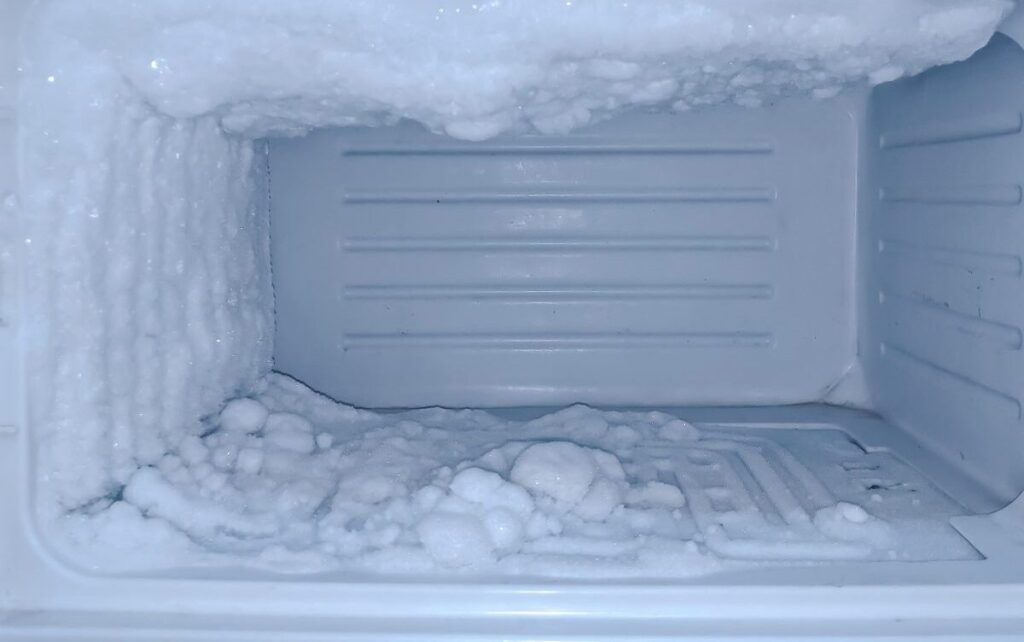

Frost-free fridge freezers work by circulating cold air using a fan and automatically defrosting the evaporator with a heating element on a timed cycle. The most common problem is the evaporator freezing over – usually after the door is left open too long – which stops cold air circulating and causes the unit to warm up. A full manual defrost (unplugging for at least 12 hours) resolves this if the underlying cause is user behaviour rather than a sensor or heater fault.
How Frost-Free Refrigeration Works
In a conventional fridge freezer, the evaporator (the plate or coil that gets cold) is exposed inside the food compartment. Frost builds up on it and must be defrosted manually. In a frost-free appliance, the evaporator is hidden behind a plastic panel at the back of the food compartment, and cold air is circulated around the cabinet using a fan motor. The system automatically defrosts the evaporator on a timed cycle without any manual intervention.

The evaporator
Hidden behind the rear plastic panel inside the food compartment. Cold air passes over it and is then distributed around the cabinet by the fan. When working correctly, small beads of ice may be visible on the back plastic wall – this is normal. During a defrost cycle you may see water on the back wall instead.

The defrost heater
A heating element is built into the evaporator assembly. On a timed cycle, this heater runs briefly to melt any frost that has accumulated. The resulting water drains down channels in the rear wall, through a drain hole, and out to the evaporator tray on top of the compressor. The compressor generates heat that evaporates this water into the air behind the unit.

The control system
Sensors, a defrost timer, and a PCB control the cooling and defrost cycles. This additional complexity means frost-free appliances have more components that can potentially fail compared to a simple conventional fridge – though they remain generally reliable.
Common Problems
Evaporator Frozen Over
The most common problem with frost-free appliances is the evaporator freezing over entirely. When this happens, the fan cannot circulate cold air effectively and the food compartment warms up. This can happen for two reasons:
 Door left open (user cause)
If the door is left open for an extended period in warm or humid conditions, excessive moisture enters the cabinet and the evaporator ices over rapidly. Because the evaporator is hidden behind the rear panel, the extent of the ice build-up is not visible. A complete manual defrost (unplugging for at least 12 hours with doors open) typically resolves this if it does not recur.
 Defrost system fault
If the defrost heater, defrost sensor, or timer fails, the evaporator will ice over progressively even with normal use. The fault will recur after a manual defrost. This requires an engineer to diagnose which component has failed – heater, sensor, or PCB.
Fan Ice Build-Up and Noise
In severe cases of evaporator icing, ice can form around the fan motor itself. Before the fan seizes completely, it will catch on the ice and produce a distinctive high-pitched noise or intermittent grinding sound. If the fan seizes, cold air circulation stops entirely. This symptom almost always indicates the defrost system is not clearing ice correctly – either from a one-off door-open event or a defrost component failure.

Modern frost-free appliances contain a thermal fuse that protects the defrost circuit. Direct application of a hair dryer can trigger or damage this fuse. The correct method is to unplug the appliance and allow it to defrost naturally with the doors open over at least 12 hours.
Preventing Problems
-

Check the door seals regularly using the paper test. A seal that is not creating an airtight closure allows continuous warm air ingress that overloads the defrost system over time. See our guide on frosting up in a fridge or freezer. -
Do not leave the door open longer than necessary. Each time warm moist air enters the cabinet, the defrost system must clear it. In humid conditions a few minutes with the door fully open is enough to cause problems. -
Do not overload door shelves on American-style fridge freezers. Overloaded doors on large American-style models may not seal correctly even when closed. The large door storage capacity makes overfilling easy – keep items within the designed weight limit for each shelf. -
Stack food to allow air circulation. Frost-free appliances depend on fan-circulated air. Items packed too tightly against the back panel or stacked to obstruct airflow within the cabinet create warm spots and reduce efficiency. Read the instruction manual for stacking guidance for your specific model. Manuals can be downloaded via our appliance user manuals page. -
Check the drain channel is clear. The channel at the rear of the fridge compartment that directs defrost water out through the back can become blocked with food debris. A blocked drain causes water to collect at the base of the fridge rather than draining correctly. See our guide on water in the base of a fridge.
Related Guides
Related Guides
Frosting Up in a Fridge or FreezerHow to check and fix door seal problems causing excessive frost – the most common cause of frosting in frost-free appliances.
 Water in the Base of a Fridge
Why defrost water collects at the base of the fridge compartment and how to clear the blocked drain.
 Ice in the Base of a Freezer
Causes of ice accumulation in the freezer base and how to diagnose whether it is a defrost fault.
 Fridge Freezer in a Garage
How temperature extremes in a garage affect frost-free fridge freezer performance and reliability.
Frequently Asked Questions
How does a frost-free fridge freezer defrost itself?
A heating element built into the evaporator assembly runs on a timed cycle – typically once or twice a day – melting any frost that has accumulated on the evaporator. The resulting water drains down channels in the rear wall and exits through a drain hole at the back, running into a tray on top of the compressor where it evaporates. This cycle repeats automatically throughout the appliance’s service life.
Why is my frost-free fridge freezer not cooling properly?
The most common cause is the evaporator freezing over – which stops the fan from circulating cold air effectively. This can happen after the door is left open for an extended period, or if the automatic defrost system has developed a fault (failed heater, sensor, or PCB). Try unplugging the appliance and leaving doors open for at least 12 hours to defrost manually. If it works normally afterwards but the problem recurs, the defrost system needs investigation by an engineer.
What does a high-pitched noise from a frost-free fridge mean?
A high-pitched noise or intermittent grinding from inside the cabinet is usually the fan catching on ice that has built up around it. This indicates the evaporator is frozen over and the defrost system is not clearing it correctly. Unplug the appliance and defrost it manually. If the noise returns after defrosting, the defrost heater, sensor, or timer has likely failed and needs replacement.
Ask the repair forum
Post the make, model and symptoms and get help from the Whitegoods Help community.
117 Comments
Grouped into 95 comment threads.
0 replies Also, make sure it isn't affected by this safety recall Beko Frost Free Fridge Freezers recall – safety notice (Fire risk)
0 replies Hi, I've got a beko 50/50 fridge freezer - frost free, 9 years old, only one stat, fan in freezer constantly going along with compressor, but fridge not very cold ...well warm really..but does get beads of water on back wall..but not cold enough to chill a 4 pack. Used to be excellent but now even on highest setting it's no good any advise would be greatfully received. Freezer is working fine and its below the fridge
Hi, I’ve got a beko 50/50 fridge freezer – frost free, 9 years old, only one stat, fan in freezer constantly going along with compressor, but fridge not very cold …well warm really..but does get beads of water on back wall..but not cold enough to chill a 4 pack. Used to be excellent but now even on highest setting it’s no good any advise would be greatfully received.
Freezer is working fine and its below the fridge
0 replies Keith: A hair dryer is often used by engineers although it takes so long even with a hair dryer none would have time to do it except in particular circumstances. Best method is a full 24 hour shut off with doors open and lots of towels to catch defrosted water. A hot air gun such as one used for paint stripping would definitely risk damaging something.
Keith: A hair dryer is often used by engineers although it takes so long even with a hair dryer none would have time to do it except in particular circumstances. Best method is a full 24 hour shut off with doors open and lots of towels to catch defrosted water. A hot air gun such as one used for paint stripping would definitely risk damaging something.
0 replies Defrosted Hoover frost free with hot air gun. BIG MISTAKE Now it won't switch on?
Defrosted Hoover frost free with hot air gun. BIG MISTAKE Now it won’t switch on?
0 replies Zac: Yes a fridge only goes down to about 5 degrees so there should be no frost, but modern fridges can get excessive ice build-up on the back wall. They have an evaporator at the back wall which gets very cold and forms drops of ice, the cold is pumped round the fridge by a fan and every so often they defrost. The water runs down a channel out of the back of the fridge.
Zac: Yes a fridge only goes down to about 5 degrees so there should be no frost, but modern fridges can get excessive ice build-up on the back wall. They have an evaporator at the back wall which gets very cold and forms drops of ice, the cold is pumped round the fridge by a fan and every so often they defrost. The water runs down a channel out of the back of the fridge.
0 replies I'm looking for a american fridge freezer from comet for £600 or less. When comparing products all of them say Frost free but only one of them says automatic fridge defrost. But like you I thought if there's no frost then why would you defrost it. So should I just ignore this feature.In your opinion what's the most important feature to consider and compare when buying a new Fridge Freezer ? Thank You
I’m looking for a american fridge freezer from comet for £600 or less. When comparing products all of them say Frost free but only one of them says automatic fridge defrost. But like you I thought if there’s no frost then why would you defrost it. So should I just ignore this feature.In your opinion what’s the most important feature to consider and compare when buying a new Fridge Freezer ?
Thank You
0 replies jeremy: Water should run down into the evaporator tray after being defrosted by the heat from the defrost heater, which literally melts the ice. It should run into the tray on top of the compressor at the back of the machine. From there it is supposed to evaporate using the heat generated by the running compressor. If it's not evaporating I wonder if for some reason the compressor isn't running hot enough?
jeremy: Water should run down into the evaporator tray after being defrosted by the heat from the defrost heater, which literally melts the ice. It should run into the tray on top of the compressor at the back of the machine. From there it is supposed to evaporate using the heat generated by the running compressor. If it’s not evaporating I wonder if for some reason the compressor isn’t running hot enough?
0 replies I have a whirlpool side by side auto defrost. It is about 4 months old. A couple days ago the evapator tray over filled and ran water on to the floor. I emptied the tray and could not see a leak anywhere. I had a sears repair man out today. He could not find a leak anywhere but said there was more water in the tray then there should be. He left without fixing anything as we could not find where the abundance of water is coming from. Tonight I heard water running so I looked under at the tray and could see water coming from the freezer auto defrost tube. It filled the tray up about halfway. What do think could be causing so much water being dispersed during defrost? Thank you
I have a whirlpool side by side auto defrost. It is about 4 months old. A couple days ago the evapator tray over filled and ran water on to the floor. I emptied the tray and could not see a leak anywhere. I had a sears repair man out today. He could not find a leak anywhere but said there was more water in the tray then there should be. He left without fixing anything as we could not find where the abundance of water is coming from. Tonight I heard water running so I looked under at the tray and could see water coming from the freezer auto defrost tube. It filled the tray up about halfway. What do think could be causing so much water being dispersed during defrost? Thank you
1 reply Thanks to this blog I have a working fridge again and I know a lot more about how they work. When I got up this morning the fridge was fully functional again, having come back on during the.night. I think it happened because I was doing a lot of baking and may not have been bothering to fully shut the fridge door while I was going back and forth. I also had the oven on very high and it is right beside the fridge - not a good piece of kitchen design. The defrost took a full 48 hours. Meanwhile the 30 year old frost free that lives in tha garage was a life saver. Thanks again
Thanks to this blog I have a working fridge again and I know a lot more about how they work. When I got up this morning the fridge was fully functional again, having come back on during the.night. I think it happened because I was doing a lot of baking and may not have been bothering to fully shut the fridge door while I was going back and forth. I also had the oven on very high and it is right beside the fridge – not a good piece of kitchen design. The defrost took a full 48 hours. Meanwhile the 30 year old frost free that lives in tha garage was a life saver. Thanks again
Likely replying to Alisiri
Thanks Alisiri: If you are doing the 24 hour defrost it should be left unplugged or it will come on before it’s fully defrosted. The fan would start up as soon as it became free enough but there would still be loads of ice around and the fan wouldn’t need much more to jam it up again.
If the fault reoccurs do a full defrost with door open and no power..
0 replies Our John Lewis Fridge stopped working (power off totally) and after checking fuses we followed advice above. We left the door open for 12 hoursand cleaned out the water outlet hole. So far no response. How will we know if it'sfixed? Will the power just come back on? Help!
Our John Lewis Fridge stopped working (power off totally) and after checking fuses we followed advice above. We left the door open for 12 hoursand cleaned out the water outlet hole. So far no response. How will we know if it’sfixed? Will the power just come back on? Help!
Leave a comment
0 replies tony: It's unlikely the hole would need to be made wider, it's only for water to run through. If it's blocked because it's iced up in the hole though it could mean there's a fault on the appliance.
tony: It’s unlikely the hole would need to be made wider, it’s only for water to run through. If it’s blocked because it’s iced up in the hole though it could mean there’s a fault on the appliance.
0 replies I have a john lewis freezer which has had alot of ice forming on the bottom of the freezer. I took the back cover off which exposed the fan and the element it was solid with ice. I defrosted the ice and saw that the hole into which the water drains was iced up, unblocked and put it all back together. I noticed that the drain hole is quite small, could that be the probelm and needs somehow to be widened?
I have a john lewis freezer which has had alot of ice forming on the bottom of the freezer.
I took the back cover off which exposed the fan and the element it was solid with ice. I defrosted the ice and saw that the hole into which the water drains was iced up, unblocked and put it all back together. I noticed that the drain hole is quite small, could that be the probelm and needs somehow to be widened?
1 reply Researching a problem for my sister in law, has with a 2 month old Frost Free FF making a noise, I found the answer in the above & thank you for your nefforts in answering such questions.
Researching a problem for my sister in law, has with a 2 month old Frost Free FF making a noise, I found the answer in the above & thank you for your nefforts in answering such questions.
Likely replying to mICHAEL
Thanks Michael:
Jackbowles: The water created through defrosting should run down a channel on the back wall inside the appliance and then into the back of the machine where it runs into a drip tray on top of the compressor pump and evaporates. If it’s not doing that the hole at the base of the channel may be blocked.
You might be able to download an instruction book here Appliance instruction books and manuals
0 replies Hi - sorry if you have already answered this, but we have an 'eco' auto defrosting fridge freezer. We bought second hand and never received a manual. Every couple of weeks it defrosts and leaks quite a large puddle of water all over the kitchen floor. We have tried looking underneath and around the back for a tray that might need emptying, but can't see anything. Do you have any ideas or suggestions? I can't remember the make and model off the top of my head - but if that will help I can look when I get home. Your article is really informative by the way - thanks! Jack
Hi – sorry if you have already answered this, but we have an ‘eco’ auto defrosting fridge freezer. We bought second hand and never received a manual.
Every couple of weeks it defrosts and leaks quite a large puddle of water all over the kitchen floor.
We have tried looking underneath and around the back for a tray that might need emptying, but can’t see anything.
Do you have any ideas or suggestions?
I can’t remember the make and model off the top of my head – but if that will help I can look when I get home.
Your article is really informative by the way – thanks! Jack
1 reply darn! my fridge wasn't working at all. the freezer portion was operating but at a diminishing capacity. the repairmen said they needed to replace two circuit boards. now that i read your article, i probably could have fixed the fridge with a 24 hr full defrost. maybe all they did was check the evaporator for ice after the overnight power off defrost they started. could i have done all this myself instead of paying them all that money? or are circuit board replacements a for real fix?
darn! my fridge wasn’t working at all. the freezer portion was operating but at a diminishing capacity. the repairmen said they needed to replace two circuit boards. now that i read your article, i probably could have fixed the fridge with a 24 hr full defrost. maybe all they did was check the evaporator for ice after the overnight power off defrost they started. could i have done all this myself instead of paying them all that money? or are circuit board replacements a for real fix?
Likely replying to Ike
Hello Ike: A faulty pcb can indeed cause these issues. A 24 hour defrost can cure the problem if it’s just iced up around the fan motor due to the door being left open too long, but the fault can often return even if a full defrost gets the freezer working again if the icing up was caused by another fault on the appliance such as a faulty sensor or pcb.
Even if the pcb was the cause they would still need a 24 hour defrost to clear the ice around the fan chamber.
0 replies Amanda: It sounds like it's just developed a fault. I don't think the instruction book would help, you need an engineer. If it's been placed in a cold environment it could account for it but I wouldn't have thought it was that cold at the moment - How are fridges and freezers affected by the room temperature?
Amanda: It sounds like it’s just developed a fault. I don’t think the instruction book would help, you need an engineer. If it’s been placed in a cold environment it could account for it but I wouldn’t have thought it was that cold at the moment – How are fridges and freezers affected by the room temperature?
0 replies Hello, I have a PRESTIGE PRT295FFCS fridge freezer. I have never had any problems with it until last night all of a sudden the freezer started warming up for no apparent reason. I checked the door was closed properly, removed a layer of ice from the bottom & put the 'super freeze' on to try to get it back to -18, but nothing has made a difference. It is now at +1. I can't find my user manual to check in there, any ideas? Any help would be much appreciated!
Hello,
I have a PRESTIGE PRT295FFCS fridge freezer. I have never had any problems with it until last night all of a sudden the freezer started warming up for no apparent reason.
I checked the door was closed properly, removed a layer of ice from the bottom & put the ‘super freeze’ on to try to get it back to -18, but nothing has made a difference. It is now at +1.
I can’t find my user manual to check in there, any ideas?
Any help would be much appreciated!
4 replies There should only be ice on the back wall occasionally Rod. When in a defrost cycle the ice melts and runs down the back wall as water.
There should only be ice on the back wall occasionally Rod. When in a defrost cycle the ice melts and runs down the back wall as water.
Likely replying to Washerhelp
Hi Washerhelp,
I appreciate your expertise, and would like your opinion. I am purchasing a new fridge and was planning on buying the Compact Summit.
I noticed that this has a manual defrost on the freezer. What will this mean in terms of my maintenance of the freezer? I don’t go into the freezer that often (maybe 3 times a week), but I am scared of what “Manuel defrost” means. I have nice wood floors in the kitchen, am I going to have ice build up that I cannot get rid of sans huge amounts of towels and syphoning water into the sink? How often will I have to defrost the freezer?
I currently have a White Westinghouse Frost Free freezer that is almost 20 years old… What sort of differences should I expect?
Thanks,
Reddy
Likely replying to Reddy
Hello Reddy: The link you give has a link to the actual manual of that product which has a section on manually defrosting where it describes the process in detail for you. How often you have to do it depends on how often you open the freezer up and how long you keep the door open as well as how humid it is but if you don’t go in too often it shouldn’t need doing too often. I’m not familiar with the Westinghouse but if it looks like an ordinary fridge freezer as opposed to a frost free one.
Likely replying to Washerhelp
Hi Washerhelp,
I have a Diplomat APM6318 built-in larder.
Do these small stand alone fridges usually have a defrost timer, heater etc?
It is a wet wall fridge and I’ve noticed that ice beads form and then melt quite often (every time the thermostat is on or off). I would have thought the fridge would auto-defrost every 6 hours or so, not every time the thermostat cycles, unless there is no extra defrost capability.
Thanks for your help!
Likely replying to Richard
Hello Richard: Larders tend to have a defrost cycle, which raises the temperature inside the fridge using a heating element (believe it or not) to melt the ice beads on the back wall. This means food doesn’t last as long in a larder fridge as it would in a normal fridge.
The water should run down the back wall into a large v-shaped channel with a small hole at the apex where the water runs into the back of the appliance onto the evaporator tray (on top of the compressor).
0 replies hi i have a hoover fridge freezer frost free freezer working ok but fridge is cold but just cold the back wall of the fridge seams to be wet all the time no ice on the back wall can enyone help pls
hi i have a hoover fridge freezer frost free freezer working ok but fridge is cold but just cold the back wall of the fridge seams to be wet all the time no ice on the back wall can enyone help pls
0 replies Gary: Frost is caused when air gets inside and the moisture within it deposits as frost. Make sure it's dead level as slight twists in the cabinet can cause the door seal to not fit properly letting air inside. Make sure the door seal is in good condition too. Other than that it would need looking at, it's not necessarily connected to the previous repair. Lesley: It sounds like you might be entitled to reject these machines under the sale of goods act as they appear to have an inherent fault. They may be able to hold back some of the money as you've had a certain amount of use from them but I would ask for a refund or exchange to a completely different brand. Read this article carefully Consumer Rights Act 2015 gives us 6 years to claim for faulty appliances Emma: Modern frost free fridge freezers are quite different to the old ones. They work by blowing cold air through the appliance hence the fan. I would expect it to settle down somewhat when fully loaded and down to temperature but I couldn't say how often it should come on. Once down to temperature and full of food though unless the door is opened it ought to maintain temperature for reasonable lengths of time.
Gary: Frost is caused when air gets inside and the moisture within it deposits as frost. Make sure it’s dead level as slight twists in the cabinet can cause the door seal to not fit properly letting air inside. Make sure the door seal is in good condition too. Other than that it would need looking at, it’s not necessarily connected to the previous repair.
Lesley: It sounds like you might be entitled to reject these machines under the sale of goods act as they appear to have an inherent fault. They may be able to hold back some of the money as you’ve had a certain amount of use from them but I would ask for a refund or exchange to a completely different brand. Read this article carefully Consumer Rights Act 2015 gives us 6 years to claim for faulty appliances
Emma: Modern frost free fridge freezers are quite different to the old ones. They work by blowing cold air through the appliance hence the fan. I would expect it to settle down somewhat when fully loaded and down to temperature but I couldn’t say how often it should come on. Once down to temperature and full of food though unless the door is opened it ought to maintain temperature for reasonable lengths of time.
0 replies Hello, I had a Beko frost-free fridge freezer deliverd on Saturday. I wasn't aware that it was frost free (and to be honest, would have not known to check this). The fan comes on every half hour for 10 minutes. I have an open plan lounge / diner and this is quite annoying. It emits a high pitched whistle (and gurgling). I note from the site that this noise may be normal? I used to have a Zanussi manual defrost. However, this actually made even louder noises (so would have been no good in an open plan room). My parents have a 17 year old fridge freezer, totally and utterly silent (although it's still working!). I am trying to 'live' with the noise. The fridge and freezer are currently empty, I have simply plugged the unit in (after waiting 6 hours). Question : is it normal for the fan to come on this regularly and will the noise diminish when the fridge & freezer are full? I am tempted to ask for a refund and go to back to manual defrost. However, is there any guarantee that this may be totally silent? Thank you
Hello,
I had a Beko frost-free fridge freezer deliverd on Saturday. I wasn’t aware that it was frost free (and to be honest, would have not known to check this). The fan comes on every half hour for 10 minutes. I have an open plan lounge / diner and this is quite annoying. It emits a high pitched whistle (and gurgling).
I note from the site that this noise may be normal? I used to have a Zanussi manual defrost. However, this actually made even louder noises (so would have been no good in an open plan room). My parents have a 17 year old fridge freezer, totally and utterly silent (although it’s still working!).
I am trying to ‘live’ with the noise. The fridge and freezer are currently empty, I have simply plugged the unit in (after waiting 6 hours).
Question : is it normal for the fan to come on this regularly and will the noise diminish when the fridge & freezer are full?
I am tempted to ask for a refund and go to back to manual defrost. However, is there any guarantee that this may be totally silent?
Thank you
0 replies I have had trouble with my frost-free fridge freezer since purchasing it in 2007. The first one had frost on 'ceiling' of the freezer and condensation on the outside of appliance. Repairman concluded it was faulty and I was supplied with a new one of same model. This one, which arrived in 2008, also gets frost on the ceiling of freezer and last autumn had terrible noises which I think was fan icing up. I called repair team and was told to switch machine off. This meant had to do a total defrost which took forever, and you can't leave the machine for more than 5 mins at a time as not designed to be defrosted so nowhere for water to go except floor! therefore need to be on hand to mop up all day) . Repairman arrived and said there was a fault with a hose not being large enough so he cut a 'v' in it and sealed something at bottom. For the first time ever my appliance had no ice on the ceiling for 3 months. But now - it's back with a vengeance and even icicles have formed! I have done 2 mini defrosts by placing my food in freezer bags for a couple of hours but the frost returns. I never leave the door open and am always checking that it is closed, especially at night when it is a ritual to check it like switching off lights and locking doors. I have no young children either so the door is firmly closed for most of the time and really only opened in evening when I need food for cooking or sometimes in the day when putting frozen shopping away. The seals all look fine and the appliance is properly surrounded by ventilation. Help please! ps. Do frost-free freezers hold loads more water than conventional ones? I think now I will return to purchasing a conventional non frost-free freezer.
I have had trouble with my frost-free fridge freezer since purchasing it in 2007. The first one had frost on ‘ceiling’ of the freezer and condensation on the outside of appliance. Repairman concluded it was faulty and I was supplied with a new one of same model. This one, which arrived in 2008, also gets frost on the ceiling of freezer and last autumn had terrible noises which I think was fan icing up. I called repair team and was told to switch machine off. This meant had to do a total defrost which took forever, and you can’t leave the machine for more than 5 mins at a time as not designed to be defrosted so nowhere for water to go except floor! therefore need to be on hand to mop up all day) . Repairman arrived and said there was a fault with a hose not being large enough so he cut a ‘v’ in it and sealed something at bottom.
For the first time ever my appliance had no ice on the ceiling for 3 months. But now – it’s back with a vengeance and even icicles have formed! I have done 2 mini defrosts by placing my food in freezer bags for a couple of hours but the frost returns. I never leave the door open and am always checking that it is closed, especially at night when it is a ritual to check it like switching off lights and locking doors. I have no young children either so the door is firmly closed for most of the time and really only opened in evening when I need food for cooking or sometimes in the day when putting frozen shopping away. The seals all look fine and the appliance is properly surrounded by ventilation. Help please! ps. Do frost-free freezers hold loads more water than conventional ones? I think now I will return to purchasing a conventional non frost-free freezer.
0 replies Hi, I have a John Lewisfreezer model: JLUCFZ6002 now 5 years old. 2 years ago the drain valve was replaced. Now I appear to have small deposits of frost on the bottom. Tried a 13 hour switch off which resulted in losing my ice cream ( no big deal ) but the problem is still there. Any ideas?
Hi, I have a John Lewisfreezer model: JLUCFZ6002 now 5 years old. 2 years ago the drain valve was replaced. Now I appear to have small deposits of frost on the bottom. Tried a 13 hour switch off which resulted in losing my ice cream ( no big deal ) but the problem is still there. Any ideas?
0 replies Greetings Washerhelp - no worries, I understand. Thank you for taking the time to reply. I'm so glad that I have found such an informative website.
Greetings Washerhelp – no worries, I understand. Thank you for taking the time to reply. I’m so glad that I have found such an informative website.
0 replies Louisa: Sorry about the delayed reply. I would say when it's reached temperature which is normally around -18 degrees on a freezer. Katie: The hole at the bottom of the back wall is possibly blocked. When defrosting the water from the back wall runs down into two channels and out through the back where it evaporates in a tray on top of the compressor. If this passageway is blocked water will run into the base instead and freeze up.
Louisa: Sorry about the delayed reply. I would say when it’s reached temperature which is normally around -18 degrees on a freezer.
Katie: The hole at the bottom of the back wall is possibly blocked. When defrosting the water from the back wall runs down into two channels and out through the back where it evaporates in a tray on top of the compressor. If this passageway is blocked water will run into the base instead and freeze up.
0 replies my frost free fridge freezer seems to have puddles water at bottom fridge an ice has now formed at bottom freezer help only 4yrs old expected to have longer.
my frost free fridge freezer seems to have puddles water at bottom fridge an ice has now formed at bottom freezer help only 4yrs old expected to have longer.
0 replies Hello - I have just switched my fridge freezer back on after defrosting it. How long do I have to wait before I can safely put some food in it? Many thanks.
Hello – I have just switched my fridge freezer back on after defrosting it. How long do I have to wait before I can safely put some food in it? Many thanks.
0 replies Frost free fridge freezers are prone to icing up around the fan if the door is left open. This can cause the fan that blows the cold air around the fridge to become encased in ice and stop running. Prior to stopping all together they often make a searing noise as the fan catches on enclosing ice. If the fan is restricted or the fan chamber blocked with ice the fridge can warm up as cold air can no longer circulate. A remedy to this can sometimes be a complete defrost by removing all food and unplugging the appliance then leaving the door open for at least 24 hours. As the ice is deep in the fridge it will take a long time to defrost properly.
Frost free fridge freezers are prone to icing up around the fan if the door is left open. This can cause the fan that blows the cold air around the fridge to become encased in ice and stop running. Prior to stopping all together they often make a searing noise as the fan catches on enclosing ice. If the fan is restricted or the fan chamber blocked with ice the fridge can warm up as cold air can no longer circulate.
A remedy to this can sometimes be a complete defrost by removing all food and unplugging the appliance then leaving the door open for at least 24 hours. As the ice is deep in the fridge it will take a long time to defrost properly.
0 replies I have a JOhn Lewis fridge freezer. I've been away for the weekend and came back to a fridge that smells a bit. I noticed the fridge temp has gone up to 14! What can I do? The freezer part is fine. I did leave the door open a few times last week!! Please help. Thanks
I have a JOhn Lewis fridge freezer. I’ve been away for the weekend and came back to a fridge that smells a bit. I noticed the fridge temp has gone up to 14! What can I do? The freezer part is fine. I did leave the door open a few times last week!! Please help. Thanks
0 replies Hi Andy, We think our Zanussi fridge freezer ZRB227XO is of the 'Flat Back' type of design as per Googled spec. sheet and therefore the condenser is not exposed or accessible at the rear of this unit. The User Handbook is at fault advising annual cleaning of the condenser on this model. Please accept our apologies for wasting your time. Unit performance seems satisfactory.
Hi Andy,
We think our Zanussi fridge freezer ZRB227XO is of the ‘Flat Back’ type of design as per Googled spec. sheet and therefore the condenser is not exposed or accessible at the rear of this unit. The User Handbook is at fault advising annual cleaning of the condenser on this model. Please accept our apologies for wasting your time. Unit performance seems satisfactory.
0 replies That is our point , Dear Washerhelp, there is no exposed condenser on the rear of our new Zanussi fridge freezer ZRB227XO, just a flat back from the compressor opening at the base to the plastic top plate which is also without vent openings.
That is our point , Dear Washerhelp, there is no exposed condenser on the rear of our new Zanussi fridge freezer ZRB227XO, just a flat back from the compressor opening at the base to the plastic top plate which is also without vent openings.
1 reply Jopaco: Do they not mean the black condenser at the back of the machine which is open to the air and gets very dusty? The gas passes through and loses heat there and attracts a lot of dust. I wouldn't have thought a part concealed under a backplate would get any dust.
Jopaco: Do they not mean the black condenser at the back of the machine which is open to the air and gets very dusty? The gas passes through and loses heat there and attracts a lot of dust. I wouldn’t have thought a part concealed under a backplate would get any dust.
Likely replying to Washerhelp
Hi Washerhelp
Thank you for comments, very helpful.
I have a Prestige PRT 325 FFCS my fridge has packed up I have tried turning off the fridge and leaving the freezer as that is functioning ok but still not cooling. Have seen some terrible comments on this model from another site. Is it worth calling an engineer. Had this one for 3 years.
0 replies The User Handbook supplied with our new Zanussi fridge freezer advises cleaning the dust off the condenser annually. The condenser is however concealed by a backplate and not accessible by a long handled dusting brush! as advised by Zanussi Customer care. Should we leave well alone! Thanks in anticipation!
The User Handbook supplied with our new Zanussi fridge freezer advises cleaning the dust off the condenser annually.
The condenser is however concealed by a backplate and not accessible by a long handled dusting brush! as advised by Zanussi Customer care. Should we leave well alone! Thanks in anticipation!
0 replies H Neil, I found out that this fridge freezer has a separate cooling coil with a fan hidden under all the foam sound proofing. The diagnosis is that there is insufficient gas (due to leakage) to cool the fridge section. It would need all the insulation to be removed and even then it woul dbe difficult to find the leak to repair and recharge the system. So I was advised to switch off it's life support machine and replace it with another Unit. Many thanks for your assistance. John
H Neil, I found out that this fridge freezer has a separate cooling coil with a fan hidden under all the foam sound proofing. The diagnosis is that there is insufficient gas (due to leakage) to cool the fridge section. It would need all the insulation to be removed and even then it woul dbe difficult to find the leak to repair and recharge the system.
So I was advised to switch off it’s life support machine and replace it with another Unit.
Many thanks for your assistance.
John
0 replies Neil: I don't reply by email as that wouldn't help anyone else reading this in the future. The channel is there to allow water from the back wall, which runs down after a defrosting cycle to be channelled through to the back of the appliance and run into a drip tray on top of the compressor. This tray gets hot from the compressor and the water evaporates. Items should be kept away from the back wall and is one of the disadvantages of frost free fridges as you can't pack too much in them which restricts the cold air flow. If the hole is icing up it can cause water to flow into the base of the appliance and form a sheet of ice. This can happen if the hole is blocked somehow and the water doesn't run through to the tray at the back. John: Sorry I can't try to solve specific faults but the fan should be in the freezer compartment. The fan then blows the cold air around the fridge compartment. If the fan was in the fridge it couldn't circulate any cold air.
Neil: I don’t reply by email as that wouldn’t help anyone else reading this in the future. The channel is there to allow water from the back wall, which runs down after a defrosting cycle to be channelled through to the back of the appliance and run into a drip tray on top of the compressor. This tray gets hot from the compressor and the water evaporates. Items should be kept away from the back wall and is one of the disadvantages of frost free fridges as you can’t pack too much in them which restricts the cold air flow.
If the hole is icing up it can cause water to flow into the base of the appliance and form a sheet of ice. This can happen if the hole is blocked somehow and the water doesn’t run through to the tray at the back.
John: Sorry I can’t try to solve specific faults but the fan should be in the freezer compartment. The fan then blows the cold air around the fridge compartment. If the fan was in the fridge it couldn’t circulate any cold air.
0 replies I have a Zanussi ZI 920 integrated F/F which is frost free and has been working for about 6 years OK. Symptom is the common one of Freezer works OK, but fridge warm. Fitted new defrost timer and now the freezer temp is uncontrolled. It hits the stop on the manual gauge. There is a fan in the freezer compartment above the evaporator, but no fan and no ducting for the fridge. I am toold that there must be a separate evaporator for the fridge. Thermostats near the evap. OK, fan and timer OK. The condenser behind the unit gets quite hot in the first quarter, but the rest is just cool. Any suggestions please as I am at my wit's end. Thanks and regards, John
I have a Zanussi ZI 920 integrated F/F which is frost free and has been working for about 6 years OK. Symptom is the common one of Freezer works OK, but fridge warm.
Fitted new defrost timer and now the freezer temp is uncontrolled. It hits the stop on the manual gauge.
There is a fan in the freezer compartment above the evaporator, but no fan and no ducting for the fridge. I am toold that there must be a separate evaporator for the fridge.
Thermostats near the evap. OK, fan and timer OK.
The condenser behind the unit gets quite hot in the first quarter, but the rest is just cool.
Any suggestions please as I am at my wit’s end.
Thanks and regards,
John
0 replies My fridge has two channels at the back leading to hole in the centre. This hole tends to get blocked with ice frequently why is this. Do items in the fridge that touch the fridge walls make the back wall and hole ice up, if so why is this. Why does it ice up if things touch the walls, making sure food items are not touching the sides sevrely reduces the amount of space I can place items on each shelf. I would see this as a design flaw. Can't something be done in the design of the units that makes it ok for items to be touching the side walls. Please can you return your answere to me via email. Many thanks Neil.
My fridge has two channels at the back leading to hole in the centre. This hole tends to get blocked with ice frequently why is this. Do items in the fridge that touch the fridge walls make the back wall and hole ice up, if so why is this. Why does it ice up if things touch the walls, making sure food items are not touching the sides sevrely reduces the amount of space I can place items on each shelf. I would see this as a design flaw. Can’t something be done in the design of the units that makes it ok for items to be touching the side walls.
Please can you return your answere to me via email. Many thanks Neil.
1 reply I am considering on buying a fridge freezer. On some of them there is a sign "No Frost" and on some "Frost Free". Is that the same? And another question: Is it better the freezer to be on top (freezer top), or on bottom (freezer bottom)? Thank you in advance
I am considering on buying a fridge freezer. On some of them there is a sign “No Frost” and on some “Frost Free”. Is that the same? And another question: Is it better the freezer to be on top (freezer top), or on bottom (freezer bottom)?
Thank you in advance
Likely replying to Gjorgji
Hello Gjorgji: It’s possible some manufacturer’s are using the different phrases to describe the same product. Logically the terms “no frost” and “frost free” should mean exactly the same thing. You need to check with the sales people if there is any difference. If there is I’d like to know and would write an article specifically about it to clear things up.
Regarding the position of the freezer as far as I know it would be just down to personal preference. Most people are likely to prefer the fridge on top as they are likely to use it frequently each day but maybe someone frail might prefer the freezer on top if they found it easier to load and unload. Come to think of it I didn’t even know you could get one with the freezer on top. If it was a tall one you’d need step ladders to get to the top drawer.
0 replies Apologies for not replying sooner - AMBAR: If the power goes off you need to not open the door until power is resumed and the temperature's gone down again. The fridge is insulated enough to normally maintain temperature for several hours as long as the door isn't opened though if it's very hot I've no idea how long it would take to defrost. I'm not sure how much impact the ice would have in maintaining a cold temperature with the power off. It's possible it won't make much difference but I understand the logic behind assuming it would be better with ice inside so it may be better to keep the old type in your circumstances. Stephen UK: If you are leaving it unplugged for a couple of days you will be completely clearing the blockage or the ice if the fan is getting encased in ice. If it keeps returning then clearly there's a fault that needs fixing properly. You need to find a proper fridge repair expert - not ones that just tell you to defrost it. Your fault could be caused by a faulty sensor over freezing, an ill fitting door or one with a worn door seal allowing air to be sucked in which then forms ice around the fan or a blockage or the problem with the defrosting system. pat, harrogate: Frost free means no frost is generated, but auto defrost means frost is generated and the fridge automatically gets rid of it by defrosting. "Frost Free" shouldn't need to defrost. Some manufacturers may try to con by saying their appliance is "frost free" because it automatically defrosts but true frost free can only mean that it runs without creating any frost (or ice) in the first place. maria Modern frost free refrigeration is complex compared to the old fashioned fridges and freezers that just had a compressor and a capillary thermostat. Compared to the old ones they are very complicated and many people who are sent to repair them aren't really thoroughly up to speed with them. I would try the manufacturer or look for a specialist refrigeration repair company.
Apologies for not replying sooner –
AMBAR: If the power goes off you need to not open the door until power is resumed and the temperature’s gone down again. The fridge is insulated enough to normally maintain temperature for several hours as long as the door isn’t opened though if it’s very hot I’ve no idea how long it would take to defrost. I’m not sure how much impact the ice would have in maintaining a cold temperature with the power off. It’s possible it won’t make much difference but I understand the logic behind assuming it would be better with ice inside so it may be better to keep the old type in your circumstances.
Stephen UK: If you are leaving it unplugged for a couple of days you will be completely clearing the blockage or the ice if the fan is getting encased in ice. If it keeps returning then clearly there’s a fault that needs fixing properly. You need to find a proper fridge repair expert – not ones that just tell you to defrost it. Your fault could be caused by a faulty sensor over freezing, an ill fitting door or one with a worn door seal allowing air to be sucked in which then forms ice around the fan or a blockage or the problem with the defrosting system.
pat, harrogate: Frost free means no frost is generated, but auto defrost means frost is generated and the fridge automatically gets rid of it by defrosting. “Frost Free” shouldn’t need to defrost. Some manufacturers may try to con by saying their appliance is “frost free” because it automatically defrosts but true frost free can only mean that it runs without creating any frost (or ice) in the first place.
maria Modern frost free refrigeration is complex compared to the old fashioned fridges and freezers that just had a compressor and a capillary thermostat. Compared to the old ones they are very complicated and many people who are sent to repair them aren’t really thoroughly up to speed with them. I would try the manufacturer or look for a specialist refrigeration repair company.
0 replies I have a zanussi frost free fridge freezer which I was expecting to give years of good service but has now broken down. I guess I've had it 5 years but that doesn't seem that long for a good brand. The cold air seems to be circulating to the fridge and there is a humming sound but the usual loud noises that indicate it is working, seem to have stopped - fridge showed sign "too warm" but seemed to be working a little bit but don;t think freezerwas working at all. In first instance I could hear slight "clicks" (and my kitchen lights flickered) when I waited for it to start up but then it wouldn;t kick in as normal. Now I am not sure I can hear anything expect the hum. I left it off overnight and have tried to get a repairman to come today but no-one likes frost free! One person told me to leave it at least 24 hours with doors open in order to ensure it is not iced up behind panel. I am doing that now but none of the 3 people I called, volunteered to come and look at it if this does not solve the problem! And I thought there was a recession and people wanted the business!
I have a zanussi frost free fridge freezer which I was expecting to give years of good service but has now broken down. I guess I’ve had it 5 years but that doesn’t seem that long for a good brand. The cold air seems to be circulating to the fridge and there is a humming sound but the usual loud noises that indicate it is working, seem to have stopped – fridge showed sign “too warm” but seemed to be working a little bit but don;t think freezerwas working at all. In first instance I could hear slight “clicks” (and my kitchen lights flickered) when I waited for it to start up but then it wouldn;t kick in as normal. Now I am not sure I can hear anything expect the hum. I left it off overnight and have tried to get a repairman to come today but no-one likes frost free! One person told me to leave it at least 24 hours with doors open in order to ensure it is not iced up behind panel. I am doing that now but none of the 3 people I called, volunteered to come and look at it if this does not solve the problem! And I thought there was a recession and people wanted the business!
0 replies i have been trying to establish the difference between fridgefreezers that have both frost free (freezer) & auto defrost (fridge), & those that are advertised simply as frost free. In spite of the huge help your site has been, I'm still confused: on the one hand I've been told that ALL modern fridgefreezers have auto defrost, but if so why do manufacturers differentiate - advertising some models as frost free and auto defrost, & others simply as frost free? Beko has both types & so do other makers. This ambiguity along with other constraints like having small kitchen means I've spent 6 months without a fridgefreezer, trying to find right one. OK, bit obsessive! I had a lovely one but left it behind, not expensive but never any trouble; it's quite scary reading all that can go wrong....but if, like mine did, they work properly they are so much more convenient than those that need defrosting manually. thank you
i have been trying to establish the difference between fridgefreezers that have both frost free (freezer) & auto defrost (fridge), & those that are advertised simply as frost free. In spite of the huge help your site has been, I’m still confused: on the one hand I’ve been told that ALL modern fridgefreezers have auto defrost, but if so why do manufacturers differentiate – advertising some models as frost free and auto defrost, & others simply as frost free? Beko has both types & so do other makers. This ambiguity along with other constraints like having small kitchen means I’ve spent 6 months without a fridgefreezer, trying to find right one. OK, bit obsessive!
I had a lovely one but left it behind, not expensive but never any trouble; it’s quite scary reading all that can go wrong….but if, like mine did, they work properly they are so much more convenient than those that need defrosting manually. thank you
3 replies A similar question was asked by ernie when he said his made a noise like a jack hammer - I replied underneath. Hope it helps
A similar question was asked by ernie when he said his made a noise like a jack hammer – I replied underneath. Hope it helps
Likely replying to Washerhelp
Dear Washerhelp
Thanks for such an informative blog. I have gone through most of the problems discussed above.
My problem is a bit different. We are planning to replace our existing refrigerator (which is not frost free and accumulates frost in freezer compartment.) I am currently in a city where continued suppy of electricity is a problem. The power normally goes off one hour each thrice a day. On some hot days, or due to grid power failure the shut down could be prolonged may be 6 to 8 hours. Now the issue is, with a freezer having forsting mechanism, there is lot of ice inside the freezer compartment, which can keep the frozen food intact for a longer period. I was wondering what would happen if there is no ice in the freezer compartment (if I buy fros-free fridge), and power goes off. I presume it would certainly impact the food quality and might spoil it or render it unconsumable.
what do you recommend in this scenario, shall we go for frost free or for old frost type?
thanks in advance
AMBAR
Likely replying to Washerhelp
Hi Washerhelp
Many thanks for making the effort to put all of this information up. I know you’ve answered this problem before, but I’ve got a slight variation to ask:
I have one of those fridge / freezers where the fridge is cooled by pumping in cold air from the freezer compartment. Sadly, every few months, the fridge bit seems to stop working – I’m guessing because the air conduit gets blocked by ice. We empty both compartments (bye-bye lovely food) and switch it off and leave the doors open for a few days, and then all is ok again (for a few months). In this instance I’m a bit fed up and don’t want to lose all my food again, and wondered if there’s likely to be any way I can get in there manually, remove the ice blockage myself, and get the unit back up and running before the food has had time to go off.
Also, do you have any other tips as to things we might be able to do / not do to stop this happening in future (fyi we’ve had engineers out, but they just recommend the defrost solution!)
Thanks again for your help,
Stephen
Likely replying to Washerhelp
Hi Washerhelp
further to the above comment, I’ve noticed something that may help diagnose the problem (if indeed it’s in any way different to the problems already mentioned on this board): when the f/f malfunctions in this way, it also seems to misread the temperature of the fridge section. It’s currently reading 2-3 deg Celsius, but the temperature in the fridge compartment is very clearly not that low (more like 18 – it’s warmer in there than it is in the room!)
Stephen
0 replies I have a zanussi fridge freezer which works fine but every so often it makes a terrible banging noise not quite as bad but similar to a compressor kicking in. Is this normal?
I have a zanussi fridge freezer which works fine but every so often it makes a terrible banging noise not quite as bad but similar to a compressor kicking in. Is this normal?
0 replies Anonymous: Frost free only applies to the freezer as fridges don't generate any frost. If your fridge freezer is frost free and the fridge isn't getting cold there could be a blockage stopping the cold air being blown into the fridge compartment. This could be ice so a 24 hour defrost could work. However, if the fault returns it will need looking at by an engineer. (Appliance repair companies)
Anonymous: Frost free only applies to the freezer as fridges don’t generate any frost. If your fridge freezer is frost free and the fridge isn’t getting cold there could be a blockage stopping the cold air being blown into the fridge compartment. This could be ice so a 24 hour defrost could work. However, if the fault returns it will need looking at by an engineer.
0 replies Hi, very helpful article. This may sound a silly question, but how can you tell if you have a frost free fridge, the fridge part of my fridge/freezer doesn't work but the freezer part works fine, i wonder if it needs defrosting. Thanks
Hi, very helpful article. This may sound a silly question, but how can you tell if you have a frost free fridge, the fridge part of my fridge/freezer doesn’t work but the freezer part works fine, i wonder if it needs defrosting.
Thanks
0 replies Tanya: It's normal for the back wall to ice up and defrost regularly but not in a sheet, it normally has many globules of frosted ice. It might for a so-called sheet but it shouldn't be a smooth sheet of ice, just a covering of small drops of water that have frozen.
Tanya: It’s normal for the back wall to ice up and defrost regularly but not in a sheet, it normally has many globules of frosted ice. It might for a so-called sheet but it shouldn’t be a smooth sheet of ice, just a covering of small drops of water that have frozen.
0 replies Hello, I bought a new frost free fridge freezer and the fridge started to develop a very tiny ice layer at the inner back panel which is defrosting every hour or so. The problem is the fridge is constantly wet and even the glass shelves are sweaty. An engineer came and said it's normal, however I’m concerned so please help!
Hello,
I bought a new frost free fridge freezer and the fridge started to develop a very tiny ice layer at the inner back panel which is defrosting every hour or so. The problem is the fridge is constantly wet and even the glass shelves are sweaty. An engineer came and said it’s normal, however I’m concerned so please help!
3 replies I would try a defrost Tony R. Jenny: Check your instruction book, hopefully they will mention these things. Frost free fridges can get hot at the sides and the fans do run on and off a lot but shouldn't run constantly once settled in.
I would try a defrost Tony R.
Jenny: Check your instruction book, hopefully they will mention these things. Frost free fridges can get hot at the sides and the fans do run on and off a lot but shouldn’t run constantly once settled in.
Likely replying to Washerhelp
Washerhelp,
Just found your site. What a help I found it. My sanity is returing.
Situation: Am really rather ill. Have to store temperature controlled drugs injections in fridge 2 – 8 degrees. It’s a relatively new, expensive fridge/freezer. Jabs are useless if go out of temp. – it’s a nightmare. This stuff can cause cancer and lupus, etc.
Got a data logger. Seems the unit is suceptible to room temperature of kitchen vv cooking, food retrieval, overnight drop in the air temperature. I live in a bungalow. data logger shows teemp. in fridge drops to 1.5 during the night.
There must be millions of people who are storing vital drugs in domestic fridges and have no way of knowing that they have ‘gon out of temperature’. I have tried to engage the press media over here to address the situation as I feel the responsibility, loaded by the NHS, on folk who are already very ill is unacceptable. Sadly, they don’t recognise the importance. I have seen that the US authorities have seen the situation and are currently researching dedicated units – pity UK authorities are turning a blind eye.
I’m now going to buy a pharmacy fridge and hope that this will resolve the problem. I’m undecided whether to call an engineer to look at this Bosch fridge/feezer I have, or to cause it’s demise with a 15lb hammer! There must be a problem because the frequent fall of ice into the tray is sufficient to wake one up – from the other end of the house.
If you’ve read this … thanks for your patience. this morning I need to rant – I’ve been up since the crack of dawn.
Rgds Jean
Likely replying to jean UK
Hello Jean UK: You are right in that you may need a pharmacy fridge. No domestic appliance manufacturer is going to guarantee their refrigeration is suitable for looking after such delicate medical products. Normal fridge temperatures should be between 0 degrees and 5 degrees so 1.5 degrees is perfectly OK for normal use.
The coldest part of a fridge is usually at the bottom, have you tried monitoring the temperature at the bottom of the fridge in case it remains colder? Also I would try setting the temperature as low as you can without getting lumps of ice in the milk, that could make a difference too.
Likely replying to Washerhelp
Hello Washerhelp,
Sorry for the delay in answering. Been experimenting. Nope! Nothing works. Have now got a pharmacy fridge, all checked, set up and doing the business. I was abolutely amazed at the service/delivery … ordered it one day, here before 1pm the following day.
I can now sleep at night and stop asking questions which must seem daft to those in the trade. Thanks for taking the trouble to ‘hold my hand’ – I was glad of your input. Take care, and may all your problems be small and solvable.
0 replies I just got a new Frigidare frost free freezer/upright. The sides are hot to the touch; I also wondered...I can hear the fan running constantly. Is this normal? Thank you
I just got a new Frigidare frost free freezer/upright. The sides are hot to the touch; I also wondered…I can hear the fan running constantly. Is this normal? Thank you
0 replies Hi, I've noticed that on the back of the inside of the fridge of my 4.5 year old Miele fridge/freezer has iced up considerably and I hear the occasional loud knocking noise coming from it. Any ideas what this could be? Shall I try and defrost just the fridge and see if it comes back? Thanks!
Hi, I’ve noticed that on the back of the inside of the fridge of my 4.5 year old Miele fridge/freezer has iced up considerably and I hear the occasional loud knocking noise coming from it. Any ideas what this could be? Shall I try and defrost just the fridge and see if it comes back? Thanks!
1 reply Firstly thanks for all the great advice on here! We just got our new AEG frost free fridge-freezer today, and was concerned about the the noises it's been making since switching it on - I can only describe it as strange scraping-like sounds that vary in noise level. Is this a normal noise? The other thing I'm a bit worried about: it's supposed to have a charcoal air filter in the fridge, but never came with one. Is it essential to have one of these or is it ok to operate without one? Thanks for your help!
Firstly thanks for all the great advice on here! We just got our new AEG frost free fridge-freezer today, and was concerned about the the noises it’s been making since switching it on – I can only describe it as strange scraping-like sounds that vary in noise level. Is this a normal noise?
The other thing I’m a bit worried about: it’s supposed to have a charcoal air filter in the fridge, but never came with one. Is it essential to have one of these or is it ok to operate without one? Thanks for your help!
Likely replying to Sylvia
Hi Sylvia: Thanks very much. You can get lots of strange noises from modern fridges including whooshing noises, the sound of something liquid running through pipes and even the occasional loud cracking sound. Obviously any noise that suddenly starts and continues may be cause for concern but when new you don’t know what it should sound like. I can only advise to see if it settles down and use your judgement as if it sounds like something is wrong or not.
A charcoal filter would only be to help reduce food smells. It might be useful but not essential.
0 replies tus: You could try a 24 hour defrost. If the fault is cured but returns soon after you need to get an engineer to look at it Appliance Repairs gon: No, frost free is achieved by fitting the evaporator behind a plastic wall and away from the insides of the freezer. The fan blows the cold air into the freezer compartment. In a normal freezer the evaporator is exposed inside the freezer.
tus: You could try a 24 hour defrost. If the fault is cured but returns soon after you need to get an engineer to look at it Appliance Repairs
gon: No, frost free is achieved by fitting the evaporator behind a plastic wall and away from the insides of the freezer. The fan blows the cold air into the freezer compartment. In a normal freezer the evaporator is exposed inside the freezer.
0 replies I am getting a small table top freezer that is not frost free. Reading the above, I am wondering if introducing a small fan into the freezing compartment will make the freezer frost free? If so, where would I get a small fan that will work inside the freezer? Battery or mains? Thanks G
I am getting a small table top freezer that is not frost free. Reading the above, I am wondering if introducing a small fan into the freezing compartment will make the freezer frost free? If so, where would I get a small fan that will work inside the freezer? Battery or mains?
Thanks
G
0 replies My freezer works like fridge and after reading the comment on your site, i checked the freezer and found ice on the inner plastic. Do i need to defrost it to work as a freezer again or something else is wrong? Thanks.
My freezer works like fridge and after reading the comment on your site, i checked the freezer and found ice on the inner plastic. Do i need to defrost it to work as a freezer again or something else is wrong? Thanks.
0 replies I agree DIYer. As it's only 6 weeks old it's covered by the sale of goods act that states if a fault occurs under 6 months it is deemed to have had an inherent fault when sold and you should be entitled to a refund or replacement from the retailer. However, the same legislation also says that if the retailer can show it is disproportionately expensive to replace it rather than repair it they can insist on doing a repair. This is likely to protect retailers from the expense of replacing a product if it can be quickly and simply repaired. It would be daft for example to insist on a new machine if it only has a wire come off or a small part that they have in stock and can quickly fit without much effort. If a repair is going to cause a lot of inconvenience or going to take an unacceptable amount of time you may want to try insisting on a replacement or even refund. On the other hand if they say they can repair it without you having to defrost it you might be happy to allow a repair. [ related: EU 2 year guarantee. Sale of Goods Act gives us 6 years to claim for faulty appliances ]
I agree DIYer. As it’s only 6 weeks old it’s covered by the sale of goods act that states if a fault occurs under 6 months it is deemed to have had an inherent fault when sold and you should be entitled to a refund or replacement from the retailer.
However, the same legislation also says that if the retailer can show it is disproportionately expensive to replace it rather than repair it they can insist on doing a repair. This is likely to protect retailers from the expense of replacing a product if it can be quickly and simply repaired. It would be daft for example to insist on a new machine if it only has a wire come off or a small part that they have in stock and can quickly fit without much effort.
If a repair is going to cause a lot of inconvenience or going to take an unacceptable amount of time you may want to try insisting on a replacement or even refund.
On the other hand if they say they can repair it without you having to defrost it you might be happy to allow a repair.
[ related: EU 2 year guarantee. Sale of Goods Act gives us 6 years to claim for faulty appliances ]
0 replies Carol. Sounds (excuse the pun) like faulty fan bearings to me, if so then sooner or later the fan will fail and the cold air will stop circulating. I would follow Washerhelp's advice (re invoking the guarantee) - it's going to be better to deal with the problem of where to temporarily store your frozen food at a time of your choosing, rather than when the fan finally fails. Maybe Washerhelp could help concerning warranty. I think, although I am no expert, that with the freezer being essentially new, you can demand a replacement freezer - then you would not have the problem of the temporary storage of your food.
Carol. Sounds (excuse the pun) like faulty fan bearings to me, if so then sooner or later the fan will fail and the cold air will stop circulating. I would follow Washerhelp’s advice (re invoking the guarantee) – it’s going to be better to deal with the problem of where to temporarily store your frozen food at a time of your choosing, rather than when the fan finally fails.
Maybe Washerhelp could help concerning warranty. I think, although I am no expert, that with the freezer being essentially new, you can demand a replacement freezer – then you would not have the problem of the temporary storage of your food.
0 replies Carol: If it was encased in ice and the fan was jamming up it should start to affect the performance of the freezer as they rely on the fan to circulate the cold air. If the freezer is working perfectly ok the noise may be a faulty fan rather than being encased in ice. If it was encased in ice though many engineers will just charge the call out and tell you to defrost it for 24 hours and call them back if the problem returns. If it's making, as you say, "an awful whining noise, getting higher and higher and then suddenly stops" it sounds like it needs looking at under guarantee before it packs in altogether.
Carol: If it was encased in ice and the fan was jamming up it should start to affect the performance of the freezer as they rely on the fan to circulate the cold air. If the freezer is working perfectly ok the noise may be a faulty fan rather than being encased in ice. If it was encased in ice though many engineers will just charge the call out and tell you to defrost it for 24 hours and call them back if the problem returns.
If it’s making, as you say, “an awful whining noise, getting higher and higher and then suddenly stops” it sounds like it needs looking at under guarantee before it packs in altogether.
0 replies Hi Guys, thanks for your advice. I have pulled the fridge freezer out and had a good listen to the noise which is a high pitched whine which does stop suddenly and does appear to be coming from the fan area. It starts after the compressor has been running for a few minutes. There is no noise coming from the compressor. The contents of the freezer are frozen perfectly ok. If I knock the unit hard, the noise stops for a bit. I am reluctant to do a 24hr defrost as I have nowhere else to store the frozen food. I bought it on the internet, do you still think I should contact the supplier or can I do anything myself? Thanks, Carol.
Hi Guys, thanks for your advice. I have pulled the fridge freezer out and had a good listen to the noise which is a high pitched whine which does stop suddenly and does appear to be coming from the fan area. It starts after the compressor has been running for a few minutes. There is no noise coming from the compressor. The contents of the freezer are frozen perfectly ok. If I knock the unit hard, the noise stops for a bit. I am reluctant to do a 24hr defrost as I have nowhere else to store the frozen food. I bought it on the internet, do you still think I should contact the supplier or can I do anything myself?
Thanks, Carol.
0 replies Sharon: If it's 15 years old it may be different to modern freezers. If you have the instruction book see what it says. If it has automatic defrosting on the freezer it may be normal. With automatic defrosts the back wall should get a covering of small globules of ice or frost, which when the defrost cycle takes place turn to water, run down the back wall into the v shaped channel at the bottom and run out through to the evaporation tray on top of the compressor. Alternatively if the door seal is letting air into the freezer it could cause moist air to be constantly drawn in which will turn to frost (as mentioned in the main article).
Sharon: If it’s 15 years old it may be different to modern freezers. If you have the instruction book see what it says. If it has automatic defrosting on the freezer it may be normal.
With automatic defrosts the back wall should get a covering of small globules of ice or frost, which when the defrost cycle takes place turn to water, run down the back wall into the v shaped channel at the bottom and run out through to the evaporation tray on top of the compressor.
Alternatively if the door seal is letting air into the freezer it could cause moist air to be constantly drawn in which will turn to frost (as mentioned in the main article).
0 replies hello, my 15-yr.old GE fridge [the label says "no frost"] was not freezing anything in the freezer & the icemaker was not working. a repairman came out & said it needed a new "defrosting system" [later he said it was a new thermostat]. he said to unplug it for about 24 hr. & he came back & fixed it. that was about 4 days ago. it seemed to be working but then today i noticed some frost accumulating again on the back wall of the freezer . . is some frost normal? should i call the repairman back out? Help! thanks!
hello, my 15-yr.old GE fridge [the label says “no frost”] was not freezing anything in the freezer & the icemaker was not working. a repairman came out & said it needed a new “defrosting system” [later he said it was a new thermostat]. he said to unplug it for about 24 hr. & he came back & fixed it. that was about 4 days ago. it seemed to be working but then today i noticed some frost accumulating again on the back wall of the freezer . . is some frost normal? should i call the repairman back out? Help! thanks!
0 replies Carol: The noise could be the fan catching on ice, especially if it's a high pitched sound, which eventually stops dead. You could try a 24 hour defrost leaving door open, but if it cured it and the noise returned or if it didn't make any difference you'd need an engineer to look at it. ( Appliance Repairs)
Carol: The noise could be the fan catching on ice, especially if it’s a high pitched sound, which eventually stops dead. You could try a 24 hour defrost leaving door open, but if it cured it and the noise returned or if it didn’t make any difference you’d need an engineer to look at it. ( Appliance Repairs)
0 replies Carol. Can't really help you with this. More details needed. Does the freezer actually deliver the goods - that is, does it freeze your food at the right temperarure. If not then I suggest you get on to your supplier, otherwise, how noisy is it? maybe the compressor is noisy when it is active. There is no whining noise from my freezer, whatever it is doing. I think you should raise this with your supplier, presumably your freezer, six weeks old, is still within warranty. I feel sure Washerhelp would agree. If they fob you off (as Phillips did with me over a DVD player) fill out a small claims court action. Phillips succummed immediately despite their prior adamant denial of any responsibility.
Carol. Can’t really help you with this. More details needed. Does the freezer actually deliver the goods – that is, does it freeze your food at the right temperarure. If not then I suggest you get on to your supplier, otherwise, how noisy is it? maybe the compressor is noisy when it is active. There is no whining noise from my freezer, whatever it is doing. I think you should raise this with your supplier, presumably your freezer, six weeks old, is still within warranty. I feel sure Washerhelp would agree. If they fob you off (as Phillips did with me over a DVD player) fill out a small claims court action. Phillips succummed immediately despite their prior adamant denial of any responsibility.
0 replies Hi, can you advise please, I have a Bekko frost free fridge freezer, only 6 weeks old which makes an awful whining noise, getting higher and higher and then suddenly stops. The motor seems to come on every 20 minutes or so for about 8 to 10 minutes although I only have the thermostat set at number 1. Is all this normal. Thankyou.
Hi, can you advise please, I have a Bekko frost free fridge freezer, only 6 weeks old which makes an awful whining noise, getting higher and higher and then suddenly stops. The motor seems to come on every 20 minutes or so for about 8 to 10 minutes although I only have the thermostat set at number 1. Is all this normal.
Thankyou.
0 replies DIYer: Thanks. The lower trays should be colder because of the cold air being heavier and congregating more at the bottom, just as in an oven where conversely the hottest air is at the top.
DIYer: Thanks. The lower trays should be colder because of the cold air being heavier and congregating more at the bottom, just as in an oven where conversely the hottest air is at the top.
0 replies Washerhelp. See #31 and #32. Due to the construction of my freezer there is absolutely no way the the drain hole can be blocked by anything other than ice - so the origin of my problem is still a mystery. (My actions under #31 seems to have succeeded). I can only assume we left the door open inadvertantly for a lengthy period. Even so, with no foreign matter blocking the hole, I can only assume that a chunk of ice fell off the evaporator during the defrost cycle and lodged in the drain. Maybe it depends on which direction the fan blows!. I would like to think it draws cold air from the evaporator and blows it over the food trays and not the other way round. (I'm suspicious since my manual says that the lower trays are the best ones for getting a faster freezing rate, suggesting that the fan pushes air past the evaporator so that the emerging cold air hits the lower trays before the upper ones - the snag with this is that the air would encounter the drain hole almost immediately after passing the evaporator.) Either way, some of this cold air must go down the drain hole so that if there is a parial blockage due to a fallen lump of ice, then this current of cold air may make the blockage complete. Many thanks for your excellent site - without it I feel sure that like Kirsty, (#33) I too would have been stung for £160 or so. Thank you.
Washerhelp. See #31 and #32. Due to the construction of my freezer there is absolutely no way the the drain hole can be blocked by anything other than ice – so the origin of my problem is still a mystery. (My actions under #31 seems to have succeeded). I can only assume we left the door open inadvertantly for a lengthy period. Even so, with no foreign matter blocking the hole, I can only assume that a chunk of ice fell off the evaporator during the defrost cycle and lodged in the drain.
Maybe it depends on which direction the fan blows!. I would like to think it draws cold air from the evaporator and blows it over the food trays and not the other way round. (I’m suspicious since my manual says that the lower trays are the best ones for getting a faster freezing rate, suggesting that the fan pushes air past the evaporator so that the emerging cold air hits the lower trays before the upper ones – the snag with this is that the air would encounter the drain hole almost immediately after passing the evaporator.) Either way, some of this cold air must go down the drain hole so that if there is a parial blockage due to a fallen lump of ice, then this current of cold air may make the blockage complete.
Many thanks for your excellent site – without it I feel sure that like Kirsty, (#33) I too would have been stung for £160 or so. Thank you.
0 replies DIYer: I would also enlist the use of some large towels.
DIYer: I would also enlist the use of some large towels.
0 replies Kirsty: Frost free does mean you shouldn't have to defrost, if it's not mentioned in the manual that proves it. If a fault develops, ice can form, or it can form if the door is left open accidentally in which case you would need to defrost it but in normal operation it shouldn't create any ice. Unfortunately with frost free freezers the ice forms out of sight so you aren't aware it's there but whilst ever it is the freezer wont function properly. They also take a long time to defrost for the same reason, the ice is packed around the fan or evaporator which is being insulated panels. A minimum of 12 hours defrosting is needed and possible even longer depending on ambient temperatures.
Kirsty: Frost free does mean you shouldn’t have to defrost, if it’s not mentioned in the manual that proves it. If a fault develops, ice can form, or it can form if the door is left open accidentally in which case you would need to defrost it but in normal operation it shouldn’t create any ice.
Unfortunately with frost free freezers the ice forms out of sight so you aren’t aware it’s there but whilst ever it is the freezer wont function properly. They also take a long time to defrost for the same reason, the ice is packed around the fan or evaporator which is being insulated panels. A minimum of 12 hours defrosting is needed and possible even longer depending on ambient temperatures.
0 replies Defrosting a frost free freezer. Beware a flood. If it's like mine, there is nowhere for the melted ice to go until the hole mentioned by Washerman is free of ice or of any other blockage, therefore until this hole is free it will overflow and end up on the floor! and even when the hole eventually becomes clear, the melt water will go to the tray over the compressor, fill it, possibly overflow and cause more agony. Defrosting takes a long time - have your mop ready.
Defrosting a frost free freezer. Beware a flood. If it’s like mine, there is nowhere for the melted ice to go until the hole mentioned by Washerman is free of ice or of any other blockage, therefore until this hole is free it will overflow and end up on the floor! and even when the hole eventually becomes clear, the melt water will go to the tray over the compressor, fill it, possibly overflow and cause more agony.
Defrosting takes a long time – have your mop ready.
0 replies Our top of the range AEG frost free freezer is almost 3 years old. We never take out those extended warrantees so it is not covered. It has had a mind of its own recently, with its alarm going off, its temp varying between minus 10 and minus 20 despite being set at minus 18 and finally I called the number on the instruction book. Was advised to take out a year's extra cover for £160 and the engineer came today. Had already parked the surviving food with neighbours and had a clear-out of the dross. Needless to say, once empty it was behaving perfectly. The engineer said 'frost free' does NOT mean don't defrost. He showed me the frost buildup behind the grill at the top of the fridge. He advised me to turn it off for 24 hrs, clean it out (it looks perfectly clean) and restart. He practically guaranteed that it would be ok. Why on earth don't they mention any of this in the manual? I am going to have a go at AEG but no doubt will be fobbed off. We are two adults who use the freezer and we do not leave it open for long. I am furious that such a simple remedy has cost me £160 - I could have paid a call out fee of £70 plus VAT but didn't quite dare go for this option in case it goes beserk again. Will keep you informed, but be warned and do defrost your frost-free about annually. What a bore.!
Our top of the range AEG frost free freezer is almost 3 years old. We never take out those extended warrantees so it is not covered. It has had a mind of its own recently, with its alarm going off, its temp varying between minus 10 and minus 20 despite being set at minus 18 and finally I called the number on the instruction book. Was advised to take out a year’s extra cover for £160 and the engineer came today. Had already parked the surviving food with neighbours and had a clear-out of the dross. Needless to say, once empty it was behaving perfectly. The engineer said ‘frost free’ does NOT mean don’t defrost. He showed me the frost buildup behind the grill at the top of the fridge. He advised me to turn it off for 24 hrs, clean it out (it looks perfectly clean) and restart. He practically guaranteed that it would be ok. Why on earth don’t they mention any of this in the manual? I am going to have a go at AEG but no doubt will be fobbed off. We are two adults who use the freezer and we do not leave it open for long. I am furious that such a simple remedy has cost me £160 – I could have paid a call out fee of £70 plus VAT but didn’t quite dare go for this option in case it goes beserk again. Will keep you informed, but be warned and do defrost your frost-free about annually. What a bore.!
1 reply My problem started when we discovered that we could not close the freezer door. This was because the back panel had been pushed forward (by ice behind it, as it turned out), forcing the food drawers forward. I took off the back panel (next time I have to do this I will turn off the freezer for a couple of hours to prevent ice sticking to the back of the panel and damaging the foam insulation). On removing the panel I discovered that the bottom half of the evaporator was solid with ice, the top half completely free of ice/frost. It took ages to melt this ice, even using warm air from a hair dryer. After a while, the water drain came into view, and the melting water went down it, no problem. There had been nothing blocking this drain, apart from ice! When all the ice had melted, I replaced the back panel (with restored foam insulation) and everything is now perfect - apparently - time will tell. But, how did the drain get blocked with ice in the first place? Now, my freezer (a Hotpoint FZA80) has a 'fast freeze' button. I guess this cuts out the defrost cycle when it is used - and this means that when the freezer returns to normal operation the first defrost cycle will melt a lot of ice, perhaps with chunks falling off and blocking the drain hole. What say you? Should I advise my wife to stop using the fast freeze button?
My problem started when we discovered that we could not close the freezer door. This was because the back panel had been pushed forward (by ice behind it, as it turned out), forcing the food drawers forward.
I took off the back panel (next time I have to do this I will turn off the freezer for a couple of hours to prevent ice sticking to the back of the panel and damaging the foam insulation). On removing the panel I discovered that the bottom half of the evaporator was solid with ice, the top half completely free of ice/frost.
It took ages to melt this ice, even using warm air from a hair dryer. After a while, the water drain came into view, and the melting water went down it, no problem. There had been nothing blocking this drain, apart from ice! When all the ice had melted, I replaced the back panel (with restored foam insulation) and everything is now perfect – apparently – time will tell.
But, how did the drain get blocked with ice in the first place?
Now, my freezer (a Hotpoint FZA80) has a ‘fast freeze’ button. I guess this cuts out the defrost cycle when it is used – and this means that when the freezer returns to normal operation the first defrost cycle will melt a lot of ice, perhaps with chunks falling off and blocking the drain hole. What say you? Should I advise my wife to stop using the fast freeze button?
Likely replying to DIYer
Hello DIYer: I would have thought using fast freeze should only freeze up the hole if it’s already blocked and already full of water. Otherwise it shouldn’t cause any problem.
Frost free refrigeration relies on the defrost cycle warming up the ice and having it run down the back wall and collect in the runners that channel it to the hole in the centre. From there it runs out to a tray on the main compressor (which gets naturally hot) and evaporates. Frost free freezers can suffer from the hole getting blocked up which can cause future water to run into the base of the fridge instead and freeze up.
0 replies The fridgman: Further to my reply, as far as I'm aware most engineers don't test sensors as if they are faulty they should cause an error code in most modern fridges. Most engineers these days go on error codes, if an error code says a sensor is faulty they will just replace the sensor and not test it, especially as it involves stripping down to test. They will just order a new sensor and replace it. Unfortunately the good old days when an engineer determined a fault using skill, experience and a test meter are just about finished - especially with regards to engineers working for large repair companies and even manufacturers. Most of these engineers operate by ordering lots of parts and hoping it will cure the fault.
The fridgman: Further to my reply, as far as I’m aware most engineers don’t test sensors as if they are faulty they should cause an error code in most modern fridges. Most engineers these days go on error codes, if an error code says a sensor is faulty they will just replace the sensor and not test it, especially as it involves stripping down to test. They will just order a new sensor and replace it.
Unfortunately the good old days when an engineer determined a fault using skill, experience and a test meter are just about finished – especially with regards to engineers working for large repair companies and even manufacturers. Most of these engineers operate by ordering lots of parts and hoping it will cure the fault.
0 replies Thanks fridge man. I didn't have the exact resistance readings and the question was pretty general covering lots of parts. Thanks for taking the trouble to put some figures up.
Thanks fridge man. I didn’t have the exact resistance readings and the question was pretty general covering lots of parts. Thanks for taking the trouble to put some figures up.
0 replies mr dame to check sensor using a multimeter you should get a reading between 6 and 27 kOhms depend on room temp higher reading at colder temperature. Defrost heater should have resistance of about 300 ohms Drain heater should be about 1000 ohm (heater resistance depending on model and heater wattage) thermal fuse should be very low resistance usualy about 1 to 3 ohms. Looking for ice biuld up can tell what problem is if ice is very white and fluffy looking at top or bottom of evaporator usually air flow problem. if it's clear and very solid looking prob drainage problem if evaporator is completly covered usually defrost problem
mr dame to check sensor using a multimeter you should get a reading between 6 and 27 kOhms depend on room temp higher reading at colder temperature.
Defrost heater should have resistance of about 300 ohms
Drain heater should be about 1000 ohm (heater resistance depending on model and heater wattage)
thermal fuse should be very low resistance usualy about 1 to 3 ohms.
Looking for ice biuld up can tell what problem is
if ice is very white and fluffy looking at top or bottom of evaporator usually air flow problem.
if it’s clear and very solid looking prob drainage problem
if evaporator is completly covered usually defrost problem
0 replies Frost free fridges have a lot more parts to go wrong such as the ones you mention but remain one of the more reliable appliances we have. I don't think you can test sensors very easily. Engineers usually just replace them if they are suspect or if an error code implicates them.
Frost free fridges have a lot more parts to go wrong such as the ones you mention but remain one of the more reliable appliances we have. I don’t think you can test sensors very easily. Engineers usually just replace them if they are suspect or if an error code implicates them.
0 replies can you tell me please wich parts of the frost free fridge usely got probleme ,defrost heater ,defrost timer,thermostat,or the sensors.and how do i know that 1 is not doing his job proply by using an electrical tester.thanks
can you tell me please wich parts of the frost free fridge usely got probleme ,defrost heater ,defrost timer,thermostat,or the sensors.and how do i know that 1 is not doing his job proply by using an electrical tester.thanks
0 replies Thank you for your reply, it is appreciated
Thank you for your reply, it is appreciated
0 replies Farro: The fan should switch on and off to maintain the right temperature. If it's stopped working after the door was left open it may have iced up around it. This would normally be preceded by some strange noises as the fan started catching on the ice before it finally stopped. If possible you should try totally defrosting the appliance for a full 24 hours. That packed ice is hard to get rid of so any less wouldn't work. Patricia: It should be easy to defrost an upright freezer, the water should run just down into a bowl at the bottom.
Farro: The fan should switch on and off to maintain the right temperature. If it’s stopped working after the door was left open it may have iced up around it. This would normally be preceded by some strange noises as the fan started catching on the ice before it finally stopped. If possible you should try totally defrosting the appliance for a full 24 hours. That packed ice is hard to get rid of so any less wouldn’t work.
Patricia: It should be easy to defrost an upright freezer, the water should run just down into a bowl at the bottom.
0 replies As a disabled person would I find it easy to defrost an upright freezer? Our frost free has proved unreliable and we need to replace
As a disabled person would I find it easy to defrost an upright freezer? Our frost free has proved unreliable and we need to replace
0 replies I am wondering if the fan in the freezer on a frost free appliance is always on or does it switch on and off. The fan in my frost free has stopped working i think and i am finding that sum of my food is not freezing. I have noticed this has happened since my daughter left the freezer door open and it was a good few hours before i noticed. Could this have affected the running of it?. I have had the appliance over 5 years. I have read on the internet that it could have frozen up due to the door being left open and to unplug it and defrost it completely.
I am wondering if the fan in the freezer on a frost free appliance is always on or does it switch on and off. The fan in my frost free has stopped working i think and i am finding that sum of my food is not freezing. I have noticed this has happened since my daughter left the freezer door open and it was a good few hours before i noticed. Could this have affected the running of it?. I have had the appliance over 5 years. I have read on the internet that it could have frozen up due to the door being left open and to unplug it and defrost it completely.
0 replies Emma: The gasses pumping round can make gurgling and strange noises.
Emma: The gasses pumping round can make gurgling and strange noises.
0 replies Hi, Our self defrosting ff is making a funny noise. It started last night - more of a shrieking noise rather than the loud cracking sound we usually have encountered. I can also hear water going around it - is this normal? I have tried plunging the hole in the fridge and have made sure the fan in the freezer is clear of food. The freezer has now started to defrost but not sure if this is the sekf defrost or wether it is not working properly?
Hi, Our self defrosting ff is making a funny noise. It started last night – more of a shrieking noise rather than the loud cracking sound we usually have encountered. I can also hear water going around it – is this normal?
I have tried plunging the hole in the fridge and have made sure the fan in the freezer is clear of food. The freezer has now started to defrost but not sure if this is the sekf defrost or wether it is not working properly?
1 reply I have tiny kitchen and fancy a fridge freezer. The only location would be a foot from the cooker. Is this too close?
0 replies As with most appliances air needs to circulate around the appliance. Some modern fridges can get quite hot on the sides so ideally they need to be able to cool off. The main requirement would be space at the back where the compressor is for air to circulate.
As with most appliances air needs to circulate around the appliance. Some modern fridges can get quite hot on the sides so ideally they need to be able to cool off. The main requirement would be space at the back where the compressor is for air to circulate.
0 replies Can a frost free freezer be housed in a confined space or should there be gaps between the walls and the freezer?
Can a frost free freezer be housed in a confined space or should there be gaps between the walls and the freezer?
0 replies I would say that if you have the ability to set the temperature for the fridge and the freezer separately then there should be two separate sensors for that to be possible. A sensor in the freezer is not likely to be visible and behind the panel at the back. If you have a fridge freezer with just one temperature control that you can adjust warmer or colder it may just have the one sensor controlling the fridge and freezer. The temperature inside the freezer should normally be -18 degrees.
I would say that if you have the ability to set the temperature for the fridge and the freezer separately then there should be two separate sensors for that to be possible. A sensor in the freezer is not likely to be visible and behind the panel at the back.
If you have a fridge freezer with just one temperature control that you can adjust warmer or colder it may just have the one sensor controlling the fridge and freezer.
The temperature inside the freezer should normally be -18 degrees.
2 replies Your article on 'how does it work' is very helpful but could you please explain the exact sequence of events from initial switch-on of a frostfree fridge freezer. e.g. what determines the temperature of the freezer section as I understand that the variable stat only controls the temperature in the fridge section. Maybe a little circuit diagram or would that be too much to ask. thank you
Your article on ‘how does it work’ is very helpful but could you please explain the exact sequence of events from initial switch-on of a frostfree fridge freezer. e.g. what determines the temperature of the freezer section as I understand that the variable stat only controls the temperature in the fridge section. Maybe a little circuit diagram or would that be too much to ask. thank you
Likely replying to GEORGE
Hello George. Thanks, any decent frost-free fridge freezer should have a separate sensor for fridge and freezer. But as my article Freezer defrosted: Can you put a fridge freezer in a garage? describes some (presumably budget brands) only have one sensor or thermostat in the fridge section which causes problems if the unit is placed in a colder than a normal kitchen environment.
Likely replying to Washerhelp
Thanks washerhelp, I had thought that there would have been a second (hidden) thermostat controlling the freezer section. I guess I have the economy version, from Comet. Very hard frost coupled with a heating problem may have been the cause of my problem as the offending article now seems to be working again albeit with a wild temperature swing in the freezer section, from -8 to -30 , would that be normal ?
1 reply Our Prestige fridge freezer (frost free) makes a noise like jack hammer) and then goes quiet. we haave been told by COMET that this is normal of frost free fridge freezers? is this normal?
Our Prestige fridge freezer (frost free) makes a noise like jack hammer) and then goes quiet. we haave been told by COMET that this is normal of frost free fridge freezers? is this normal?
0 replies Mike: The name auto defrost implies there must be some frost to de-frost, therefore any appliance with auto defrost can't be frost free or there'd be nothing to defrost. These appliances work "normally" but have a heater and a timer built in, which automatically defrosts it by warming up the appliance inside and causing the water created to run down a channel at the back. From there it runs out onto a tray mounted on top of the compressor, which runs hot enough to evaporate it. Frost free means it doesn't create any frost and this is achieved by hiding the evaporator behind the back wall and circulating the cold air created by it over the food. It usually refers to freezer compartments which used to gather thick layers of frost. As you point out there are several disadvantages to this including extra cost, more parts to fail, less storage space and less storage life. Each time an extra convenience is created it's usually at the cost of compromise elsewhere but we rarely get informed of the pros and cons and rarely get a chance to choose, they just steam ahead and decide that's what everyone would prefer.
Mike: The name auto defrost implies there must be some frost to de-frost, therefore any appliance with auto defrost can’t be frost free or there’d be nothing to defrost. These appliances work “normally” but have a heater and a timer built in, which automatically defrosts it by warming up the appliance inside and causing the water created to run down a channel at the back. From there it runs out onto a tray mounted on top of the compressor, which runs hot enough to evaporate it.
Frost free means it doesn’t create any frost and this is achieved by hiding the evaporator behind the back wall and circulating the cold air created by it over the food. It usually refers to freezer compartments which used to gather thick layers of frost.
As you point out there are several disadvantages to this including extra cost, more parts to fail, less storage space and less storage life. Each time an extra convenience is created it’s usually at the cost of compromise elsewhere but we rarely get informed of the pros and cons and rarely get a chance to choose, they just steam ahead and decide that’s what everyone would prefer.
0 replies Thanks for casting more light into this dark area. From my research it seems that Americans use the terms auto-defrost and frost free interchangably, as if they mean and are the same thing. Obviously they are not. But see the quote from Comet below. I only learned today from a guy at Currys that auto-defrost only applies to the fridge (and most new ones are, even if they don't say so). This is the auto defrost described in the above article. Comet "helpfully" answered the question this way: Auto-defrost - this automatically regulates the temperature in your fridge to prevent frost build up. Frost Free models mean there is no build of frost and would not require de-frosting. That should be clear to everybody! What I am trying to decide is which to buy. Frost- free means: costs more to run (I have seen 20% quoted), more expensive to buy, less room for food, and more technology to go wrong. Plus, the regular warming cycles can be detrimental to the food and reduces its storage life. Are all these factors really worth having?
Thanks for casting more light into this dark area. From my research it seems that Americans use the terms auto-defrost and frost free interchangably, as if they mean and are the same thing. Obviously they are not. But see the quote from Comet below.
I only learned today from a guy at Currys that auto-defrost only applies to the fridge (and most new ones are, even if they don’t say so). This is the auto defrost described in the above article.
Comet “helpfully” answered the question this way:
Auto-defrost – this automatically regulates the temperature in your fridge to prevent frost build up. Frost Free models mean there is no build of frost and would not require de-frosting.
That should be clear to everybody!
What I am trying to decide is which to buy. Frost- free means: costs more to run (I have seen 20% quoted), more expensive to buy, less room for food, and more technology to go wrong. Plus, the regular warming cycles can be detrimental to the food and reduces its storage life. Are all these factors really worth having?
1 reply is there any difference between "FROSTFREE" and "AUTOMATIC DEFROST"?
is there any difference between “FROSTFREE” and “AUTOMATIC DEFROST”?
Likely replying to Anonymous
Hello Anonymous. Automatically defrosting wouldn’t necessarily mean an appliance is “frost free”. My understanding is that frost free refrigeration operates by blowing cold air into the compartment instead of having an exposed condenser cooling the air.
An appliance could be a normal unit that just has an automatic defrost which negates the need to manually defrost it, but frost could still accumulate prior to the defrosting operating.
0 replies Vince: It could be a sensor fault or even a pcb fault, or something else. Best get someone to look at it as they can be tricky to diagnose.
Vince: It could be a sensor fault or even a pcb fault, or something else. Best get someone to look at it as they can be tricky to diagnose.
0 replies Below is the exact same problem I am having. What causes this? Thanks for the help, Vince Water or sheet of ice inside fridge If your fridge has two sloping channels at the back wall and a hole in the middle this is designed to channel the water created on the defrost cycle through to the back of the unit where it runs onto an evaporator tray. This tray sits on top of the compressor and gets quite hot. The water simply evaporates. Sometimes this hole gets clogged up and prevents the water running out to this tray. The result is that water runs into be base of the unit. Very often the appliance will come with small tool for cleaning out this hole, but if not you can improvise. If the water in the base of the unit is frozen solid it could be that the unit has malfunctioned and is over freezing. The blockage preventing the water running through to the evaporator tray could actually be solid ice.
Below is the exact same problem I am having. What causes this?
Thanks for the help, Vince
Water or sheet of ice inside fridge
If your fridge has two sloping channels at the back wall and a hole in the middle this is designed to channel the water created on the defrost cycle through to the back of the unit where it runs onto an evaporator tray. This tray sits on top of the compressor and gets quite hot. The water simply evaporates. Sometimes this hole gets clogged up and prevents the water running out to this tray. The result is that water runs into be base of the unit. Very often the appliance will come with small tool for cleaning out this hole, but if not you can improvise.
If the water in the base of the unit is frozen solid it could be that the unit has malfunctioned and is over freezing. The blockage preventing the water running through to the evaporator tray could actually be solid ice.
0 replies What a well written article. Thank you for taking the time to do so. We are having just this problem and will try a full 23hr deforst before buying a new unit as we thought we wouyld have to.
What a well written article. Thank you for taking the time to do so. We are having just this problem and will try a full 23hr deforst before buying a new unit as we thought we wouyld have to.
0 replies The freezers are frost free and accomplish this by hiding the evaporator behind the plastic wall and blowing the cold air around the freezer compartment using a fan. Fridges shouldn't normally attract frost as they don't get cold enough. Modern refrigeration automatically defrosts using a timer and a heating element which raises the temperature just enough to melt any ice and letting it run down the back wall to the back of the appliance where it evaporates.
The freezers are frost free and accomplish this by hiding the evaporator behind the plastic wall and blowing the cold air around the freezer compartment using a fan.
Fridges shouldn’t normally attract frost as they don’t get cold enough.
Modern refrigeration automatically defrosts using a timer and a heating element which raises the temperature just enough to melt any ice and letting it run down the back wall to the back of the appliance where it evaporates.
0 replies I am puzzled as to why, in many modern fridge freezers, only the fridge is frost-free?
I am puzzled as to why, in many modern fridge freezers, only the fridge is frost-free?
Also, make sure it isn’t affected by this safety recall Beko Frost Free Fridge Freezers recall – safety notice (Fire risk)