
Connect a cold fill washing machine to the hot water tap
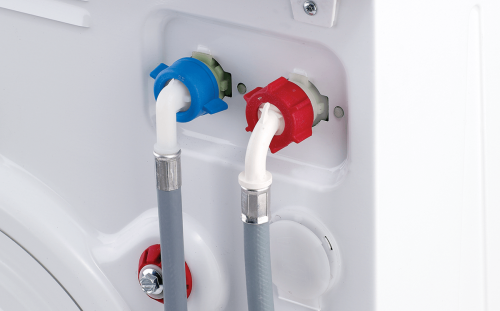

A cold-fill washing machine cannot be safely connected directly to the hot water tap. Household hot water is typically around 60°C – too hot for most wash cycles, damaging to biological detergents, and harmful to many fabrics. The machine has no way to control incoming water temperature. The only potential workaround – a thermostatic mixing valve – is technically possible but brings its own limitations and is unlikely to save significant energy for most households.

Modern washing machines are designed and tested with a cold water supply only. Connecting directly to a hot supply can damage laundry, shorten wash cycles, compromise wash quality, and may void the warranty. Manufacturers explicitly advise against this.
If you have solar panels, a heat pump, or another low-cost source of hot water, it is natural to wonder whether you can connect your cold-fill washing machine to the hot supply instead. The short answer is no – but the full picture is more nuanced, and there is a limited workaround worth understanding.
Why Can’t You Connect a Cold-Fill Machine to the Hot Tap?
There are four distinct reasons why connecting a cold-fill washing machine directly to the hot water supply causes problems. Each one on its own would be sufficient.
The water is too hot for most wash programmes
Household hot water is typically stored and delivered at around 60°C. The most commonly used wash cycles – cotton at 30°C or 40°C, synthetics, delicates – need water significantly cooler than this. A cold-fill machine has no way to regulate or reduce the temperature of an incoming hot supply.
The wash cycle is cut short
Cold-fill machines are designed to heat cold water progressively to the target wash temperature. The cleaning action happens during this warm-up period. If incoming water is already at or near the target temperature, the machine’s thermostat reaches the set point almost immediately and moves to rinsing far too soon – dramatically shortening actual wash time and compromising cleaning performance.
Biological detergent is destroyed by hot water
Biological detergents contain enzymes that work most effectively as water temperature rises gradually and are deactivated at high temperatures – typically above 40 to 50°C. If the machine fills with hot water from the start, the enzymes are killed before they can work, rendering biological detergent largely ineffective.
Rinsing in hot water causes serious problems
A machine connected only to the hot supply would also rinse in hot water. Hot water rinsing causes severe creasing in many fabrics, can activate detergent and create excess suds, and wastes a large amount of heated water unnecessarily. Cold water rinsing is more effective and considerably more energy efficient.
What About Using a Y-Connector to Mix Hot and Cold?
 Why a simple Y-connector does not work
Without precise pressure balancing between the two supplies, the blend cannot be reliably controlled. Hot water also takes time to arrive through pipework – particularly where the hot water cylinder is some distance from the machine. By the time hot water actually reaches the inlet, a modern machine may have already finished filling. The result is unpredictable and largely ineffective.
 What could theoretically work
A thermostatic mixing valve – the same type used in shower systems – set to the target wash temperature could blend hot and cold water to a controlled temperature before it enters the machine. This approach is technically possible, though it has significant practical limitations for most households.
The Thermostatic Valve Workaround – Does It Save Money?
Some users have successfully fitted a thermostatic shower mixing bar to supply their cold-fill washing machine with pre-blended warm water. The argument is that gas-heated water costs significantly less per kilowatt-hour than electricity – so heating water with a gas boiler before it enters the machine is cheaper than the machine’s internal electric heater doing the same job.
The logic has merit in some circumstances. But for most UK households, the practical reality limits the benefit considerably.

Modern machines use very little wash water
Contemporary washing machines use a surprisingly small volume of water during the actual wash cycle. By the time hot water has travelled through pipework to the machine, the wash fill may already be complete – meaning little or no hot water actually enters on the wash.

Distance from the boiler matters greatly
If the hot water cylinder is some distance from the washing machine – common in UK homes where machines are often in a ground-floor kitchen and the cylinder is upstairs – it can take a full washing-up bowl of cold water to run through before hot water arrives, negating most of the saving.

Rinses account for most water use
Even if warm water successfully enters on the wash cycle, rinsing in warm water is unnecessary and wasteful – each rinse cycle uses far more water than the wash. A thermostatic valve should be bypassed for the rinse phases to avoid heating large volumes of water for no benefit.

When it genuinely makes sense
The thermostatic valve approach is most beneficial where the boiler or solar thermal system is close to the machine (hot water arrives in seconds), you regularly wash at 60°C or higher, and you can control the valve to supply warm water only during the wash fill – not the rinses.

Even with a thermostatic valve, introducing pre-warmed water to a cold-fill machine may still shorten the wash cycle slightly – the machine reaches its target temperature faster and moves to rinsing sooner. Whether this meaningfully affects wash results depends on the machine and the water temperature used.
For a full analysis of whether hot-fill is more economical, see our guide on whether a hot and cold fill washing machine is more economical.
Efficiency by Hot Water Source
| Hot water source | Close to machine? | Thermostatic valve likely to help? |
|---|---|---|
| Solar thermal system with nearby cylinder | Often yes | Yes – especially for 60°C+ cycles |
| Combi boiler – machine nearby | Sometimes | Marginal – boiler fires for small volumes inefficiently |
| Hot water cylinder – upstairs or distant | Rarely | Unlikely – heat lost in pipework before water arrives |
| Heat pump water heater | Varies | Potentially – depends on proximity and usage pattern |
| No alternative hot water source | N/A | No – no saving to be made |
Why Are Almost All Modern Washing Machines Cold-Fill Only?
The move away from hot and cold fill connections happened for several well-founded reasons:
-
Modern machines use far less water. The small volumes used on the wash cycle make drawing hot water from the supply impractical – filling is often complete before hot water arrives through the pipework. -
Precise temperature control requires internal heating. The machine can only accurately manage water temperature if it controls the heating process itself from cold. -
Energy efficiency standards are built around cold-fill operation. UK and EU energy ratings are measured on cold-fill machines; manufacturers optimise designs accordingly. -
Simpler installation. A single cold connection reduces plumbing complexity and the risk of incorrect installation or cross-connection. -
Global manufacturing. Appliances are produced for multiple markets, many of which do not use domestic hot water systems in the same way as the UK.
For a full explanation of the arguments for and against, see our guide on cold fill versus hot and cold fill washing machines.
Need help with washing machine installation or plumbing?
Related Guides
Cold Fill vs Hot and Cold FillThe full arguments for and against each type – and why cold-fill has become universal.
 Is Hot and Cold Fill More Economical?
Detailed analysis of the running cost differences between cold-fill and hot and cold fill machines.
 What to Do With the Old Hot Tap
How to correctly blank off the old hot water tap connection when fitting a cold-fill machine.
 Connecting a Dishwasher to Hot Water
The same principles applied to dishwashers – where it does and does not make sense.
Frequently Asked Questions
Can I connect my washing machine to the hot tap instead of the cold?
No – not directly. Household hot water is typically around 60°C, which is too hot for most wash programmes, destroys biological detergent enzymes, and means the machine has no way to control the incoming water temperature. The wash cycle would be cut short and laundry quality would suffer.
I have solar panels and free hot water – can I use it for washing?
Not directly – but a thermostatic mixing valve could allow you to supply pre-warmed water to your cold-fill machine for wash cycles. Whether this saves meaningful money depends on how close the solar system is to the machine and whether hot water arrives quickly enough for the machine to actually benefit. For everyday 30°C and 40°C washes the saving may be small. For regular 60°C or higher cycles the benefit is more significant.
What happens if you accidentally connect a washing machine to the hot tap?
The machine will fill and attempt to run, but wash cycles will be shortened because the thermostat reaches its target temperature almost immediately. Some fabrics may be damaged or shrink if washed in significantly hotter water than intended. Biological detergent will be less effective. Reconnect to the cold supply as soon as the error is noticed.
Could I use a thermostatic shower valve to supply warm water to my machine?
Yes – this is technically possible and some users have done it successfully, particularly where the boiler or hot water system is close to the machine. A thermostatic mixing bar set to around 38 to 40°C blends hot and cold water before it enters the machine’s inlet. The saving depends on gas versus electricity costs, proximity of the hot water source, and how frequently you wash at higher temperatures. For most UK households with a distant hot water cylinder, the practical benefit is limited.
My old machine had both hot and cold inlets – where can I get a replacement?
Hot and cold fill washing machines are very rare. Ebac is one of the few UK manufacturers still offering models with a genuine hot water inlet. Options are limited and inconsistent – check directly with retailers for current availability.
What should I do with the old hot water tap if I’ve switched to a cold-fill machine?
The old hot tap needs to be properly capped off or blanked – it cannot simply be left disconnected and open. See our guide on what to do with the old hot tap when connecting a cold fill washing machine.
Can a dishwasher be connected to the hot water supply?
The same principles largely apply. See our guide on connecting a dishwasher to the hot water supply.
Ask the repair forum
Post the make, model and symptoms and get help from the Whitegoods Help community.
66 Comments
Grouped into 47 comment threads.
1 reply I have accidently hooked my cold fill to a hot tap feed. After a week the machine can still draw water, spin and drain but won't start any cleaning cycles. Guessing it's a dud now?
1 reply I put my cold waterfeed pipe onto the hot tap and used it, wish I hadn't now it buggered our machine up and they said I had lost the garentee by doing that, and it also shrunk some of the clothes, not a happy bunny.
I put my cold waterfeed pipe onto the hot
tap and used it, wish I hadn’t now it buggered our machine up and they said I had lost the garentee by doing that,
and it also shrunk some of the clothes, not a happy bunny.
1 reply Love my American top loading washer, currently a Speed Queen. It has both hot & cold connections, washes a full load in a fraction of the time taken by a modern European front loader & clothes come out drier after the wash. When hot wash is selected, the built in thermostatic valve regulates the incoming water temperature & warm rinse can also be selected. Apart from the physical size & cost, I'm not sure why they aren't as popular here in the UK.
Love my American top loading washer, currently a Speed Queen. It has both hot & cold connections, washes a full load in a fraction of the time taken by a modern European front loader & clothes come out drier after the wash. When hot wash is selected, the built in thermostatic valve regulates the incoming water temperature & warm rinse can also be selected. Apart from the physical size & cost, I’m not sure why they aren’t as popular here in the UK.
Likely replying to Nigel
Hi Nigel. Yes top loaders are rare in the UK. I think it’s because the majority of UK houses never used to have a wash room so washing machines had to fit under a worktop in the kitchen. Most still do although modern houses always have a utility room now but even so they often come fitted with a sink and small worktop and are quite small.
Thermostatic valves are part of the potential solution to properly utilising hot water but in the UK most people get their hot water supply from a hot water cylinder in a cupboard on a higher floor than the washing machine – sometimes two floors higher. This means it takes too long for hot water to arrive at the washing machine and as modern washing machines use so little water the washer has finished filling before hot water gets inside for most people. This is demonstrated nicely in my latest article Is a hot and cold fill washing machine more economical?
Therefore a thermostatic valve would need to monitor water temperature until it detects hot water. Tis could be as much as a washing up bowlful. Then, either pump out or store the water drawn in in. so it can start the cycle in a position where it can totally control the incoming water temperature.
But then you would also introduce hot water wastage, because all the pipes from the hot water cylinder to the washing machine (which could be several metres) would now be full of piping hot water. In most cases it would just slowly cool down and be wasted. And all the water that had been drawn into the washing machine and all of the pipework would have been replaced in the cylinder with cold water. This could be several litres and
it will cool down any hot water stored inside which has used energy to heat up and will need more energy to re-heat.
So essentially when you look at the big picture, for most people it really is a lot cheaper to just heat up the water in the washing machine. Many people though will have different circumstances, and may have a “free” source of hot water with solar panels, or may have the washing machine next to a powerful combination boiler that can deliver hot water to the washing machine in 3 or 4 seconds. In those cases a sophisticated washing machine with thermostatic valve would be ideal.
4 replies When I bought my present washing machine about 10 years, I was unhappy that it only had a cold fill. So I set about thinking how I could overcome this, and came up with the idea of fitting two leaver type valves back to back with the leavers bolted to each other so in the first position one valve would be open while the other was closed, then when you moved the leaver to the second position the valve that was closed opened and the valve that was open closed. one of the valves was fed from the hot supply and the other was fed from the cold supply. When I wanted to use the washing machine I would first run the hot tap nearest to the washing machine until it had hot water running, that would clear the cold water sitting in the pipework. I would then put the leaver valve in the position that fed hot water into the washing machine.and start the machine: When the machine had done its wash cycle after about 1/4 hour, I would then move the leaver valve to the second position which would put cold water into the machine for the rest of the rinse part of the programme: Win,Win situation
When I bought my present washing machine about 10 years, I was unhappy that it only had a cold fill. So I set about thinking how I could overcome this, and came up with the idea of fitting two leaver type valves back to back with the leavers bolted to each other so in the first position one valve would be open while the other was closed, then when you moved the leaver to the second position the valve that was closed opened and the valve that was open closed. one of the valves was fed from the hot supply and the other was fed from the cold supply.
When I wanted to use the washing machine I would first run the hot tap nearest to the washing machine until it had hot water running, that would clear the cold water sitting in the pipework. I would then put the leaver valve in the position that fed hot water into the washing machine.and start the machine:
When the machine had done its wash cycle after about 1/4 hour, I would then move the leaver valve to the second position which would put cold water into the machine for the rest of the rinse part of the programme:
Win,Win situation
Likely replying to Paul Hooke
Hello Paul. I think I would also apply my last two comments (in reply to Pete) to your situation. The problem with trying to circumvent a cold water washing machine by deliberately introducing hot water essentially it boils down to one thing, which is that a cold fill washing machine is designed specifically to wash effectively starting with cold water and slowly heating it up. Therefore introducing hot water from the start is highly likely to shorten the wash cycle (and your quote of 15 minutes seems to confirm this) because they are designed to finish washing once they have reached temperature. So introducing water that is already at or close to the wash temperature is likely to impact wash performance.
It also wastes hot water although how much is likely to be different depending on the systems in individual houses. Hopefully yours and Pete’s individual situation is good and it all works satisfactory for you. But for most people it’s best to feed a modern washing machine with cold water because they are specifically designed to work best that way. These days they hardly use any electricity to heat up a litre or so of wash water. Anyway the complicated argument is in my article pros and cons of cold fill versus hot fill washing machines if interested :)
I came here looking for an answer to this question and I like your solution. Unlike Andy, I think the fact that your wash cycle takes only 1/4 hour seems an added bonus because I think wash circles take far too long anyway. The twin tub I just replaced only washed for 12 minutes and that got stuff perfectly clean.
Hi Kathy. The difference with wash times, is that the twin tubs agitated the laundry constantly for 12 minutes, but a front loader only agitates the laundry for very short periods of time with lots of static periods. It’s the agitation that mostly does the cleaning, which is why twin tubs could wash for short periods. However, they weren’t very gentle either.
4 replies All of the 'reasons' put forward above for not using a thermostatic valve to supply a cold-fill only washing machine just don't stand up. I've had a thermostat feeding my cold-fill washing machine for years, and it must have saved me a few hundred ££s in that time. The thermostat is a cheap shower mixer bar, set to its default 38 degrees Celsius. The hot water comes from a multipoint gas boiler that currently costs 4p per KWh to heat the water, while electricity costs about 20p per KWh. Expensive electricity is therefore only used to raise the water temperature by 2 degrees for a 40 degree wash, saving 50p to £1 on each average wash cycle. In my opinion, the cold-fill only washing machine was an utterly idiotic idea in the first place. The hot fill inlet could just have been retained, and easily blanked off by those people who like wasting their money!
All of the ‘reasons’ put forward above for not using a thermostatic valve to supply a cold-fill only washing machine just don’t stand up. I’ve had a thermostat feeding my cold-fill washing machine for years, and it must have saved me a few hundred ££s in that time.
The thermostat is a cheap shower mixer bar, set to its default 38 degrees Celsius. The hot water comes from a multipoint gas boiler that currently costs 4p per KWh to heat the water, while electricity costs about 20p per KWh. Expensive electricity is therefore only used to raise the water temperature by 2 degrees for a 40 degree wash, saving 50p to £1 on each average wash cycle.
In my opinion, the cold-fill only washing machine was an utterly idiotic idea in the first place. The hot fill inlet could just have been retained, and easily blanked off by those people who like wasting their money!
Likely replying to Pete
Hello Pete. Thanks for your contribution and for sharing your experience. I don’t have a single “reason” against connecting a cold fill washing machine using a thermostatic valve. My article is only about connecting it directly to the hot water tap, which would be a very bad idea as pointed out. I don’t mention thermostatic valves in the article although I’m not convinced even they are a good idea although obviously you prove it can be done.
I’m not sure though that if you have thermostatic valve to constantly supply water at around 40° how much money will be saved. There is no need for a washing machine to rinse in water at 38° so arguably it’s a waste unless you turn off the hot water after the washing machine is filled for the wash cycle.
Also, with this set up unless the boiler is only a few feet away from the washing machine you are likely to suffer the same problem as most of the UK in that because modern cold fill washing machines hardly use any water on the wash cycle (you can’t use even see much water while it’s washing) then by the time the hot water is actually running into the washing machine it has often virtually filled up with all it needs. So therefore can be very difficult to get much hot water into a washing machine for the main wash. I have discussed this problem at length here pros and cons of hot and cold water washing machines versus cold fill only
Modern washing machines use the overwhelming majority of their water during the rinses. They hardly use any on the wash in comparison. So here we are comparing heating a few litres of water at 20p per kilowatt-hour with heating at the very least several times more water at 4p per kilowatt. Someone would have to do the maths but maybe the savings aren’t as big once you take into account all of the rinse water being heated up. I won’t be surprised to be fair if you are still on the winning side though :-)
I agree with you 100%. But you are also forgetting the fact that most people also dry their clothes in a tumble dryer. This uses electricity to heat the water remaining in the clothes enough to evaporate, so surely rinsing in hot water provided by a gas boiler is giving the tumble dryer (or whatever drying method) a huge head start!
I’m leaning heavily toward the hot water feed
Thanks Mike. It’s an interesting point that laundry rinsed in warm water might reduce tumble-drying times. They can’t rinse in hot water, which would badly crease and even damage lots of laundry. A washing machine would need to use a thermostatic valve to mix hot and cold water to an acceptable temperature.
I would be very surprised if rinsing in warm water could make a significant difference to tumble-drying times, but it would cost a lot more money to buy a capable washing machine, and it would cost more money to use so much hot water on several rinses each wash cycle.
Likely replying to Pete
Hi Pete. I forgot to mention that one of the problems with injecting hot water artificially into a wash is that a cold fill washing machine is designed specifically to get good wash results by starting with cold water. This is particularly true when using biological detergents. It’s designed in such a way that it takes roughly a specific amount of time to heat the water up to 40° and during this time the cleaning is achieved. Once the water reaches 40° the chances are that the wash cycle is complete and the dirty wash water is drained out for rinses to commence.
If you inject water into the washing machine that is already almost at the correct temperature, this is likely to substantially reduce the wash time and therefore substantially reduce how well the laundry is washed. Again someone would have to test this in a laboratory to prove it 100% but to me the logic makes total sense. It might be interesting to do an experiment by doing two washes, one with a thermostatic valve, and one with the hot water turned off to see if and by how much it affects how long the washing machine washes for.
1 reply Main question is how much is this hot water already costed you before it will be used in washing machine? Then what would be the required temperature rise from cold tap water. I think that if the smart washing machine or dishwasher would be programmed to be able to recognize whenthe actual hot water would be good for certain cycle(main wash,prewash) that would be the way to go forward and couldn't see it being a big problem to solve for big manufacturers. It could have a very eco selling pointbregardless how real are the saving on energy or how to measure saving for ordinary buyer at home. I'm always using the shower head and while the by me decided cycle is starting by just adding hot water via washing chemicals little drawer. Just open it and ad hot water it will be cooled down a bit by mixing up with water coming by program requirements but I normally check the temp on glass of the door and it is definitely warm. Did it from kettle before moved to a place with long enough shower pipe or hose or how does it cold.
Main question is how much is this hot water already costed you before it will be used in washing machine?
Then what would be the required temperature rise from cold tap water.
I think that if the smart washing machine or dishwasher would be programmed to be able to recognize whenthe actual hot water would be good for certain cycle(main wash,prewash) that would be the way to go forward and couldn’t see it being a big problem to solve for big manufacturers. It could have a very eco selling pointbregardless how real are the saving on energy or how to measure saving for ordinary buyer at home. I’m always using the shower head and while the by me decided cycle is starting by just adding hot water via washing chemicals little drawer. Just open it and ad hot water it will be cooled down a bit by mixing up with water coming by program requirements but I normally check the temp on glass of the door and it is definitely warm. Did it from kettle before moved to a place with long enough shower pipe or hose or how does it cold.
Likely replying to rad magyar
Hello rad. The biggest problem is that hot water coming into a washing machine is never instantaneous. Even with a combination boiler, if everything is set up okay, hot water can reach the washing machine reasonably quickly – but still potentially not quick enough for most settings. Any washing machine supplied with a hot water pipe that has quite a long pipe run from the boiler will take a while to deliver hot water because all of the previous hot water that had been drawn in has since has cooled down and gone cold.
With hot water supplies in the UK commonly being delivered by a hot water cylinder in an airing cupboard upstairs, this problem is even worse. It can take so long for piping hot water inside the tank to actually get to the washing machine that with today’s washing machines hardly using any water the washing machine has just about finished filling up by the time any hot water arrives.
The only way around this involves wasting water or trying to recycle it but with no room to store it . Temperature sensors on the incoming water could divert the water from the drum and from washing in the detergent until it gets to the correct usable temperature. But this water would need to be diverted to a separate container and there is definitely no room for one in a modern washing machine. Or alternatively it would have to be pumped away down the drain instead. So one potential problem is solved by causing water wastage.
So it is technically possible for manufacturers to utilise hot water intelligently and effectively, but only at the expense of wasting water, or trying to recycle the unneeded cold water in the hot pipes later on by storing it in a container somewhere inside the washing machine. It is just completely impractical to do so. So it’s either go back to hot and cold fill washing machines (that for most people means hardly any hot water getting into the washing machine) or use cold fill only and heat up just the right amount of water that is needed for the wash which is the current trend. In the great scheme of things, looking at the most common scenarios and the most common requirements it is by far the most sensible way of doing it.
0 replies The cold pipe to our kitchen developed a pinhole corrosion leak, as evidenced by water coming out of the floor. Great joy. Our eldest then arrived home with an enormous bag of washing. Faced with this combination, the obvious question is - can I connect my cold fill washer to the hot tap that dates from the time of its predecessor? As I am made from biological materials, I do not use powder with enzymes it in because I found that they eat my skin; this means that we do not have the problem of the enzymes not working. So the only problems that seem to apply is the danger of delicate fabrics being damaged (don't think he has any of those!) and excessive creasing (don't think he is that worried!). Faced with going through insurance and waiting months; getting a plumber and waiting weeks; or getting out a hammer and bolster (Why do they put concrete on top of water pipes? Definitely a decision made by the sort of people who choose chipboard as a material for under-sink cupboards); the temporary expedient is a choice between hot fill, do it in the bath or drive to a launderette.
The cold pipe to our kitchen developed a pinhole corrosion leak, as evidenced by water coming out of the floor. Great joy. Our eldest then arrived home with an enormous bag of washing. Faced with this combination, the obvious question is – can I connect my cold fill washer to the hot tap that dates from the time of its predecessor? As I am made from biological materials, I do not use powder with enzymes it in because I found that they eat my skin; this means that we do not have the problem of the enzymes not working. So the only problems that seem to apply is the danger of delicate fabrics being damaged (don’t think he has any of those!) and excessive creasing (don’t think he is that worried!). Faced with going through insurance and waiting months; getting a plumber and waiting weeks; or getting out a hammer and bolster (Why do they put concrete on top of water pipes? Definitely a decision made by the sort of people who choose chipboard as a material for under-sink cupboards); the temporary expedient is a choice between hot fill, do it in the bath or drive to a launderette.
0 replies after reading only part way through, the defeatist attitude of repliers decrying the need for hot fill was disheartening. simple solution for hot and cold fill wm's: connect cold to wm/cold, connect cold to thermostatic mixer, connect hot to thermostatic mixer, connect thermostatic mixer to wm/hot, set mixer at 30-40. Initial hot intake will be cold from pipe till hot reaches mixer then water intake will be at preset temp of mixer. If your hot water system is a loop for instant hot at the tap, then spur off the loop with zig zag arrangement a few metres long, ours is under the kitchen unit kickboards, then into the mixer valve. This ensures the initial charge of water is not too hot for biological powders. All this is pointless unless your hotwater source is really close to the washer.
after reading only part way through, the defeatist attitude of repliers decrying the need for hot fill was disheartening.
simple solution for hot and cold fill wm’s:
connect cold to wm/cold,
connect cold to thermostatic mixer, connect hot to thermostatic mixer, connect thermostatic mixer to wm/hot, set mixer at 30-40. Initial hot intake will be cold from pipe till hot reaches mixer then water intake will be at preset temp of mixer.
If your hot water system is a loop for instant hot at the tap, then spur off the loop with zig zag arrangement a few metres long, ours is under the kitchen unit kickboards, then into the mixer valve. This ensures the initial charge of water is not too hot for biological powders.
All this is pointless unless your hotwater source is really close to the washer.
0 replies Re Martin's comment: my daughter has a flat with a service charge which includes all hot water and heating so we are adding a cheap thermostatic valve to deliver water at 40 degrees. This will be reduced by the (short) dogleg of cold water and the heat lost in warming up the cold machine.
Re Martin’s comment: my daughter has a flat with a service charge which includes all hot water and heating so we are adding a cheap thermostatic valve to deliver water at 40 degrees. This will be reduced by the (short) dogleg of cold water and the heat lost in warming up the cold machine.
1 reply we have a Hoover washing machine that requires the use of both hot and cold water supply. Is there a way of adapting the machine to only use cold water
we have a Hoover washing machine that requires the use of both hot and cold water supply. Is there a way of adapting the machine to only use cold water
Likely replying to sean
Sean, this should help Washing machine is a hot and cold fill, but I only have a cold water supply
Leave a comment
0 replies I have a cold fill washing machine but by using a thermostatic mixing valve set to deliver the hot water at the lowest wash temperature (30 degrees centigrade) this will not compromise the wash quality. As for the cold water draw off I have installed a secondary circulation circuit from the cylinder to shorten all the dead legs in the house as a whole. In the case of the bathroom, the taps required a minute to reach temperature, now only a few seconds are required. The washing machine only draws about half a litre before the hot water is delivered. Obviously this is a large undertaking for just the washing machine as the savings will not cover the cost of the upgrade, however, if you are contemplating upgrading your plumbing system anyway it is worth considering.
I have a cold fill washing machine but by using a thermostatic mixing valve set to deliver the hot water at the lowest wash temperature (30 degrees centigrade) this will not compromise the wash quality. As for the cold water draw off I have installed a secondary circulation circuit from the cylinder to shorten all the dead legs in the house as a whole. In the case of the bathroom, the taps required a minute to reach temperature, now only a few seconds are required. The washing machine only draws about half a litre before the hot water is delivered. Obviously this is a large undertaking for just the washing machine as the savings will not cover the cost of the upgrade, however, if you are contemplating upgrading your plumbing system anyway it is worth considering.
0 replies I don't really believe that there are any disadvantages to having a machine that takes in hot water. I too had various machines over the years that had proper thermostats which meant that they took in hot water until the correct temperature was reached and then switched to cold. The programmes were quite sophisticated, with some taking in cold water initially where this was more appropriate. Most plumbing systems would give a short run of cold first (which I could run off for another purpose using an adjacent tap if I had time). I believe that the only disadvantages are those for the washing machine manufacturers who don't have to put as many parts into a cold fill only machine. We run our machines at night on cheaper electricity and it makes sense to use up some of the hot water remaining in the tank.
I don’t really believe that there are any disadvantages to having a machine that takes in hot water. I too had various machines over the years that had proper thermostats which meant that they took in hot water until the correct temperature was reached and then switched to cold. The programmes were quite sophisticated, with some taking in cold water initially where this was more appropriate. Most plumbing systems would give a short run of cold first (which I could run off for another purpose using an adjacent tap if I had time). I believe that the only disadvantages are those for the washing machine manufacturers who don’t have to put as many parts into a cold fill only machine. We run our machines at night on cheaper electricity and it makes sense to use up some of the hot water remaining in the tank.
0 replies I've read through the debate on hot and cold fill machines but have a particular problem no one has so far mentioned. My cold water supply is very slow, the best delivery rate from our cold-only tap is 4.75 litres a minute. Combine it with hot tap and it goes up to 9.5 litres a minute. We have a very old hot and cold fill Bosch which is on its last legs but I can get no sense from any washing machine manufacturer as to whether their cold-fill only machines will work satisfactorily under these circumstances. They all say I need at least 1 bar of pressure (how do you test for pressure?) and somewhere in the region of 8 litres a minute. I have been warned off connecting the machine up to a the hot and cold supply via a 'Y' piece as it will upset the machines thermometer and will result in creased clothes. Any ideas anyone? Thanks in anticipation
I’ve read through the debate on hot and cold fill machines but have a particular problem no one has so far mentioned. My cold water supply is very slow, the best delivery rate from our cold-only tap is 4.75 litres a minute. Combine it with hot tap and it goes up to 9.5 litres a minute. We have a very old hot and cold fill Bosch which is on its last legs but I can get no sense from any washing machine manufacturer as to whether their cold-fill only machines will work satisfactorily under these circumstances. They all say I need at least 1 bar of pressure (how do you test for pressure?) and somewhere in the region of 8 litres a minute. I have been warned off connecting the machine up to a the hot and cold supply via a ‘Y’ piece as it will upset the machines thermometer and will result in creased clothes. Any ideas anyone? Thanks in anticipation
0 replies My central heating and water run off a Multi Fuel stove. I would have to be an idiot to pay for electricity to heat my washing water! I don't think forty degrees washes clothes hygenicaly, this has been proven. It isn't a problem to start with clothes needing a hot wash and end with clothes needing a warm wash as the hot water runs out. I don't find the clothes any more creased if you shake them before hanging them out on the line. As for wasting water I use the water that is run off first for watering my tomato plants.
My central heating and water run off a Multi Fuel stove. I would have to be an idiot to pay for electricity to heat my washing water! I don’t think forty degrees washes clothes hygenicaly, this has been proven. It isn’t a problem to start with clothes needing a hot wash and end with clothes needing a warm wash as the hot water runs out. I don’t find the clothes any more creased if you shake them before hanging them out on the line. As for wasting water I use the water that is run off first for watering my tomato plants.
0 replies Depending on how far your sink is, you can get an attachment that fits onto the u bend of the sink waste pipe. A tap can be fitted by any semi competent DIY person as you can use compression fixing which have no need for soldering which requires a degree of skill and more specialist tools.
Depending on how far your sink is, you can get an attachment that fits onto the u bend of the sink waste pipe. A tap can be fitted by any semi competent DIY person as you can use compression fixing which have no need for soldering which requires a degree of skill and more specialist tools.
0 replies I think you may have to get someone in to do this. Was there a machine there before that was connected to the waste pipe. I think you can get a kit in B&Q to connect the cold feed to your pipe,but you will need to turn off the water and drill a hole in the pipe. This could be a disaster if you do it wrong. If you get someone in get a Price 1st there are a lot of crooks in the plumbing game as you probably know.
I think you may have to get someone in to do this. Was there a machine there before that was connected to the waste pipe. I think you can get a kit in B&Q to connect the cold feed to your pipe,but you will need to turn off the water and drill a hole in the pipe. This could be a disaster if you do it wrong. If you get someone in get a Price 1st there are a lot of crooks in the plumbing game as you probably know.
0 replies I have just bought a new cold water fill washing machine but there is only a tap connected to the hot water supply under the kitchen sink to connect it to. There is a cold water pipe but no tap and no where for the waste water to go what should i do and can i do this myself or roughly how much is it going to cost me to get it done? HELP!!
I have just bought a new cold water fill washing machine but there is only a tap connected to the hot water supply under the kitchen sink to connect it to. There is a cold water pipe but no tap and no where for the waste water to go what should i do and can i do this myself or roughly how much is it going to cost me to get it done? HELP!!
0 replies I've got to say that after reading most of the information on this site that I still want a hot and cold fill washing machine as I feel that it would best suit our needs. One of the kids is sensitive to enzymes so we use non bio powder. I am eco minded and have solar panels being installed on my farmhouse which is undergoing renovation. I will have oodles of hot water from it and wood burning stoves. I have 4 very dirty kids and a dirty partner (stop giggling). We're farmers and live on the farm hence there is an enormous amount of filthy washing to be done on a daily basis so we require a large capacity machine. Our house is being insulated to the nth degree, pipe runs are quite short and all pipes are lagged so although there will be heat loss it will be kept as low as we can manage. However our old water comes direct (no cold water tank) from our own spring and is very very cold. much colder than water that has been within the envelope of the house. So for us a hot & cold fill machine would be advantageous. I realise that my particular circumstances are not the norm but in more and more people are putting solar panels on their roofs and insulating their houses and apparently the incidence of asthma and exzema are increasing which may translate to more use of non-bio powder. So more people might be looking for a hot & cold fill washer. My remedy for my problem if I can't find such a machine will be to fit a thermostatic mixing valve to the cold supply of the machine set at about 30 degrees. It might/might not work but hey nothing ventured nothing gained.
I’ve got to say that after reading most of the information on this site that I still want a hot and cold fill washing machine as I feel that it would best suit our needs. One of the kids is sensitive to enzymes so we use non bio powder. I am eco minded and have solar panels being installed on my farmhouse which is undergoing renovation. I will have oodles of hot water from it and wood burning stoves. I have 4 very dirty kids and a dirty partner (stop giggling). We’re farmers and live on the farm hence there is an enormous amount of filthy washing to be done on a daily basis so we require a large capacity machine. Our house is being insulated to the nth degree, pipe runs are quite short and all pipes are lagged so although there will be heat loss it will be kept as low as we can manage. However our old water comes direct (no cold water tank) from our own spring and is very very cold. much colder than water that has been within the envelope of the house. So for us a hot & cold fill machine would be advantageous. I realise that my particular circumstances are not the norm but in more and more people are putting solar panels on their roofs and insulating their houses and apparently the incidence of asthma and exzema are increasing which may translate to more use of non-bio powder. So more people might be looking for a hot & cold fill washer. My remedy for my problem if I can’t find such a machine will be to fit a thermostatic mixing valve to the cold supply of the machine set at about 30 degrees. It might/might not work but hey nothing ventured nothing gained.
0 replies I will make this clear to everyone who hasn't read my comments in other blogs on the whitegoodshelp site: WARM WATER from start to finish is superior to cold. The key word here is WARM water and not hot. If you can start off with warm water at 30 - 35C MAXIMUM, that is ideal and enzymes in biological detergents will not be affected, in fact the enzymes will work immediately. The problem with cold water is the enzymes won't work until the water temperature is warm, so power is wasted warming the water from cold. Yes, warm water to start with can cut down on the time performed washing, but modern washing machines wash for far too long, which is one reason (of many) why they are less reliable now and clothing looks worn-out quicker. Shorter wash times will only be a problem if the main wash time was too short, say if it was reduced to washing for just 15 minutes instead of 1 hour. Again, as some readers will know by reading my other comments in different areas of whitegoodshelp - warm water rinsing is far better than cold - it dissolves the detergent and removes all perfumes - which have been found to irritate skin (watch out as virtually all fabric conditioners, except Surcare, have perfumes). Also the warm water rinses will continue cleaning the clothes, so you get extra 'washes' too. :) I can now use less fabric conditioner than I used to and the clothes feel softer now compared to when I rinsed them in cold water using more conditioner. I've found it quicker to fill up a large jug from the hot tap and tip the hot water into the soap drawer - this is the only time the water must be hot, as the water that's already in the washing machine is cold. It makes no sense having spare hot water going unused, as the shower uses the hot and cold taps and little hot water gets used elsewhere. It would be different if hot water was being used to run a bath, but most people have showers fitted, either electric showers or showers connected to the hot and cold.
I will make this clear to everyone who hasn’t read my comments in other blogs on the whitegoodshelp site: WARM WATER from start to finish is superior to cold. The key word here is WARM water and not hot.
If you can start off with warm water at 30 – 35C MAXIMUM, that is ideal and enzymes in biological detergents will not be affected, in fact the enzymes will work immediately. The problem with cold water is the enzymes won’t work until the water temperature is warm, so power is wasted warming the water from cold.
Yes, warm water to start with can cut down on the time performed washing, but modern washing machines wash for far too long, which is one reason (of many) why they are less reliable now and clothing looks worn-out quicker. Shorter wash times will only be a problem if the main wash time was too short, say if it was reduced to washing for just 15 minutes instead of 1 hour.
Again, as some readers will know by reading my other comments in different areas of whitegoodshelp – warm water rinsing is far better than cold – it dissolves the detergent and removes all perfumes – which have been found to irritate skin (watch out as virtually all fabric conditioners, except Surcare, have perfumes). Also the warm water rinses will continue cleaning the clothes, so you get extra ‘washes’ too. :) I can now use less fabric conditioner than I used to and the clothes feel softer now compared to when I rinsed them in cold water using more conditioner.
I’ve found it quicker to fill up a large jug from the hot tap and tip the hot water into the soap drawer – this is the only time the water must be hot, as the water that’s already in the washing machine is cold. It makes no sense having spare hot water going unused, as the shower uses the hot and cold taps and little hot water gets used elsewhere. It would be different if hot water was being used to run a bath, but most people have showers fitted, either electric showers or showers connected to the hot and cold.
0 replies One way you can make use of a reduntant hot water supply is by connecting it to the washing machine intake when doing a weekly cleaning cycle (ie no washing), The hot water is good for killing off mould build up.
One way you can make use of a reduntant hot water supply is by connecting it to the washing machine intake when doing a weekly cleaning cycle (ie no washing), The hot water is good for killing off mould build up.
0 replies My Zanussi 25 yr old washing machine is not longer serviceable. All the components still work it's just it make an alarming noise on a spin. I also suspect it's not as economical as it could be. I'm running a combi boiler which is about 2 meter from the washing machine, so hot water is delivered very quickly, consequently some of the arguments don't apply to me regarding the benefits of cold fill. Hot fills machines seem to be few and far between so have had to opt for a cold fill. What I propose to do is to fit a switchable Y tap to the hot and cold supply. Work out the boiler setting to deliver say 35 c water. I know it's a little bit of faffing around, but what I'm planning on doing is: Switch the Y tap to hot supply. Set the boiler to deliver the correct temp water Start the washing as normal. Once the WM has finished with the hot cycle, switch the Y tap over to cold supply. The main draw back to this is: You'll only get warmish water through the rest of the house, when it's completing the hot fill. Only a problem is someone needs a shower. You will need to be about to switch it over. (if you're not, then just leave it with the cold fill) The main drawback is human error. I'm liable to forget, so perhaps a kitchen timer will do the trick. As most people tend to only use a max of 3 programmed settings, the time taken (should) be easy to work out. The other problem is trying the sell the merits of the process to the boss lady who does the lions share of the washing. p.s I'd be interested to know the proportion of Uk households that have the old heating system with the tank in the loft. Everyone I know has a combi. I suspect it's at least 50% have combi's
My Zanussi 25 yr old washing machine is not longer serviceable. All the components still work it’s just it make an alarming noise on a spin. I also suspect it’s not as economical as it could be.
I’m running a combi boiler which is about 2 meter from the washing machine, so hot water is delivered very quickly, consequently some of the arguments don’t apply to me regarding the benefits of cold fill.
Hot fills machines seem to be few and far between so have had to opt for a cold fill.
What I propose to do is to fit a switchable Y tap to the hot and cold supply. Work out the boiler setting to deliver say 35 c water.
I know it’s a little bit of faffing around, but what I’m planning on doing is:
Switch the Y tap to hot supply.
Set the boiler to deliver the correct temp water
Start the washing as normal.
Once the WM has finished with the hot cycle, switch the Y tap over to cold supply.
The main draw back to this is:
You’ll only get warmish water through the rest of the house, when it’s completing the hot fill. Only a problem is someone needs a shower.
You will need to be about to switch it over. (if you’re not, then just leave it with the cold fill)
The main drawback is human error. I’m liable to forget, so perhaps a kitchen timer will do the trick. As most people tend to only use a max of 3 programmed settings, the time taken (should) be easy to work out.
The other problem is trying the sell the merits of the process to the boss lady who does the lions share of the washing.
p.s I’d be interested to know the proportion of Uk households that have the old heating system with the tank in the loft. Everyone I know has a combi. I suspect it’s at least 50% have combi’s
0 replies After reading all comments and a deliberating a little why could we not: Install a well insulated tank of around 6-10 litres close to the washing machine which contains pressurised water heated to at most 45-50 deg from solarpanels. Connect this to the cold inlet on the machine via a mechanical thermo mixing valve set to 45-50 deg with cold water feed from house . When the washing machine or dishwasher is put into action on a standard 40deg wash it would empty the small tank of it's warm water into the drum and be just about ready to start washing. Meanwhile the small tank has refilled with now considerably cooler water from the solar system so when the rinse cycles begin the machine would receive the cooler water. Thoughts: This system may require some investment at first but surely would eventually benefit households or 4+ people. Pressure pumps and any electronics could be run from a battery charged by solar pv.
After reading all comments and a deliberating a little why could we not:
Install a well insulated tank of around 6-10 litres close to the washing machine which contains pressurised water heated to at most 45-50 deg from solarpanels. Connect this to the cold inlet on the machine via a mechanical thermo mixing valve set to 45-50 deg with cold water feed from house . When the washing machine or dishwasher is put into action on a standard 40deg wash it would empty the small tank of it’s warm water into the drum and be just about ready to start washing. Meanwhile the small tank has refilled with now considerably cooler water from the solar system so when the rinse cycles begin the machine would receive the cooler water.
Thoughts: This system may require some investment at first but surely would eventually benefit households or 4+ people. Pressure pumps and any electronics could be run from a battery charged by solar pv.
0 replies Hello, very interesting to read this blog as I've had a bee in my bonnet for some years about this topic. I had several Bosch machines over the years which had hot and cold fill. They were quite sophisticated: appropriate programmes had cold fill, some started with cold and then added hot, others started hot. All were controlled by a thermostat which switched from the hot water to cold if the chosen wash temperature was reached in the drum. The machines did not shorten the wash time if the water was up to temperature but moved round the dial at the normal rate. If you have a hot water storage tank it just seems to make sense to use water that has already been heated rather than start from scratch with very cold mains water. The only "anti" that I can see is that warm rinsing water would mean that the clothes would spin whilst warm and could be very creased, particularly synthetics. However since I have cheap power overnight my washer usually runs after midnight, by which time the water has cooled considerably, so it probably would be quite practical, even for rinsing. I did have trouble finding a good machine with a delay timer though. Incidentally I do have the hot water supply connected to my cold-fill dishwasher for its night time run and do believe that this saves power without impairing the wash performance.
Hello, very interesting to read this blog as I’ve had a bee in my bonnet for some years about this topic.
I had several Bosch machines over the years which had hot and cold fill. They were quite sophisticated: appropriate programmes had cold fill, some started with cold and then added hot, others started hot. All were controlled by a thermostat which switched from the hot water to cold if the chosen wash temperature was reached in the drum. The machines did not shorten the wash time if the water was up to temperature but moved round the dial at the normal rate.
If you have a hot water storage tank it just seems to make sense to use water that has already been heated rather than start from scratch with very cold mains water. The only “anti” that I can see is that warm rinsing water would mean that the clothes would spin whilst warm and could be very creased, particularly synthetics.
However since I have cheap power overnight my washer usually runs after midnight, by which time the water has cooled considerably, so it probably would be quite practical, even for rinsing. I did have trouble finding a good machine with a delay timer though.
Incidentally I do have the hot water supply connected to my cold-fill dishwasher for its night time run and do believe that this saves power without impairing the wash performance.
0 replies Bournetoride: The article advises not to connect the hot water hose directly to the washing machine as it would result in all the problems described in the article. It isn't about washing machines designed to use solar heated water or even attaching a thermostatic valve to mix hot and cold water. The article is only responding to people asking if it's OK to just connect the hot water directly to the washing machine's cold only fill valve.
Bournetoride: The article advises not to connect the hot water hose directly to the washing machine as it would result in all the problems described in the article.
It isn’t about washing machines designed to use solar heated water or even attaching a thermostatic valve to mix hot and cold water. The article is only responding to people asking if it’s OK to just connect the hot water directly to the washing machine’s cold only fill valve.
0 replies Alan There is a machine suitable for solar heated water, the Electrolux (REX) Sunny, alas it seems to be sold only in Italy where solar heating is more prevalent. Its not rocket science despite Washerhelp's objections, when the"Solar" button is pressed hot water mixed with just enough cold to achieve the desired temperature for pre-rinse and main wash. Cold only for rinses. The net result is that the hot water pipe is flushed of cold water during the pre-rinse and hot water is used for main wash. The cold water that refills the hot tank will be replaced by more solar heated water on any sunny day.
Alan
There is a machine suitable for solar heated water, the Electrolux (REX) Sunny, alas it seems to be sold only in Italy where solar heating is more prevalent.
Its not rocket science despite Washerhelp’s objections, when the”Solar” button is pressed hot water mixed with just enough cold to achieve the desired temperature for pre-rinse and main wash. Cold only for rinses.
The net result is that the hot water pipe is flushed of cold water during the pre-rinse and hot water is used for main wash.
The cold water that refills the hot tank will be replaced by more solar heated water on any sunny day.
0 replies That would make sense Daisy. Or turn the temp right down when washing.
That would make sense Daisy. Or turn the temp right down when washing.
0 replies hello I understand that but as a temporary solution, would turning the temperature down on the combi-boiler to 30 degrees work?
hello
I understand that but as a temporary solution, would turning the temperature down on the combi-boiler to 30 degrees work?
1 reply Hi I have been reading this thread with interest and hope someone can help. We just had a cold fill only machine fitted, the previous one was hot and cold fill. However, the hot water pipe had no cap and no lever to turn it off, so we connected to the hot water supply instead of the cold. The main thing I am concerned is the temperature being too high to start with if I am only doing a 30 degree/40 degree wash. To stop this, could I turn down the temperature of the water on the combination boiler? There is an option to do this I believe, but would it solve the problem or am I better to get the hot water pipe capped and then connect it to the cold pipe/valve as it was meant to? thanks Daisy
Hi
I have been reading this thread with interest and hope someone can help.
We just had a cold fill only machine fitted, the previous one was hot and cold fill. However, the hot water pipe had no cap and no lever to turn it off, so we connected to the hot water supply instead of the cold.
The main thing I am concerned is the temperature being too high to start with if I am only doing a 30 degree/40 degree wash. To stop this, could I turn down the temperature of the water on the combination boiler? There is an option to do this I believe, but would it solve the problem or am I better to get the hot water pipe capped and then connect it to the cold pipe/valve as it was meant to?
thanks
Daisy
2 replies When we had our solar panels fitted the plumber removed the cold water header tank and fitted a pressure regulator on the feed into the hot tank. So now our hot tank fills straight from the mains and the hot pressure is only a tad lower than the cold. We were told that this is now standard practice. We are just getting rid of a 16 year old hot and cold fill machine and replacing it with a cold fill only one, having contacted all the manufacturers I could think of and being told all machines are cold fill only. I have been holding on hoping that as the number of people with solar panels increases one of the manufacturers will have the foresight to see that there is a market for a machine that intelligently mixes water to the correct temperature, but the old machine has finally died so I'm forced to make a purchase. It's all very well manufacturers quoting these wonderful efficiency ratings but any machine that heats cold water when there is surplus hot water available is extremely wasteful. Also I understand the efficiency ratings are based on low temperature washes. Anyone who cares about the environment wouldn't put bological washing chemical down their drain, so would need to use a higher temperature wash.
When we had our solar panels fitted the plumber removed the cold water header tank and fitted a pressure regulator on the feed into the hot tank. So now our hot tank fills straight from the mains and the hot pressure is only a tad lower than the cold. We were told that this is now standard practice.
We are just getting rid of a 16 year old hot and cold fill machine and replacing it with a cold fill only one, having contacted all the manufacturers I could think of and being told all machines are cold fill only. I have been holding on hoping that as the number of people with solar panels increases one of the manufacturers will have the foresight to see that there is a market for a machine that intelligently mixes water to the correct temperature, but the old machine has finally died so I’m forced to make a purchase.
It’s all very well manufacturers quoting these wonderful efficiency ratings but any machine that heats cold water when there is surplus hot water available is extremely wasteful. Also I understand the efficiency ratings are based on low temperature washes. Anyone who cares about the environment wouldn’t put bological washing chemical down their drain, so would need to use a higher temperature wash.
Likely replying to Alan
Hello Alan. It would be nice if washing machines were sophisticated enough to perform optimally by adjusting how they work according to the environment they are placed in instead of being designed to work optimally for the average customer only. Being able to configure the washing machine by telling it whether we are using biological detergents or not, whether we are using solar heated hot water or a combination boiler or an immersion heater tank upstairs etc. might be better.
However, it’s not accurate to assume that using cold water only is always inefficient as my article describes in detail Should I buy a cold fill washing machine or hot and cold fill?. As this article describes, in circumstances where the hot water to the washing machine is supplied via a hot water tank a long way from the washing machine it can be very wasteful to use hot water.
The point is though that cold fill only washing machines are only “better” for a customer using hot water from a hot water tank upstairs and using biological detergents and doing mostly 40 degree washes. There must be a substantial number of customers where this scenario is just not the one they are using which is why with so much focus on efficiency and energy saving many would prefer washing machines to be designed to always be the most efficient for all customers.
Likely replying to Alan
Hello Alan. Yes my article mentions all of the downsides, not least the extra cost of wasting hot water, damaging delicate laundry, and causing excessive creasing. If you’re aware of all the problems and want to try that’s up to you but it’s definitely a bad idea. However, I appreciate you might be desperate. If you could, just don’t put the hot water on, or wait until the hot water has been used up. Then you could use the washing machine with the hot water supply and as long as the water pressure was adequate the washing machine wouldn’t notice any difference. Pretty much all of the disadvantages would disappear if the hot water supply wasn’t actually hot.
0 replies Louise: Glad this article helped. It's not uncommon for that to happen as I said in the article. No damage should have been done to the washing machine, just a lot of wasted hot water and extra ironing will have been needed, maybe even shrinkage caused to clothes.
Louise: Glad this article helped. It’s not uncommon for that to happen as I said in the article. No damage should have been done to the washing machine, just a lot of wasted hot water and extra ironing will have been needed, maybe even shrinkage caused to clothes.
0 replies I have just proved what I suspected... that my partners cold fill AEG has been connected to the hot water pipe by accident for 4 years because the blue (cold) plastic lever was on the hot pipe and visa versa. Will this have done any damage to the machine? when it was opened at the end, the washing was steaming! I've changed it over now.
I have just proved what I suspected… that my partners cold fill AEG has been connected to the hot water pipe by accident for 4 years because the blue (cold) plastic lever was on the hot pipe and visa versa. Will this have done any damage to the machine?
when it was opened at the end, the washing was steaming!
I’ve changed it over now.
0 replies Been planning on using a thermostatic tap when I return home and fit a solar system. Thanks for some invaluable information clearly explained. I shan't be connecting up the plumbing now!
Been planning on using a thermostatic tap when I return home and fit a solar system. Thanks for some invaluable information clearly explained. I shan’t be connecting up the plumbing now!
0 replies Thanks very much for your help!
Thanks very much for your help!
0 replies It's impossible to say without knowing what they are like and how they are being fixed but if if they are the kind that are designed for appliances to stand on it should hopefully be OK.
It’s impossible to say without knowing what they are like and how they are being fixed but if if they are the kind that are designed for appliances to stand on it should hopefully be OK.
0 replies I've placed my washing machine in my kitchen, however, it's a top loader, and there's a marble counter top above the washing machine (that's why I didn't think I could put my washing machine in my kitched originally - see above post). I now have to pull out the washing machine every time I use it. I've bought castors, and will be placing the machine on them. I just hope it's safe to use... do you know if it is OK to put a washing machine on castors? I bought them at a hardware store and they look pretty stable...
I’ve placed my washing machine in my kitchen, however, it’s a top loader, and there’s a marble counter top above the washing machine (that’s why I didn’t think I could put my washing machine in my kitched originally – see above post). I now have to pull out the washing machine every time I use it. I’ve bought castors, and will be placing the machine on them. I just hope it’s safe to use… do you know if it is OK to put a washing machine on castors? I bought them at a hardware store and they look pretty stable…
0 replies Hi there, Thanks for your answer! I've managed to make another plan regarding my washing machine. I had a feeling connecting the washing machine to a hot water tap wasn't a good thing to do. Glad you confirmed it. I'm not sure why my landlady has only a hot water tap in the laundry room she said I could use. Very odd!
Hi there,
Thanks for your answer!
I’ve managed to make another plan regarding my washing machine. I had a feeling connecting the washing machine to a hot water tap wasn’t a good thing to do. Glad you confirmed it. I’m not sure why my landlady has only a hot water tap in the laundry room she said I could use. Very odd!
0 replies Alissa: I've not heard of such a button before and can't imagine why any manufacturer would allow you to only use hot water because the washing machine can't control the temperature of this water. I can't see how a washing machine could work connected only to a hot water supply for the reasons I listed in this article. As the hot water temperature in our supplies are usually at least 60 degrees centigrade how could you do a 40 degree or 30 degree wash? It would ruin woollens and badly crease laundry as well as shrink some. It would kill the biological enzymes in biological detergent reducing its effectiveness an would waste loads of hot water and energy. If you are renting the house the landlord surely has a duty to provide a means for you to use a washing machine so you need a cold supply plumbing in.
Alissa: I’ve not heard of such a button before and can’t imagine why any manufacturer would allow you to only use hot water because the washing machine can’t control the temperature of this water. I can’t see how a washing machine could work connected only to a hot water supply for the reasons I listed in this article.
As the hot water temperature in our supplies are usually at least 60 degrees centigrade how could you do a 40 degree or 30 degree wash? It would ruin woollens and badly crease laundry as well as shrink some. It would kill the biological enzymes in biological detergent reducing its effectiveness an would waste loads of hot water and energy.
If you are renting the house the landlord surely has a duty to provide a means for you to use a washing machine so you need a cold supply plumbing in.
0 replies Hi there, I have a Samsung washing machine. The machine has a "Water Supply" button on it, where I have to indicate whether the water supply is hot or cold, when I do my washing. I've connected the washing machine to a tap, however I've just discovered that it's a hot water tap, not a cold water tap, and I have no alternative except to use this tap (I don't own the cottage I live in; I rent, so therefore can't make changes to the plumbing etc). I live in a cottage with a geyser which is very far away from my washing machine. It takes a few minutes for the water to heat up in this hot water tap. These are my two questions: 1) If I've indicated that my water supply is "hot" on the machine, will this affect how my clothes are washed, as cold water is actually filling the washing machine initially as the water hasn't heated up yet? 2) Will the water used to rinse my clothes be hot or cold? Will the water have cooled down in the pipes by the time the rinse cycle is on? I've heard that it's good to rinse clothes in cold water, not hot, but my washing machine is connected to a hot water tap. Fortunately, my machine has the option for receiving a hot water supply, so it's not as if I'm filling a cold fill machine with hot water. I only have one water supply valve, though, so I don't have two separate valves where hot and cold water can flow in separately, and I'm not sure if this is a problem? Please advise how I should proceed in using my washing machine. (It's quite an old machine - bought in 2003, although it was only used for a couple of years. I then got a frontloader, but it's broken, so I'm reverting to my top loader). It's quite a basic machine, and there are no temperature settings really that I can see. Should I be concerned about the hot water supply? I would have preferred a cold water supply as I'm used to doing my washing this way, and I'm not sure how clothes are washed with only a hot water supply. Thanks.
Hi there, I have a Samsung washing machine. The machine has a “Water Supply” button on it, where I have to indicate whether the water supply is hot or cold, when I do my washing.
I’ve connected the washing machine to a tap, however I’ve just discovered that it’s a hot water tap, not a cold water tap, and I have no alternative except to use this tap (I don’t own the cottage I live in; I rent, so therefore can’t make changes to the plumbing etc). I live in a cottage with a geyser which is very far away from my washing machine. It takes a few minutes for the water to heat up in this hot water tap.
These are my two questions:
1) If I’ve indicated that my water supply is “hot” on the machine, will this affect how my clothes are washed, as cold water is actually filling the washing machine initially as the water hasn’t heated up yet?
2) Will the water used to rinse my clothes be hot or cold? Will the water have cooled down in the pipes by the time the rinse cycle is on? I’ve heard that it’s good to rinse clothes in cold water, not hot, but my washing machine is connected to a hot water tap. Fortunately, my machine has the option for receiving a hot water supply, so it’s not as if I’m filling a cold fill machine with hot water. I only have one water supply valve, though, so I don’t have two separate valves where hot and cold water can flow in separately, and I’m not sure if this is a problem?
Please advise how I should proceed in using my washing machine. (It’s quite an old machine – bought in 2003, although it was only used for a couple of years. I then got a frontloader, but it’s broken, so I’m reverting to my top loader). It’s quite a basic machine, and there are no temperature settings really that I can see.
Should I be concerned about the hot water supply? I would have preferred a cold water supply as I’m used to doing my washing this way, and I’m not sure how clothes are washed with only a hot water supply. Thanks.
1 reply can I just add some hot water to the drum before turning on the washing machine?
can I just add some hot water to the drum before turning on the washing machine?
Likely replying to Jillian
Hello Jillian: Yes you can but if you have to run the water for a while before it gets hot and you don’t use that water for something then you are wasting water.
Also, for anyone with a hot water tank in the airing cupboard, or with their boiler not close to the washing machine, by running the hot water to put into the machine they will have drawn x litres of hot water into the pipework which probably will just cool down and get wasted. In such cases it’s not really saving anything.
0 replies PS. I'm told by an American internet friend that pretty nearly all washing machines in the States have Hot and Cold fill
PS. I’m told by an American internet friend that pretty nearly all washing machines in the States have Hot and Cold fill
0 replies For some years I've used a hot-cold fill washing machine. I had two pipes connecting to the machine but each has aa tap which I turn on hot at the outset and after the wash starts, I switch to the cold supply. This ensures the machine has very little furring in the heater, which would lead to less efficiency in the heating and consequently more cost to heat the water. (I use a gas heater for the water and although I live in the London area have had no problems with scaling) For me the only answer is to place a Y connector to supply both hot and cold water and then switch the required tap as before. I can easily turn the temperature of the Hot water to the required heat level, so feel there should be no problem with the arrangement.
For some years I’ve used a hot-cold fill washing machine. I had two pipes connecting to the machine but each has aa tap which I turn on hot at the outset and after the wash starts, I switch to the cold supply.
This ensures the machine has very little furring in the heater, which would lead to less efficiency in the heating and consequently more cost to heat the water. (I use a gas heater for the water and although I live in the London area have had no problems with scaling)
For me the only answer is to place a Y connector to supply both hot and cold water and then switch the required tap as before.
I can easily turn the temperature of the Hot water to the required heat level, so feel there should be no problem with the arrangement.
0 replies Astrand: I agree with your point that there are cases when hot fill solutions makes sense and have said so several times. The problem is that unless it is commercially advantageous to offer these solutions it will never happen. It isn't realistic to expect manufacturers of any product to redesign and make their products more expensive than the competition in order to please a minority of customers. But as more and more people start to use environmentally friendly methods of heating their water the commercial advantage for manufacturers to redesign their washing machines in order to utilise this hot water increases. Current thinking is that hot water costs a certain amount of money and the vast majority of people would benefit from simply heating up the exact amount of water that the washing machine requires. Until enough people are using free or very cheap environmentally friendly hot water supplies this is not a likely to change. I agree about not investing in something likely to take seven years to start producing savings. There is a fair old chance that seven years from now washing machines will be quite different and may even use cold water only to wash. As you point out, using hot water all the time will counteract some of the savings in heating the wash water. I'm not sure how much potential savings can be gained by heating from 25 to 40° of just several litres of water compared with the wasting of possibly 20 L of hot water being used during all the rinses.
Astrand: I agree with your point that there are cases when hot fill solutions makes sense and have said so several times. The problem is that unless it is commercially advantageous to offer these solutions it will never happen. It isn’t realistic to expect manufacturers of any product to redesign and make their products more expensive than the competition in order to please a minority of customers. But as more and more people start to use environmentally friendly methods of heating their water the commercial advantage for manufacturers to redesign their washing machines in order to utilise this hot water increases.
Current thinking is that hot water costs a certain amount of money and the vast majority of people would benefit from simply heating up the exact amount of water that the washing machine requires. Until enough people are using free or very cheap environmentally friendly hot water supplies this is not a likely to change.
I agree about not investing in something likely to take seven years to start producing savings. There is a fair old chance that seven years from now washing machines will be quite different and may even use cold water only to wash.
As you point out, using hot water all the time will counteract some of the savings in heating the wash water. I’m not sure how much potential savings can be gained by heating from 25 to 40° of just several litres of water compared with the wasting of possibly 20 L of hot water being used during all the rinses.
0 replies I don't think we should dismiss these kind of solutions just due to the "average" situation. Clearly, there are cases when hot fill solutions makes sense. In my case, I have a Geothermal heat pump with a COP of 5.03 just a few meters away, so it only takes 20% of the energy to heat water with the heat pump, compared to heating it in the washing machine. Most of our pipes are lagged as well, and those that aren't will just act as radiators, thus contribute to the heating of the house. I think that the Alfamix device looks interesting, but it's too expensive: Even if the claimed 300 kWh savings per year is true, it will take something like 7 years before break even, with our current energy prices. I'm considering a simpler solution: A mechanical thermostatic mixer valve that will always provide the washer with water of a temperature of, say, 25 degrees. This should be cold enough for efficient rinsing etc, but heating from 25 to 40 will consume much less energy than heating from 10 to 40 (or whatever temperature that cold water has). Of course some energy will be wasted due to consuming more warm water than necessary in the rinsing, but as long as the cold water usage is less than 5 times the hot water usage, you should save energy.
I don’t think we should dismiss these kind of solutions just due to the “average” situation. Clearly, there are cases when hot fill solutions makes sense. In my case, I have a Geothermal heat pump with a COP of 5.03 just a few meters away, so it only takes 20% of the energy to heat water with the heat pump, compared to heating it in the washing machine. Most of our pipes are lagged as well, and those that aren’t will just act as radiators, thus contribute to the heating of the house.
I think that the Alfamix device looks interesting, but it’s too expensive: Even if the claimed 300 kWh savings per year is true, it will take something like 7 years before break even, with our current energy prices.
I’m considering a simpler solution: A mechanical thermostatic mixer valve that will always provide the washer with water of a temperature of, say, 25 degrees. This should be cold enough for efficient rinsing etc, but heating from 25 to 40 will consume much less energy than heating from 10 to 40 (or whatever temperature that cold water has). Of course some energy will be wasted due to consuming more warm water than necessary in the rinsing, but as long as the cold water usage is less than 5 times the hot water usage, you should save energy.
1 reply Howdy again. I've now found a (rather expensive) German device called the Alfamix, which is a smart mixer installed outside the washing machine. I wonder what you think? Clearly it would still need very short coupling or one would have to run off contents of the feed pipe first. (I'll be using a combi - and anyway hope to tee-off mains pressure solar hot water before it even reaches the combi). Also, did I rightly understood the second bullet point in your article, about warm fill undesirably shortening a machine's cycle? So the washing machine starts timing from the moment the correct temperature is reached?
Howdy again. I’ve now found a (rather expensive) German device called the Alfamix, which is a smart mixer installed outside the washing machine. I wonder what you think? Clearly it would still need very short coupling or one would have to run off contents of the feed pipe first. (I’ll be using a combi – and anyway hope to tee-off mains pressure solar hot water before it even reaches the combi).
Also, did I rightly understood the second bullet point in your article, about warm fill undesirably shortening a machine’s cycle? So the washing machine starts timing from the moment the correct temperature is reached?
Likely replying to Jacky
Hello Jacky: I think for most people such a device would be pointless because when the washing machine calls for water on the initial wash it only asks for about a bowlful of water. By the time hot water starts to run through the valve (in the average situation) the washer will have virtually stopped filling.
All that will happen is that the pipework between the hot water cylinder or boiler and the washing machine will get the most hot water drawn into it and this water will sit in the pipework and go cold. Plus if hot water is supplied via a hot water tank then all the water drawn into the pipework will be replaced by cold water from the storage tank cooling down the water in the hot tank and possibly triggering the boiler to top it back up to temperature.
Washing machines usually impulse on after reaching temperature, if not instantly at least after a set time. If you supply a cold fill machine with hot water I would expect it to reduce wash efficiency. Ultimately these machines are designed to use cold water and they have achieved A wash efficiency ratings by washing slowly and thoroughly using small amounts of cold water heated up slowly.
This issue of using hot water efficiently in the home needs a complete rethink regarding how we heat up water. For one thing, why are none of the internal hot water pipes lagged to slow down the wasteful cooling of water in the pipes?
0 replies lemurtail: You make several good points. If you can't use solar powered hot water in the washing machine and dishwasher it seems a waste. Unless a household runs lots of baths each day it's hard to see how you would save lots of money considering the amount of initial investment needed in solar heating because most people probably hardly use any hot water if they have a dishwasher and washing machine. I know that apart from baths and showers, our household hardly uses any hot water from the hot water system, and in fact heating up a massive hot water tank each day just to use several litres of water is a waste. I tend to agree that water should be heated up at source - just the amount needed and nothing more. A large hot water cylinder can hold over 200 litres of water. What's the point of heating up all that each day to 60 degrees only to use a couple of bowlfuls at most? However, solar powered hot water is still more environmentally friendly so many people will still want to convert. It wouldn't damage your machine to mix in a little hot water in during the initial fill process if you were prepared to go to the trouble. It should increase the initial wash water temperature and in theory the washing machine would use a little less energy. However, it could use more water because most people would need to run off a fair bit before seeing any hot water due to cooling in the pipework. Then all the water you run off plus the water that goes into the washing machine will need replacing in the hot water cylinder (unless you have a combination boiler). In this scenario this would cool down the hot water in the cylinder as all the water used is replaced by cold water from the tank in the loft. This would trigger the immersion heater to heat this water back up to temperature causing extra energy usage that goes towards cancelling out the lower energy used by the washing machine. Hot and cold water fill washing machines always heat the water. Many people mistakenly believe they don't but they always still use the heater and it's all controlled by thermostats so no over heating can occur. The points I'm making are pretty general. There will be lots of people where this doesn't apply exactly as some may have shorter pipe runs and experience less cooling in the pipes and some may use combination boilers etc. but the average UK user still uses a gravity fed how water system as described and washing machines are designed to run efficiently with that system. A further point on this topic is that if you make the initial water intake to hot it can interfere with the efficiency of biological detergents which work best when used in cold water that's heated slowly. Anything over 40 degrees is bad for biological detergents as it kills off the enzymes. Some washing machines have 30 minute quick washes still. Economy washes take longer to wash because they use less energy heating but need to spend longer allowing the detergent to work as explained here - Economy settings take much longer - why?
lemurtail: You make several good points.
If you can’t use solar powered hot water in the washing machine and dishwasher it seems a waste. Unless a household runs lots of baths each day it’s hard to see how you would save lots of money considering the amount of initial investment needed in solar heating because most people probably hardly use any hot water if they have a dishwasher and washing machine.
I know that apart from baths and showers, our household hardly uses any hot water from the hot water system, and in fact heating up a massive hot water tank each day just to use several litres of water is a waste. I tend to agree that water should be heated up at source – just the amount needed and nothing more. A large hot water cylinder can hold over 200 litres of water. What’s the point of heating up all that each day to 60 degrees only to use a couple of bowlfuls at most?
However, solar powered hot water is still more environmentally friendly so many people will still want to convert.
It wouldn’t damage your machine to mix in a little hot water in during the initial fill process if you were prepared to go to the trouble. It should increase the initial wash water temperature and in theory the washing machine would use a little less energy. However, it could use more water because most people would need to run off a fair bit before seeing any hot water due to cooling in the pipework. Then all the water you run off plus the water that goes into the washing machine will need replacing in the hot water cylinder (unless you have a combination boiler).
In this scenario this would cool down the hot water in the cylinder as all the water used is replaced by cold water from the tank in the loft. This would trigger the immersion heater to heat this water back up to temperature causing extra energy usage that goes towards cancelling out the lower energy used by the washing machine. Hot and cold water fill washing machines always heat the water. Many people mistakenly believe they don’t but they always still use the heater and it’s all controlled by thermostats so no over heating can occur.
The points I’m making are pretty general. There will be lots of people where this doesn’t apply exactly as some may have shorter pipe runs and experience less cooling in the pipes and some may use combination boilers etc. but the average UK user still uses a gravity fed how water system as described and washing machines are designed to run efficiently with that system.
A further point on this topic is that if you make the initial water intake to hot it can interfere with the efficiency of biological detergents which work best when used in cold water that’s heated slowly. Anything over 40 degrees is bad for biological detergents as it kills off the enzymes.
Some washing machines have 30 minute quick washes still. Economy washes take longer to wash because they use less energy heating but need to spend longer allowing the detergent to work as explained here – Economy settings take much longer – why?
0 replies Would it damage my washing machine if I attach a hose to the hot tap and channel it into the drawer when the cold water is going in? If I do this will it save time as the water won't have to be heated up, or will the machine automatically heat the water up anyway and cause the machine to overheat? OK, you can tell from those 2 questions that I haven't a clue how washing machines work but I'd like to know the answers as I know several people who are wondering the same things. I'd rather not risk finding out by trial and error that I 've written off a new washing machine! For the record, from the late 80's early 90s, I used to obtain endless hot water from an experimental solar panel (now defunct) so it always made sense to use a hot and cold fill machine. Running costs were very cheap, and my washing was never damaged or overheated. Even though I mainly used 30 and 40 degree washes, the hot water definitely flowed into the machine. It filled up in a fraction of the time as my new machine does. I don't see the point in saving up for a domestic solar panel to heat water if that water can't be used in washing machines and presumably dishwashers too?? Cold fill only has made them a bit redundant hasn't it? My new machine is cold fill only but the quick wash takes at least one and a half hours as opposed to my 14 year old machine's 40 minute quick wash. I don't see how my modern machine is saving energy!? The parts will wear out quicker too, considering each wash will generate twice the wear and tear of the old one. It doesn't look like progress or efficiency to me.
Would it damage my washing machine if I attach a hose to the hot tap and channel it into the drawer when the cold water is going in?
If I do this will it save time as the water won’t have to be heated up, or will the machine automatically heat the water up anyway and cause the machine to overheat?
OK, you can tell from those 2 questions that I haven’t a clue how washing machines work but I’d like to know the answers as I know several people who are wondering the same things. I’d rather not risk finding out by trial and error that I ‘ve written off a new washing machine!
For the record, from the late 80’s early 90s, I used to obtain endless hot water from an experimental solar panel (now defunct) so it always made sense to use a hot and cold fill machine. Running costs were very cheap, and my washing was never damaged or overheated. Even though I mainly used 30 and 40 degree washes, the hot water definitely flowed into the machine. It filled up in a fraction of the time as my new machine does.
I don’t see the point in saving up for a domestic solar panel to heat water if that water can’t be used in washing machines and presumably dishwashers too?? Cold fill only has made them a bit redundant hasn’t it?
My new machine is cold fill only but the quick wash takes at least one and a half hours as opposed to my 14 year old machine’s 40 minute quick wash. I don’t see how my modern machine is saving energy!? The parts will wear out quicker too, considering each wash will generate twice the wear and tear of the old one. It doesn’t look like progress or efficiency to me.
1 reply The problem of the incoming water being too hot is easily dealt with by fitting a thermostatic mixing valve set to 30C (or 40C if you use that wash temp).These are now widely and cheaply available.
The problem of the incoming water being too hot is easily dealt with by fitting a thermostatic mixing valve set to 30C (or 40C if you use that wash temp).These are now widely and cheaply available.
Likely replying to Wookey
Hello Wookey. Thanks for your comment. I’m not sure which angle you are coming from though. The scenario in the article is of cold fill only washing machines with only one valve. If the hot water was connected to it instead of cold the problems I listed would be experienced. If you mixed a hot and cold supply to a thermostatic valve then the water supplied would always be at that temperature.
This would mean all rinsing would be done at 30 or 40 degrees which could reduce rinsing efficiency (some say rinsing in warm water is more efficient but some say it causes more lather). It would also waste a lot of heated water because only a small amount of warm water is needed for wash and all rinsing needs cold.
If you mean the manufacturers should fit a thermostatic mixing valve and make washing machines hot and cold fill again the problem is that it takes so long for hot water to start running through to the machine that it’s already finished filling up by the time it does. In order to use hot water you’d have to let the hot valve run until it was delivering hot water and monitor the temperature. Then either store the cooler water that cam out first (but there’s no space to store it) or pump it down the drain and waste it. Even then, the simple act of drawing off water from the hot supply means that extra hot water would be drawn into the plumbing pipework which is likely to just cool down and be wasted. Cold water would top up the water in the cistern and cool down the rest of the hot water in the tank which may then need heating up further.
I have to say I can see why manufacturers decided it’s simpler and more economical overall to just take in cold and heat it up. The fact that a small minority of users may have ideal set ups with short pipe runs, solar powered heated water and maybe insulated pipes doesn’t detract from the fact that overall, chances are that the UK will use much less energy using cold fill washing machines than hot and cold. I remain open minded but am mostly convinced of the argument.
I have accidently hooked my cold fill to a hot tap feed. After a week the machine can still draw water, spin and drain but won’t start any cleaning cycles. Guessing it’s a dud now?
Hello Ryan. I can’t see how that could adversely affect a washing machine once the fill hoses are connected properly.