This article is for when a washing machine won’t fill with water. It may be that no water is coming in at all, or water comes in at one part of the cycle but not at another. If you’ve come to this article because your washer isn’t filling with water – but it also won’t do anything else either – you need this article – won’t start. If it takes in water but you don’t think it’s taking in enough try here – Is washing machine taking in enough water? Otherwise, read on.
Check the basics first
A common cause of a washing machine not taking in any water is either a kinked fill hose, or the tap becoming faulty (or even accidentally turned off). Some of the easy fit self-tapping taps can become clogged up inside, others can jam inside so you turn it on but unbeknown to you, the valve inside doesn’t turn.
Other causes can be wiring faults, water valve faults, PCBs or pressure system faults. So before looking at anything on the washing machine a good engineer will always check that there is an adequate water supply to the washing machine. This cannot be done by simply checking to see if the tap is turned on because as explained above a tap may be turned on but that does not guarantee water is actually coming through it.
Make sure water is available to the washing machine
- Carefully pull the washing machine out (What’s the best way to pull a washing machine out?)
- Examine the fill hose(s) for signs of kinking (Most likely if recently installed or moved out for repair or cleaning)
- Turn off the tap(s) supplying the washing machine
- Unscrew the fill hose(s) from the water valve. Have a bucket or bowl and towel ready as there may be a spurt of water at first due to the pressure in the hose. If you get a spray of water coming out that lasts longer than a second or so the tap may not be actually turned off properly, or faulty.
- Hold the hose over a bowl or bucket and switch the tap back on to see if there is a decent supply of water coming through the hose
No water coming through the hose?
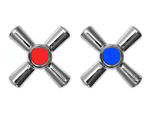
 If no water comes through the hose, or the flow is very slow, then the fault is in the plumbing. Check your taps. The taps with blue (and red) levers (see photo) commonly go faulty. You think you’ve switched it off or on, but only the plastic lever has moved. It hasn’t actually operated the valve inside the tap.
This is typically caused when the red or blue plastic lever cracks. The valves inside these taps are prone to getting very stiff. This is usually why the plastic levers crack or break. You can usually unscrew and remove the lever, and operate the tap using pliers.
If one of those self plumbing taps that clamp on to the copper water pipes has been fitted then they can get clogged up inside. Especially the hot one. When installed they only pierce a very small hole in the copper pipe. This hole is prone to clogging up. This type of tap can be unscrewed to gain access to clear the hole in the copper pipe.
If this happens to the cold supply turn the main stop tap off first! A blockage inside a hot tap would require more work if the hot water is supplied from a hot water tank.
You would have to turn off the main stop tap, and then then drain the hot water tank (unless you know where the valve is to turn the hot water off in your water cylinder). Think twice before interfering with the plumbing unless you know what you are doing. If anything goes wrong you could be in big trouble. Especially if you have to call out an emergency plumber.
Buy appliance water valves
Don’t get carried away

Over the years, even experienced appliance repairmen have been seriously injured or killed.
If there is an adequate water supply available
 If water comes through the fill hose at a decent flow rate then next check the filter in the water valve on the washing machine. You can pull it out with a pair of pliers and clean it. However, this will only explain the fault if it is severely blocked up, which is rare. The picture on the left shows a water valve, which could do with cleaning, but is in no way blocked enough to cause any issues.
Be careful not to damage the filter with the pliers. The filter is often delicate and brittle. The pic shows an old Hoover water valve which has a metal filter but the majority of filters now are made of very thin and brittle plastic.
If you create a hole in one – even a small hole – it can let grit and dirt through into the water valve and prevent it shutting off properly resulting in possible flooding in the future. Don’t use narrow-nosed pliers, use flat pliers, and be gentle with it.
If there’s a good water supply and valve filter isn’t blocked
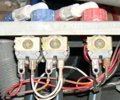 The next suspect is a faulty water valve (or solenoid). Or maybe a faulty connection. Water valves can have a live supply to them even when not operating. So never work on a washing machine when it’s connected to the electricity! The picture on the left shows a typical set of water valves. These days it’s common to only have 1 or 2 valves.
The solenoids can be tested with a continuity test meter. Ideally take off the wires before testing. Make sure you take a photo first. It is much easier to forget where wires went than you think. Fill valve solenoids have quite a high resistance. If completely open circuit that’s the fault. All valves should have the same reading, so you may be able to compare if more than one valve is fitted.
If they test out ok, and you can’t see any faulty connections then we’ve tested as far as we can for this article and it’s best to get an engineer in. The only other line of enquiry could be a fault on the pressure system but this could be difficult to diagnose. Read this article for help on how washing machines control water levels
Choose from the following list of appliance repairers..
If the drum starts to turn around without any water inside
If instead of filling up with water, the drum starts to turn back and forth like it does on wash there could be a fault on the pressure system. The pressure system is responsible for detecting the levels of water inside the drum.
If it goes faulty it is possible for it to believe that water is already inside the machine. This could explain why it doesn’t take any more water in. But it can also result in the heating element being energised to heat up the phantom water. This can cause serious damage and is a potential fire risk. If you suspect this is happening turn off the washing machine straightaway. (Faults on pressure system)
If water runs into the machine but never fills up in the drum
If you can see or hear water running into the machine but the water level never rises inside the drum it could be siphoning straight out down the drain. Check this article – fills and drains at same time
Only fills on one part of the cycle
If the washing machine fills okay on one section of the cycle but not on another it is worth checking how many valves are fitted. And how many solenoids there are. Each solenoid lets water in at a specific point in the cycle.
Hot and cold fill machines (rare these days) can have either the hot or the cold valves go faulty. If the cold valve went faulty (or the cold water supply had failed) water would go in on wash, but not on rinses.
No fill error codes
 Most washing machines are now controlled by software programmes and produce error codes if they don’t detect the right amount of water has been taken in within a set amount of time. So you may be reading this because an error code indicated a filling fault. If so just try to work out why from the advice here.
Repairs
Fixed-price repairs, Pay monthly options, Repair & protect your whole appliance..
Save Money Now
Subscribe to Which? today and start saving money now. Subscription offers often available.
Spares
Spares4Appliances is a spares company run by repair engineers who understand all about spare parts for appliances.
Yay! All done, no doubt will be back when I get round to replacing the whole piece.
Thanks for the advice :)
Excellent :)
Hi there. My washing machine fills with water but it drains while it fills now. What could be the problem. I thought I was loosing it as I put the washing u on and it just wouldn’t fill up. Then I saw it was draining as the water ran in…
Any advice would be great.
Thanks
I have a hoover dynamic 8 that starts to fill with water then stops after about five seconds. the machine continues to go through the wash cycle with no water but will not spin, an eventualy comes up with the error E03 which is a draining fault.
I have cleaned filter and put drain hose into the sink where it empties, also removed flow constrainer from water inlet. There is plenty of water going into machine.
Any ideas?
My Kenmore 400 top loader will fill for 20 seconds then stop. Then if I push the knob in and pull it out again, it will go for another 20 seconds then stops. Everything else works except this 20-second filling process. Any thoughts? Thanks
Frank, that sounds frustrating. I don’t do top loaders as we don’t like them much in the UK :) It could be a connection fault on or in the valve. I would say time it. If it always fills for the exact same time before stopping I’d say that’s pretty controlled and would suspect the main pcb or some fault on a sensor but I would not speculatively change any part, get an engineer. If it’s stopping filling roughly at the same time period, sort of roughly 20 second but varies it may be more to do with a faulty connection somewhere.
Patrick, it could be a fault on the pressure system which is how it detects levels of water in the machine – faults on pressure system
Heidi, check this out Washing machine fills and drains at same time
Thanks Andy I read your section on the pressure system, and disconcted the pipe at the switch, then turned on the machine to fill but the same fault occurred, if anything with the pipe off it should have over filled I,m thinking. I can hear a click when I blow up the switch. It has twin cold water inlet solanoids and I have tried swapping the leads but it makes no difference.
That’s correct Patrick, with the pressure tubing disconnected it should overfill. It could be a faulty pressure switch though. I’d normally expect 2 clicks, one for low level (for wash) and another for higher level for rinses. Try hitting firmly with a screwdriver handle or something to see if it unsticks something. If it does, replace the pressure switch. If it doesn’t it could still be faulty. If there are 5 or 6 wires on it then it should be 2 levels.