
How can a tumble dryer catch fire when unplugged?
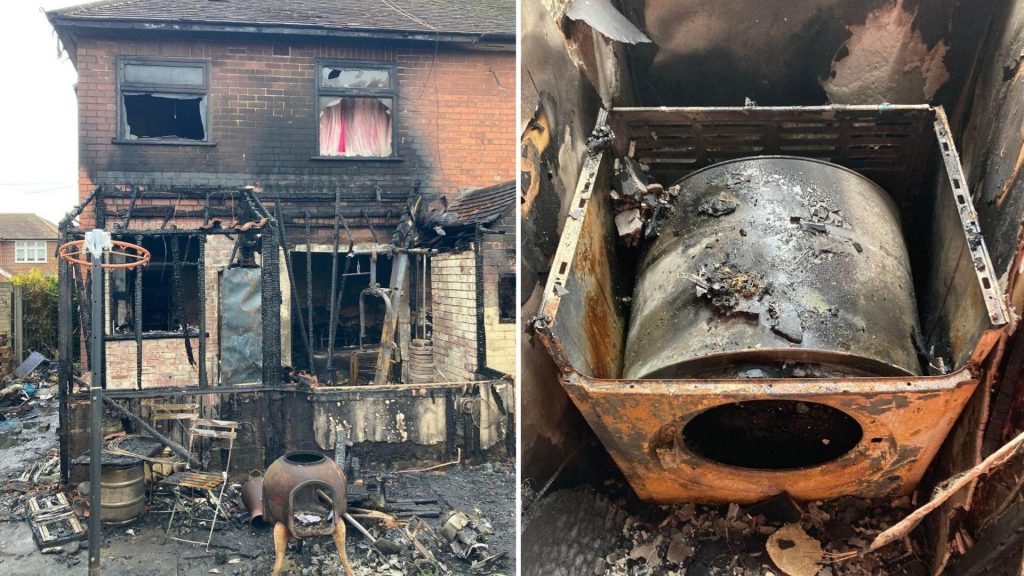
A news report about a tumble dryer fire in Honley raised an unsettling question: how can a dryer catch fire when it had already been unplugged? This article explains the most likely mechanism, why it matters, and what to do if a dryer shows signs of fire.
“Fire at Honley home after UNPLUGGED tumble dryer bursts into flames.”

A tumble dryer that has been unplugged or switched off mid-cycle – without allowing the cooling-down phase to complete – can retain enough residual heat to cause laundry inside to smoulder and potentially catch fire. The dryer does not need to be connected to the mains for this to happen. Always allow a drying cycle to finish completely before switching the machine off.
How Can a Dryer Catch Fire When Unplugged?
If a dryer is unplugged while a fire is already developing inside – even a small smoulder – disconnecting the power will not extinguish it. But there is a more specific mechanism that makes this possible even without a pre-existing electrical fault.
At the end of a drying cycle, most tumble dryers run a cooling-down phase. During this phase the heating element switches off but the drum continues to rotate with cool air flowing through, bringing the temperature of the laundry down to a safe level before the cycle ends.
If the dryer is switched off or unplugged before this cooling phase completes, the heating element cuts off immediately – but the laundry inside retains significant residual heat with no airflow to dissipate it. Under the right conditions, particularly with laundry that contains oils or grease residues, this latent heat can be sufficient for smouldering to begin and eventually develop into a fire – even with the machine completely disconnected from the mains.

This can happen to someone trying to do the right thing – switching off the dryer before going out rather than leaving it running. The solution is not to leave the dryer running unattended, but to make sure the cycle finishes fully before switching off. See: never stop a tumble dryer mid-cycle.
Why Is Laundry a Fire Risk Inside a Dryer?
Laundry that is heavily soiled with body oils, cooking grease, or other flammable residues is particularly susceptible. At least one manufacturer has confirmed to Whitegoods Help that laundry containing significant grease or oil content can catch fire inside a tumble dryer under elevated heat conditions.
This risk can be reduced by ensuring laundry is washed properly on the correct cycle with the appropriate amount of detergent – particularly items that come into direct contact with the skin and are likely to carry body oils or residues.
The warning about stopping a dryer before the cooling phase is not obscure or theoretical. Standard tumble dryer instruction manuals explicitly address it. Whitegoods Help’s experience reviewing dryer manuals has found warnings such as:
“…if the drying programme is interrupted before the end of the cooling down phase, this could cause the laundry to self-ignite.”
This type of warning appears in manuals from multiple brands. If you have a tumble dryer, read the manual carefully and look for similar warnings. Lost the manual? See: download white goods instruction manuals.
What About a Power Cut or Machine Fault Mid-Cycle?
A power cut or an internal fault that causes the dryer to stop mid-cycle would have the same effect as manually switching the machine off – the cooling phase does not complete, and the laundry retains residual heat with no airflow.
This situation is harder to avoid since it is outside the user’s control. However, it is a further reason why a tumble dryer should never be left running when the house is empty or when occupants are asleep. If the dryer stops due to a fault or power cut and no one is present, there is no opportunity to identify or respond to any developing risk.
If someone is at home when an unexpected mid-cycle stop occurs, monitoring the machine carefully until it has fully cooled is sensible. See also: risks of leaving a tumble dryer running when out or in bed.
What to Do If a Dryer Shows Signs of Fire
If a tumble dryer begins to smoke or there are signs of a fire developing inside, the instinct to open the door and retrieve the laundry should be resisted. Opening the door introduces a rush of fresh air into the drum, which can cause smouldering to immediately develop into active flames.
-
Do not open the drum door. Keep it closed to limit the oxygen supply to any fire inside.
-
Disconnect the dryer from the mains as quickly as possible. If you cannot reach the plug safely, switch off at the fuse board or consumer unit.
-
Keep the machine under observation. Do not leave it unattended until it has fully cooled.
-
If a fire extinguisher suitable for electrical fires is available and the fire appears very small and contained, it may be appropriate to use it – but only if safe to do so. If there is any doubt, evacuate and call 999.
-
If the fire cannot be safely contained, evacuate the building, close doors behind you, and call 999 immediately.

A home fire extinguisher is useful for a very small, contained fire in its earliest stage. If there is any doubt about safety, evacuate immediately and call 999. Do not re-enter the building.
Fire Extinguishers and Smoke Alarms
Having a fire extinguisher suitable for electrical fires close to where tumble dryers are kept – typically the kitchen, utility room, or garage – provides a means to tackle a very small fire at its earliest stage. CO2 extinguishers are the most appropriate type for electrical appliance fires. See: home fire extinguishers near appliances.
A working smoke alarm fitted close to the dryer provides early warning. Kitchens require heat alarms rather than standard smoke alarms to avoid false alarms from cooking, but if the dryer is in a utility room, garage, or similar space a standard smoke alarm is straightforward to install.
More on tumble dryer safety
Frequently Asked Questions
How can a tumble dryer catch fire when it’s unplugged?
If a dryer is unplugged or switched off before the cooling-down phase at the end of the cycle has completed, the laundry inside retains significant residual heat with no airflow to dissipate it. Under the right conditions – particularly if the laundry contains oil or grease residues – this heat can cause smouldering to develop into fire even after the machine is disconnected from the mains. The dryer does not need to be powered for this to happen.
Is it safe to switch a tumble dryer off before the cycle ends?
No – not without allowing the cooling-down phase to complete. Many tumble dryer manuals explicitly warn that stopping the drying programme before the cooling phase ends can cause laundry to self-ignite. If the drying cycle needs to be cancelled, use the machine’s cancel or end function rather than switching it off at the socket or unplugging it, and allow the drum to cool before removing the laundry. See: never stop a tumble dryer mid-cycle.
What makes laundry more likely to catch fire in a dryer?
Laundry that contains significant oil or grease residues – from body oils, cooking, or other sources – is at higher risk. At least one manufacturer has confirmed that laundry with high grease content can catch fire inside a dryer under elevated temperature conditions. Washing laundry thoroughly on the correct cycle with the appropriate amount of detergent, particularly items that contact the skin regularly, reduces this risk.
Should I open the dryer door if I think there’s a fire inside?
No. Opening the door supplies fresh air to the drum and can cause smouldering to immediately develop into active flames. Keep the door closed, disconnect the machine from the mains, and keep the dryer under observation until fully cooled. If the fire is small and a suitable extinguisher is available, use it only if it is safe to do so. If there is any doubt, evacuate and call 999.
What if the dryer stops mid-cycle due to a power cut?
A power cut or internal fault stopping the dryer mid-cycle has the same effect as manually switching it off – the cooling phase does not complete and laundry retains residual heat. This is outside the user’s control, which is a further reason never to leave a tumble dryer running when the house is empty. If someone is at home when a mid-cycle stop occurs, monitor the machine carefully until it has cooled fully.
Ask the repair forum
Post the make, model and symptoms and get help from the Whitegoods Help community.
2 Comments
Grouped into 1 comment thread.
Living on my own for many years now I have not bothered with a tumble drier just making sure that clothes are well spun and putting on the clothes line in good weather, or left to air dry in the house. (Make sure you have good air circulation in the property.) Both my daughters families do have tumble driers and I have seen some issues with those. The big problem, as you mentioned is loss of power as cancelling should allow the cooling cycle to continue, however I am always surprised at how with so much electronic technology manufacturers make so many bad decisions with regards to safe operation, etc..
Where I live we get several brief power cuts per month. These appear to be at grid changeover, surge compensation times, and usually last no longer than about 10 seconds. Those that do exceed this are normally less than a minute. This does mean that each month there are several opportunities for driers to overheat. This is likely to get even worse with power usage probably going to outstrip supply. I would have thought that to overcome the loss of power and enable some form of cooling to continue, though maybe at a reduce rate, with the use built in rechargeable lithium ion batteries that cut in on loss of power. It should also possible to remember where you were at power loss and return to that phase in the cycle unless cancelled.
Likely replying to Geoff
Hello Geoff. I’ve today researched this subject a little more and modified my article in places. It seems that some of these dryers are at risk of laundry catching fire if the dryer is stopped mid cycle by a power cut or fault. My own tumble dryer has the following warning in the instruction manual – “If the drying programme is interrupted before the end of the cooling down phase, this could cause the laundry to self-ignite. ”
Unfortunately battery power wouldn’t provide enough electricity to operate a fan, but I agree that this is potentially a very serious flaw in their design. The manufacturer’s don’t seem to view this as a flaw, but more of just an undesirable side effect.
It’s one thing warning people to never stop one mid cycle but if there’s a power cut people can’t do anything about that. As to what they could do though.. I expect it’s a problem that is solvable but probably only at great expense and elaboration. If so, manufacturer’s should not think it’s good enough to only mention this fire risk in a small section deep within a large instruction manual that they know most people won’t read. Warnings should surely be printed on the front of the appliance. Fires are exceptionally serious – and can kill!