
Don’t stop a tumble dryer mid-cycle
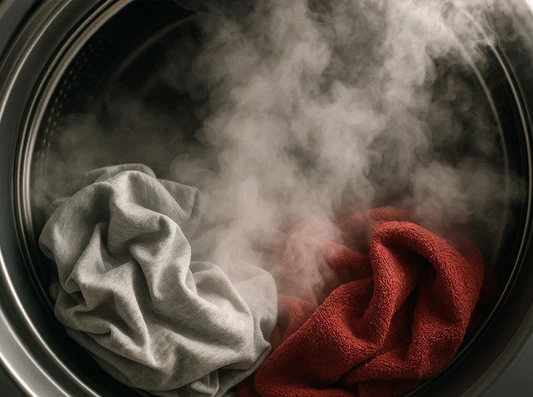
Stopping a tumble dryer mid-cycle – particularly when it has been running for a while and the drum is very hot – carries two potential risks: component damage, and in extreme cases, fire. This guide explains why, and what to do instead if a cycle needs to be interrupted.

If the dryer must be stopped, use the cancel or cool-down function rather than cutting power directly. Do not open the door immediately after stopping if there is no cool-down period – allow the drum to cool first.
Why Stopping Mid-Cycle Is Risky
While a tumble dryer is running, the internal fan constantly circulates air over the heating element. This keeps the element at the correct operating temperature and prevents dangerous heat build-up. When the dryer is switched off mid-cycle, the fan stops immediately – but the heating element continues to give off residual heat for a short period with no airflow to dissipate it. This sudden temperature spike can cause two problems:
 Thermal cutout (TOC) tripping
Tumble dryers contain thermal cutout devices (TOCs) designed to trip if the temperature inside reaches a dangerous level. Stopping the fan suddenly can cause a brief but significant temperature spike that trips the TOC. On some older Hotpoint and Indesit models in particular, this was a recurring fault. A tripped TOC typically means the dryer will not heat again until the TOC is reset or replaced.
Element damage or fire risk
The sudden loss of airflow can cause the heating element itself to overheat momentarily. This can cause the element to warp or, in extreme cases, create conditions that allow laundry inside to ignite – particularly if the laundry contains grease or other flammable residues.
The Fire Risk From Greasy Laundry
Some tumble dryers reach very high temperatures internally during certain drying cycles. Some manufacturers explicitly warn against stopping a dryer mid-cycle for this reason – Miele, for example, states in at least one of its instruction manuals that laundry could catch fire if the machine is stopped mid-cycle.
Laundry that has been exposed to cooking grease, engine oil, or other flammable substances – and which has not been washed at a temperature high enough to remove those substances – can retain enough residue to present a fire risk at high temperatures. Human skin also deposits natural oils onto clothing and bedding over time.
If the fan stops suddenly and the temperature momentarily spikes, this can be enough to ignite laundry that contains flammable residues – even in a machine that has just been unplugged. See: can a tumble dryer catch fire when unplugged?
What to Do Instead: Use the Cool-Down Period
Most tumble dryers are designed with a controlled cool-down phase at the end of the drying cycle. During this period – typically around 10 minutes – the heating element switches off but the drum and fan continue to run. This allows the internal temperature to reduce gradually before the machine stops completely.
If a cycle needs to be interrupted, the safest approach is to advance to this cool-down phase rather than switching the dryer off entirely. On machines with a mechanical timer knob, this means turning the dial to a point near the end of the cycle where only the cool-down period remains.

Many modern dryers no longer use a mechanical timer and are controlled by software instead. Some of these models do not automatically enter a cool-down phase when the programme is cancelled – they may stop immediately. Check the instruction manual for the correct procedure to cancel a cycle on your specific model. If no cool-down cancel mode is available, do not open the door until the drum has had time to cool.
The Broader Risk: Leaving Dryers Running Unsupervised
Tumble dryers are one of the appliances most commonly associated with house fires. It is strongly recommended never to leave a tumble dryer running when everyone is out of the house – or when everyone is in bed. If a fire starts in an unsupervised dryer, the consequences can be catastrophic.
There is therefore a degree of irony in the situation: leaving a dryer running unattended is a fire risk, but stopping it abruptly mid-cycle is also a potential fire risk. The answer is to plan ahead – aim to run the dryer when someone is at home, and allow it to complete its cycle naturally or use the cool-down cancel function if it must be stopped. See: risks of leaving a tumble dryer, washing machine, or dishwasher running when out or in bed.
More tumble dryer safety guides
Frequently Asked Questions
Why is it dangerous to stop a tumble dryer mid-cycle?
When a tumble dryer stops, the fan stops immediately but the heating element continues to give off residual heat with no airflow to dissipate it. This brief temperature spike can trip a thermal cutout (TOC), warp the heating element, or in extreme cases create conditions that allow laundry containing grease or flammable residues to ignite. The risk is highest when the dryer has been running for a while and the drum is very hot.
What is the cool-down period on a tumble dryer and why is it important?
The cool-down period is typically the last 10 minutes or so of a drying cycle, during which the heating element switches off but the drum and fan continue to run. This allows the internal temperature to reduce gradually and safely before the machine stops. It is the correct way to end a cycle and prevents the sudden temperature spike caused by stopping the fan while the element is still hot.
My dryer doesn’t have a cool-down option when I cancel the programme – what should I do?
If the machine stops immediately when cancelled with no cool-down phase, do not open the door straight away. Allow the drum time to cool before opening. This reduces the risk of air entering the drum and potentially facilitating ignition if laundry inside contains any flammable residues. Check the instruction manual for any recommended procedure for cancelling a cycle on your specific model.
Can laundry really catch fire inside a tumble dryer?
Yes – in certain circumstances. Laundry that contains grease, cooking oils, or other flammable substances – and which was not washed at a high enough temperature to fully remove them – can retain enough residue to present a fire risk at high drying temperatures. Some manufacturer instruction manuals explicitly warn of this risk. It is also possible for laundry to catch fire after the machine has been switched off, if residual heat in the drum is sufficient. See: can a tumble dryer catch fire when unplugged?
Is it safe to leave a tumble dryer running overnight or when everyone is out?
No. Tumble dryers are one of the appliances most commonly involved in house fires, and a fire in an unsupervised dryer can cause devastating damage before it is detected. It is strongly recommended to run a tumble dryer only when someone is at home and able to respond if something goes wrong. See: leaving appliances running when out or in bed.
10 Comments
Grouped into 8 comment threads.
1 reply Which condenser drier would you buy for a tenant? I am thinking of easy use, and safety - fire prevention. Your advice would be most appreciated. Thank you.
1 reply I have recently heard that if you change dryer cycles while the dryer is running that it will cause problems for the dryer or break the dryer. Is this true? Do you have to turn off the dryer and then change the cycle and then restart? Any input is much appreciated!
I have recently heard that if you change dryer cycles while the dryer is running that it will cause problems for the dryer or break the dryer. Is this true? Do you have to turn off the dryer and then change the cycle and then restart? Any input is much appreciated!
Likely replying to Michelle
Hello Michelle. The answer is in the article. If you need to cut short a cycle or turn it off whilst leaving the house use the cancel option to properly cancel the dry cycle. If there isn’t a cancel option (check the instruction book) and there is a mechanical timer turn the timer to the last 10 minutes to let it cool down naturally. Essentially you need to follow the instructions in the manual, which can differ from model to model.
0 replies That's a good idea Mark. My Miele tumble dryer has a cancel button that drops the time down to 5 minutes cooling time so arguably even 5 minutes will do. However there's nothing to stop me just turning it off with the on off switch. Another potential issue is if there is a build up of fluff around the heating element it's possible that during normal operation the element doesn't ignite the fluff but if stopped during the cycle the fan stops blowing over the element and temperature could rise enough to ignite it. This is something that should be very rare and dependent on the design of the dryer but thousands have caught fire over recent years so just be cautious and never leave them totally unattended. Always have a suitable fire extinguisher close by to appliances just in case.
That’s a good idea Mark. My Miele tumble dryer has a cancel button that drops the time down to 5 minutes cooling time so arguably even 5 minutes will do. However there’s nothing to stop me just turning it off with the on off switch.
Another potential issue is if there is a build up of fluff around the heating element it’s possible that during normal operation the element doesn’t ignite the fluff but if stopped during the cycle the fan stops blowing over the element and temperature could rise enough to ignite it. This is something that should be very rare and dependent on the design of the dryer but thousands have caught fire over recent years so just be cautious and never leave them totally unattended. Always have a suitable fire extinguisher close by to appliances just in case.
0 replies The cancel button on my Beko tumble dryer stops the cycle immediately (so it cannot be doing a controlled shut down). On the, very few, occasions I need to shut it down early I run a "freshen up" cycle (air flow and tumbling without heat for 15 mins) which should prevent the element getting too hot.
The cancel button on my Beko tumble dryer stops the cycle immediately (so it cannot be doing a controlled shut down).
On the, very few, occasions I need to shut it down early I run a “freshen up” cycle (air flow and tumbling without heat for 15 mins) which should prevent the element getting too hot.
0 replies The danger is more towards the end of the cycle. It's real enough to be warned about in instruction manuals.
The danger is more towards the end of the cycle. It’s real enough to be warned about in instruction manuals.
0 replies It does not seem to me that stopping the dryer mid-cycle would pose too much problem due to the fact that the clothes should still be pretty damp. If you have to leave the house, you could check to see if they are still damp, and thus not in fire danger. If they are nearly dry, put them in a laundry basket and finish them up when you get home.
It does not seem to me that stopping the dryer mid-cycle would pose too much problem due to the fact that the clothes should still be pretty damp. If you have to leave the house, you could check to see if they are still damp, and thus not in fire danger. If they are nearly dry, put them in a laundry basket and finish them up when you get home.
0 replies Thanks for adding your experience GW. I've copied and pasted your comment on my other article as it's highly relevant there too ( Is it safe to leave appliances running? )
Thanks for adding your experience GW. I’ve copied and pasted your comment on my other article as it’s highly relevant there too ( Is it safe to leave appliances running? )
0 replies With regard to a Tumble Dryer being a fire hazard? My Indesit (Model: IDVA735S) caught fire from the rear of the appliance within a couple of minutes of being started. This was the first 'dry' of the day, so the machine wasn't hot due to a previous drying cycle. When I added one quilt cover and a couple of pillowcases to the dryer drum, I left the dryer in motion whilst I continued with my usual tidying up first thing in the morning. Within a couple of minutes I could smell smoke, that rather obvious 'electrical' burning smell that you get when a hairdryer gives up. I dashed back to the machine, where there was very slow grey smoke coming from around the sides of the dryer. I quickly pulled the quilt cover and pillowcases out, none were damaged, but I could see flames through the rear of the drum. The flames were approx' 7-10" high and clearly well alight. Immediately I chucked water towards the flames, yes, I know I should have unplugged the machine, but I challenge anybody not to do precisely what I did when faced with such a situation! Because I caught the fire straight away, the flames hadn't even damaged a plastic panel located above the motor compartment, so I was relieved to have been on hand when the incident occurred. I think it's important to mention, I was about to go out in my car as soon as I started the machine, secondly, there were four persons (family) upstairs in bed when this incident occurred ... I was genuinely having palpitations with the thought of what could have happened? The machine was in my kitchen, the filter was clean and the machine was serviced just one month ago ... Hotpoint were called and an engineer is apparently coming out to check this fire hazard today. Needless to say, I expect the company to replace this dangerous machine, via my insurance. I'm just waiting for some jobsworth to try and extort delivery costs for any new appliance? I certainly don't want a bloody repair! The moral of the above account is: Don't leave these appliances on when you intend leaving home for a period of time, my machine was around 5 years old, but was recently serviced.
With regard to a Tumble Dryer being a fire hazard? My Indesit (Model: IDVA735S) caught fire from the rear of the appliance within a couple of minutes of being started. This was the first ‘dry’ of the day, so the machine wasn’t hot due to a previous drying cycle.
When I added one quilt cover and a couple of pillowcases to the dryer drum, I left the dryer in motion whilst I continued with my usual tidying up first thing in the morning. Within a couple of minutes I could smell smoke, that rather obvious ‘electrical’ burning smell that you get when a hairdryer gives up. I dashed back to the machine, where there was very slow grey smoke coming from around the sides of the dryer.
I quickly pulled the quilt cover and pillowcases out, none were damaged, but I could see flames through the rear of the drum. The flames were approx’ 7-10″ high and clearly well alight. Immediately I chucked water towards the flames, yes, I know I should have unplugged the machine, but I challenge anybody not to do precisely what I did when faced with such a situation!
Because I caught the fire straight away, the flames hadn’t even damaged a plastic panel located above the motor compartment, so I was relieved to have been on hand when the incident occurred.
I think it’s important to mention, I was about to go out in my car as soon as I started the machine, secondly, there were four persons (family) upstairs in bed when this incident occurred … I was genuinely having palpitations with the thought of what could have happened? The machine was in my kitchen, the filter was clean and the machine was serviced just one month ago …
Hotpoint were called and an engineer is apparently coming out to check this fire hazard today. Needless to say, I expect the company to replace this dangerous machine, via my insurance. I’m just waiting for some jobsworth to try and extort delivery costs for any new appliance? I certainly don’t want a bloody repair!
The moral of the above account is: Don’t leave these appliances on when you intend leaving home for a period of time, my machine was around 5 years old, but was recently serviced.
Which condenser drier would you buy for a tenant? I am thinking of easy use, and safety – fire prevention. Your advice would be most appreciated. Thank you.
Hello there. Unfortunately, I don’t have time to review white goods appliances any more. It would be a full-time job just to keep on top of that. If I was buying a tumble dryer though, and I wasn’t wanting to spend a fortune, I would definitely look at the brand of Bosch. However, the best thing I can honestly recommend is to become a Which? Member and have a look at their latest reviews. They even warn you against white goods appliances to definitely not buy.