
Economy 7 Safety warning
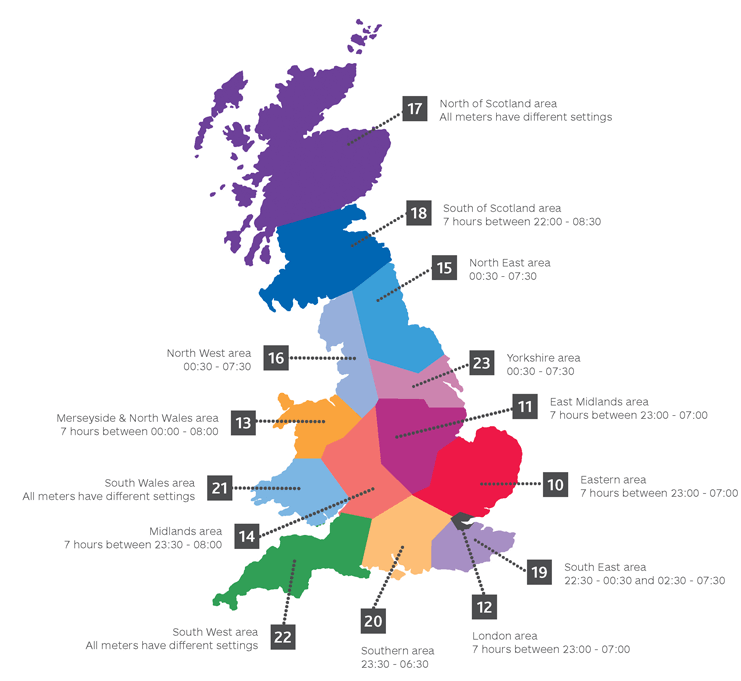

Economy 7 and other off-peak tariffs can save money on overnight electricity – but are primarily designed for storage heating, not for running appliances. The financial saving from running a washing machine or tumble dryer overnight is typically 10 to 30 pence per cycle. The safety risk of running these appliances unattended while everyone is asleep is not justified by this saving.

White goods appliances are a leading cause of house fires. Running them while everyone is asleep removes the opportunity to detect and respond to a fire in its early stages. The financial saving from overnight off-peak tariff rates is small – the risk is not.
Is Economy 7 Worth Having If You Don’t Use Storage Heating?
Economy 7 and similar off-peak tariffs divide the day into two pricing periods: a cheaper overnight rate (typically 7 hours) and a more expensive daytime rate. The tariffs were designed for storage heaters – appliances that draw electricity overnight at the cheap rate and release heat during the day.
For households without storage heating, the tariff structure is less favourable. To benefit overall, a significant proportion of total electricity use must occur during the 7 off-peak hours – typically at least 40%. If most consumption happens during the day and evening at the higher rate, the tariff can work out more expensive than a standard flat-rate tariff. In some cases, daytime rates under Economy 7 are substantially higher than standard tariff rates.
Use a smart meter or energy monitor to understand when electricity is actually consumed in the household. If most use occurs in the evening and daytime, an Economy 7 tariff is likely to cost more overall, not less.
The Fire Risk of Running Appliances Overnight
Washing machines, tumble dryers, and dishwashers are responsible for a significant proportion of domestic fires. The risk exists whether the appliance is running during the day or night – but the consequences differ substantially.
 Running appliances while awake and present
A fire that starts while someone is awake and in the building is more likely to be noticed quickly. Early detection allows time to respond, evacuate, and call for help. Smoke alarms are more likely to wake an awake occupant than to rouse someone deeply asleep.
 Running appliances unattended overnight
A fire that starts while everyone is asleep has time to develop before being detected. Smoke can incapacitate sleeping occupants before they wake. Response time is reduced. The consequences of the same fire are materially worse than if it had occurred while people were awake and nearby.

The saving from running a washing machine or tumble dryer during off-peak overnight hours rather than in the evening is typically in the range of 10 to 30 pence per cycle. This is not a meaningful financial benefit. The potential consequences of an undetected appliance fire at night are severe. These appliances should not be left running while the household is asleep.
Safer Alternatives to Overnight Running
-
Use the delay start timer to run appliances in the early morning. Many washing machines and dishwashers have delay start functions. Setting the machine to start an hour or two before the household wakes up means it finishes close to when people get up – while still capturing some off-peak rate benefit – without running through the deepest hours of sleep. -
Run appliances in the early evening before bed. Running the washing machine or dishwasher early in the evening rather than leaving it to run overnight means someone is awake in the building while the appliance is running. The cycle is typically complete before everyone goes to sleep. -
Ensure working smoke alarms are fitted. If an appliance is ever left running unattended – even during the day – working smoke alarms throughout the property are essential. Test them regularly. See our guide on 8 ways to make appliances safer. -
Consider a time-of-use tariff with a daytime off-peak window. Some newer smart tariffs offer off-peak rates at different times of day, not only overnight. A tariff with cheaper rates in the early morning hours (6am to 8am, for example) allows a delay-start appliance to capture the saving while still finishing before the household leaves for work.
Appliance Safety Guides
Related Guides
 8 Ways to Make Appliances Safer
Practical steps every household can take to reduce appliance fire risk.
 How Dangerous Are Our Appliances?
The data on domestic appliance fires – which appliances carry the highest risk and why.
 Tumble Dryer Filter Fire Risk
Why a blocked lint filter is a fire risk – and why it must be cleaned after every cycle.
Tumble Dryer Safety NoticesKnown safety notices on tumble dryers – check whether any cover your appliance.
Frequently Asked Questions
Is it safe to run a washing machine overnight?
It is not recommended. White goods appliances are a leading cause of domestic fires. Running a washing machine, tumble dryer, or dishwasher while everyone in the household is asleep means a fire could develop significantly before being detected. The financial saving from overnight off-peak rates is typically 10 to 30 pence per cycle – not enough to justify the risk. Run appliances while awake, or use a delay start to finish the cycle close to when the household wakes up.
Is Economy 7 worth it if I don’t have storage heaters?
Probably not. Economy 7 tariffs were designed for storage heating, which draws large amounts of electricity overnight at the cheap rate. Without storage heating, the higher daytime rates under Economy 7 typically outweigh the overnight savings unless a very significant proportion of total electricity use occurs during the 7 off-peak hours. Check the tariff rates and consumption pattern carefully before switching.
Can I use a delay start to run appliances at cheaper times without running them overnight?
Yes. Setting a delay start so the appliance finishes shortly before the household wakes up – rather than running through the night – reduces the time the appliance runs unattended. Early morning (from around 5am or 6am) is a reasonable compromise between capturing some off-peak benefit and not leaving appliances running through the deepest hours of sleep. Check whether your specific tariff has off-peak windows at other times of day.
7 Comments
Grouped into 4 comment threads.
1 reply Thanks. I hope the article is right, which is what I originally thought, i.e. all electricity used at night is cheap. I have been told the opposite by several people who ought to know, so just hope they're wrong!
1 reply Can anybody clarify whether on Economy 7 all your electricity used during the 7 hours is cheaper? I have also been told that it is only for appliances that are specially wired up to the Economy 7 meter. If so, this would mean that you were paying more for all your other electricity, even during the off-peak hours. Then there would be the expense of having the special wiring. And would this mean that you couldn't use them during the day? I am having storage heaters put in and would like to take full advantage of Economy 7.
Can anybody clarify whether on Economy 7 all your electricity used during the 7 hours is cheaper? I have also been told that it is only for appliances that are specially wired up to the Economy 7 meter. If so, this would mean that you were paying more for all your other electricity, even during the off-peak hours. Then there would be the expense of having the special wiring. And would this mean that you couldn’t use them during the day?
I am having storage heaters put in and would like to take full advantage of Economy 7.
0 replies Bhanu. That's more than I pay all year.
Bhanu. That’s more than I pay all year.
0 replies Hi I just received my electric bill for dec-feb (3months) and was shocked to see it was £850 for a 1 bed flat in bounds green. I am with british gas and they seem to think its correct? I use the usual fridge, laptop, tv, hairdryer, heaters but always swich of at plug point before going to work in morning and at night so cant imagine why its so much. The readings were 3734 units on rate 1 and 1170 units on rate 2. This just seems way to high. Will be taking daily readings to see what going on. Is this bill average on all electrics?
Hi
I just received my electric bill for dec-feb (3months) and was shocked to see it was £850 for a 1 bed flat in bounds green. I am with british gas and they seem to think its correct? I use the usual fridge, laptop, tv, hairdryer, heaters but always swich of at plug point before going to work in morning and at night so cant imagine why its so much. The readings were 3734 units on rate 1 and 1170 units on rate 2. This just seems way to high. Will be taking daily readings to see what going on. Is this bill average on all electrics?
Thanks. I hope the article is right, which is what I originally thought, i.e. all electricity used at night is cheap. I have been told the opposite by several people who ought to know, so just hope they’re wrong!
Likely replying to Jean
Hi Jean
All your electric at night for the off peak hours is at reduced rate – when I put my washer on I watched the electric meter – sad that I am. It never moved untill morning My electric was 12.30 – 7.30 off peak and this changes with the clocks.