
Bosch Washing Machine Error Codes
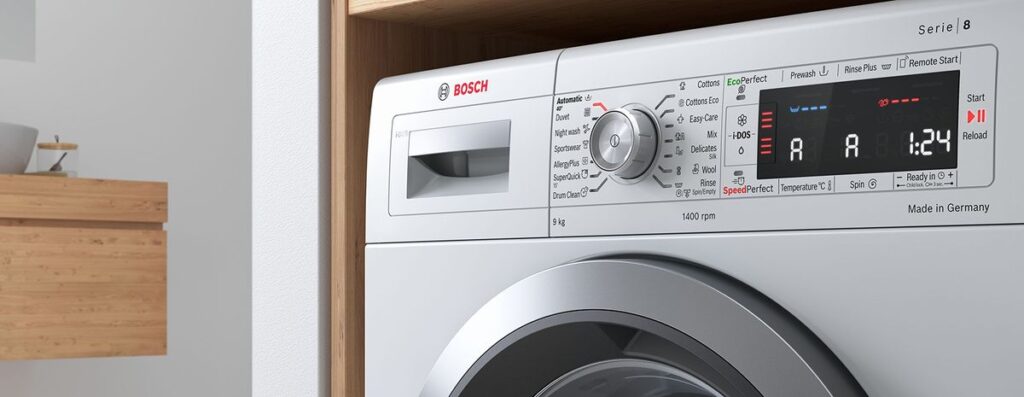

Bosch washing machines display error codes as either E or F followed by a number, depending on the age and model range. The E and F versions of the same number mean the same thing. Find your code in the tables below. Before assuming a component has failed, always check the simple physical causes first – many Bosch error codes are resolved without parts or an engineer.
Codes covered on this page
E02 / F02 – Heating
E03 / F03 – Drain
E04 / F04 – AquaStop
E06 / E07 – NTC sensor
E09 / F09 – Heating circuit
E10 / F10 – Comms
E11 / F11 – Motor / drum
E16 / F16 – Door
E17 / F17 – Fill
E18 / F18 – Drain
E20 / E27 – Power
E28 / E29 – Flow / pressure
E32 / E34 / E35 – Sensors / door
E43 – Triac
E50 / F50 – Motor
WFF/WFL/WFP F01-F10
WOK/WOL numeric 1-5
Which Bosch error code system does your machine use?
Bosch has used several different error code formats across its washing machine range. Identifying which system your machine uses is the first step, as the same number can mean different things on different model generations. For broader brand context see our Bosch home appliances overview.
 E or F codes on a digital display
Most Bosch washing machines produced from the late 1990s onwards display errors as E01, E02, E17, F17, F34 and so on. The E and F versions of the same number are equivalent – E17 and F17 mean the same fault. This system is used across the WAE, WAS Logixx, WOK, WOL, honeycomb drum models, and all modern Bosch machines. Use the main BSH error code table below.
 F codes on WFF, WFL, and WFP ranges
Older Bosch machines from the WFF, WFL, and WFP ranges use a separate F code system where F01 means water intake fault, F02 means heating timeout, and so on. These codes look similar to the main system but the meanings are different. Use the WFF/WFL/WFP table further down this page.
 Numeric codes on WOK and WOL models
Some older WOK and WOL models display simple numeric fault indicators rather than alphanumeric codes. Code 1 indicates a door fault, Code 2 a fill fault, Code 3 a heating fault, Code 4 a drain fault, and Code 5 a motor or drum fault. Use the WOK/WOL table below.
 Bosch, Neff, and Siemens shared platform
All three brands are made by BSH Hausgeräte and share the same control system and error code structure across equivalent model generations. If you have a Neff or Siemens machine and cannot find your code here, the meanings in this guide apply equally to those brands. The fault codes are identical across the BSH platform.
Which Bosch codes are seen most often?
Across the field, four code groups account for the majority of Bosch fault callouts. Knowing which they are helps narrow the diagnosis before you open anything up.
Drain fault – almost always a blocked filter
Fill – tap, hose, or AquaStop filter
Door interlock – common at 5-10 years
Motor – usually worn carbon brushes
Bosch error codes – main BSH platform (WAE, WAS, WOK, WOL, modern models)
The following codes apply to the majority of Bosch washing machines with a digital display, including the WAE range, WAS Logixx series, WOK, WOL, honeycomb drum models, and all modern Bosch machines from approximately 2003 onwards. The same codes apply to equivalent Neff and Siemens models.

On Bosch washing machines, E17 and F17 refer to the same fault. E34 and F34 are the same fault. The letter E or F is a display format difference between models, not a difference in meaning. Throughout this guide, both versions are listed together.
| Error code | Fault description | Most likely causes | Check first |
|---|---|---|---|
| E01 / F01 E17 / F17 |
Water fill fault – machine not filling or fill taking too long | Water tap closed or partially closed. Kinked or trapped inlet hose. Blocked inlet hose filter. Low mains water pressure. Failed inlet valve solenoid. AquaStop hose filter blocked. | Confirm the tap is fully open. Straighten the inlet hose. Check and clean the filter at the back of the machine where the inlet hose connects. |
| E02 / F02 E19 / F19 |
Heating fault – water not reaching target temperature within expected time | Failed heating element. Failed NTC thermistor (temperature sensor). Wiring fault between element or thermistor and control board. Limescale heavily fouling the element. Control board fault. | Check whether the machine is actually cold at the end of a hot wash. Test the element and thermistor with a multimeter. Descale if the machine is in a hard water area and has not been maintained – see how to descale a washing machine and washing machine not heating water. |
| E03 / F03 E18 / F18 |
Drain fault – machine unable to drain water within expected time | Blocked pump filter (by far the most common cause). Kinked or obstructed drain hose. Standpipe too high. Foreign object (coins, buttons, underwire) blocking the pump impeller. Failed drain pump motor. | Clean the pump filter via the small panel at the bottom front of the machine. Check the drain hose is not kinked and that the standpipe height is correct (maximum 1 metre from floor). See washing machine not draining and no blockage and still not draining. |
| E04 / F04 E13 |
AquaStop / anti-flood device triggered – water detected in the machine base | Water has leaked into the base tray of the machine, triggering the AquaStop float switch. Possible sources – failed door seal, leaking pump, cracked hose inside the machine, or inlet valve fault. The AquaStop feature on the inlet hose may also have triggered if the hose itself has developed a fault. | Tilt the machine slightly backward to drain any water from the base tray, then stand upright again. Check the door seal, pump area, and internal hoses for signs of a leak source. The AquaStop hose itself can be tested by disconnecting and checking for moisture inside it. |
| E06 / F06 E07 / F07 |
NTC temperature sensor fault – incorrect or no reading from temperature sensor | Failed NTC thermistor. Loose or corroded wiring connector to the thermistor. Thermistor heavily scaled. In some cases a control board fault can produce this code. | Test the NTC thermistor with a multimeter (approximately 30,000 ohms at room temperature, decreasing as temperature rises – infinite resistance / open circuit confirms a failed thermistor). In hard water areas, descale before replacing – see limescale in washing machines. |
| E09 / F09 | Heating circuit fault – related to the element relay or heating control circuit | Failed heating element. Faulty relay on the control board switching the element circuit. Wiring fault in the heating circuit. | Test the element for continuity with a multimeter. If the element tests good, the fault is in the relay or board circuit – engineer diagnosis required. |
| E10 / F10 | Communication error between control modules | Internal communication fault between the main control board and a secondary module. Can be caused by a loose wiring harness connector, moisture on board connections, or a failed module. | Switch the machine off at the mains for 60 seconds and restart – transient communication errors often clear. If the code reappears, engineer diagnosis is required. |
| E11 / F11 F43 |
Motor or drum fault – motor not running correctly or drum not rotating | Worn motor carbon brushes (very common on older machines). Failed motor. Foreign object jamming the drum. Worn or failed tachogenerator (drum speed sensor). Wiring fault to the motor. Drive belt broken or slipped on belt-drive models. | Check whether the drum turns freely by hand with the machine unplugged. If it does, worn carbon brushes are the most likely cause on older models – inspect and replace if worn below 10mm – see carbon brushes diagnostics guide. If the drum is stiff or jammed, check for a foreign object trapped between drum and seal. |
| E16 / F16 | Door open or door not properly closed | Door not fully latched. Obstruction preventing door closing properly (clothing caught in seal). Failed door interlock. Door handle or catch broken preventing full closure. | Open and firmly close the door, ensuring nothing is trapped in the door seal. If the door closes correctly and the code persists, test the door interlock for continuity – a failed interlock is a common repair on older machines. See also washing machine door won’t open. |
| E20 / F20 | Unexpected heating detected – machine detecting heat when it should not be | Failed NTC thermistor reading an incorrect temperature. Heating element not switching off due to a relay fault. Control board fault. | Test the NTC thermistor. If it reads correctly, a relay or control board fault is likely – engineer diagnosis required. |
| E21 / F21 | Drain fault variant – motor speed sensor reading during drain phase | Blocked pump filter. Blocked pump impeller. Failed drain pump. Wiring fault to drain pump. | Clean the pump filter and check the impeller for obstructions. If the filter is clear and the pump still does not drain, test the pump motor with a multimeter. |
| E23 / F23 | Drain pump fault – specific pump motor or capacitor failure | Failed pump motor. Failed pump capacitor. Wiring fault to pump. | Test the drain pump for continuity. A pump that tests open circuit has failed and requires replacement. Genuine Bosch pump replacements are available – see our spare parts section. |
| E27 | Low voltage supply fault | Mains supply voltage below the acceptable operating range for the control board. Intermittent or poor connection at the wall socket or plug. Extension lead introducing voltage drop. | Ensure the machine is plugged directly into a wall socket rather than an extension lead. Check the plug and socket for signs of overheating or poor contact. |
| E28 | Flow sensor error – water flow not detected as expected | Failed flow meter. Blocked inlet system. Wiring fault to flow meter. | Check inlet filters and hose first. Flow meter fault requires engineer diagnosis. |
| E29 | Water pressure too low | Mains water pressure below minimum required. Tap partially closed. Blocked inlet filter. | Confirm tap is fully open. Clean inlet hose filter. Check household water pressure is adequate (minimum 1 bar recommended). |
| E32 / F32 | Drum position sensor fault | Failed Hall sensor monitoring drum position. Wiring fault to sensor. Drum bearing fault causing abnormal drum movement. | Engineer diagnosis required. If accompanied by unusual drum noise or vibration, check drum bearings. |
| E34 / F34 | Door lock fault – interlock not engaging or releasing correctly | Failed door interlock mechanism. Wiring fault to interlock. Door not fully closing. Door catch or handle broken preventing proper closure. | Confirm the door closes firmly. If it does, test the interlock for continuity. Door interlock replacement is a straightforward repair – genuine parts available via our spare parts section. |
| E35 / F35 | Water level too high – overflow risk detected | Inlet valve not closing fully, allowing water to continue entering. Failed pressure switch reading the water level incorrectly. Pressure switch hose kinked or blocked. | Check whether water is actually above the door seal level. If overfilling is confirmed, the inlet valve is the likely cause. If the water level appears normal but the code shows, test the pressure switch. |
| E36 / F36 | Pressure switch fault – water level sensor not reading correctly | Failed pressure switch. Blocked or kinked pressure switch hose. Soap suds build-up in the pressure hose or pressure chamber causing false readings. | Check the pressure switch hose is not blocked or kinked. Run a service wash on a hot cycle to clear any soap residue from the pressure system – see too much foam in washing machines. Test the pressure switch if accessible. |
| E43 / F43 | Triac fault – heating element circuit triac failure on control board | Failed triac component on the main control board. The triac switches the heating element on and off under instruction from the board’s processor. | This is a control board fault. Triac replacement by a competent repairer is possible on some boards, but full board replacement is often the more reliable solution. Assess against the machine’s age and value – see repair or replace appliance. |
| E44 / E47 / E48 | Door lock electronics fault | Failure in the electronic component of the door interlock rather than the mechanical locking mechanism. The physical latch may work but the electronic confirmation signal is not received by the control board. | Test the interlock’s electrical continuity and signal. Door interlock replacement is the most common resolution. |
| E50 / F50 | Motor fault – tachogenerator or motor driver error | Failed tachogenerator (the small sensor that monitors motor speed). Motor driver circuit fault on control board. Motor winding failure. | Test tachogenerator resistance (typically 100 to 200 ohms – open circuit reading confirms the tachogenerator has failed). Engineer diagnosis required for motor driver faults. |
Bosch WFF, WFL, and WFP range error codes
Older Bosch washing machines in the WFF, WFL, and WFP series use a different F code system. These machines were produced in the 1990s and early 2000s. The F numbers look similar to the main BSH system but the fault meanings are different.
| Error code | Fault description | Most likely causes | Check first |
|---|---|---|---|
| F01 | Water intake timeout – machine not filling within expected time | Tap closed or restricted. Blocked inlet filter. Faulty Aquastop fill hose. Low water pressure. Failed inlet valve. | Confirm tap fully open. Clean the inlet hose filter. Check Aquastop hose for blockage at connection point. |
| F02 | Heating timeout – wash temperature not reached within expected time | Failed heating element. Failed NTC thermistor. Wiring fault to heating circuit. | Check the element and thermistor with a multimeter before ordering parts. |
| F03 | Drain timeout – machine unable to drain within expected time | Blocked pump filter. Kinked drain hose. Standpipe too high. Failed drain pump. | Clean the pump filter first – this resolves the majority of F03 faults. |
| F04 | NTC temperature sensor fault | Failed NTC thermistor. Wiring fault to sensor. | Test thermistor resistance with a multimeter. |
| F05 | AquaStop / anti-flood fault | Water in the machine base triggering the AquaStop float. Internal leak source. | Tilt machine to drain base tray. Investigate leak source before using machine again. |
| F06 | Motor fault | Worn motor carbon brushes. Failed motor. Tachogenerator fault. | Check carbon brushes – replace if worn below 10mm. Test tachogenerator resistance. |
| F07 | Drum or spin fault | Drum not rotating correctly during spin. Worn brushes. Drum obstruction. Tachogenerator fault. | Check drum rotates freely with machine unplugged. Check carbon brushes. See also washing machine not spinning. |
| F08 | Door lock fault | Failed door interlock. Door not properly closed. | Close door firmly. Test interlock for continuity. |
| F09 | Heater relay fault – relay controlling the heating element | Relay on control board failed in open or closed position. | Engineer diagnosis required for control board relay fault. |
| F10 | Control board communication error | Internal board fault. Wiring harness connector loose. | Power cycle the machine. If code persists, engineer diagnosis required. |
Bosch WOK and WOL range – numeric fault codes
Some older WOK and WOL Bosch washing machines display simple numeric fault indicators. These machines typically have a more limited display that shows a number rather than an alphanumeric code.
| Code | Fault description | Check first |
|---|---|---|
| 1 | Door not closed | Close door firmly. Check for obstruction. Test door interlock. |
| 2 | Machine not filling with water | Tap open? Hose kinked? Inlet filter clean? Inlet valve functional? |
| 3 | Water not heating correctly | Test heating element and NTC thermistor with a multimeter. |
| 4 | Not draining | Clean pump filter. Check drain hose. Check standpipe height. |
| 5 | Motor or drum fault | Check drum rotates freely. Inspect carbon brushes. Check for drum obstruction. |
What should you check before calling an engineer?
The majority of Bosch washing machine error codes that consumers encounter are caused by one of a small number of straightforward issues that take minutes to check. Work through these before assuming a component has failed.
-
Power cycle the machine. Switch off at the wall socket, wait 60 seconds, and switch back on. Many Bosch error codes are caused by a transient electrical fluctuation, a momentary sensor reading, or a software glitch that clears on restart. If the code does not return, monitor the machine over the next few cycles.
-
Check the pump filter (for any E03, E18, E21, E23, F03 drain-related codes). The pump filter is behind a small panel at the bottom front of the machine. Place a towel and shallow tray in front before opening as water will flow out. Unscrew the filter anticlockwise, remove and clean it under a tap, check the pump cavity behind it for foreign objects, and refit firmly.
-
Check the water supply (for any E01, E17, E29, F01 fill-related codes). Confirm the tap is fully open. Straighten any kinks in the inlet hose. Unscrew the inlet hose from the back of the machine and clean the small filter mesh inside the inlet port.
-
Check the door (for E16, E34, E44, F08, F16 door-related codes). Open and firmly close the door, ensuring no clothing is trapped in the seal. If the door closes correctly but the code persists, the door interlock has likely failed.
-
Descale the machine (for recurring E02, E06, E19 heating and temperature codes in hard water areas). Heavy limescale on the element and NTC sensor causes both to malfunction and generate incorrect temperature readings. Run an empty cycle on the hottest programme with a proprietary descaler.
-
Check for drum obstructions (for E11, F06, F07, F43 motor and drum codes). With the machine unplugged, check that the drum rotates freely by hand. A drum that is stiff or jammed suggests a foreign object between the drum and the seal, or a bearing fault.
Safety notice
Always switch the machine off at the wall socket and unplug it before opening any panels, cleaning the pump filter, or inspecting internal components. Never attempt any repair work with the machine connected to the mains. Isolate the water supply at the inlet valve before disconnecting hoses.
A washing machine combines mains electricity with mains water – two of the most unforgiving things in a domestic setting. If you are not confident with electrical work or have any doubt about a fault, book a qualified engineer rather than attempt the repair yourself. See our full DIY appliance repair safety guide.
BSH appliances (Bosch, Neff, Siemens) have been subject to UK safety notices across other categories – see our coverage of the Bosch, Neff and Siemens dishwasher safety notice, the Bosch and Neff gas hob safety notice, and the Siemens tumble dryer fire risk. Always check the OPSS product safety database for any active recall affecting your specific BSH model and serial number before continuing to use it.
Can you fix a Bosch washing machine error code yourself?
 Straightforward to check or fix yourself
- Cleaning the pump filter (E03, E18, E21, E23 drain codes)
- Cleaning the inlet hose filter (E01, E17, E29 fill codes)
- Checking the door closes properly (E16, E34 door codes)
- Power cycling to clear transient codes
- Descaling on heating fault codes in hard water areas
- Replacing carbon brushes on motor fault codes (E11, F06)
- Replacing the door interlock on door fault codes
- Replacing the NTC thermistor on temperature sensor codes
 Requires an engineer or advanced competence
- Control board faults (E10, E43, triac faults)
- AquaStop fault investigation and leak source diagnosis (E04)
- Tachogenerator and motor driver faults (E50)
- Flow sensor faults (E28)
- Drum position sensor and bearing faults (E32)
- Any fault that persists after all basic checks have been completed
- Any work on the sealed wiring harness or internal plumbing
Bosch, Neff, and Siemens – the BSH shared platform
Because Bosch, Neff, and Siemens washing machines are produced by BSH Hausgeräte on shared manufacturing platforms, the error code systems described in this guide apply equally to equivalent Neff and Siemens models. If you have a Neff or Siemens washing machine displaying a code that you cannot find in a brand-specific guide, search for the equivalent Bosch code as the meaning and diagnosis steps will be identical.
The same cross-reference applies in reverse – if a Bosch code guide references a Neff or Siemens article, the information is directly applicable to your Bosch machine. The brands are different names on the same appliances, produced in the same factories, using the same components and control systems.
Bosch error code pointing to a fault you cannot resolve?
If basic checks have not resolved the fault and the code is pointing to a component failure, a qualified engineer is the right next step. We cover Bosch washing machine repairs nationwide with genuine BSH spare parts available for most models.
BSH platform – Bosch, Neff, and Siemens guides
The BSH ecosystem includes Bosch, Neff, and Siemens. The codes and diagnostic procedures in this guide apply across all three brands. Below are the most useful related references.
Bosch brand hubBackground on Bosch as an appliance brand within BSH Hausgeräte.
Neff brand hubBackground on Neff – same BSH platform, same error codes as Bosch.
Siemens brand hubBackground on Siemens – same BSH platform, same error codes as Bosch.
BSH dishwasher safety noticeUK safety notice affecting Bosch, Neff, and Siemens dishwashers.
Bosch / Neff gas hob safety noticeUK gas leak safety notice for certain Bosch and Neff gas hobs.
Siemens tumble dryer fire riskUK fire-risk safety notice for certain Siemens tumble dryers.
Looking for error codes on a different brand?
We have error code references for the other major UK washing machine brands. Use the cards below to jump to the relevant guide.
AEG error codesAEG Lavamat E-code reference – the other major German-engineered brand.
Zanussi error codesZanussi E-code reference – same Electrolux platform as AEG.
Beko error codesBeko / Blomberg / Grundig error code reference.
Samsung error codesSamsung washing machine error code reference.
LG error codesLG Direct Drive washing machine error code reference.
Hotpoint error codesHotpoint F-code and flashing-light fault reference.
Want to learn appliance fault diagnosis properly?
Reading error codes is one of the more basic skills in appliance repair. For anyone wanting to develop the full skill set – whether for a career, a side business, or just to repair their own appliances confidently – the NAC National Training Centre offers practical hands-on courses and online training delivered by working engineers.
Frequently asked questions about Bosch washing machine error codes
What is the most common Bosch washing machine error code?
The E03 or E18 drain fault code is the most frequently encountered Bosch washing machine error, and in the majority of cases it is caused by a blocked pump filter rather than a failed pump. The pump filter should be the first thing checked when a drain code appears. It takes around five minutes to clean and resolves the fault without any parts or engineer visit in most cases.
What does E17 or F17 mean on a Bosch washing machine?
E17 or F17 indicates a water fill fault – the machine has not filled with water within the expected time. Check that the tap supplying the machine is fully open, that the inlet hose is not kinked, and that the small filter mesh inside the inlet port at the back of the machine is clean and unblocked. If the water supply checks out and the code persists, the inlet valve solenoid may have failed or the AquaStop hose filter may be blocked.
What does E34 or F34 mean on a Bosch washing machine?
E34 or F34 is a door lock fault. The machine is not receiving confirmation that the door is securely locked. First confirm the door closes fully and nothing is obstructing the seal. If the door closes correctly and the code persists, the door interlock has likely failed. Door interlock replacement is one of the most common Bosch washing machine repairs, genuine replacement parts are widely available, and it is a practical DIY repair for a confident person following proper safety procedures.
Does E and F mean different things on a Bosch washing machine?
No. E17 and F17 mean exactly the same fault on a Bosch washing machine. The letter E or F is simply a display format variation between different model generations and does not indicate a different type or severity of fault. When looking up a code, treat E and F as interchangeable. The same applies to Neff and Siemens machines on the BSH platform.
My Bosch washing machine shows an error code but works normally. What should I do?
Switch the machine off at the wall, wait 60 seconds, and switch back on. Transient error codes caused by voltage fluctuations, momentary sensor readings, or minor software events are common on electronically controlled machines and often clear after a power reset. If the same code reappears consistently, or the machine develops a symptom that matches the code, it represents a real fault worth investigating using the tables on this page.
My Bosch Neff or Siemens machine has the same code. Do the same checks apply?
Yes. Bosch, Neff, and Siemens washing machines are produced on the same BSH Hausgeräte platform with the same components and control systems. The error codes and their meanings are identical across all three brands on equivalent model generations. All the guidance in this article applies equally to Neff and Siemens machines.
Ask the repair forum
Post the make, model and symptoms and get help from the Whitegoods Help community.
0 Comments