
WEEE penalises quality appliances
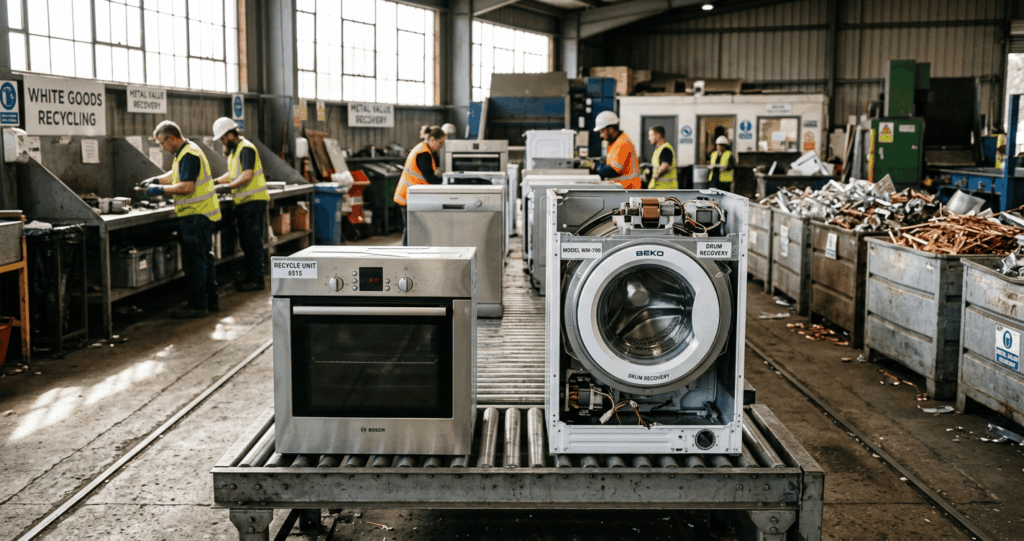

WEEE (Waste Electrical and Electronic Equipment) compliance costs are calculated primarily by weight. This means manufacturers of heavy, high-quality appliances – which last longer, end up in landfill less often, and are more recyclable due to higher metal content – pay more in compliance costs than manufacturers of lighter, lower-quality products. The system creates a perverse incentive against building durable appliances.
WEEE legislation was introduced with the goal of reducing electrical waste. A structural quirk in how compliance costs are calculated produces an outcome that works directly against this intention – penalising the manufacturers most likely to keep their appliances out of landfill.
What Is WEEE?
WEEE stands for Waste Electrical and Electronic Equipment. The UK WEEE Directive requires manufacturers to take responsibility for the end-of-life disposal and recycling of the electrical products they sell. Manufacturers must register and pay compliance costs based on the volume and weight of equipment they put onto the market.
“The WEEE Directive aims to both reduce the amount of electrical and electronic equipment being produced and to encourage everyone to reuse, recycle and recover it. The WEEE Directive also aims to improve the environmental performance of businesses that manufacture, supply, use, recycle and recover electrical and electronic equipment.”
UK Government – Waste electrical and electronic equipment (WEEE) responsibilities
The Unintended Consequence
WEEE compliance costs are substantially calculated by weight – specifically the weight of equipment placed onto the market. This creates a structural problem when applied to domestic appliances where quality and durability are closely correlated with weight.
 How the system currently works
- Compliance cost is based on the weight of appliances sold
- Lighter, cheaper appliances attract lower compliance costs
- Heavier, better-built appliances attract higher costs
- A manufacturer producing durable, repairable, metal-construction appliances pays more per unit than one producing lightweight, plastic-heavy, shorter-lifespan products
The environmental reality this ignores
- A heavy, high-quality appliance lasting 20 years reaches landfill once in 20 years
- A lightweight, low-quality appliance lasting 5 years reaches landfill four times in the same period
- Metal-heavy construction is generally more recyclable than plastic-heavy construction
- The total weight of waste generated by cheap appliances over their combined service life is higher than from quality appliances
“The targets for WEEE are based on weight of appliances / goods put into the market. A manufacturer’s WEEE Declaration has to state the weight of each appliance sold. So, the lighter you make them, the less that WEEE costs you… ISE and others, with even heavier and better-built machines get penalised even though they are designed to stay in use for longer. So effectively we pay more on ‘Green Tax’ even though we’re more environmentally friendly.”
Ken Watts, ISE appliances
Why This Matters for Consumers
Manufacturers of high-quality, durable appliances already face a structural disadvantage in the market. They produce heavier, more expensive machines that compete against cheaper, lighter alternatives from manufacturers who have reduced quality to keep prices down. WEEE compliance costs, calculated by weight, add to this disadvantage.
The practical effect is that a manufacturer committed to building appliances designed to last 15 to 20 years pays higher environmental compliance costs than one building appliances designed to last 5 to 7 years. This additional cost ultimately flows through to the consumer price of the higher-quality product – making it harder for durable appliances to compete on price.
The same dynamic applies to repairability. Right to Repair legislation now requires manufacturers to make spare parts available for a period after a model is discontinued – an improvement, but addressing a different aspect of the same underlying issue. See our guide on white goods Right to Repair.
Related Industry Guides
Related Guides
 Why Don’t Washing Machines Last?
How 50 years of price competition has reduced build quality – and what the inflation-adjusted numbers show.
 White Goods Right to Repair
What the UK Right to Repair legislation requires manufacturers to do – and what it means for consumers.
 Miele Washing Machines
Why Miele remains the benchmark for build quality and longevity in the UK washing machine market.
 Should We Replace Old Appliances to Save Energy?
Whether replacing working appliances actually delivers the environmental benefit claimed.
Frequently Asked Questions
What does WEEE stand for?
WEEE stands for Waste Electrical and Electronic Equipment. It is a UK and EU directive that requires manufacturers to take financial responsibility for the end-of-life recycling and disposal of the electrical products they sell. Manufacturers register with a compliance scheme and pay costs based on the volume and weight of equipment they place on the market each year.
Why does WEEE penalise manufacturers of quality appliances?
WEEE compliance costs are substantially calculated by weight of product sold. Higher-quality appliances tend to be heavier – they use more metal and denser materials in their construction. Manufacturers of quality, durable appliances therefore pay more per unit in compliance costs than manufacturers of lighter, cheaper products, even though the heavier appliances reach landfill far less frequently and are generally more recyclable due to their metal content.
Does WEEE legislation actually reduce appliance waste?
WEEE legislation has contributed to improved recycling infrastructure and raised compliance expectations across the industry. However, the weight-based calculation method creates an incentive structure that does not reward longevity or repairability. A system that factored in expected service life and recyclability of materials rather than simply weight of units sold would better align financial incentives with the stated environmental goals.
6 Comments
Grouped into 6 comment threads.
0 replies Excellent points Terry and topical given the results of the judicial review. Spot on with LDA's (Large Domestic Appliances), which have value, but a lot of that so called none availability of old appliances is due to compliance schemes wanting low cost bulk collections from Designated Collection Facilities rather than putting together plans to achieve the collection rates large enough to off-set their members tonnage. The only way to do that is beat the scrap man to door-step collections and that would be even more expensive than buying the evidence. I am delighted action is being taken on illegal shipments abroad it truly is the 'elephant in the room' and is happening because safe disposal cost money. The number of appliances through AAFTs (Approved Authorised Treatment Facilities) would be hugely helped if trade were allowed to drop electrical goods in to council run DCFs (Designated collection facility). I have never understood why this is an issue. If you did license properly councils could also establish a system for local traders to collect machines for commercial refurbishment which would help re-use, support local businesses and provide high quality low cost appliances within local community. This would also reduce the volume of low cost low lifespan appliances sold. To put the above in to context I know a guy who runs a private Designated Collection Facility he informs me 13% of what he gets back just works, up to 30% can be fixed for under £30 and if the cost of parts for certain manufacturers machines were not so high, up 80% of what he handles could but fixed and sold. Imaging that on a national basis. But that would require a coherent nation plan and removal of some to the licenses and stipulations which act as barriers for commercial re-conditioners.
0 replies Thank you both for your valuable contributions. I think manufacturers should be forced to display the average expected lifespan or designed for lifespan on the eco labels - Eco-labels suggestion It might be slightly off topic but if consumers could see how long products were designed for there would be less waste because they are likely to avoid products with unacceptably low design lifespans and favour those with higher ones.
Thank you both for your valuable contributions. I think manufacturers should be forced to display the average expected lifespan or designed for lifespan on the eco labels – Eco-labels suggestion It might be slightly off topic but if consumers could see how long products were designed for there would be less waste because they are likely to avoid products with unacceptably low design lifespans and favour those with higher ones.
0 replies 1 IPR (Individual Producer Responsibility) The labelling idea may have potential as it has the advantage that the "sustainability" of a product would be measured up front. The sustainability rating could then be applied to the weight of product placed on the market by the manufacturer. This would result in the producer of high quality but heavier products attracting some relief on their share of disposal costs. 2 It is true that Producer Compliance Schemes - PCS (and their manufacturer clients) only pick up costs for items processed by an Approved Authorised Treatment Facility (AATF). Ironically the complaint is that not enough Large domestic appliances are being made available to Producer Compliance Schemes. The reason of course is that there is substantial scrap value in the items. Now providing the "missing" LDAs are being processed correctly this is not an issue from an environmental perspective - but there are concerns over illegal exports. The Environment Agency (EA) are beginning to crack down and now have a project team specifically looking at illegal exports. They recently recorded their first major success when a site in Essex was raided and several hundred containers were opened for inspection. This resulted in several stop orders and some arrests. The EA strategy is to follow the trail up the line and discover the source of the items with potentially prosecutions to follow. 3 Spot on that Re-use has been very much the poor relation of Re-cycling despite both the Directive and UK Regs requiring re-use as a priority. But there are moves afoot to change things. There are several initiatives running to improve the re-use profile and it is to be hoped that the results of the recent consultations on the UK Regs and a recast EU Directive will give re-use a big boost.
1 IPR (Individual Producer Responsibility)
The labelling idea may have potential as it has the advantage that the “sustainability” of a product would be measured up front. The sustainability rating could then be applied to the weight of product placed on the market by the manufacturer. This would result in the producer of high quality but heavier products attracting some relief on their share of disposal costs.
2 It is true that Producer Compliance Schemes – PCS (and their manufacturer clients) only pick up costs for items processed by an Approved Authorised Treatment Facility (AATF). Ironically the complaint is that not enough Large domestic appliances are being made available to Producer Compliance Schemes. The reason of course is that there is substantial scrap value in the items. Now providing the “missing” LDAs are being processed correctly this is not an issue from an environmental perspective – but there are concerns over illegal exports. The Environment Agency (EA) are beginning to crack down and now have a project team specifically looking at illegal exports. They recently recorded their first major success when a site in Essex was raided and several hundred containers were opened for inspection. This resulted in several stop orders and some arrests. The EA strategy is to follow the trail up the line and discover the source of the items with potentially prosecutions to follow.
3 Spot on that Re-use has been very much the poor relation of Re-cycling despite both the Directive and UK Regs requiring re-use as a priority. But there are moves afoot to change things. There are several initiatives running to improve the re-use profile and it is to be hoped that the results of the recent consultations on the UK Regs and a recast EU Directive will give re-use a big boost.
0 replies I have had a lot of dealing with a number of agencies (including governmental ones) prior to and since the WEEE regulations came in to place. As I see it, while it is well meaning, there are three areas where the implementation of regulations work against the basic principle of reducing the number of machines that are thrown away each year. 1. IPR (Individual Producer Responsibility) Had the government stuck to it's guns and imposed a system on all manufacturers where if you own the brand you are responsible, the waste IPR could have been implemented. However, I am well aware that they would have faced legal challenges from the manufacturers association (AMDEA) relating to forcing members then to take responsibility for WEEE for companies who have now disappeared as part of acquisitions, even though in many case the brand names from the same companies are still used by their new parents. This means that the system we have is based on paying based on what a manufacturer sells, rather than what they scrap. The basic assumption here is that all machines have the same life-span. Not true; the best measure of likely machine lifespan are the factories own destruction test data, which measure how long a particular model of machine will run before it's parts start to wear and fail. In broad terms a 'VALUE' machine bought on the high street is built for around 800 cycles, a 'MID MARKET' machine around 2000, but some machines are as high as 8000. To achieve this level those manufacturers use higher grades of steel, making them twice as heavy. As WEEE is measured in weight, this means the manufacturers pay 20 times more per machine than those who make the least durable ones. Apart from being counter productive on WEEE, it begs the question why is destruction test data not a compulsory part of labeling for consumers when they purchase their machine? 2. Only the cost of re-cycling machines which go through government registered re-cyclers (AAFTs) are allocated to the manufacturers for payment. This means the fewer machines that get re-cycled, the less the manufacturers pay. In 2008 only 40% of the tonnage of Large Domestic Appliances put on the Market found it's way through the AAFTs (Approved Authorised Treatment Facilities). With cooling appliances this figure was less than 10%. This means that 9 out of 10 fridges that become waste when you purchase a new one simply disappear. Where they go, nobody knows or cares. Good news for manufacturers though as that saves them money - not good news for where they end up though, and it's worrying given that the Directive expressly forbids the export of electrical waste. 3. Re-use of waste does not count against manufacturers obligations To reduce their cost, manufacturers can (and some do) run schemes where instead of paying towards overall re-cycling costs they collect old appliances and put them through AAFTs (Approved Authorised Treatment Facilities), this offs their obligations. However, if they refurbish these products rather than re-cycling them this does not count against their obligation. How does this fit with the government's mantra of REDUCE, RE-USE, RE-RECYCLE? The spirit of the Directive and the officials who implemented and police it are all acting with the best of intentions, however what is happening on the ground is being influenced more by manufacturer's desires to keep down cost than their moral obligation to the environment.
I have had a lot of dealing with a number of agencies (including governmental ones) prior to and since the WEEE regulations came in to place. As I see it, while it is well meaning, there are three areas where the implementation of regulations work against the basic principle of reducing the number of machines that are thrown away each year.
1. IPR (Individual Producer Responsibility)
Had the government stuck to it’s guns and imposed a system on all manufacturers where if you own the brand you are responsible, the waste IPR could have been implemented. However, I am well aware that they would have faced legal challenges from the manufacturers association (AMDEA) relating to forcing members then to take responsibility for WEEE for companies who have now disappeared as part of acquisitions, even though in many case the brand names from the same companies are still used by their new parents.
This means that the system we have is based on paying based on what a manufacturer sells, rather than what they scrap. The basic assumption here is that all machines have the same life-span. Not true; the best measure of likely machine lifespan are the factories own destruction test data, which measure how long a particular model of machine will run before it’s parts start to wear and fail.
In broad terms a ‘VALUE’ machine bought on the high street is built for around 800 cycles, a ‘MID MARKET’ machine around 2000, but some machines are as high as 8000. To achieve this level those manufacturers use higher grades of steel, making them twice as heavy. As WEEE is measured in weight, this means the manufacturers pay 20 times more per machine than those who make the least durable ones.
Apart from being counter productive on WEEE, it begs the question why is destruction test data not a compulsory part of labeling for consumers when they purchase their machine?
2. Only the cost of re-cycling machines which go through government registered re-cyclers (AAFTs) are allocated to the manufacturers for payment.
This means the fewer machines that get re-cycled, the less the manufacturers pay. In 2008 only 40% of the tonnage of Large Domestic Appliances put on the Market found it’s way through the AAFTs (Approved Authorised Treatment Facilities). With cooling appliances this figure was less than 10%. This means that 9 out of 10 fridges that become waste when you purchase a new one simply disappear. Where they go, nobody knows or cares. Good news for manufacturers though as that saves them money – not good news for where they end up though, and it’s worrying given that the Directive expressly forbids the export of electrical waste.
3. Re-use of waste does not count against manufacturers obligations
To reduce their cost, manufacturers can (and some do) run schemes where instead of paying towards overall re-cycling costs they collect old appliances and put them through AAFTs (Approved Authorised Treatment Facilities), this offs their obligations. However, if they refurbish these products rather than re-cycling them this does not count against their obligation. How does this fit with the government’s mantra of REDUCE, RE-USE, RE-RECYCLE?
The spirit of the Directive and the officials who implemented and police it are all acting with the best of intentions, however what is happening on the ground is being influenced more by manufacturer’s desires to keep down cost than their moral obligation to the environment.
0 replies I thought the original idea was to add a cost to the manufacturers, which would encourage them to make better products that were more more repairable and would last longer. After much lobbying by manufacturers it seems to have corrupted into being penalised less for making lighter products. Ironically, Miele could reduce their WEEE costs considerably by substantially reducing the quality of their machines, replacing strong metal with cheap alloy or plastic. Replacing their chrome or stainless steel washing machine doors which virtually never break with cheap plastic ones that do - and so on. Have I got this wrong? Or is this right and is therefore a little crazy?
I thought the original idea was to add a cost to the manufacturers, which would encourage them to make better products that were more more repairable and would last longer.
After much lobbying by manufacturers it seems to have corrupted into being penalised less for making lighter products. Ironically, Miele could reduce their WEEE costs considerably by substantially reducing the quality of their machines, replacing strong metal with cheap alloy or plastic. Replacing their chrome or stainless steel washing machine doors which virtually never break with cheap plastic ones that do – and so on.
Have I got this wrong? Or is this right and is therefore a little crazy?
0 replies The EU WEEE Directive calls for Individual Producer Responsibility (IPR) i.e manufacturers pay for end of life disposal of their own products. The problem is how to implement this in practice. The idea of items being identified in the waste stream and separated out so that individual manaufacturers pay only for disposal of their own products is horendously expensive. We would all bear this cost as it would of course be reflected in the price of new items. Many manufacturers and academics have wrestled with this problem but there is no solution in sight yet. How should it be done ?
The EU WEEE Directive calls for Individual Producer Responsibility (IPR) i.e manufacturers pay for end of life disposal of their own products. The problem is how to implement this in practice. The idea of items being identified in the waste stream and separated out so that individual manaufacturers pay only for disposal of their own products is horendously expensive. We would all bear this cost as it would of course be reflected in the price of new items.
Many manufacturers and academics have wrestled with this problem but there is no solution in sight yet. How should it be done ?
Excellent points Terry and topical given the results of the judicial review.
Spot on with LDA’s (Large Domestic Appliances), which have value, but a lot of that so called none availability of old appliances is due to compliance schemes wanting low cost bulk collections from Designated Collection Facilities rather than putting together plans to achieve the collection rates large enough to off-set their members tonnage. The only way to do that is beat the scrap man to door-step collections and that would be even more expensive than buying the evidence.
I am delighted action is being taken on illegal shipments abroad it truly is the ‘elephant in the room’ and is happening because safe disposal cost money.
The number of appliances through AAFTs (Approved Authorised Treatment Facilities) would be hugely helped if trade were allowed to drop electrical goods in to council run DCFs (Designated collection facility). I have never understood why this is an issue. If you did license properly councils could also establish a system for local traders to collect machines for commercial refurbishment which would help re-use, support local businesses and provide high quality low cost appliances within local community. This would also reduce the volume of low cost low lifespan appliances sold.
To put the above in to context I know a guy who runs a private Designated Collection Facility he informs me 13% of what he gets back just works, up to 30% can be fixed for under £30 and if the cost of parts for certain manufacturers machines were not so high, up 80% of what he handles could but fixed and sold. Imaging that on a national basis.
But that would require a coherent nation plan and removal of some to the licenses and stipulations which act as barriers for commercial re-conditioners.