A Washing machine tripping or fusing electrics is a fault you can’t really deal with unless you have electrical knowledge, and a specialist insulation test meter. However, you might be able to do some basic checks as described in this article. A fusing washing machine can be caused by many different components, and many different wires or connections.
Most common causes for a washing machine fusing electrics
- The motor
- The heater
- The suppressor
- A wire shorting out somewhere
- Water getting onto an electrical part
Insulation test meter
 To properly diagnose a fusing washing machine you need an insulation test meter. These meters put 500 volts (DC) through the appliance and individual parts.
They can detect the slightest of leaks to earth (low insulation faults). So this isn’t a diy job. If you have the right equipment then you probably already know how to diagnose and deal with low insulation faults. If not, you should get someone in to look at it unless you can see something obvious like a chaffed wire.
If you can’t see anything it might be wiser to book an appliance repair
If you don’t have an insulation test meter
Without an insulation test meter you can’t do proper insulation tests, but it may be worth testing with an ordinary multimeter if that’s all you have. It should pick up a direct short to earth. For example, if you test for continuity between the heating element pins and its earth tag or any part of the metal on the element (remove wires before testing) there should be no continuity.
Warning
 Never test anything on an appliance when it is plugged in. Don’t try to test live parts. Disconnect from mains before testing.
If you do get a continuity reading, then electricity running through the heater will find a path to earth. This will trip rcds or fuse the plug. The same applies to any other part such as the motor. There should be no continuity between any electrical connection and earth (or the metal casing of the part). However, if no reading is found it doesn’t prove there is no fault.
No continuity may just mean a fault can’t be detected. A continuity test (or multimeter) uses a little as 3 volt’s. It can’t jump gaps, or pass through high resistance paths. But 230 volts from the mains can if there is a fault. This is why a proper insulation test meter is needed.
Exactly when is it tripping the electrics?
If you don’t have an insulation test meter, and/or you can’t find anything with a multimeter, the next best thing is to try to get clues by observing exactly when the machine trips out. If it’s as soon as you plug it in then it could be the suppressor (warning: suppressors and capacitors can give a nasty shock – even when unplugged).
Get Your Appliance Fixed
Fixed-price repairs, Pay monthly, Repair & protect..
If it only trips out after it has started filling with water and the drum first started to turn, then maybe it’s a fault on the motor. (If you suspect the motor then it should also trip on spin).
If it trips the electrics a short time after it has finished filling with water and has been turning the drum ok a few times then suspect the heater. (removing the heater from washing machine).
If it only trips out on spin then it could be a bare wire in the wiring somewhere that’s touching something metal when the drum is bouncing around. This can often be intermittent, only tripping with large loads when the drum bounces around much more.
Process of elimination
 A competent engineer should be able to find the cause of this fault quite quickly. But without an insulation test meter it’s a different story. You can disconnect the washer from the mains and do physical checks for any snagged or disconnected wires.
Buy new Heating element
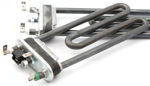 Buy a new heating element, or any other appliance part from Ransom Spares. A family run business with a friendly site and a price-match guarantee – Washing machine elements
Or for wires where the plastic insulation has been rubbing against something revealing the copper wire. This can short out if it touches something metal when the tub swings about on spin with a heavy load in.
If a part is suspected you can disconnect it to see if it stops the fusing. However this isn’t an ideal method. It could just trigger an error code.
And if it stops the tripping you can’t guarantee it means the part is faulty. For example, you could have a bare wire in the wiring harness to the motor which is shorting out on something.
You might disconnect the motor (moving the affected wire away from where it shorts out).
The washer no longer trips the electrics. So you buy a new motor at great expense. But it isn’t the motor.
The only way to truly test is with an insulation test meter. By the way they are far too expensive to buy to test one appliance. They are typically between £200 and £600 and carried by professional repair engineers.
If washer has tripped the RCD or fused – and now won’t work properly
 Most people will naturally reset or replace a fuse and try the appliance again. If it fuses or trips again do not keep repeating this pointless cycle. Clearly there is something drastically wrong, which needs fixing. Especially in the case of physically blowing a fuse. If you keep allowing something to blow the fuse it can cause more damage to components.
Also, it would be very stupid to try bypassing a fuse!
Occasionally the washer might work OK and appear to have suffered no ill effects. If so, keep an eye on it. If it does it again try to observe when it does it as described above to get clues of possible suspects. If the appliance starts up – but with something not working properly – then it needs repairing. Whatever fused has failed completely, or damaged something else.
If nothing is working at all other than some lights it could be the main suppressor or main pcb. If the motor no longer runs it could be that the motor is the problem and it’s failed completely. However it could also have blown something on the pcb. Without the right knowledge and a proper insulation test meter you need to call in an engineer.
Fused and door won’t open
 If the door won’t open and the washer has tripped the electrics it could have fused the door lock inside. This should only usually happen if there was a big flash, and maybe there isn’t an RCD fuse-board fitted (which should trip fast enough to not blow parts inside).
Alternatively it could even be the door lock that has tripped the electrics due to something shorting out inside (Washing Machine Door Will Not Open).
Notice how I keep saying, “could”? That’s not a good reason to speculatively by new parts. You need to be sure a part is faulty before thinking about buying one unless it’s cheap enough for you to be happy to take a risk on. And is also easy to replace.
Don’t get carried away

Over the years many experienced appliance repairmen have been seriously injured or killed.
Spares
Spares4Appliances is a spares company run by repair engineers who understand all about spare parts for appliances.
If it only trips when washing, and not when rinsing or spinning then it’s likely to be related to the heating element or connections.
My washer does not turn on because the water from my drain backed up and water got all over it and it was working in till water got on it and the light won’t turn on …I can hear it turn on but no lights if I let it sit and dry will it turn on
You would need to make sure everything inside it is totally dry before it will work, but it’s always possible some electrical components got damaged.
Hi
I have a hotpoint AQ113D 697E aqua kris washing machine.
It trips the whole electrics. I then have to let the water out from the drain/plug as it won’t start again.
It will then run on a spin cycle and a rinse cycle fine but if I try a full wash it trips after its full of water. I’m thinking it’s probably the heater?
How would I go about checking this or is it easier just to change?
Any help would be great full.
Thanks Paul
Hi Andy I have a Hotpoint washing machine just over a year old , it has started tripping the fuse, if I turn the machine off reset the fuse it automatically turns the washing machine on!!! Any ideas please
Hello valve. Unfortunately all my ideas already in this article. The only thing I can suggest this to carefully read all of my article above because I thought of all possible causes and actions for a fusing washing machine. But as you will see from the article, if you do not have an insulation test meter you are limited to what you can do.
Hi, I have a Hotpoint WMYF 822 washing machine. Fairly new, couple of years old. Worked fine until recently, couldn’t get machine to power up. Changed fuse in socket and worked fine. Next day, same thing happened, change fuse, all OK. The machine works fine and never stops mid cycle. If we do multiple loads, it’s fine too. The problem occurs only if we haven’t used machine for a day or so. The weird thing is though is that it is not blowing the fuses. I change fuse for an old one and works fine. It’s getting a little frustrating now. I’ve tried other appliances in sockets and no problem so pretty sure it is a machine fault. Any ideas ? Many thanks in advance :-)
Hello Maurice. That seems bizarre. If you are saying that replacing the fuse gets it going again, but the fuses aren’t actually blowing I would say you must be inadvertently fixing the issue simply by unplugging it, working inside the plug, and plugging it back in. Obviously if the fuse you replace has not actually blown then it can’t possibly be replacing the fuse that is getting it running again only something that is being disturbed or adjusted during the process. The first thing you need to do is try running the machine in a totally different socket. If there isn’t one available try using a good quality extension cable.
I would suspect that the wall socket is worn, or has a loose fitting or connection inside or there is something wrong inside the plug or in the mains cable of the washing machine. If the fault still occurs when plugged into an entirely different socket I would cut off 2 or 3 inches of the mains cable (assuming it is long enough) and fit a new plug altogether to discount any problem inside the plug or the mains cable running into it.
Thanks for your detailed reply Andy. I had an electrician out today ( friend of mine ) and he is baffled. He tested power to socket after washing machine failed to power up and power definitely at socket. He cannot understand how taking a fuse out and putting back the SAME fuse rectifies it ! He checked power cable and socket, no problem. The machine is only 2 years old and is in very good order. So, still none the wiser. I can rule out my sockets, so, it is a machine fault but how can flipping a fuse in a plug socket rectify it ? To be honest, I’m loathe to get an engineer out for this. I’ll just keep flipping the fuse but it is a very strange fault and I’d love to know if anyone else has suffered something similar. Thanks again for your help Andy :-)
Hello Maurice. Changing a fuse which is still working for another can’t possibly fix anything and we both know it :) The only explanation is that the act of removing the plug and fiddling about with it to change the fuse is somehow reinstating a connection that had failed. A break in the mains cable (often around where the cord goes into the cord grip) can do it. It’s possible for the copper wire inside the neutral or live to be broken but still touching, and just moving or twisting the wire can make or break the connection.
I’m assuming that you have also tried just unplugging and re-plugging in instead of changing the fuse? Have you used the “old” fuses in other appliances to prove they are working OK? Have you tried just unplugging the machine, taking the plug cover off, just having a look inside and refitting everything?
You need to cut 2 inches off the washing machine cable and fit a new plug to eliminate those two possibilities. Otherwise you are leaving a theoretical possible cause in place. Even though it may well make no difference unless you do it you can’t be 100% sure it isn’t that. If it isn’t that, it has to be a fault on the socket (bear in mind the fault is highly unusual and the washer works perfectly ok for long periods so “testing” it may not discover anything.
Thanks Andy, I’ll give your suggestions a crack and will let you know how I get on .
Proof for us was that it didn’t trip while on a cold wash – so it has to be to do with the heater circuit – not sure yet if a loose wire on the heater element