A Washing machine tripping or fusing electrics is a fault you can’t really deal with unless you have electrical knowledge, and a specialist insulation test meter. However, you might be able to do some basic checks as described in this article. A fusing washing machine can be caused by many different components, and many different wires or connections.
Most common causes for a washing machine fusing electrics
- The motor
- The heater
- The suppressor
- A wire shorting out somewhere
- Water getting onto an electrical part
Insulation test meter
 To properly diagnose a fusing washing machine you need an insulation test meter. These meters put 500 volts (DC) through the appliance and individual parts.
They can detect the slightest of leaks to earth (low insulation faults). So this isn’t a diy job. If you have the right equipment then you probably already know how to diagnose and deal with low insulation faults. If not, you should get someone in to look at it unless you can see something obvious like a chaffed wire.
If you can’t see anything it might be wiser to book an appliance repair
If you don’t have an insulation test meter
Without an insulation test meter you can’t do proper insulation tests, but it may be worth testing with an ordinary multimeter if that’s all you have. It should pick up a direct short to earth. For example, if you test for continuity between the heating element pins and its earth tag or any part of the metal on the element (remove wires before testing) there should be no continuity.
Warning
 Never test anything on an appliance when it is plugged in. Don’t try to test live parts. Disconnect from mains before testing.
If you do get a continuity reading, then electricity running through the heater will find a path to earth. This will trip rcds or fuse the plug. The same applies to any other part such as the motor. There should be no continuity between any electrical connection and earth (or the metal casing of the part). However, if no reading is found it doesn’t prove there is no fault.
No continuity may just mean a fault can’t be detected. A continuity test (or multimeter) uses a little as 3 volt’s. It can’t jump gaps, or pass through high resistance paths. But 230 volts from the mains can if there is a fault. This is why a proper insulation test meter is needed.
Exactly when is it tripping the electrics?
If you don’t have an insulation test meter, and/or you can’t find anything with a multimeter, the next best thing is to try to get clues by observing exactly when the machine trips out. If it’s as soon as you plug it in then it could be the suppressor (warning: suppressors and capacitors can give a nasty shock – even when unplugged).
Get Your Appliance Fixed
Fixed-price repairs, Pay monthly, Repair & protect..
If it only trips out after it has started filling with water and the drum first started to turn, then maybe it’s a fault on the motor. (If you suspect the motor then it should also trip on spin).
If it trips the electrics a short time after it has finished filling with water and has been turning the drum ok a few times then suspect the heater. (removing the heater from washing machine).
If it only trips out on spin then it could be a bare wire in the wiring somewhere that’s touching something metal when the drum is bouncing around. This can often be intermittent, only tripping with large loads when the drum bounces around much more.
Process of elimination
 A competent engineer should be able to find the cause of this fault quite quickly. But without an insulation test meter it’s a different story. You can disconnect the washer from the mains and do physical checks for any snagged or disconnected wires.
Buy new Heating element
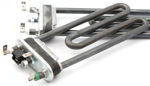 Buy a new heating element, or any other appliance part from Ransom Spares. A family run business with a friendly site and a price-match guarantee – Washing machine elements
Or for wires where the plastic insulation has been rubbing against something revealing the copper wire. This can short out if it touches something metal when the tub swings about on spin with a heavy load in.
If a part is suspected you can disconnect it to see if it stops the fusing. However this isn’t an ideal method. It could just trigger an error code.
And if it stops the tripping you can’t guarantee it means the part is faulty. For example, you could have a bare wire in the wiring harness to the motor which is shorting out on something.
You might disconnect the motor (moving the affected wire away from where it shorts out).
The washer no longer trips the electrics. So you buy a new motor at great expense. But it isn’t the motor.
The only way to truly test is with an insulation test meter. By the way they are far too expensive to buy to test one appliance. They are typically between £200 and £600 and carried by professional repair engineers.
If washer has tripped the RCD or fused – and now won’t work properly
 Most people will naturally reset or replace a fuse and try the appliance again. If it fuses or trips again do not keep repeating this pointless cycle. Clearly there is something drastically wrong, which needs fixing. Especially in the case of physically blowing a fuse. If you keep allowing something to blow the fuse it can cause more damage to components.
Also, it would be very stupid to try bypassing a fuse!
Occasionally the washer might work OK and appear to have suffered no ill effects. If so, keep an eye on it. If it does it again try to observe when it does it as described above to get clues of possible suspects. If the appliance starts up – but with something not working properly – then it needs repairing. Whatever fused has failed completely, or damaged something else.
If nothing is working at all other than some lights it could be the main suppressor or main pcb. If the motor no longer runs it could be that the motor is the problem and it’s failed completely. However it could also have blown something on the pcb. Without the right knowledge and a proper insulation test meter you need to call in an engineer.
Fused and door won’t open
 If the door won’t open and the washer has tripped the electrics it could have fused the door lock inside. This should only usually happen if there was a big flash, and maybe there isn’t an RCD fuse-board fitted (which should trip fast enough to not blow parts inside).
Alternatively it could even be the door lock that has tripped the electrics due to something shorting out inside (Washing Machine Door Will Not Open).
Notice how I keep saying, “could”? That’s not a good reason to speculatively by new parts. You need to be sure a part is faulty before thinking about buying one unless it’s cheap enough for you to be happy to take a risk on. And is also easy to replace.
Don’t get carried away

Over the years many experienced appliance repairmen have been seriously injured or killed.
Spares
Spares4Appliances is a spares company run by repair engineers who understand all about spare parts for appliances.
Hello Scott. Yes it could be the heating element. If the drum is turning ok whilst it’s filling up then it’s not likely to be the motor. The only things that kick in on wash are the motor and the heater. Depending on how accessible the heater is (some are easy and others need stripping down to get to them) you could try disconnecting the heater making sure the wires are safely insulated and not able to catch on anything. This should trigger a time out on heat error but hopefully it would not trip any more.
However, if it was the heater I would expect it to trip quite quickly after filling up and not half way through a cycle.
Hi Andy,
Very interesting and comprehensive article, thanks. My 14 year old Bosch classixx machine has never had a fault until last night. Essentially the machine runs fine until the spin cycle at the end – once it gets up to full speed it is tripping out the mains with a distinct smell coming from the machine like something has shorted out and potentially melted. Not a technical person at all so have had a brief look and can’t see anything obviously melted etc. Can I ask whether it is actually worth getting someone to look at it to fix it or am I best just biting the bullet and buying a new machine? If it really could be anything causing this is it going to cost a lot in terms of the call out and potential parts? I had an experience a few years back where I was repeatedly replacing parts on a tumble dryer and would prefer not to throw good money after bad.
Cheers,
David
Thanks David. 14 years is pretty amazing these days. Even back in the good old days 14 years was a respectable age. Therefore it’s not likely to be worth spending a lot. It sounds like possibly the motor may be playing up. Can you hear any sparking or strange noises just before it cuts out? Another possibility is if something is shorting out when the tub bounces around on spin.
To test the latter try it on spin with no laundry in so the tub won’t move at all during spin. To test the former I would taking the back off, position myself behind where I can see the motor and watch it on spin to see if I could observe any nasty sparking from the motor or anywhere during the spin cycle.
Hi Andy. Could you help me please. My candy washing machine is on the blink. When I turn it on at the wall it blows the fuse and makes an electrical bang somewhere in the guts of the machine. I have left for a couple of days with the dehumidifier next to it with the back panel removed from wash machine. Tested today still blowing fuse and making bang sound. Is there anything else Barr calling an engineer you can advise me to do ?
Much appreciated for your time in advance
Paul
Hello Paul. My article was written to advise on what to do if a washing machine is fusing electrics or tripping so I honestly can’t think of anything else to add to my article above. However, if it making a loud bang when it happens the only thing you could possibly try is to take the lid on the back panel and very carefully see if you can spot where the bang is coming from.
Even then though you won’t know what is definitely causing it. For example it could be the motor blowing the PCB because the motor is shorting down-to-earth. But witnessing the PCB flashing is not much help because if you were to just replace the PCB the motor would blow the new one too. As I say in my article you cannot diagnose this fault without a proper insulation test meter. If you are lucky enough to spot a flash somewhere though and can trace it to something simple like bare wire touching the casing then that would be one of the rare cases where the lack of an insulation test meter wouldn’t necessarily prevent diagnosis.
Hi Andy I’m having a few problems with my washing machine tripping my mains electricity this doesn’t happen all the time and it happens anywhere in the cycle sometimes I start the washer and it trips instantly or when it fills/empty/spins can trip on any setting but then other times it works great you wouldn’t think anything was wrong with it but today it’s tripped 4 times on a 30 mins was 1st wash of the day I have now done 2 more washes and not had a problem with it in got no way of testing machine just wanted to see if you have any idea what it could be
Hello Chris. With a fault so intermittent, combined with the lack of an insulation test meter you are likely to struggle to get to the bottom of this. Even an engineer with a meter may not find anything. The reason I say this is that when he tests the washing machine with an insulation test meter he may very well find nothing shows up. If there is anything shorting to earth then it should trip the electrics every time without fail. The fact that it doesn’t, and it can go through entire washes without tripping the electrics implies strongly that there is no part on the machine that is leaking to earth. Therefore testing with a meter may not show anything.
It is possible he could get a low reading which might implicate a particular part, but I’m not aware of parts that leak to earth intermittently. The only possible contender might be a motor, which if running poorly and sparking badly could occasionally cause the electrics to trip.
So, even an engineer may not be able to find anything with it being so intermittent. He could turn up, put the meter over it and find nothing wrong, then sit and watch the machine for half an hour in which time it is unlikely to trip, and if it doesn’t trip the electrics what can he do?
On the other hand, intermittent tripping of this sort can be caused by water leaking onto part, with the amount of water leaking varying dependent upon which wash cycle is being used and how heavy the loaders. Another contender could be something as simple as a wire in the machine which has rubbed against something exposing a copper wire inside which occasionally touches earth depending on where it is lying inside the machine. Washing machines moves about a lot and can disturb wiring that runs up and down the casing. Something like that may be found quite quickly by an experienced engineer.
So in summary unless you could spot anything like a loose or worn wire, or could see that it is leaking onto something you have no chance of finding the problem without a test meter. The very first thing any engineer would do after being called out to an appliance tripping the electrics is to put the insulation test meter across Earth, live and neutral.
Hello
My neighbour has an old washing machine, unknown age or make. Each time it is started, it works for between 3 and 5 minutes before it trips the circuit board. After turning electric back on, moving dial to another position in the cycle, it again works for 3 – 5 minutes before trupping out again. Whichever part of the cylcle the dial is moved to, it always works for a while then trips. Any ideas so we can have a quick look before she buys a new machine? Thanks
Tripping after 3 to 5 minutes could be a leak running onto something or a wire catching somewhere. It’s unusual. If it does it on spin only with no water let in though you can discount a leak.
I have read your article with interest as I have just had a similar problem. I have a 18 month old Hotpoint WMUD 10637 P ultima washing machine which is tripping the RCD. This seems to happen 15-30 seconds into a wash cycle. However, after manually opening the door and removing the clothes I put it on the ‘spin/rinse/pump out’ programme which operated correctly. I tried a wash cycle again with the same results. The ‘spin/rinse/pump out’ always works correctly. Do you have any ideas on the cause before I commit to calling out an engineer? Also, would you recommend calling an engineer via the Hotpoint phone line or contacting a local engineer? Any help would be greatly appreciated as I am already drowning under a pile of kids clothes!
Many thanks.