
Washing performance ratings on eco labels
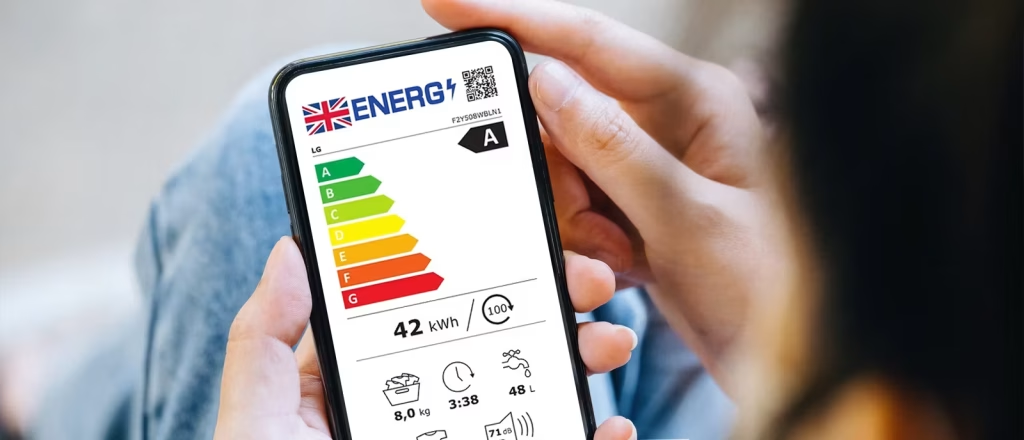

The washing performance rating on a washing machine energy label is one of its least useful figures. It is based on a single wash programme – a 60-degree cotton cycle – and virtually every machine on the market achieves the same top rating. It tells you almost nothing meaningful about how well a machine actually washes in everyday use.
This is Part 3 of the Whitegoods Help guide to washing machine energy labels, covering the washing performance rating – what it measures, how it is assessed, and why it has become largely redundant as a tool for comparing machines.
What Does the Washing Performance Rating Measure?
The washing performance rating appears on the energy label as a letter grade on a scale from A to G, where A represents the highest rated performance. The intention was straightforward: to give consumers a way to compare how effectively different machines clean laundry, in the same way the energy efficiency rating compares running costs.
In practice, the washing performance rating has a fundamental problem that makes it almost useless for comparison purposes – virtually every machine achieves the same rating, regardless of its actual washing quality.
Why the Rating Has Become Meaningless
Once manufacturers understood that achieving a top wash performance rating was commercially important, they designed their programmes to meet the test criteria. The result is that the overwhelming majority of washing machines – from premium models to the cheapest budget machines – now achieve the same top grade on the wash performance scale. A rating that was supposed to differentiate quality has instead become a marketing minimum that almost everyone meets.
The 2021 energy label reform reset the efficiency scale but did not fundamentally change the approach to wash performance testing. The structural problem – that the test is too narrow to meaningfully separate machines – remains.

Because virtually all machines achieve the same grade, the rating cannot be used to distinguish between them. A budget machine with a poor real-world reputation and a premium machine with an excellent one will typically carry identical wash performance ratings.
The Single Cycle Problem
The wash performance rating is not based on testing across a range of programmes. It is assessed using a single wash cycle – a 60-degree cotton wash – and the grade awarded applies to that one programme only. The rest of the machine’s wash cycles are not assessed as part of the rating.
This creates a significant gap between what the rating appears to say and what it actually means. Most consumers will reasonably assume that an A-rated machine has been assessed and found to wash well across its programmes. That is not the case. A machine could theoretically perform well on the rated 60-degree cycle and poorly on every other programme it offers, and the label would not reflect this at all.
 What the Rating Covers
A single 60-degree cotton wash programme, tested under standardised laboratory conditions. The grade reflects performance on this cycle only.
 What the Rating Does Not Cover
Every other programme the machine offers – quick washes, lower temperatures, delicate cycles, and the cycles most households use on a daily basis.
Why 60 Degrees Is a Poor Choice of Test Cycle
The 60-degree cotton wash was chosen as the basis for the washing performance test, but it is among the least commonly used programmes in most households. The majority of everyday washing is done at 30 or 40 degrees, on cycles most people use far more frequently than a hot cotton wash.
Basing the entire wash performance rating on a cycle that most people rarely run means the grade has very little bearing on the performance that matters most to most users.
There is a further complication: independent testing has found that a significant number of machines do not actually reach their advertised temperature on the 60-degree cycle. A machine that runs its 60-degree programme at only 43 to 50 degrees will use less energy during the test – which may help its energy efficiency rating – but is not delivering what the user expects. For more detail on this, see our guide on washing machines not delivering the right temperature.
Longer Cycles: A Better Rating, Not Better Washing
Some machines achieve a stronger wash performance rating by extending the duration of the rated programme – sometimes to two or three hours. A longer cycle at the same temperature can improve wash results on the test, but in practice it leads many users to avoid the programme entirely in favour of quicker options. This can result in lower wash temperatures, more residue left on laundry, and detergent build-up inside the machine over time.
Two machines can achieve an identical wash performance rating, but one may complete its rated cycle in 90 minutes while the other takes over two and a half hours. The label shows the same grade for both.
What Should You Use Instead?
Given the limitations of the wash performance rating, independent reviews and long-term reliability data from owners are more useful guides to real-world washing quality. Look for reviews that assess performance across a range of cycles and temperatures, not just the headline programme.
For broader context on what energy labels can and cannot tell you, see our companion article on how designing for eco labels can be misleading.
Need Help With a Washing Machine?
Whether you need a repair or genuine spare parts, Whitegoods Help can point you in the right direction.
Energy Label Series: All Parts
 Part 1: Energy Efficiency Ratings
What the A to G energy efficiency rating measures and how to interpret it when comparing machines.
 Part 2: Energy Consumption (kWh per Cycle)
How to read the energy consumption figure and what it means for your actual running costs.
 Part 4: Spin, Water Use and Noise
The remaining label data points – spin drying performance, water consumption, and noise ratings – explained.
 Are Eco Labels Misleading?
Why energy labels do not tell the full story about running costs, reliability, or environmental impact.
Frequently Asked Questions
What does the washing performance rating on an energy label actually measure?
It measures how well the machine performs on a single 60-degree cotton wash cycle under standardised test conditions. It does not assess performance on any other programme, and it does not measure rinsing quality, performance at lower temperatures, or how the machine performs on the cycles most people use every day.
Why do almost all washing machines have the same wash performance rating?
Because manufacturers optimise their products to pass the specific test used to generate the rating. Since the test uses only one cycle, it is straightforward to engineer a machine that scores well on that programme. The result is that virtually every machine – from budget to premium – achieves the same top grade, making the rating useless for comparison.
Does a top wash performance rating mean the machine washes well on all cycles?
No. The rating applies only to the 60-degree cotton programme used in the test. A machine with a top wash performance rating may perform quite differently on the programmes most households use daily – 30 and 40-degree cycles, quick washes, and delicate programmes are not assessed.
Why is the 60-degree wash used as the test cycle?
It was chosen as a standardised, reproducible test. However, it is one of the least commonly used cycles in most households, which means the rating has limited relevance to everyday washing performance. Most people wash at 30 or 40 degrees far more frequently than at 60 degrees.
Should I pay attention to the wash performance rating when buying?
Not in isolation. Because virtually all machines achieve the same rating, it cannot be used to differentiate between them. Independent reviews that test performance across multiple cycles and temperatures will give you far more useful information about real-world washing quality.
Ask the repair forum
Post the make, model and symptoms and get help from the Whitegoods Help community.
6 Comments
Grouped into 6 comment threads.
0 replies For what it's worth, the labels are meant to mean something and the information is out there! The regulation about washing machines spin performance relates to the measured water left after a weighted average of programmes. Obviously this gives the manufacturers an incentive to design to the test instead of good design. Spin-drying efficiency class | Remaining moisture content| A (most efficient) | % < 45 | B | 45 ≤ % < 54 | C | 54 ≤ % < 63 | D | 63 ≤ % < 72 | E | 72 ≤ % < 81 | F | 81 ≤ % < 90 | G (least efficient) | % ≥ 90 | The law is called Commission Delegated Regulation (EU) No 1061/2010 of 28 September 2010 supplementing Directive 2010/30/EU of the European Parliament and of the Council with regard to energy labelling of household washing machines https://eur-lex.europa.eu/LexUriServ/LexUriServ.do?uri=CELEX:32010R1061:EN:NOT
0 replies Dave On the Which? website you can see what their members think of every product tested, not just the best buys. On a "best buy" washer-dryer for instance, there are plenty of negative views from Which? members who bought that model. I would rather trust Which? to test a washing machine than rely on the useless eco labels. The eco labels don't even tell you how well a washing machine rinses, but Which? test for that, obviously important if you are sensitive to detergents. I'm not saying Which? are perfect, but at least you get a good idea before you buy something major. When it's time to buy something such as a mobile phone, I will look at all the best buys and also read the members' views to see if they have any criticisms about the product they've paid for.
Dave
On the Which? website you can see what their members think of every product tested, not just the best buys. On a “best buy” washer-dryer for instance, there are plenty of negative views from Which? members who bought that model.
I would rather trust Which? to test a washing machine than rely on the useless eco labels. The eco labels don’t even tell you how well a washing machine rinses, but Which? test for that, obviously important if you are sensitive to detergents.
I’m not saying Which? are perfect, but at least you get a good idea before you buy something major. When it’s time to buy something such as a mobile phone, I will look at all the best buys and also read the members’ views to see if they have any criticisms about the product they’ve paid for.
0 replies I'm interested in WhatMatters' comment (No3 above). I've been a member of Which? several times in the past but each time I've given up in disgust after buying Which? recommended products which WERE utter and complete rubbish. These have included a CD Player, a Dishwasher and a Lawnmower. Granted that the CD player was back in 1986 when they were quite new and the Dishwasher back in 1988 and I realise that things have changed a great deal since then. What annoys me most (other than their recommended products turing out to be rubbish) is Which?'s extremely high-handed attitude to what they actually test. My most recent "trial" subscription was when I was forced to buy a new washing machine just over a year ago and wanted one with a hot fill. When I enquired of Which? why they did not test any of the LG ones which have hot fill (LG being the only brand available in the UK to make any hot fill machines any more as far as I know) the woman, who I can only describe as "Snotty" said "oh we don't test those, that's a very old fashioned request". When I pointed out that Which? do test Solar Water heating, and that I have solar water heating and that's exactly why I wanted a hot fill washer, she was clearly taken aback, and obviously had never thought of this connection before, and fumbled for a response before eventually muttering that she would put my suggestion forward for consideration in future reviews. Fat lot of use that is! Similarly I cannot trust the Energy Savings Trust who awarded the LG machine that I bought an award for energy efficiency. This is patently a joke since the machine uses around 4 units of electricity for a wash cycle on the programme nominated for testing, compared to my 26 year old Hoover that I had last which used less than 1 unit for a hotter wash of similar type. When I asked The Energy Savings Trust about this their response was that "modern machines will always use more power than older ones because they have more features, but we can advise you which modern ones are the most efficient in their class". What a load of utter loblocks - clearly not to be trusted at all.
I’m interested in WhatMatters’ comment (No3 above).
I’ve been a member of Which? several times in the past but each time I’ve given up in disgust after buying Which? recommended products which WERE utter and complete rubbish. These have included a CD Player, a Dishwasher and a Lawnmower. Granted that the CD player was back in 1986 when they were quite new and the Dishwasher back in 1988 and I realise that things have changed a great deal since then.
What annoys me most (other than their recommended products turing out to be rubbish) is Which?’s extremely high-handed attitude to what they actually test. My most recent “trial” subscription was when I was forced to buy a new washing machine just over a year ago and wanted one with a hot fill.
When I enquired of Which? why they did not test any of the LG ones which have hot fill (LG being the only brand available in the UK to make any hot fill machines any more as far as I know) the woman, who I can only describe as “Snotty” said “oh we don’t test those, that’s a very old fashioned request”. When I pointed out that Which? do test Solar Water heating, and that I have solar water heating and that’s exactly why I wanted a hot fill washer, she was clearly taken aback, and obviously had never thought of this connection before, and fumbled for a response before eventually muttering that she would put my suggestion forward for consideration in future reviews. Fat lot of use that is!
Similarly I cannot trust the Energy Savings Trust who awarded the LG machine that I bought an award for energy efficiency. This is patently a joke since the machine uses around 4 units of electricity for a wash cycle on the programme nominated for testing, compared to my 26 year old Hoover that I had last which used less than 1 unit for a hotter wash of similar type. When I asked The Energy Savings Trust about this their response was that “modern machines will always use more power than older ones because they have more features, but we can advise you which modern ones are the most efficient in their class”. What a load of utter loblocks – clearly not to be trusted at all.
0 replies You can only trust "Which?" reports on washing machines' cleaning performance. The Which? tests are performed using programmes and temperatures that consumers actually use and the washing machines have to shift some very tough stains to get good marks. I don't work for Which? but I'm a member and would encourage others to sign up for Which? to avoid wasting money on products that are absolute rubbish.
You can only trust “Which?” reports on washing machines’ cleaning performance. The Which? tests are performed using programmes and temperatures that consumers actually use and the washing machines have to shift some very tough stains to get good marks.
I don’t work for Which? but I’m a member and would encourage others to sign up for Which? to avoid wasting money on products that are absolute rubbish.
0 replies P.S Andy thanks for the interesting new article, look forward to seeing good contributions in the near future! Oliver
P.S Andy thanks for the interesting new article, look forward to seeing good contributions in the near future!
Oliver
0 replies Hello Andy, Going to start a good debate here! Where to start, you are quite correct that the "A" wash rating is absolute rubbish , have researched this and only found 1 washing machine not to have it........HEC priced at only £156.49, no wonder it is a "B", at Argos. Now I know this is one of those cheap sh1te Chinese affairs! But all the others, even all cheapo Merlonis have an "A"! So you are qtite correct it tells you nothing! I have a 15 year old Bosch and it washes and rinses FAR better than any modern machine you can buy today, mainly because of the high water usage. I had a Hotpoint proir to this and it was a new efficient model, it did NOT get clothes clean and the rinsing was abysmol. I wouldn't have any modern machine again their performance like you say is tailored to economy not good cleaning and rinsing performance. And on to the long cycle times, modern "A" rated washers wash in excess of one hour some even as long as two before they start to rinse, not only will this wear out the machine much quicker but will ruin you clothing bobbling it and removing the colour etc. Going back to my Bosch, it washes for no more than 20-40 minutes dependant on the temperature and cycle chosen, I have an "intensive" option button but it washes so well find it not to be needed. I am even able to wash alot of things with the "Short wash" button selected, meaning no more than a 20 minute wash! The rinsing and spin only take about 45 minutes meaning the programmes are very short and whats more wash better to! Making machines wash for longer is bad for the environment because they wear out faster and with machines not being built like they used to be some don't even make it past the warranty period, meaning more land fill. Also with spare parts being extortionate, virtually no body repairs them any more and they get thrown away! Throw away society springs to mind. Like Andy clearly states washing machines are tested on "Cotton 60" a very long high temperature wash, that no one uses! So they should test "Cotton 40" the most commonly used cycle in Britain, they could test both! Some 60 cycles wash for in excess of 3 hours, thats 3 times longer than my Bosch. Now on to this eco bandwagon trend of low temperature washing, this is less effective at removing dirt than say a 60 wash, so even longer cycles. But thats not really the issue, if you constantly wash at 30/40 degrees your poor washing machine will pay the price, it will get all gunked up and rot away the drum spider, meaning that at least once a month the 90/95 maintanence wash is needed with either a bleach containig powder or washing machine cleaner such as Maytag Affresh! If not its either engineer time or new washer time!! Personally I wash 90% of things on Cotton 60 or Cotton economy 60, both good at killing bacteria in towels etc. Low temperatures do not kill bacteria, meaning not only you laundry may smell but your washer will some what HUM!! Hope to recieve some comments on this, especially from Andy and Dave, should be very interesting!! All the best Oliver
Hello Andy,
Going to start a good debate here!
Where to start, you are quite correct that the “A” wash rating is absolute rubbish , have researched this and only found 1 washing machine not to have it……..HEC priced at only £156.49, no wonder it is a “B”, at Argos. Now I know this is one of those cheap sh1te Chinese affairs! But all the others, even all cheapo Merlonis have an “A”! So you are qtite correct it tells you nothing!
I have a 15 year old Bosch and it washes and rinses FAR better than any modern machine you can buy today, mainly because of the high water usage. I had a Hotpoint proir to this and it was a new efficient model, it did NOT get clothes clean and the rinsing was abysmol. I wouldn’t have any modern machine again their performance like you say is tailored to economy not good cleaning and rinsing performance.
And on to the long cycle times, modern “A” rated washers wash in excess of one hour some even as long as two before they start to rinse, not only will this wear out the machine much quicker but will ruin you clothing bobbling it and removing the colour etc. Going back to my Bosch, it washes for no more than 20-40 minutes dependant on the temperature and cycle chosen, I have an “intensive” option button but it washes so well find it not to be needed. I am even able to wash alot of things with the “Short wash” button selected, meaning no more than a 20 minute wash! The rinsing and spin only take about 45 minutes meaning the programmes are very short and whats more wash better to!
Making machines wash for longer is bad for the environment because they wear out faster and with machines not being built like they used to be some don’t even make it past the warranty period, meaning more land fill. Also with spare parts being extortionate, virtually no body repairs them any more and they get thrown away! Throw away society springs to mind.
Like Andy clearly states washing machines are tested on “Cotton 60” a very long high temperature wash, that no one uses! So they should test “Cotton 40” the most commonly used cycle in Britain, they could test both! Some 60 cycles wash for in excess of 3 hours, thats 3 times longer than my Bosch.
Now on to this eco bandwagon trend of low temperature washing, this is less effective at removing dirt than say a 60 wash, so even longer cycles. But thats not really the issue, if you constantly wash at 30/40 degrees your poor washing machine will pay the price, it will get all gunked up and rot away the drum spider, meaning that at least once a month the 90/95 maintanence wash is needed with either a bleach containig powder or washing machine cleaner such as Maytag Affresh! If not its either engineer time or new washer time!!
Personally I wash 90% of things on Cotton 60 or Cotton economy 60, both good at killing bacteria in towels etc. Low temperatures do not kill bacteria, meaning not only you laundry may smell but your washer will some what HUM!!
Hope to recieve some comments on this, especially from Andy and Dave, should be very interesting!!
All the best
Oliver
For what it’s worth, the labels are meant to mean something and the information is out there! The regulation about washing machines spin performance relates to the measured water left after a weighted average of programmes. Obviously this gives the manufacturers an incentive to design to the test instead of good design.
Spin-drying efficiency class | Remaining moisture content|
A (most efficient) | % < 45 |
B | 45 ≤ % < 54 |
C | 54 ≤ % < 63 |
D | 63 ≤ % < 72 |
E | 72 ≤ % < 81 |
F | 81 ≤ % < 90 |
G (least efficient) | % ≥ 90 |
The law is called
Commission Delegated Regulation (EU) No 1061/2010 of 28 September 2010 supplementing Directive 2010/30/EU of the European Parliament and of the Council with regard to energy labelling of household washing machines
https://eur-lex.europa.eu/LexUriServ/LexUriServ.do?uri=CELEX:32010R1061:EN:NOT