Yes, it’s sometimes possible to do an effective repair on a washing machine drum, and this article tells you how. It describes 3 different methods of sealing a cracked drum. Virtually all washing machine outer drums (or tubs as they used to be called) are now made out of plastic. Now they can no longer rust, which is great, but there is a big disadvantage. Coins, or other metal obstructions, can now all too easily crack or put a hole in a drum, causing it to leak – or even flood.
Before fixing the damaged drum
Coins are a common cause of cracks in the drum, but anything metal can cause damage. If you find just a thin crack, then it was probably caused by the impact of an object. This object will still be inside the washing machine somewhere. But if there’s a large hole in the drum, the object may have been punched right through.
See if you can find it on the floor, or in the base of the washing machine. If this object remains inside the machine, it can cause more damage, so you need to find it before any repair.
Also, carefully examine the inner drum for dents, which are evidence of an obstruction. Check inside the sump hose and pump filter. Also lean the machine over from side to side and front to back to see if anything slides around in the drum.
Holes in the drum can be impossible to fix (although I do mention something to try later). If you just end up with a small crack, you can sometimes carry out a successful repair.
You must find the cause of the damage
If there is something inside the drum, you can usually hear it slide about. This article might help if there is something inside that you can’t get at – How to remove something stuck in washing machine drum.
How to repair a crack in the drum
In the case of a thin crack in a drum that’s leaking water, I’ve successfully repaired many of them with a soldering iron.
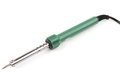
This method has worked for me. You have to be careful not to put too much pressure on, though. The point on a standard soldering iron is pretty small. So if you aren’t careful, you can potentially go through a drum with a hot soldering iron, like a knife through butter.
Get the soldering iron nice and hot. Then gently go over the crack to melt the surrounding plastic and seal it up. I try to bring some of the plastic from each side of the crack over to melt into the crack. It may be necessary to unplug the iron if you can’t get close enough. In which case you may need to keep plugging it back in to keep it hot enough as you go along.
Ideally, the crack should be sealed from inside and out. But these days that’s often impractical because many drums are welded together. Many can’t be stripped down now, by design. If by any chance you have stripped one down to investigate the leak before discovering the crack, then that’s an opportunity to seal it on the inside too.
Fix drum using washing machine sealant
After sealing up a crack using the soldering iron, I like to add a skin of sealant as a second defence. Washing machine engineers use a special flexible and heat-resistant sealant called Debor sealant. Rough up the surroundings with sandpaper and apply a large patch to cover the crack and surrounding area.
Use a special sealing tape
Alternatively, I’ve recently discovered special sealing tape that looks ideal for covering up a crack – as long as the crack is over a flat piece of the drum.
I recently used Gorilla tape to fix a leak on my roof gutter, which was advertised as weatherproof and waterproof. So I assume it would also be useful for this type of leak too. I would put plenty on and use lots of overlaps. Keep an eye on it though in case it starts to peel off.

Repairing a hole in the drum
If there is a hole in the drum, especially a large hole, or one that’s in an awkward spot, you may need a new outer drum – or replacement washing machine*.
If the hole is small, or in an accessible place, and especially if you have the piece of plastic that’s been punched out, you may be able to do a repair. If the plastic piece fits back OK and doesn’t push through into the drum, try sticking it in place with epoxy resin like Araldite.
Once stuck in place, you would need to seal the edges with the soldering iron as above. Then cover the whole repair with the tape I mention above. If you carry out a repair, but it fails, you could experience a disastrous flood. So don’t attempt any drum repair unless you are confident it will never leak again.
Don’t forget that if you do not identify what caused the damage and remove the obstruction from inside the washing machine it could do it again.
*Can you claim on home insurance?
If you have accidental damage cover on your home contents insurance, then you may be covered if something gets inside the washing machine and causes fatal damage. Let me know if you are successful.
Related
Motor bracket fixing broken on outer drum
Repairs
Fixed-price repairs, Pay monthly options, Repair & protect your whole appliance..
Save Money Now
Subscribe to Which? today and start saving money now. Subscription offers often available.
Spares
Spares4Appliances is a spares company run by repair engineers who understand all about spare parts for appliances.
Hello i have a swan sw2010w washing machine that the front counterbalance has sheered off all bolts and plastic sleeves thus the concrete counterbalance has dropped and there is now no way of reattaching it other than inserting bolts from inside the outer plastic drum casing and then attaching nuts to these bolts on the outer of the counterbalance or unless epoxy resin may give a strong enough of a bond to retain the concrete conterbalance in place. Any help would be appreciated Thank you Dave
Hello David. I would say it is likely to be impossible to fix a drum where the bolts have sheared off. The concrete weight is very heavy and is shaken around very violently during spin so I can’t imagine any resin being strong enough to deal with that. The only cure is a complete new outer drum I’m afraid. The machine is scrap.
What type of plastic is commonly used for the outer tub?
I’m fairly sure it some sort of poly something. The exact type of plastic should be displayed on a logo/stamp on the actual tub itself. It could be anywhere on there but hopefully a determined person should be able to find it if they really need to know exactly.
Maytag outer drums are PP30%GF which is polypropolene with 30% glass fiber fill for strength.
My Maytag Maxima washer has the outer drum “glued” together rather than using the clips & gasket. Has anybody opened one of these and successfully put it back together either with silicone seal and screws or epoxy or an acrylate glue?
Many outer drums are now factory sealed and cannot be taken apart and put back together. It’s a very bad step for repairability and longevity. I would think it highly risky to try and seal one yourself. If the seal failed you would have one hell of a flood. The seal would be subject to a lot of forces in spin.
Hi
I have a Hotpoint washing machine WMT101 which has a plastic drum. It has been making too much noise on spin for a while now, and finally threw the belt off. The bearings are OK (my first thought was that they were on the way out). Hover, the motor is fixed by 2 screws on the rear of the machine into the tub and then a third spigot at the end of the motor nearest the front of the machine, fitting into what was a hole in a plastic bracket which is an integral part of the tub. The plastic bracket has broken which I believe has led to the motor banging on the tub, and eventually to it moving so much it has thrown the belt off. 2 questions
1. Is it possible to repair that bracket (I can supply a photo if necessary)?
2. Should there be some sort of rubber (or similar) sleeve between the metal spigot and the plastic drum to absorb shock? There is no sign of one, but the spigot seems too big for the hole otherwise?
Any help will be much appreciated! I don’t want to run the risk of any catastrophic failures (flooding!) as this is on a newly fitted wooden floor in a new kitchen!
I don’t think it is likely to be able to do a decent lasting repair to the bracket if it has broken off. There should be some plastic sleeve or rubber sleeve but it has most probably fallen off somewhere. Check inside the base of the machine. It is very unusual for a plastic bracket for fixing the motor on to break. Just in case I’m not totally understanding exactly what has happened feel free to send me a picture.
Hi Andy,
Thanks for the prompt response – I suspect you may be right about a decent lasting repair but I will send the photos. I did wonder if I could wire something back into place but it would be a bit of a bodge!.
I may be missing something, but I cannot see how to attach a photo to my comments. Please advise me how to do that.
BTW it is actually a WMT01, but I don’t suppose that changes anything!
Richard