Yes, it’s sometimes possible to do an effective repair on a washing machine drum, and this article tells you how. It describes 3 different methods of sealing a cracked drum. Virtually all washing machine outer drums (or tubs as they used to be called) are now made out of plastic. Now they can no longer rust, which is great, but there is a big disadvantage. Coins, or other metal obstructions, can now all too easily crack or put a hole in a drum, causing it to leak – or even flood.
Before fixing the damaged drum
Coins are a common cause of cracks in the drum, but anything metal can cause damage. If you find just a thin crack, then it was probably caused by the impact of an object. This object will still be inside the washing machine somewhere. But if there’s a large hole in the drum, the object may have been punched right through.
See if you can find it on the floor, or in the base of the washing machine. If this object remains inside the machine, it can cause more damage, so you need to find it before any repair.
Also, carefully examine the inner drum for dents, which are evidence of an obstruction. Check inside the sump hose and pump filter. Also lean the machine over from side to side and front to back to see if anything slides around in the drum.
Holes in the drum can be impossible to fix (although I do mention something to try later). If you just end up with a small crack, you can sometimes carry out a successful repair.
You must find the cause of the damage
If there is something inside the drum, you can usually hear it slide about. This article might help if there is something inside that you can’t get at – How to remove something stuck in washing machine drum.
How to repair a crack in the drum
In the case of a thin crack in a drum that’s leaking water, I’ve successfully repaired many of them with a soldering iron.
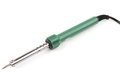
This method has worked for me. You have to be careful not to put too much pressure on, though. The point on a standard soldering iron is pretty small. So if you aren’t careful, you can potentially go through a drum with a hot soldering iron, like a knife through butter.
Get the soldering iron nice and hot. Then gently go over the crack to melt the surrounding plastic and seal it up. I try to bring some of the plastic from each side of the crack over to melt into the crack. It may be necessary to unplug the iron if you can’t get close enough. In which case you may need to keep plugging it back in to keep it hot enough as you go along.
Ideally, the crack should be sealed from inside and out. But these days that’s often impractical because many drums are welded together. Many can’t be stripped down now, by design. If by any chance you have stripped one down to investigate the leak before discovering the crack, then that’s an opportunity to seal it on the inside too.
Fix drum using washing machine sealant
After sealing up a crack using the soldering iron, I like to add a skin of sealant as a second defence. Washing machine engineers use a special flexible and heat-resistant sealant called Debor sealant. Rough up the surroundings with sandpaper and apply a large patch to cover the crack and surrounding area.
Use a special sealing tape
Alternatively, I’ve recently discovered special sealing tape that looks ideal for covering up a crack – as long as the crack is over a flat piece of the drum.
I recently used Gorilla tape to fix a leak on my roof gutter, which was advertised as weatherproof and waterproof. So I assume it would also be useful for this type of leak too. I would put plenty on and use lots of overlaps. Keep an eye on it though in case it starts to peel off.

Repairing a hole in the drum
If there is a hole in the drum, especially a large hole, or one that’s in an awkward spot, you may need a new outer drum – or replacement washing machine*.
If the hole is small, or in an accessible place, and especially if you have the piece of plastic that’s been punched out, you may be able to do a repair. If the plastic piece fits back OK and doesn’t push through into the drum, try sticking it in place with epoxy resin like Araldite.
Once stuck in place, you would need to seal the edges with the soldering iron as above. Then cover the whole repair with the tape I mention above. If you carry out a repair, but it fails, you could experience a disastrous flood. So don’t attempt any drum repair unless you are confident it will never leak again.
Don’t forget that if you do not identify what caused the damage and remove the obstruction from inside the washing machine it could do it again.
*Can you claim on home insurance?
If you have accidental damage cover on your home contents insurance, then you may be covered if something gets inside the washing machine and causes fatal damage. Let me know if you are successful.
Related
Motor bracket fixing broken on outer drum
Repairs
Fixed-price repairs, Pay monthly options, Repair & protect your whole appliance..
Save Money Now
Subscribe to Which? today and start saving money now. Subscription offers often available.
Spares
Spares4Appliances is a spares company run by repair engineers who understand all about spare parts for appliances.
Hi
It’s about a plastic outer drum on a Bosch 1200 Washing machine came home to find out the kitchen was flooded from washer I investigated the prob only to find that the whole circumference of the plastic case have had been ripped away from the rest of the case would love to know why this happens machine eight yrs old gets used once a week wish I could send a pic
Cheers John
Hi John, yes, please send me a photo. Send me a message using my Contact form at top of the page and I will reply by email so you can reply and attach a photo.
I’m trying to replace the inner drum dearing on a whirlpool 6th sense. The tub was sealed with a compound that was as hard as plastic! Can I get a compound to this standard at a wholesalers?
Hello Will, it sounds like a sealed outer drum (tub), which is not repairable. They are welded by melting the plastic.
Hi I discovered a similar problem with a damaged outer drum on a Bosch Maxx Classic WAE22260AU.
The outer drum has circular damage (sort of crescent shaped), which ultimately wore through to leak in two areas, symmetrically bottom/right and top/left. The hole is now 5mm by 30mm in its largest spot.
This looks like it wore through from the inside. It is not at a
The two circular damages traces stretch over about 25% of the circumference of the outer drum, starting small and getting wider and deeper towards their ends where the holes are.
One thing I also noted, the drum is not centered perfectly with the outer drum. However, when I rotate the inner drum, I cannot see any contact or chafing between the two, even when I push the plastic of the outer drum inwards with my thumbs.
I checked for worn bearing (pushing and pulling the inner drum) but seems ok.
I have the imression this developed over years of use. Along the traces I found dried-up washing powder, possibly mixed up with plastic filings.
Anyone have a clue how this could have happened, or seen this before on a Bosch like this one?
Photos available.
Many thanks
Hello William, you can always send me photos by using my contact form to get in touch and replying to my email back to you. The only thing I’ve ever known damage an outer tub is a coin or other metal object left in pockets. Sometimes the coin can punch right through and disappear. Usually there will be some indentation on the inner drum as evidence but if a coin was pushed through the outer tub by a part of the drum underneath one of the 3 lifter bars it may not leave any evidence visible from our side of the drum.
hi there, and thank you for the tremendously useful site! i have a hotpoint washer dryer aquarius, which had a hole punched in the outer drum. my husband repaired it (at my suggestion :-) ) using fibreglass and epoxy resin. it has worked well in that the leak went from about a bucket of water on the floor to just a few tablespoons. my question is this: if we don’t mind this small amount of leakage, is it dangerous to keep running the machine, from the point of view of the electrics? if you were able to answer promptly that would be amazing as I ordered a new washing machine and now am feeling like i want to keep the old one, but i’d need to cancel the order today if i am going to!
many thanks indeed
HI there, thanks for running this useful website. I have a front load stirling xqg65-908e about 4-5 yrs old, i just noticed a water leakage from the bottom of the unit. when i disassembled it, i noticed there are two symmetrical holes about 6 cm long and 5mm wide. i have read your previous post and i believed this could have happened by a coin trapped. I would really appreciate if i can send you some pictures and get some tips about the easiest to fix it ,for example if i can use sealant to fix the plastic outer tub.
I would say you can’t repair large gashes or holes. The advice in my article is only about sealing cracks. The only thing I would attempt to use in such circumstances is something called Milliput, which is like two large sticks of different coloured plasticine (or putty). When mixed together they set rock hard and will even set under water. I used to use it all the time but large holes may be difficult. You’d need to rough up the surrounding area and make a patch much bigger than the holes. As long as it sticks properly to the drum and never comes loose it is a great product.
Hi andy, i was about to buy the milliput product when i noticed that the crack is a lot more serious than what i thought…It pretty much goes all around the outer drum and i would basically need to disassemble the drum to fix it which is not worthy for me…Thnks a lot for your support..cheers
Yes Steeve, it’s only really appropriate for relatively minor repairs.