 There appears to be a problem with many washing machines routinely “causing” small holes in laundry. Judging from the correspondence I’ve received so far it is happening to a lot of people, with different makes of washing machine and with various drum sizes and spin speeds. Therefore, finding a pattern and identifying a definite cause is proving difficult.
However, almost everyone is blaming the washing machine. This article attracted 298 comments (bottom of this article) before being closed. They indicate that many of the holes may not be caused by the washing machine after all, though washing machines can clearly cause holes in laundry.
What’s causing holes in clothes after washing?
 There is no one simple answer to the cause of holes in clothes but a detailed look at this article and its comments may help.
One common theory is that the quality of many modern fabrics are to blame, that they are too thin. It may be necessary to try and work out the cause by process of elimination and looking for clues. It’s not as simple as just blaming the washing machine.
The people having problems are finding holes routinely appearing in denim skirts & shirts, cotton shirts, t-shirts, sheets, dresses, corduroy skirts etc. so the problem doesn’t seem to be confined to one type of laundry. Up to now, many people who have complained to their washing machine manufacturer have been told the same thing.
They’ve been told the fault lies with themselves, and that they are probably spinning certain items too fast.
In my experience, many faults are caused by customers either misusing appliances or not reading instruction books (or the wash labels on the laundry!) properly so they are naturally the first suspects.
At this stage it is unclear whether or not there is a problem with the design or quality of some washing machine drums and tubs that could account for lots of small holes in laundry. However, it makes sense for anyone getting holes in their laundry on a regular basis to make absolutely sure that they are not inadvertently causing the problem themselves before pursuing a manufacturer or the seller of the appliance.
Make sure you are not inadvertently causing the holes in clothes
If you are experiencing regular random holes in your washing you need to check that you are not washing items on wash programmes with a final spin speed that is too fast for them. This is the explanation some manufacturers have given to customers who complained about holes in washing.
If you know you are definitely using the washing machine correctly then at least you can say with confidence that the manufacturer, or their engineer is wrong if they try to blame incorrect spin speeds for the damage.
To help you decide you really should check out the instruction book but here is a rough guide from my Miele 1400 rpm spin washing machine operating instructions which has a 6kg drum.
Different manufacturers and different models of washing machine may vary but this chart shows that certain items should not be spun at full spin speed
- Cottons: – 1400 rpm
- Minimum iron: – 1200 rpm
- Delicates: – 600 rpm
- Woollens: – 1200 rpm
- Silks: – 400 rpm
- Shirts: – 600 rpm
- Denim: – 900 rpm
Make sure you aren’t overloading the drum
Many people don’t realise that different types of laundry have different wash load capacities and that exceeding them amounts to overloading.
In most cases the consequences are more likely to be reduced wash efficiency but if you put a full load of denim, or shirts on a wash programme that does the maximum spin then the manufacturer could claim some may get damaged.
Here is a link to a previous article showing the maximum recommended loads for certain fabrics (again, consult your washing machine’s instruction book because the load sizes will vary amongst manufacturers and models – especially models with larger or smaller drum capacities) Laundry comes out of washing machine badly creased?
Other possible causes of holes
Bra wire (or underwires)
 Bra wires are an extremely common problem with washing machines. Many of them (especially from cheaper bras) escape during the wash and get trapped under the drum.
Commonly you will hear a gentle metallic scraping noise as the drum turns but depending where it settles it may not make any noise at all. The ends of bra wires can be sharp, especially if they break. As the clothes are forced through the small holes in the drum (particularly cottons) during spin they can snag on the underwire and cause damage to the laundry.
If underwires from a bra are removable they should always be removed before washing. I’m sure many of them are supposed to be hand washed only!
Here’s an article I’ve published about washing nets designed specifically to protect a bra in the washing machine – Bra washing nets
Other obstructions in the tub, a damaged drum, loose drum lifter etc.
 Coins and other metallic obstructions commonly cause problems with washing machines. They can damage the drum or loosen and break the plastic drum lifter (paddles) leaving a small hole or gap where laundry can snag.
Carefully examine the drum for dints or even tears, maybe an elongated drum hole that now has a sharp edge. TIP: Try using a nylon stocking stretched over a hand to feel all the way round a drum and paddles to see if anything snags.
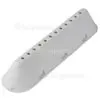 Check none of the drum lifters or paddles are damaged or loose revealing a hole with sharp edges.
If you have a loose or broken drum paddle (lifter) it can cause damage to clothes. You can buy a replacement drum lifter or paddle for your washing machine on Spares4Appliances Drum lifter (paddles)
Zips and buckles
As a precaution try turning garments with zips inside out after zipping up the zipper. Watch out for garments that have metal buttons or buckles. Also try placing delicate laundry in net wash bags.
Biological detergents could damage woollens and silks
I’ve just written another related article describing how some holes in clothing could be caused by using biological detergent.
This issue is only related to silks and woollens though – Biological washing machine detergents can damage woollens and silks causing holes
Insects – Moths?
Don’t forget that certain insects and moth larvae can damage clothes. They cause lots of small holes that look very similar to the holes in clothes photos I’ve received. Obviously if holes only appear in specific places on clothes (like only the front lower part of a t-shirt) it’s not likely to be caused by insects or moth larvae randomly chewing on them. Try searching for the following subjects – clothes damaged by insects – clothes damaged by larvae – what do moth holes look like? There’s a good artcile here too. Notice the holes are virtually the same as in some of my photos except they are cleaner holes than some of my examples – Do moths eat cotton?
Removing a drum paddle (lifter) to gain access to the bottom of the tub
Bleach
Undiluted bleach should not be used in a washing machine. It’s corrosive. Even dilute bleach can weaken laundry. Read the label carefully before using.
Sometimes you can get an obstruction out through the dispenser/tub hose or the heating element
If you suspect the obstruction is trapped somewhere in the middle of the drum you may be able to get to it through the hole in the outer drum where the dispenser hose is attached. This is where the water and detergent is washed into the drum from the soap drawer.
Sometimes an underwire gets mangled and trapped on the heating element and removing the element can allow access to it. However, it depends where the heater is, some are right at the front of the machine and very hard to access and some are at the back behind the rear panel and easy to access. This method is not recommended though unless desperate because it may involve stripping a washing machine down, and you may not be able to refit the heater even if you get it out.
Worse still you could refit it incorrectly and it pops out during a wash cycle flooding the kitchen, or you don’t get it located under its holding bracket and the drum bashes it relentlessly on spin.
However, this article looks at where is the heater and how to remove it?
I’ve written another article on this subject here Holes in clothes photos which features many photos sent in to me with holes of all sizes and on various laundry.
If tiny holes are appearing only in t-shirts at the front
 This can be caused by physical wear caused by rubbing against jeans, belts, and even kitchen worktops whilst working in the kitchen.
Photos of damaged laundry
For further details see the many comments below this article. Several people have identified their holes in the front lower half of t-shirts as being caused by rubbing against the kitchen worktop. Granite worktops are particularly implicated.
Try this experiment
Jeff suggested a great experiment in my comments section, which should prove whether the small holes in t shirts are caused by the washing machine or by the wearer.
Buy a new t shirt of the type that has been getting the holes (but never wear it). Each time you do laundry, throw it in with everything else and see if it ever gets holes. If it does, then as it has never been worn it’s probably the washing machine/detergent/faulty fabric. But if holes do not appear, then the holes in the other t shirts are most probably being caused by something the wearer of the shirts is doing to stress the fabric and not caused by washing.
Protect t-shirts and other laundry when washing
Use a net washing bag to protect delicate laundry, which helps prolong the life of clothes, and prevents wear and tear from friction
Comments now disabled
There are many comments below to research but new comments have been disabled because they have reached a large enough number for it to be impractical for most people to read them – let alone even more.
However, I strongly advise you take the time to read through them if this is a serious problem for you as there are many thoughts, speculations and ideas that may help. If you have any useful advice or information please contact me and I can either open up the comments for you or add your thoughts to the article.
Repairs
Fixed-price repairs, Pay monthly options, Repair & protect your whole appliance..
Save Money Now
Subscribe to Which? today and start saving money now. Subscription offers often available.
Spares
Spares4Appliances is a spares company run by repair engineers who understand all about spare parts for appliances.
comment #177 on March 9th is exactly right! This is the same as my comment on Nov 28th 2008 comment #97. Try and you will see.
I’ve had a Miele Prestige Plus 6 since July 2008. During this time I’ve occasionally noticed small round holes appearing in clothes and have put it down to wear and tear, belt buckles etc. After ruining a brand new top a couple of weeks ago I started checking my clothes both before and after a wash cycle and I’m now sure it’s the washing machine causing the holes as they only appear after the wash. I’ve read about lots of possible causes but….I never over fill the machine and I check the instructions on the garments carefully. I also tend to use the 900 spin as the 1300 makes the clothes too hard and creased. I use Ariel colour tablets for coloured and Fairy non-bio for whites (I live in a hard water area). I wash wool and silk by hand. I’ve done the silk stocking test in the drum and can find no sharp edges. And I don’t use underwired bras! The holes are perfectly round and about 5mm in diameter and have appeared in cotton tee shirts, cotton/polyester mix jumpers, and even socks. I never experienced this problem with my old Zanussi, which I used with the same types of detergent and clothes. I chose the Miele machine after much research and deliberation over the cost and I’m really disappointed with it. It doesn’t seem right that manufacturers seem to blame the users over this problem. Has anyone found a satisfactory solution?
Paula, if fabric is weakened it’s common for it to only hole after washing. Curtains sometimes get holes in them after washing if they’ve become sun damaged.
But if your holes are perfectly round that sometimes could be caused by being cut while expressed through the holes in the drum. Does your machine have the honeycomb drum or normal holes?
The drum has the normal holes rather than the honeycomb. I’ve had these round holes appear in two new garments after their first wash so I don’t think the fabric was weakened. I’m also careful about using the correct wash cycle for the material – but I’ve just found out how to programme the machine to wash with a gentle action on all cycles rather than the standard setting so I’m going to see if that makes a difference. I’ll let you know if it does.
I’m absolutely staggered at the amount of people who have flagged this problem up! I’ve been getting tiny holes in my clothes for a couple of years now and it seems to be the cotton based garments only? I thought it was just me being careless and catching my clothes on work surfaces or something but have been extra vigilent of late and still it’s happening! I’m not convinced it’s the washing machine – I have a strong theory it could be something to do with washing tablets or liquid, especially the biological kind. These days the emphasis is to get the washing cleaner and cleaner even at low temperatures. Perhaps they are too concentrated and the natural materials are suffering as a result. I’m going to switch to a non-biological, very mild washing powder and see how I go.
Pat Horne
for the first time your idea makes sense to me. This is so mysterious. My only question is why does it happen to some T shirts and our house and not other T shirts. It has got to be the soap reacting with those shirts..
At our house:
1. The holes are always on the lower part of the T shirt only on the back….never the front.
2. It doesn’t happen to ALL of our T shirts just some.
3. The holes are perfectly round and there are a lot of them.
Its such a mystery at our house……
I thought we had moths! The holes usually appear in my daughter’s t-shirts which seem to be made of a thinner cotton. Maybe this could be the reason, especially if the spin speed is too fast?
Diane:
Diane, I can’t imagine how detergent could cause holes only on the lower part and back of t shirts and only on some. That would be impossible if the whole garment has been soaked in it. The washing machine couldn’t possibly be so specific either.
Your holes have to be caused by some specific friction or specific wear, or by coming into contact with something specific to them.
I have been experiencing this problem for at least 8 months now. I have noticed that it is more often GAP clothing that has gotten holes. I just want to know what the heck is causing this. I cannot afford to keep replacing my or my families clothing. Please help!!!
I am a service tech for a major retailer in the states with 34 years experience. Holes in clothes are not a new complaint & are basically caused by three classes–chemical, mechanical & biological. When clothes are discovered damaged before placement into the laundry it is easy to divine the washer and/or dryer as not the culprit. Unfortunately, this is often not the case. There is a reason for this–some damaged articles don’t reveal their damage until “after” the laundering process. In the diagnostics of holes in the clothing it is essential to do a little processing of the items involved:
1.) Is the clothing being damaged to one area of the garment such as front only, back only, right sleeve only (right-handed persons), left sleeve only (left-handed persons), etc. All of the these are indicative of a process which is being performed by the person wearing the item such as cooking spatters occurring to the front of the item that may contain chemicals or heated oils that damage & weaken the fabric, sleeves that are being abraded by right or left-handed persons in the course of typical cleaning, painting & furniture finishes containing chemicals.
2.) Is the hole in the clothing uniform and without ragged fraying that would occur from mechanical ripping of the fabric? If the holes are not frayed in appearance then this may be biological damage such as moths or insect. Of course, these are nonspecific holes as moths don’t go for the bellybutton only. Washer products generally rip fabrics leaving fraying like a pair of cutoff jeans in the washer and if occurring in the dryer there should be in evidence a trail of threads caught on some sharp edge in the dryer.
3). Is the fabric easy to tear along the edges of the hole? Generally speaking chemical damage, particularly bleach, will destroy the tensile strength of textiles when spilled or dropped into direct contact w/cotton while undiluted. Look for signs of discoloration. If you have an old blacklight from your psychedelic days then bleach damage will flouresce under a blacklight.
I don’t work on Miele over here but I do service LG, GE, Whirlpool, Sears, Samsung, Electrolux, Bosch & Frigidaire front loads & top loads. None are immune to complaints of “Holes in Clothes”. It is a dreaded complaint because once we are called the customer has firmly decided that the washer or dryer is the cause most of the time. The majority of that time it is not. I use a Frigidaire front load & have for eight years. I have experienced zero of the problems that have been complained about for that washer. My dryer is twenty-one years old (and was rebuilt 10 years ago). I have never had either tear my clothes from mechanical failure. All clothing that has come out with damage at the end I have been able to specifically equate to activities I have done to create the problem. They have mostly been chemical in nature from acids to cleaners that came in contact with me while doing routine chores & maintenance.
The use of a stocking on the hand to feel for rough surfaces or snags is an old trick that works well. Be careful however. As more than one tech has found a sharp protruding object such as a rusty underwire can snag more than a stocking if you press too firmly or move too quickly across a surface. You can also catch pins & needles from the seal areas of the dryer drum at front & back.
You should also observe mechanical actions of the machines if possible to see if something may be happening such as a top load w/agitator agitating & spinning at the same time. Of course, this results in clothing literally wrapping around the agitator as you might expect. I have serviced dryers with the drum baffles filled with coins from being loose & yet the customer was having no problems with torn clothing.
Some models of dryers are prone to “catching” clothing along the front edge of the drum & bearing surface area. This occurs when drum bearing wear exceeds a certain tolerance. This usually gives indication by leaving reddish streaks or marks on clothing before the tearing begins.
There is a fourth cause of holes which is really a combined action:
Aging of clothing-This is a mechanical/chemical action over time. Abrading of clothing is a natural process of laundering action & leads to textile failure This combined with the chemical exposure repeatedly will cause the fabric to eventually fail. Although these days people don’t seem to keep the clothes they wear long enough to see this occur. It is most commonly seen in sheets, towels & cleaning cloths. I have had customers hand me a towel to examine that was obviously so old I could practically see through it and ask me why the washer “tore” her perfectly good towel. That’s the kind of thing techs see that creates that distrust of a customer’s skill at examining just what they did do in those clothes.