 There appears to be a problem with many washing machines routinely “causing” small holes in laundry. Judging from the correspondence I’ve received so far it is happening to a lot of people, with different makes of washing machine and with various drum sizes and spin speeds. Therefore, finding a pattern and identifying a definite cause is proving difficult.
However, almost everyone is blaming the washing machine. This article attracted 298 comments (bottom of this article) before being closed. They indicate that many of the holes may not be caused by the washing machine after all, though washing machines can clearly cause holes in laundry.
What’s causing holes in clothes after washing?
 There is no one simple answer to the cause of holes in clothes but a detailed look at this article and its comments may help.
One common theory is that the quality of many modern fabrics are to blame, that they are too thin. It may be necessary to try and work out the cause by process of elimination and looking for clues. It’s not as simple as just blaming the washing machine.
The people having problems are finding holes routinely appearing in denim skirts & shirts, cotton shirts, t-shirts, sheets, dresses, corduroy skirts etc. so the problem doesn’t seem to be confined to one type of laundry. Up to now, many people who have complained to their washing machine manufacturer have been told the same thing.
They’ve been told the fault lies with themselves, and that they are probably spinning certain items too fast.
In my experience, many faults are caused by customers either misusing appliances or not reading instruction books (or the wash labels on the laundry!) properly so they are naturally the first suspects.
At this stage it is unclear whether or not there is a problem with the design or quality of some washing machine drums and tubs that could account for lots of small holes in laundry. However, it makes sense for anyone getting holes in their laundry on a regular basis to make absolutely sure that they are not inadvertently causing the problem themselves before pursuing a manufacturer or the seller of the appliance.
Make sure you are not inadvertently causing the holes in clothes
If you are experiencing regular random holes in your washing you need to check that you are not washing items on wash programmes with a final spin speed that is too fast for them. This is the explanation some manufacturers have given to customers who complained about holes in washing.
If you know you are definitely using the washing machine correctly then at least you can say with confidence that the manufacturer, or their engineer is wrong if they try to blame incorrect spin speeds for the damage.
To help you decide you really should check out the instruction book but here is a rough guide from my Miele 1400 rpm spin washing machine operating instructions which has a 6kg drum.
Different manufacturers and different models of washing machine may vary but this chart shows that certain items should not be spun at full spin speed
- Cottons: – 1400 rpm
- Minimum iron: – 1200 rpm
- Delicates: – 600 rpm
- Woollens: – 1200 rpm
- Silks: – 400 rpm
- Shirts: – 600 rpm
- Denim: – 900 rpm
Make sure you aren’t overloading the drum
Many people don’t realise that different types of laundry have different wash load capacities and that exceeding them amounts to overloading.
In most cases the consequences are more likely to be reduced wash efficiency but if you put a full load of denim, or shirts on a wash programme that does the maximum spin then the manufacturer could claim some may get damaged.
Here is a link to a previous article showing the maximum recommended loads for certain fabrics (again, consult your washing machine’s instruction book because the load sizes will vary amongst manufacturers and models – especially models with larger or smaller drum capacities) Laundry comes out of washing machine badly creased?
Other possible causes of holes
Bra wire (or underwires)
 Bra wires are an extremely common problem with washing machines. Many of them (especially from cheaper bras) escape during the wash and get trapped under the drum.
Commonly you will hear a gentle metallic scraping noise as the drum turns but depending where it settles it may not make any noise at all. The ends of bra wires can be sharp, especially if they break. As the clothes are forced through the small holes in the drum (particularly cottons) during spin they can snag on the underwire and cause damage to the laundry.
If underwires from a bra are removable they should always be removed before washing. I’m sure many of them are supposed to be hand washed only!
Here’s an article I’ve published about washing nets designed specifically to protect a bra in the washing machine – Bra washing nets
Other obstructions in the tub, a damaged drum, loose drum lifter etc.
 Coins and other metallic obstructions commonly cause problems with washing machines. They can damage the drum or loosen and break the plastic drum lifter (paddles) leaving a small hole or gap where laundry can snag.
Carefully examine the drum for dints or even tears, maybe an elongated drum hole that now has a sharp edge. TIP: Try using a nylon stocking stretched over a hand to feel all the way round a drum and paddles to see if anything snags.
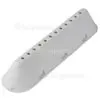 Check none of the drum lifters or paddles are damaged or loose revealing a hole with sharp edges.
If you have a loose or broken drum paddle (lifter) it can cause damage to clothes. You can buy a replacement drum lifter or paddle for your washing machine on Spares4Appliances Drum lifter (paddles)
Zips and buckles
As a precaution try turning garments with zips inside out after zipping up the zipper. Watch out for garments that have metal buttons or buckles. Also try placing delicate laundry in net wash bags.
Biological detergents could damage woollens and silks
I’ve just written another related article describing how some holes in clothing could be caused by using biological detergent.
This issue is only related to silks and woollens though – Biological washing machine detergents can damage woollens and silks causing holes
Insects – Moths?
Don’t forget that certain insects and moth larvae can damage clothes. They cause lots of small holes that look very similar to the holes in clothes photos I’ve received. Obviously if holes only appear in specific places on clothes (like only the front lower part of a t-shirt) it’s not likely to be caused by insects or moth larvae randomly chewing on them. Try searching for the following subjects – clothes damaged by insects – clothes damaged by larvae – what do moth holes look like? There’s a good artcile here too. Notice the holes are virtually the same as in some of my photos except they are cleaner holes than some of my examples – Do moths eat cotton?
Removing a drum paddle (lifter) to gain access to the bottom of the tub
Bleach
Undiluted bleach should not be used in a washing machine. It’s corrosive. Even dilute bleach can weaken laundry. Read the label carefully before using.
Sometimes you can get an obstruction out through the dispenser/tub hose or the heating element
If you suspect the obstruction is trapped somewhere in the middle of the drum you may be able to get to it through the hole in the outer drum where the dispenser hose is attached. This is where the water and detergent is washed into the drum from the soap drawer.
Sometimes an underwire gets mangled and trapped on the heating element and removing the element can allow access to it. However, it depends where the heater is, some are right at the front of the machine and very hard to access and some are at the back behind the rear panel and easy to access. This method is not recommended though unless desperate because it may involve stripping a washing machine down, and you may not be able to refit the heater even if you get it out.
Worse still you could refit it incorrectly and it pops out during a wash cycle flooding the kitchen, or you don’t get it located under its holding bracket and the drum bashes it relentlessly on spin.
However, this article looks at where is the heater and how to remove it?
I’ve written another article on this subject here Holes in clothes photos which features many photos sent in to me with holes of all sizes and on various laundry.
If tiny holes are appearing only in t-shirts at the front
 This can be caused by physical wear caused by rubbing against jeans, belts, and even kitchen worktops whilst working in the kitchen.
Photos of damaged laundry
For further details see the many comments below this article. Several people have identified their holes in the front lower half of t-shirts as being caused by rubbing against the kitchen worktop. Granite worktops are particularly implicated.
Try this experiment
Jeff suggested a great experiment in my comments section, which should prove whether the small holes in t shirts are caused by the washing machine or by the wearer.
Buy a new t shirt of the type that has been getting the holes (but never wear it). Each time you do laundry, throw it in with everything else and see if it ever gets holes. If it does, then as it has never been worn it’s probably the washing machine/detergent/faulty fabric. But if holes do not appear, then the holes in the other t shirts are most probably being caused by something the wearer of the shirts is doing to stress the fabric and not caused by washing.
Protect t-shirts and other laundry when washing
Use a net washing bag to protect delicate laundry, which helps prolong the life of clothes, and prevents wear and tear from friction
Comments now disabled
There are many comments below to research but new comments have been disabled because they have reached a large enough number for it to be impractical for most people to read them – let alone even more.
However, I strongly advise you take the time to read through them if this is a serious problem for you as there are many thoughts, speculations and ideas that may help. If you have any useful advice or information please contact me and I can either open up the comments for you or add your thoughts to the article.
Repairs
Fixed-price repairs, Pay monthly options, Repair & protect your whole appliance..
Save Money Now
Subscribe to Which? today and start saving money now. Subscription offers often available.
Spares
Spares4Appliances is a spares company run by repair engineers who understand all about spare parts for appliances.
I had this problem with my Hotpoint about 7 years ago, I recieved compensation and my machine was replaced. It wasn’t easy but I got there. In this case my clothing and bedding had a combination of small holes and very large snags. In the meantime I have moved twice the first time to rented accomadation with a machine in situ, a bosch classix which after 4 years had no issues with. I then moved again purchased my own Zanussi and three years on I have the problem back. So far I only have small holes in random places and on all the families clothing. I also have a dog and a cat so am not ruling out a bug issue. The detergent may be a factor as I try to use non bio. I recently had an issue with Black Mold in the drawer whilst waiting for someone to take my machine appart to get access to the whole drawer I started using a 2 in 1 detergent which is biological I don’t recall seeing new holes then. I also try and wash my clothes on 30 deg althou my son who has allergies has his sheets washed at 60. I have just read a link about washing at low temps and with non bio. Does this give anyone any ideas?
I am now using persil gel and comfort. My machine is a 6kg Zanussi front loader. If I’ve missed anything let me know.
This problem has nothing to do with our waistlines ( Iwear a size 4) nor do I believe our washing machines (too many people are experiencing this problem and they don’t all use the same washing machines and detergent) and unfortunately, I have to rule out the zipper on jeans explanation since I just found two holes on my pajama top (thin cotton). I wish I had an explanation, and I will keep searching, but I don’t think we are on the right track so far.
First- for anyone suffering from holes in the front of shirt (belly-button area) we are in the wrong forum! Ours is a completely different problem than people who are getting random holes which may or may not be caused by the washing machine. Sure, the washer may eventually weaken a cotton fabric that already has holes.. but to blame the machine for such specific patterns? Whatever…
I am interested in addressing the patterned front hole problem… (this was one of the few sites where anyone discussed this subject in such detail) I find myself intrigued with all the various answers/solutions to this and why its happening…
However, LOGIC over rules all the scare tactics… Please.. get real- Moths and other fabric bugs are NOT PICKY. They dont go up to a shirt and say- hmmm, let me JUST eat the front. So, if this is happening to you- dont get freaked out by all the other posts. If you had moths- ALL your clothes would show signs of it- and the eating patterns would be totally RANDOM.
As far as the friction theories- I give them credit and are very probable. CHEAP COTTON is also a definite part of the puzzle as well. I think that the people who have decided to wear aprons (yes, our parents did it- and survived) are on the right track. If you’ve lost some really expensive shirts (like I have) maybe an undershirt may help with the jean friction thing. It doesnt matter what weight, sex you are- it seems this problem can effect anyone. I purpose a web site forum set up specifically for this issue- as I do believe that as consumers we have the right to expect higher quality products (especially when we are PAYING higher prices for them)
Whether it be buttons, jeans, belts, granite/surface rubs or any other source- shouldnt our clothing be able to withstand everyday wear and tear? If not- shoudnt they be labeled in such a way to warn us NOT to wear this product when cleaning your kitchen? Comical- I know… but does anyone else have a better idea?
For now- if your COTTON is of a lesser quality or the material is extremely thin- we have to use common sense and beware of the elements that may damage it. Ridicuous- considering everything else we have to worry about it the world.
Although I am SURE that there are some clothes eating machines out there- let’s give the washer a break on this one, shall we?
I FOUND A HOLE IN A PAIR OF JEANS BUT I DID NOT DO UP ZIP OR TURN THEM INSIDE OUT! I ALSO PUT THEM ON A HIGH SPIN!!
THANKS FOR YOUR COMMENTS…..THE HOLE WAS PROBABLY DO TO MY NEGLIGENCE. I DO FEEL BETTER AS I AM GLAD IT IS NOT SOME FAULT IN THE DRUM OF MY WASHING MACHINE.
Guys and gals, through several tests I have drawn the conclusion that it is not bugs, not moths, not the deodorant spray since I never used it since I use roll-on, not the granite (since the holes are front and back of the t.shirts), not overloading, not over-spinning and I doubt that it is the washing machine since many machines of different brands seem to be reported. What I realised is that the softer and thinner the fabric is, the more holes appear. Since the holes are tiny non-stretched well defined holes (as though a drop of acid fell on the garment), I beleive that the holes are being caused by either the detergent or the softner. I am using Persil and Comfort. If anyone agrees with me, or has found a concrete solution, please let me know. I am fed up of throwing out clothes.
Zanussi washer/7kg/1400rpm spin
Have had the same problem with holes in cotton T shirts for a long time. Wifey wanted to replace the machine so checked for snags in the washer and bugs in the wardrobe but found nothing. Then read this blog and found the idea of work top edges and belts interesting as I often lean on the worktop with a beer and a fag. Just a thought, a few years ago it became fashionable to wear T shirts outside your trousers rather than tucked in,causing more contact between belt/button and worktop.Could this be the cause of the recent increase in hole formation? If so do we need a fashion change?
Hello everybody, I’m in the US and have been having the same problem of tiny holes appearing on t-shirts on or around the belly button area. It is frustrating to see so many t-shirts go to waste! The t-shirts have been of various quality cotton, not just the cheap t-shirts produce holes, the expensive heavy t-shirts also produce holes. And all in the same belly button area!
I do not have granite counter tops. I do not have a belly button ring. I wear a variety of jeans and pants. I wear different belts with my jeans from time to time.
I am wondering if the seat belt in the car is causing this phenomenon???
I purchased a ladies t-shirt from a gaming website, it fit nicely but was made from very thin cotton. Holes appeared so I threw it away and ordered the men’s t-shirt. Heavier cotton, but not a feminine fit. I have worn it several times and I discovered holes in the same area today! Bugger!
Maybe the holes are made by aliens testing our quality of clothing. (lol)
I am back one more time to tell you all that I did experiment with the granite/hard surface rub theory. Rubbed a low quality cotton shirt (that had a high price tag by the way) side to side and a few up and down movements against the edge of my granite.
YES—> tiny holes formed. After a delicate wash and air dry the holes were larger in appearance. These are the SAME holes that have been cursing all my shirts for some time now. Friction against a hard surface (whether it be rock or other material) weakens the already thin cotton fibers.
Since this area (the lower stomach, or belly button- or sometimes even on the backside) is exposed to the most friction-
it is easy to see that the problem is NOT bugs. Nor some mysterious worm.
We are just consumers plagued with a lower grade cotton that cannot withstand the abuse of regular wear and tear. Why is this so hard for us to believe and accept? Think about how everything else in our present day society has been “downsized, downgraded- made in a more economic fashion.” It’s easy to see that we are now purchasing lower quality cotton products since we’ve been conditioned to do so.
For anyone serioulsy searching for the real answer to holes in the front of your shirt- have no fear- it is simply science. Cause and effect. Even a higher grade (heavier cotton) shirt will eventually break down to friction damage.
I’ve been wearing an apron in the kitchen for the past few months now- adn NO NEW HOLES have appeared. Save your hard earned $$ and buy and apron! You will not regret it! And you can stop worrying about your washer being a monster~!
Still doesn’t “WASH” with me!!! So how do you explain the holes in the neck/back of lots of my t-shirts-see the photo’s!
Does this seem to only be a problem with top load washing machines or does this happen with front loaders like the whirlpool steam washer? If it’s the top load washing machine then I may buy a front loader. This is happening to all of my husbands shirts. I’m guessing b/c he has lots of cotton tshirts.