Yes, it’s sometimes possible to do an effective repair on a washing machine drum, and this article tells you how. It describes 3 different methods of sealing a cracked drum. Virtually all washing machine outer drums (or tubs as they used to be called) are now made out of plastic. Now they can no longer rust, which is great, but there is a big disadvantage. Coins, or other metal obstructions, can now all too easily crack or put a hole in a drum, causing it to leak – or even flood.
Before fixing the damaged drum
Coins are a common cause of cracks in the drum, but anything metal can cause damage. If you find just a thin crack, then it was probably caused by the impact of an object. This object will still be inside the washing machine somewhere. But if there’s a large hole in the drum, the object may have been punched right through.
See if you can find it on the floor, or in the base of the washing machine. If this object remains inside the machine, it can cause more damage, so you need to find it before any repair.
Also, carefully examine the inner drum for dents, which are evidence of an obstruction. Check inside the sump hose and pump filter. Also lean the machine over from side to side and front to back to see if anything slides around in the drum.
Holes in the drum can be impossible to fix (although I do mention something to try later). If you just end up with a small crack, you can sometimes carry out a successful repair.
You must find the cause of the damage
If there is something inside the drum, you can usually hear it slide about. This article might help if there is something inside that you can’t get at – How to remove something stuck in washing machine drum.
How to repair a crack in the drum
In the case of a thin crack in a drum that’s leaking water, I’ve successfully repaired many of them with a soldering iron.
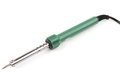
This method has worked for me. You have to be careful not to put too much pressure on, though. The point on a standard soldering iron is pretty small. So if you aren’t careful, you can potentially go through a drum with a hot soldering iron, like a knife through butter.
Get the soldering iron nice and hot. Then gently go over the crack to melt the surrounding plastic and seal it up. I try to bring some of the plastic from each side of the crack over to melt into the crack. It may be necessary to unplug the iron if you can’t get close enough. In which case you may need to keep plugging it back in to keep it hot enough as you go along.
Ideally, the crack should be sealed from inside and out. But these days that’s often impractical because many drums are welded together. Many can’t be stripped down now, by design. If by any chance you have stripped one down to investigate the leak before discovering the crack, then that’s an opportunity to seal it on the inside too.
Fix drum using washing machine sealant
After sealing up a crack using the soldering iron, I like to add a skin of sealant as a second defence. Washing machine engineers use a special flexible and heat-resistant sealant called Debor sealant. Rough up the surroundings with sandpaper and apply a large patch to cover the crack and surrounding area.
Use a special sealing tape
Alternatively, I’ve recently discovered special sealing tape that looks ideal for covering up a crack – as long as the crack is over a flat piece of the drum.
I recently used Gorilla tape to fix a leak on my roof gutter, which was advertised as weatherproof and waterproof. So I assume it would also be useful for this type of leak too. I would put plenty on and use lots of overlaps. Keep an eye on it though in case it starts to peel off.

Repairing a hole in the drum
If there is a hole in the drum, especially a large hole, or one that’s in an awkward spot, you may need a new outer drum – or replacement washing machine*.
If the hole is small, or in an accessible place, and especially if you have the piece of plastic that’s been punched out, you may be able to do a repair. If the plastic piece fits back OK and doesn’t push through into the drum, try sticking it in place with epoxy resin like Araldite.
Once stuck in place, you would need to seal the edges with the soldering iron as above. Then cover the whole repair with the tape I mention above. If you carry out a repair, but it fails, you could experience a disastrous flood. So don’t attempt any drum repair unless you are confident it will never leak again.
Don’t forget that if you do not identify what caused the damage and remove the obstruction from inside the washing machine it could do it again.
*Can you claim on home insurance?
If you have accidental damage cover on your home contents insurance, then you may be covered if something gets inside the washing machine and causes fatal damage. Let me know if you are successful.
Related
Motor bracket fixing broken on outer drum
Repairs
Fixed-price repairs, Pay monthly options, Repair & protect your whole appliance..
Save Money Now
Subscribe to Which? today and start saving money now. Subscription offers often available.
Spares
Spares4Appliances is a spares company run by repair engineers who understand all about spare parts for appliances.
Hi, I have an lg front loader washer. It appears to be leaking from the outer drum where the screws hold it together. I would think that it is just a leak in the seal due to pressure on the plastic (maybe from the screw). Just hoping I could jb weld it or even use the soldering iron to seal it up.
Hello Tim. My advice is only about sealing hairline cracks. I’m presuming you mean it is leaking from where the 2 halves of the outer tub are joined together? This is quite unusual, if you are witnessing the leak dripping from the bottom of the outer tub make sure water isn’t running from somewhere higher up as water can drip from places in a deceptive manner.
If water is leaking from a seal joining the 2 halves together it would need a replacement seal. That is if one is available as many outer tubs in washing machines now are designed not to be repaired and some cannot even be taken apart because the 2 halves are actually welded together.
Hi Andy,
We have a Siemens WM16S493GB/01 washing machine. It’s 9 years old. Usual family of four use (around 4-6 loads each weekend).
I’ve had to repair it on a number of occasions, but mainly the same fault; I ended up replacing an entire run of 240V mains cable to the motor, must have been a bad batch of cable because it just kept splitting and then arcing. Since then it’s been fine, but it triggered an F23 error the other week, which indicates water in the sump.
On investigation, it’s leaking from the seal between the two halves of the plastic outer tub just like Tim described in the last comment here for his LG washing machine. It was leaking from an area around one of the bolts on one side and definitely not running down from anywhere else.
I’ve tried sealing with Debor all along that edge, but it’s not easy as the clips get in the way obscuring the join and the leak just moved to the other side and now only under spin (before even just standing water in the drum would seep). The amount of water is negligible, so for now a plastic bowl taped to the base allowed the machine to run, but it’s obviously not a long term solution and I don’t like that it’s close to the motor.
I also noticed one of the concrete blocks on the front of the drum has split half way. It’s still holding together with the bolts and the sealant they permanently glued these to the outer tub with.
The seal kit is around £25, but the job to fit this is immense as you know, and probably requires some specialist tools I don’t have. Not proud of this, but it’s a tight space and I know one of the bolt heads shredded when I went round checking they were tight (there was a little movement, presumably just the years of use), so that one won’t loosen off again now.
So I’m in a quandary because the rest of the machine is still functioning perfectly, which makes me loath to throw it out, but I also know I could destroy it if I try and replace the outer tub seal. Also, if I was doing that, I’d probably replace the door seal too (it’s exhibiting the usual mouldy nature of one this old) and then it’s starting to get more expensive; which makes me wonder how the bearings are, and what else might drop dead soon after even if I managed to fix the leak.
I worked out it’s cost us around £1.60 per week over it’s lifetime, which is probably a good way of looking at it, but the environmental side of me is agitated that it can’t fairly easily or cost effectively be repaired.
With the Siemens brand and the original purchase price I thought I’d bought a quality product, but it hasn’t felt like that over the years and it hasn’t lasted as long as the old Bosch machine it replaced. In fact, it’s the newest machine in the kitchen; I have a Bosch dishwasher and tumble dryer, both of which have never really had a problem in over 16 years (had to replace the heating element in the dryer the other year, but other than that, nothing).
Your site has been very helpful in my research for future options and I’m definitely going to head down the Miele road having looked up a video of their factory online and eyed up the superior build quality evident in their drums, suspension, counterweights, and everything really, and the fact they look a lot more serviceable. Sad that they’re the only ones doing this though.
Anyway, I just wondered if you had any thoughts/input on my situation.
Thank you in advance for your time and also for the valuable information on your website.
Best wishes,
Jamie.
Sorry for a late reply Jamie. If the old drum is leaking between the 2 drum halves only a strip down and replacement seal will fix it properly.
Yes, Bosch are now almost a budget brand with many of their appliances. Totally different from the Bosch of old. Only Miele have really stuck to their original high build quality ethos but even their appliances are less well-made than they used to be overall.
Thank you for your reply Andy.
I dropped the Siemens off at our local recycling centre yesterday and mentioned it was fully functioning bar the slight leak; I was told that unfortunately they’re not allowed to pass anything on to someone who could fix it; there’s cameras everywhere and they have to drop it in the skip for white goods recycling, which is a real shame because I know in the old days a lot of stuff got found/passed along at local tips to be fixed up and reused. Hopefully they’ll at least recycle all the materials in the machine though.
We have a brand new Miele WKF311 arriving today. I got a great deal from Co-op Electrical and Miele said we’re OK to register for the 5 year warranty they’re currently offering too.
All the best,
Jamie.
Thanks for the update Jamie. I hope you find the Miele an excellent replacement.
Another problem with plastic outer drums is that bacteria attaches to them and eventually forms a film that smells and cannot be removed with running such as vinegar, soda crystals, professional cleaners, etc… we tried them all. I am getting quotes on wether the drum could be replaced but so far no luck. Anyone knows a reliable mechanic who could attempt this work on a Zanussi ZWV 1651S ? ..12 year old but in perfect condition except the smell.
To be honest Adrian, at 12 years old I wouldn’t think it was worth having such a major job done. It looks like quite a few parts are already obsolete for this machine. And I can only find the tub front as a spare part but not the tub rear so it may be impossible to get it repaired anyway.
Thank you Andy, can you advise where I could buy a new one with the outer drum made of metal not plastic please ? Thanks again
As far as I know only Miele definitely still fit metal outer drums. Unfortunately it’s not something a sales person is likely to know either.
Update: many Miele washing machines now have plastic outer drums.
We have had a lamona washing machine since February,noticed water leakage.called the engineer out. He sent his report stating a foreign object has punctured the drum and is unrepairable. The retailer as said it is not their responsibility albeit they did not mention it was a plastic drum when we were sold it. Do I have a case or a lost cause.