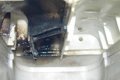
 If your washing machine has a black jelly-like substance growing in the soap dispenser it is likely to be a fungal, bacterial growth called biofilm. It can be quite pervasive and very difficult to remove as well as unsightly.
Apart from looking nasty, it can block up the little holes in the top of many soap dispensers causing water flow to be restricted. Partially blocked up nozzles can also cause water to get deflected into the fabric conditioner compartment. This causes the fabric conditioner to flush out too soon. Finally, deflected water can spray over to the front of the dispenser and leak out of the bottom of the dispenser drawer.
What causes the black jelly-like substance in soap dispenser and on soap drawer?
The growth is accelerated by moist environments. Bacteria and fungi need both water, and a source of nutrients. They get this from detergent. If both are present on a surface the organisms will grow and multiply to produce a grey/black jelly-like (slime) growth or produce a pink/red staining around bathroom tiles.
How to prevent biofilm growth
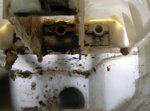 If you have a water valve not shutting off properly you can get a very small but constant drip of water into the soap dispenser. This can sometimes be observed by removing the soap drawer and seeing if you can see any dripping water.
Look out for a bulging globule of water some time after the washing machine has finished. If so, wipe the water away and see if it comes back, if it does you may need to have a new valve fitted although in some cases a badly blocked filter in the back of the valve can cause it not to shut off properly, or even water pressure that’s too low.
The best way to prevent this growth is to improve ventilation to allow these damp areas in kitchens and bathrooms to dry rapidly. With a washing machine I would leave the soap dispenser drawer open (at least partially) after using the machine drying it out manually first. If badly affected you may need to remove the drawer and wipe everything with kitchen towel or similar.
It’s a pain, but large growths can be troublesome and may require a complete new soap dispenser to be fitted – plus the growth will reoccur if nothing is done to stop it or at least control it.
Most soap dispenser drawers can easily be removed as there’s usually a clip to depress at the back which allows the drawer to come out.
It is also important to reduce the food sources for the bacteria and fungi to prevent growth. Food sources can include shampoo, soaps, propellants from hair spray and deodorants, and general kitchen food but with washing machines it’s clearly the detergent and fabric conditioner that the growth feeds on.
How to remove biofilm growth
Wiping with bleach or commercially available mildew removers should successfully remove the growth unless it’s really well established. Kitchen surfaces and bathroom tiles can be wiped with a household cleaner or mild bleach solution that will kill the bacteria and fungal spores.
Black slime associated with tap fittings can be removed by cleaning the inside of the tap or around the base of the tap with a small brush dipped in a mild solution of bleach.
I used to have this problem with my bathroom taps. Little flakes of black substance would occasionally hang from the inside of the nozzle and if I pushed a bit of tissue up the nozzle to clean it there would be a slimy black jelly inside the tap.
Give your taps a very good clean occasionally by working a little disinfectant around not only the outside, but also the inside of the tap nozzle with a toothbrush or a cotton bud.
Removing the black growth from washing machine dispenser and drawer
If your washing machine’s soap dispenser is infested with a black growth try to clean it out with the soap drawer removed.
Use on old toothbrush to clean the nozzles and top of the dispenser. Try using some of the products mentioned above. If it’s too bad to successfully remove it may need a new soap dispenser fitting
Further information – Slime and staining (external link)| Washing machine smells – causes of grease, slime and black mould inside washing machines
Repairs
Fixed-price repairs, Pay monthly options, Repair & protect your whole appliance..
Save Money Now
Subscribe to Which? today and start saving money now. Subscription offers often available.
Spares
Spares4Appliances is a spares company run by repair engineers who understand all about spare parts for appliances.
Many thanks for your help. Will try it out and let you know how I get on. Great website by the way.
I get black mould-like stuff in the dispenser drawer (nowhere else in the machine) but is is not jelly like but is sticky and difficult to remove and is felt-like. I have tried everything, as you have suggested, soaking and scrubbing the drawer with Milton Solution, and as the black stuff get gets into the inlet and in the runners where the drawer slides in and out, my husband has had to use the pressure hose to try and clean the inlet. When I spoke to the retailer and manufacturer (John Lewis) I was just told to do a hot wash! Is there anything else I should be doing?
Many thanks
Jenni
jenni: It’s not a fault on the washing machine unless by any chance the water valve isn’t shutting off properly and allowing a very slow but constant drip of water into the dispenser as described in my article.
If the machine isn’t in a damp environment or the dispenser constantly wet because of a valve not shutting off I would get your water authority to check your water supply. You could try turning off the tap after each wash if possible to see if it helps.
Hi, I bought a washing machine cleaner to clean my washing machine as I occasionally see flakes of dark brown stuff on my washed clothes. To my horror, the water (without) was filled with it and despite repeating 12 times, the problem persisted. After dismantling all that I could internally (horrible design), I found a whole lot more black slimy stuff which I scrubbed off manually. Thinking I had gotten to the root of the problem, I filled the washing machine with water and still I find a lot of the stuff, even though the colour had lighten. Tried to get washing machine repairmen to help but they say they only repair, they do not clean. Asked a favor from my air con man who tried to vacuum both the inlet and the outlet of the washing machine. Couldn’t get anywhere else as the rest of the parts are glue together (horrible design again). What should I do?
Claudia: I’ve never been convinced of the effectiveness of these so-called appliance cleaning products. They seem to just make an already clean washer or dishwasher smell a bit nicer but struggle to deal with really dirty or smelly appliances. Have you read my article Washing machine smells causes of grease, slime and black mould inside washing machines and tried the 90 degree boil washes with normal detergent?
Wondering why manufacturers dont invent a washing machine without a dispenser drawer, so that people can add the dispenser drawer to the wash and the water can come in straight from the mains. I have written to hotpoint. I suggest everyone else emails their manufacturer about the mould problem too and hopefullly they may invent this!!
Hi Steve: One of the problems would be for people wanting to use fabric conditioner, which needs to be stored somewhere until right at the end of the wash.
I recently had my washing machine soap drawer cause major problems and flooded my downstairs neighbour. I had to use this guide among others to completely dismantle my washing machine to dislodge the blockage which was a combination of this black stuff and undissolved powder in the pipe connecting the soap drawer to the drum.
As far as i can see its caused by the powder compartments jets lacking pressure, though it does come out at the correct temperature. I have thoroughly. cleaned the compartment with a bleached toothbrush and even poured undiluted bleach into it on a maintenance wash to hopefully clear away the rest of the black mould and powder from various parts of the machine.
I was wondering what the possible causes of this lack of pressure in the powder compartment are and how to fix it? Having taken it apart and put it back together again and working. I still cant see why the other two compartments on either side controlled by the same part spray strongly enough, but the centre compartment for the detergent barely drizzles.
Hopefully I can prevent this from happening again.
Hi Matt
I think that you will find that any blockage occurs in the compartments above the holes over the soap dispensers.
I have a Bosch machine, which suffers from black deposits building up above the Fabric Conditioner dispenser into a-sponge I consistency. No amount of-treatments using chemicals and hot washing cycles deals with it because the deposit is in the holes that the water emerges from before entering the soap dispenser. As it happens we always put the soap directly in the drum; we do however put fabric conditioner in the centre compartment of the soap dispenser.
You have to remove the whole soap dispenser frame from the machine and dismantle the top water dispenser compartments above the-holes, where the deposits are. The two halves of mine are just clipped together.
The blockage was preventing any water from reaching the fabric conditioner below.
In this top compartment, hot and cold water emerges from the hot and cold nozzles and is directed diagonally across the other nozzle into the respective spray areas above each soap compartment below.
When both hot and cold water emerge together, the water from the 2 nozzles collides and some of it is diverted into the centre area above the Fabric conditioner. With this upper centre area filled with the black sponge-like substance, the water had to find its way out through the hot and cold-holes. Perhaps this middle area only receiving, a-reflected mix and not a direct jet of water is why it is more prone to collecting fungus: It never gets a stream powerful enough to dislodge deposits. The two areas above the never used soap dispensers do not suffer the same problem.
I am resigned to repeating this sponge removal once a year.
Incidentally, this machine also has a double walled vertical tube inside the back panel that the waste water travels up before it leaves the machine. The gap between the two walls collects a grey jelly substance and it eventually overflows into the centre drain path and blocks the pump output.
I first noticed this grey sludge building up in the waste pipe after the soap manufacture changed its washing powder formulae.
Even putting the machine through a normal-Hot wash with flushing chemicals does not have its full effect on this residue due to the machine adding cold water for safety reasons to the hot water just before it pumps it out. Hot water is needed to dissolve the sludge.
I have to stop the machine just before this cold water is added and then select-drain to get the hot water to pass through this-sediment catcher.
Incidentally, low water pressure in my case is restricted to the hot water, which is fed from a tank in the loft, which obviously would be worse if the machine was on the first floor. Go up one floor and the hot water pressure drops by a third in my case. The drop in mains pressure one floor up would not be significant.
I understand that some new machines have a liquid reservoir for the fabric conditioner. This feature may help prevent the black fungus from forming. Now for the grey sludge!
Detergent drawers could not be more effective in encouraging black mould if they were specially designed for the purpose – the plastic mouldings have sharp corners, both in the tray and the slot, which trap residues and are difficult to clean. My Bosch washer instructions do not sufficiently emphasise the importance of cleaning it.
By the way, a joy to discover a forum with such well-considered responses informed by technical knowledge and practical experience.
Just grappling with the fabric conditioner dispenser as we speak. I have thoroughly scrubbed the black growth off repeatedly. I have been inside the housing up to my elbow with various sponges and brushes and cloths. I can’t get any more black gunk out. And yet my fabric conditioner will NOT dispense. Grr. My husband is poking around at the nozzles with a bit of wire. Surely there must be a better design. If we ever get the wretched thing to work properly again, I will remove the drawer every morning and leave it to dry out.