
Transporting a washing machine
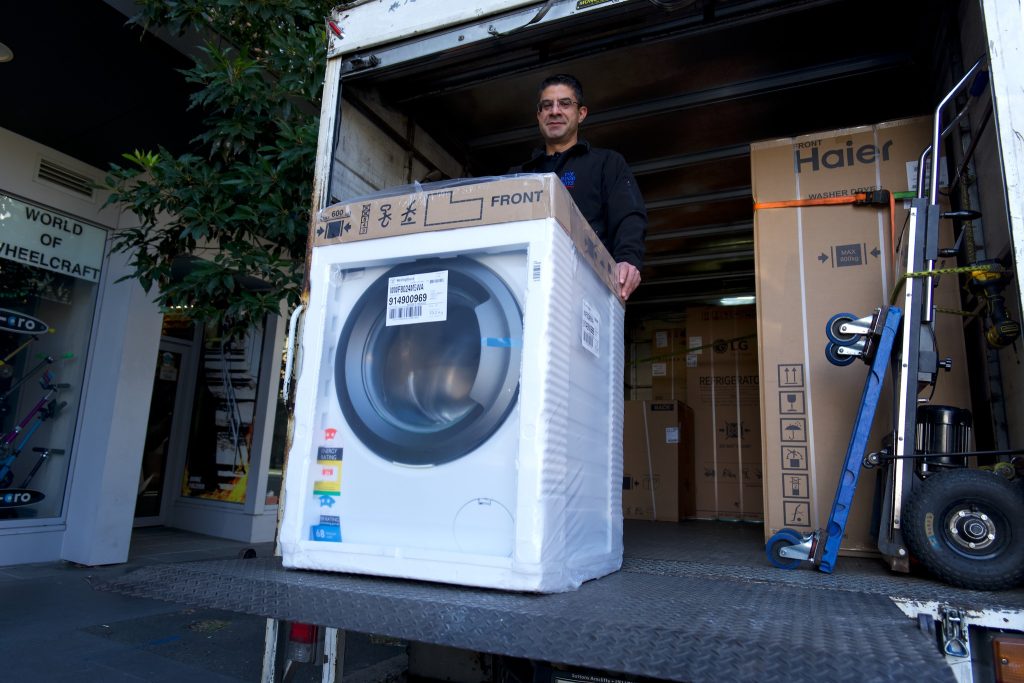

Refit the original transit bolts if they are available – these are the most reliable way to protect the drum during transport. If transit bolts are not available, drain residual water, secure all hoses, keep the machine upright throughout the move, and run a first cycle carefully after reconnecting. Most machines survive transportation without transit bolts if handled reasonably carefully, but the risk of drum damage increases on rough roads or in rough handling conditions.
Before Moving: Disconnect and Drain
-
Turn off the water supply and disconnect the fill hoses.
Turn off the tap supplying the machine. Unscrew the fill hoses from the tap connections and from the back of the machine. Drain any water remaining in the hoses and place them inside the drum for transport. Take care not to lose the rubber seals from the hose ends. See our guide on how to pull a washing machine out safely before starting.
-
Drain residual water from the sump hose and pump.
Even after a completed wash cycle, water remains in the sump hose and pump. This does not need to be removed if the machine will stay upright throughout the move. However, draining it prevents water running out from the drain hose if it drops to the floor, and avoids water dripping onto the floor or over anyone moving it when the machine is tilted. See our guide on how to drain a washing machine manually.
-
Secure the drain hose.
Use any clips provided at the back of the machine to secure the drain hose in the raised position. If no clips are fitted, use strong tape to fix the drain hose to the top of the machine so it cannot fall to the floor during transit.
-
Secure the mains cable.
Tape the plug and cable securely to the machine. A loose cable or plug dragging on the floor is a trip and safety hazard during moving.
Transit Bolts: The Most Important Step
New washing machines are supplied with transit bolts – steel rods fitted through the back panel that lock the drum in a fixed position to prevent it moving during transport. These bolts must be removed before first use and kept for any future move. If they can be refitted, this is the single most protective step for transporting a washing machine.
 If transit bolts are available
Refit them following the instructions in the machine’s manual before moving. Miele machines are specifically designed with transit packing that clips into the back panel so it will not get lost. Keep transit bolts with the machine after any move so they are available for future use. Do not forget to remove them before reconnecting and using the machine.
Most washing machines are moved without transit bolts and arrive at the destination undamaged. The risk depends on the quality of the machine’s suspension, how far it is being transported, how rough the road is, and how carefully the machine is handled. For a short local move in a careful driver’s van, the risk is low. For a long journey or rough roads, consider packing the drum space at the top (remove the lid, place folded bedding on top of the tub, and replace the lid so it presses down on the packing). Remove this packing before using the machine.

Transit bolts lock the drum rigidly to the cabinet. Running the machine with transit bolts fitted causes severe and immediate damage to the drum, suspension, and cabinet. Always remove transit bolts before the first wash after installation. The bolts are usually red or orange and visible at the back of the machine. The manual will show their exact location.
Keeping the Machine Upright – and What to Do If This Is Not Possible
A washing machine should be kept upright during transport wherever possible. The drum hangs on springs and if the machine is stood up, the drum cannot swing freely in a way that causes damage.
If transporting in a car where the machine cannot stand upright, lay it on its back (rear panel down) rather than on its side. Crucially, drain all residual water first – when the machine is laid flat, any water remaining in the sump hose and pump can run into the electrical components and cause a short circuit when the machine is next connected. Allow the machine to stand upright for a minimum of two to four hours after transport before connecting and running it, to allow any moisture to clear.
Using a Sack Trolley
If moving the machine on a sack trolley rather than lifting it directly, position the trolley plate at the base of the back panel. Hold the top of the machine firmly and tilt the trolley and machine back together as a single unit. Do not lever the trolley plate under the machine from the front – this risks damaging the base, the drum, or tipping the machine.
After Moving: First Use Check
-
Remove transit bolts before connecting. Check the back of the machine for any fitted transit bolts and remove them before starting a cycle. -
Remove any improvised drum packing. If folded bedding or similar was placed inside the machine to cushion the drum, remove it before use. -
Check all hose connections before running the first cycle. Reconnect and hand-tighten the fill hoses, checking the rubber seals are in place. Connect the drain hose to the standpipe or U-bend. -
Watch the first cycle carefully. Stay nearby during the first wash after a move to check for leaks at the fill hose connections, drain connections, and underneath the machine. See our guide on things to check after connecting a washing machine. -
If the machine won’t drain at the new location. A common problem after moving is that the drain hose position causes draining issues. See our guide on washing machine won’t drain after being moved.
Related Guides
Related Guides
 How to Pull a Washing Machine Out Safely
Technique for moving a washing machine without damaging floors, hoses, or the machine itself.
 Won’t Drain After Being Moved
Why a washing machine stops draining after being moved and reconnected – and the simple fixes.
 How to Install a Washing Machine
Full installation guide including hose connections, levelling, and first-use checks.
 How to Store a Washing Machine
Preparing a washing machine for short or long-term storage – draining, protecting, and positioning.
Frequently Asked Questions
Do I need transit bolts to transport a washing machine?
Transit bolts are the safest option and should be refitted if available. Without them, most machines survive careful transportation without damage, particularly over short distances on smooth roads. The risk increases with distance, rough roads, and rough handling. If transit bolts are not available, keeping the machine upright and handling it carefully reduces the risk significantly.
Can I transport a washing machine on its side?
Laying a washing machine on its back is preferable to its side if upright transport is not possible. Either way, the machine must be fully drained first – water remaining in the sump hose and pump can run into electrical components and cause a short circuit. Allow the machine to stand upright for at least two to four hours after laying it down before using it.
What happens if I forget to remove the transit bolts?
Running a washing machine with transit bolts fitted locks the drum rigidly to the cabinet. The drum cannot rotate freely and the machine cannot wash. In practice, attempting a cycle with transit bolts in place will cause severe damage to the drum mounting, suspension springs, and cabinet within seconds. Always remove transit bolts before the first wash.
Ask the repair forum
Post the make, model and symptoms and get help from the Whitegoods Help community.
34 Comments
Grouped into 24 comment threads.
0 replies Many thanks Mike.
0 replies What a superb site, Andy certainly offers sound advice, i have been involved in transportation of white goods for a number of years and can confirm everything Andy has said. Thank you Andy guiding others.
What a superb site, Andy certainly offers sound advice, i have been involved in transportation of white goods for a number of years and can confirm everything Andy has said. Thank you Andy guiding others.
0 replies Very good question Sue. When you buy any washing machine the hoses come with it so they belong to the washer and everyone should take them with the machine. Some may prefer not to mess about disconnecting them, or even think it will be easier for everyone but if you leave yours behind and the others take them you are stumped.
Very good question Sue. When you buy any washing machine the hoses come with it so they belong to the washer and everyone should take them with the machine. Some may prefer not to mess about disconnecting them, or even think it will be easier for everyone but if you leave yours behind and the others take them you are stumped.
0 replies Hi, we're moving house. When disconnecting the washing machine which we're taking to the new house do we take the hoses with us or do we leave them in place for the new owners of our old house? Thanks
Hi, we’re moving house. When disconnecting the washing machine which we’re taking to the new house do we take the hoses with us or do we leave them in place for the new owners of our old house? Thanks
0 replies It wouldn't normally damage anything unless it was left thumping around for a while but it's possible. The only thing you can do is check to see if you can see anything damaged by taking the top and back panel off, and that the tub is held centrally in place and the suspension bounces up and down ok when you push it from the top. After that it's a question of watching it on a few washes to make sure there are no leaks. If you have any problems it depends on the symptoms as to what the possible issue is but you'd probably need an engineer to look at it then.
It wouldn’t normally damage anything unless it was left thumping around for a while but it’s possible. The only thing you can do is check to see if you can see anything damaged by taking the top and back panel off, and that the tub is held centrally in place and the suspension bounces up and down ok when you push it from the top. After that it’s a question of watching it on a few washes to make sure there are no leaks.
If you have any problems it depends on the symptoms as to what the possible issue is but you’d probably need an engineer to look at it then.
0 replies Hi, I left the transport screw in while using the machine for the first time. It made a horrible noise. I think I broke it. I've taken it out now, but not sure it's working. Please help.
Hi,
I left the transport screw in while using the machine for the first time. It made a horrible noise. I think I broke it. I’ve taken it out now, but not sure it’s working. Please help.
0 replies Sorry for the delay in replying over the bank holiday weekend. I don't know of any time issues after moving a twin tub or dryer although if it is a modern dryer with a heat pump which is a compressor similar to that in fridges it may need to be left overnight to settle.
Sorry for the delay in replying over the bank holiday weekend. I don’t know of any time issues after moving a twin tub or dryer although if it is a modern dryer with a heat pump which is a compressor similar to that in fridges it may need to be left overnight to settle.
0 replies I am moving a whirlpool twin tub washer n dryer in a car how long till i can use it
I am moving a whirlpool twin tub washer n dryer in a car how long till i can use it
0 replies i bought a hotpoint washer/dryer from currys late last year in manchester and had it shipped to trinidad and tobago.i recieved it in march of this year in trinidad.since then i have tried getting it to work properlybut to no avail.the machine just keeps washing on the wash cycle,no rinse,no spin,no dry!i am very disappointed in currys and hotpoint ,can you assist me in having the machie work.
i bought a hotpoint washer/dryer from currys late last year in manchester and had it shipped to trinidad and tobago.i recieved it in march of this year in trinidad.since then i have tried getting it to work properlybut to no avail.the machine just keeps washing on the wash cycle,no rinse,no spin,no dry!i am very disappointed in currys and hotpoint ,can you assist me in having the machie work.
1 reply i transported a washer on it back, once i got where i was going i notice some oil had spilled. what should i do? HELP!!!
i transported a washer on it back, once i got where i was going i notice some oil had spilled. what should i do? HELP!!!
Leave a comment
1 reply I need to transport anew tumble dryer to Portugal in our car. What,s the best way
0 replies These are really helpful tips. Always keep your washer in an upright position when transporting it as excess water in the water hoses can leak and drench the motor part. When relocating, you might want to disconnect your washer 2 days ahead. Also purchase caster wheels to make transfer a lot easier.
These are really helpful tips. Always keep your washer in an upright position when transporting it as excess water in the water hoses can leak and drench the motor part. When relocating, you might want to disconnect your washer 2 days ahead. Also purchase caster wheels to make transfer a lot easier.
0 replies Just wanted to say thanks for this page, very helpful!
Just wanted to say thanks for this page, very helpful!
2 replies If the washing machine is being transported in a car or small van and cannot be kept upright I would lay the washing machine on its back. If this is how it will be moved it is doubly important to have drained out as much water as possible (as shown in the above section). This is because once laid down water can run inside the washing machine and run onto electrical parts causing an electrical short and of course expensive damage when the washing machine is next plugged in
If the washing machine is being transported in a car or small van and cannot be kept upright I would lay the washing machine on its back. If this is how it will be moved it is doubly important to have drained out as much water as possible (as shown in the above section). This is because once laid down water can run inside the washing machine and run onto electrical parts causing an electrical short and of course expensive damage when the washing machine is next plugged in
Likely replying to Washerhelp
Hi Washerhelp,
We are in the US and moving inter-state with a 3 yr old front-loader (which will be on the moving truck for 3 nights).
The manual says that if we are moving in the winter and outside temperatures could drop below freezing, then we should run a cycle in advance with some anti-freeze. To be honest, that sounds a bit over the top (and my wife is not at all keen!!) – but I would appreciate a second opinion. If we drain the hoses and do as you set out above (tipping the machine out thoroughly), do you reckon that the chances of water freezing internally and doing any damage would be pretty minimal?
Thanks so much – great page!
Likely replying to Alex
Hello Alex: I agree it does sound quite drastic. If you have drained out the water it can’t freeze and cause damage. You could never get rid of every drop of water but I can’t imagine how little bits of water could freeze and cause any damage. For it to damage something it would need to be enough to expand with nowhere to go and crack something.
Water left in the water valves could potentially freeze and would not be removed using the instructions in my article. As a precaution I would try to remove as much water from the valves as well as draining the machine.
The way I would do it is as follows –
- If the washer is cold fill only just put it onto any wash programme , but if it has a hot valve too you need to find a programme that takes hot and cold in simultaneously (non fast coloureds should do it) The object is to get any fill valve to take in water
- Once water is running through all valves turn off the taps so that the valve is still energised trying to draw in water but there is none to draw in. You only need to leave it trying to draw water in for a few seconds or so
- Once this has occurred abort or cancel the wash programme or turn it manually to a drain programme to empty away the water
- This should help to draw into the washing machine most of the water that would otherwise be held inside the water valve
Now you can follow the rest of the instructions in my article to try and remove the rest of the water.
I would also fill the drum with lightly scrunched up newspapers or paper kitchen towel to draw any more moisture out overnight.
0 replies I'm trying to move a portable washer/dryer combo which weighs 160 lbs. It is front loading with hoses fit with a faucet adaptor. Is it okay to put the washer on its side or back?
I’m trying to move a portable washer/dryer combo which weighs 160 lbs. It is front loading with hoses fit with a faucet adaptor. Is it okay to put the washer on its side or back?
0 replies Thanks a lot. Your advice is very helpful. You've probably just saved me a lot of time and mopping up. Cheers mate! Rohan.
Thanks a lot. Your advice is very helpful. You’ve probably just saved me a lot of time and mopping up.
Cheers mate! Rohan.
0 replies Thank you for your response. As I did not cause problems with my friend's mom car, I decide rent a truck. As truck comes with wheel for the use of washing machine to move on the road. Now I will start evacuate water from the washing machine flowing your guide line Thanks lots for this useful HP!
Thank you for your response.
As I did not cause problems with my friend’s mom car, I decide rent a truck. As truck comes with wheel for the use of washing machine to move on the road.
Now I will start evacuate water from the washing machine flowing your guide line
Thanks lots for this useful HP!
0 replies Should be ok in a car. I've transported many washing machines in the past in the back of hatchbacks with the seats down and estate cars. In an accident situation things could be bad if the washer is forced forward though. I would take it very steady.
Should be ok in a car. I’ve transported many washing machines in the past in the back of hatchbacks with the seats down and estate cars. In an accident situation things could be bad if the washer is forced forward though. I would take it very steady.
0 replies Hello I need to move new flat and thiking to move my washing mashine it seems it weight 60kg, with normal car ( well it is bit bigger, longer). Is this possible? Does it damage a car? putting into the car , i plan to use IKEA small wheeler (the small 2weels one)to load into the car. As this IKEA wheeler seems so weak, this might not possible. Please, let me know what you think. thanks for kind advise. regard,
Hello
I need to move new flat and thiking to move my washing mashine it seems it weight 60kg, with normal car ( well it is bit bigger, longer). Is this possible? Does it damage a car? putting into the car , i plan to use IKEA small wheeler (the small 2weels one)to load into the car. As this IKEA wheeler seems so weak, this might not possible.
Please, let me know what you think.
thanks for kind advise.
regard,
3 replies We just move to a new state, the moving company that take care of our house Layed down our Washer machine and our tumble dryer.. we just find out that they did this. I haven't be able to check them because they are in a storage unit. Do we are going to have a problem.
We just move to a new state, the moving company that take care of our house Layed down our Washer machine and our tumble dryer.. we just find out that they did this. I haven’t be able to check them because they are in a storage unit. Do we are going to have a problem.
Likely replying to Washerhelp
Hi Washerhelp,
I have an old washing machine which I want to disconnect from the inlet taps / inlet pipes, in preparation for disposing of.
The inlet taps are located underneath a kitchen sink, and they appear to have “on / off levers” on them.
Do these inlet taps normally have an additional safety mechanism inside them to prevent water flow when the pipes are disconnected? OR will water flow from the taps when disconnected if the “levers” are in the “on” position?
Thank you for your advise,
James C
Likely replying to James C
Hello James C: If they are the ubiquitous red and blue plastic levers they must be turned so that the lever is pointing either up or down instead of pointing in the direction of the pipes. When the lever is pointing in the same direction as the water flow the tap is on. When turned 90 degrees so they are pointing either up at the ceiling or down to the floor they should be off and it should be safe to remove the hose.
Have a towel ready and a bowl to drain the water into as there will be some water when they are first removed. These taps are notorious for not turning off properly so be careful they don’t drip afterwards. If possible, leave the hoses attached after disconnecting from the washing machine to drain into a bowl or bucket to make sure there isn’t a slow drip from the taps.
1 reply Shipping bolts or kits are a big problem when moving. There is a product called LITKIT that works well when shipping all types of washing machines. There are demo videos on You Tube, search LITKIT.
Shipping bolts or kits are a big problem when moving. There is a product called LITKIT that works well when shipping all types of washing machines. There are demo videos on You Tube, search LITKIT.
1 reply I moved and put my stuff in storage for a year. The movers secured it nicely and professionally. Now I am moving the stuff out of the storage with a friend or two. Do I need to remove the stuff the movers used to secure the washer during moving?
I moved and put my stuff in storage for a year. The movers secured it nicely and professionally. Now I am moving the stuff out of the storage with a friend or two. Do I need to remove the stuff the movers used to secure the washer during moving?
Likely replying to Kay
Hello Kay
If they just said they secured it while in transit they could have been referring to just securing it carefully in their van, but if they fitted some sort of transit packaging inside then it must be removed.
If they did fit anything they surely should either remove it as part of their service or at least leave you instructions on how to remove it.
You need to ask them if they fitted anything inside.
1 reply After transporting a new clothing washer on its side, how long do you have to let the oil settle before you can start washing? Thanks for the great website.
After transporting a new clothing washer on its side, how long do you have to let the oil settle before you can start washing?
Thanks for the great website.
Likely replying to Renita Leong
Hello Renita. There’s no oil in UK washing machines that I know of. If yours is an American top loader I’m not familiar with them at all.
I just purchased a new tumble dryer though and that has oil inside because it has an energy saving heat pump built in which stores heat and it uses oil. The advice on the instruction book was to leave it to stand 12 hours before using “if it has been laid on its side”. As I couldn’t be sure if it had been laid on its side sometime during transportation to me I let it stand to be on the safe side.
I would think 12 hours should be enough but 24 if you want to be cautious.
0 replies Thank you for your sugestions. I will be moving a washing machine Sat Nov. 24, 2007. I will put in in my SUV and will transport it on it's side. Thank you again, Yves Fournier in Oceanside California
Thank you for your sugestions.
I will be moving a washing machine Sat Nov. 24, 2007.
I will put in in my SUV and will transport it on it’s side.
Thank you again,
Yves Fournier in Oceanside California
Many thanks Mike.