I am talking about mild “tingles” and not proper electric shocks. However, if anyone receives any kind of electric shock, the appliance should be disconnected immediately, and an appliance engineer called out. Mild electric shocks or tingles might not be taken seriously, but they can turn into lethal full mains voltage shocks at any time.
 So never use any appliance even if you only get a mild shock from. Disconnect it immediately. The reason you get shocks from a washing machine, or any other appliance, is because it is not earthed properly.
Why Does an unearthed appliance cause shocks?
All large appliances need to be connected to earth for safety. The earth wire runs down the mains cable and then through the socket it is plugged into. If this connection becomes broken at any point in the machine, cable, plug or wall socket, then you can get the symptom of mild electric shocks.
The shocks are often mild, or just tingles because they are caused by small amounts of electricity leaking or inducing across to the disconnected earth wire and running through the casing. It’s a phenomenon related to eddy current, but it’s not necessary to understand the scientific reason.
 Such an appliance poses a serious danger. Because the mild shocks indicate that the washing machine is not earthed it means that if a component inside the machine’s insulation breaks down, or a live wire comes adrift and touches the metal parts inside, then the low voltage current will be replaced by the full mains voltage – which can kill. Without a path to earth, the washing machine cannot blow the fuse, and instead could just work as normal but be lethal.
Plug not earthed?
 The first thing an engineer is likely to check is the appliances plug. They would check inside the plug to make sure the green and yellow earth wire is connected securely.

Forbes specialise in renting Bosch appliances so they know them inside out. They also rent other brands and many other products – more details at Forbes
If it’s OK, then either the earth wire inside the mains cable could have a break somewhere inside and needs replacing, or it may not be connected inside the washing machine. (The latter is very unlikely, I’ve never known it, but it’s theoretically possible). Both can (and should) be checked with a continuity test meter by checking the continuity between the earth pin on the plug and the metal door hinge or another suitable bare metal point on the washing machine.
Moulded plugs
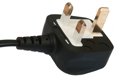 Most appliances have long since come with pre-fitted moulded plugs which can’t be checked. So if unable to check inside the plug the first thing an engineer would check is the continuity down from the earth pin as described above. If he had a good reading he shouldn’t need to look inside the plug anyway. If the reading was open circuit or high resistance, but the earth was connected properly inside the machine he’d cut off the plug about an inch down and replace it because earth wires can break at that point. If that failed to make a difference he’d replace the mains cable.
Extension cables
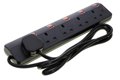 If the appliance is plugged into an extension cable then clearly there could be a problem anywhere on the extension. So an engineer would check the earth connections and continuity on the extension cable. Ideally ditch the extensions, they aren’t ideal on large white goods appliances. If one is necessary try another extension (but make sure it’s appropriate – appliances and extension cables). I have seen appliances plugged into totally inappropriate extension cables that are using 2 core cable with no earth!
Wall socket not earthed
 Another possibility is a fault in the wall socket. The earth wire could be disconnected inside or the brass earth prongs inside could be worn or too far apart to grip the earth pin on the plug properly. Obviously you don’t mess with wall sockets. If you suspect a faulty wall socket get an electrician – not an appliance engineer.
Don’t confuse with static electricity discharges
If you get just a single short shock when you touch an appliance (possibly accompanied by a cracking sound) which doesn’t reoccur when you touch the appliance again this could be static electricity discharging from your body and is very different to this issue.
Repairs
Fixed-price repairs, Pay monthly options, Repair & protect your whole appliance..
Save Money Now
Subscribe to Which? today and start saving money now. Subscription offers often available.
Spares
Spares4Appliances is a spares company run by repair engineers who understand all about spare parts for appliances.
I can only advise to get an appliance engineer to check it out. Getting a shock from inside the drum is serious and shouldn’t be ignored. Even if it’s gone away there must be something wrong somewhere for it to have initially happened and it could potentially come back any time.
Good article, especially since my husband I think thinks I’m crazy when I complain about being shocked at times by the washer. He has never experienced it he rarely does laundry and when I have made him take the clothes out b/c the shocks were to much he usually has his chef crocs on, so maybe that has something to do with it.
The grounding was my first thought when this first started occurring and the wiring in the house we are living is is very bad I’m definitely showing him this article
Hello, I experienced two electric shocks today that were pretty intense both times when I had my electric toaster oven plugged in. Just as I plugged the oven in and as I was reaching for the side to pull it away from the wall (it was too close to the wall), my hand touched the surface of the sink, then Zap! The toaster oven is placed right next to the metal stove top, and my hand haven’t even touched the metal part of the stove, just the wooden/plastic part of the sinc.
At first, since the shock came from the surface of the sinc, i thought it was the stove top with the problem. But later on I realized the toaster oven has an old school non-polarizing plug….with 120 V. The brand name is G Force Electronics. The stove top is attached to 3 prong RCD, and it is well grounded, and it must be 240 V as half the wall ports are RCDs and the other half 120V GFCIs (the landlord is from Great Britain. We live in the caribbeans). I immediately unplugged the toaster oven, and everything is back at ground, no more shocks. My concern is this never happened before with the toaster oven; do you think it has a wire problem? And I should practically stay away from all household appliances with non-polarized plugs right? I had never experienced this before, it was very panicking.
Just to add on to the question. Do I have to worry about two prong polarized plugs? Are they grounded well? My rice cooker and blender is two prong polarized. If they ever get bad and has a leak, that also wouldn’t trip off the breaker b/c it has no third ground prong (green line)?
Thank you so much; I want to stop worrying and have my arm around this.
Hello Brian. I don’t know anything about polarised plugs as we don’t have them in the UK (to my knowledge). If a plug doesn’t have an earth (or ground) prong then the appliance doesn’t need earthing and you shouldn’t be able to get a shock from it. These products are usually encased in plastic.
If you get a nasty shock from any appliance then that appliance can’t have been earthed. If it only happened once or occasionally there may be an intermittent bad connection and you should NOT use the appliance again until it’s properly investigated and fixed.
There’s no other way for any electricity to be running through the appliance casing without blowing or tripping the fuses. Earth faults can be inside the appliance, in the mains cable, in the appliance’s plug or anywhere in the wall socket or within the wiring from the wall socket back to the main fuse board.
we recently replaced our in wall oven there are red black and whitewires the ground wire showed on the last one it ran with the white wire yet while i was cooking i was holding my pot and my hand grazed the metal part onthe oven andi got a shock a few minutes later the hadle of thepot touched the metal part of the oven and i seen a spark whatis causing this
Hello Melony. The earth wire should always be yellow and green in the UK. Turn off the oven and stop using it immediately. It’s potentially dangerous. You need to get the earth checked out properly by an electrician. My article above explains this can only happen if the appliance is not earthed properly and if an electrical fault develops it could be lethal.
hi i had a small shock from around the washing machine, so i used a volt probe and touched the body of the machine, should the probe light up?
No Rich. Read my article for reasons and explanations.
My wife and I had to replace our tumble dryer a couple of months ago. The old one was a Creda – it “died”. The new one is a Beko. The old one had a plastic hose outlet, and we never had the trouble, but the new one has a tin foil type. We get regular static when touching the adjacent metal sink. Advice, please!!!!
Hello Pete. I’ve not seen a tin foil type vent hose. If you are getting a static discharge when touching the sink it shouldn’t be coming from the dryer. Static is what builds up when we walk across carpets or with clothes on made of specific fibres. The static builds up, and when we touch anything that is earthed like a sink or an appliance the static jumps from us to the object. Once it’s jumped that’s it until static gets built up again.
If you are getting one-off static shocks when touching the sink the static must be building up in the person prior to touching it from clothing, shoe-wear or carpets. If on the other hand you get a shock when touching the dryer and the sink that’s a different thing and the causes are described in my article.
Thanks for your prompt response.