I am talking about mild “tingles” and not proper electric shocks. However, if anyone receives any kind of electric shock, the appliance should be disconnected immediately, and an appliance engineer called out. Mild electric shocks or tingles might not be taken seriously, but they can turn into lethal full mains voltage shocks at any time.
 So never use any appliance even if you only get a mild shock from. Disconnect it immediately. The reason you get shocks from a washing machine, or any other appliance, is because it is not earthed properly.
Why Does an unearthed appliance cause shocks?
All large appliances need to be connected to earth for safety. The earth wire runs down the mains cable and then through the socket it is plugged into. If this connection becomes broken at any point in the machine, cable, plug or wall socket, then you can get the symptom of mild electric shocks.
The shocks are often mild, or just tingles because they are caused by small amounts of electricity leaking or inducing across to the disconnected earth wire and running through the casing. It’s a phenomenon related to eddy current, but it’s not necessary to understand the scientific reason.
 Such an appliance poses a serious danger. Because the mild shocks indicate that the washing machine is not earthed it means that if a component inside the machine’s insulation breaks down, or a live wire comes adrift and touches the metal parts inside, then the low voltage current will be replaced by the full mains voltage – which can kill. Without a path to earth, the washing machine cannot blow the fuse, and instead could just work as normal but be lethal.
Plug not earthed?
 The first thing an engineer is likely to check is the appliances plug. They would check inside the plug to make sure the green and yellow earth wire is connected securely.

Forbes specialise in renting Bosch appliances so they know them inside out. They also rent other brands and many other products – more details at Forbes
If it’s OK, then either the earth wire inside the mains cable could have a break somewhere inside and needs replacing, or it may not be connected inside the washing machine. (The latter is very unlikely, I’ve never known it, but it’s theoretically possible). Both can (and should) be checked with a continuity test meter by checking the continuity between the earth pin on the plug and the metal door hinge or another suitable bare metal point on the washing machine.
Moulded plugs
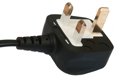 Most appliances have long since come with pre-fitted moulded plugs which can’t be checked. So if unable to check inside the plug the first thing an engineer would check is the continuity down from the earth pin as described above. If he had a good reading he shouldn’t need to look inside the plug anyway. If the reading was open circuit or high resistance, but the earth was connected properly inside the machine he’d cut off the plug about an inch down and replace it because earth wires can break at that point. If that failed to make a difference he’d replace the mains cable.
Extension cables
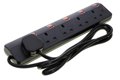 If the appliance is plugged into an extension cable then clearly there could be a problem anywhere on the extension. So an engineer would check the earth connections and continuity on the extension cable. Ideally ditch the extensions, they aren’t ideal on large white goods appliances. If one is necessary try another extension (but make sure it’s appropriate – appliances and extension cables). I have seen appliances plugged into totally inappropriate extension cables that are using 2 core cable with no earth!
Wall socket not earthed
 Another possibility is a fault in the wall socket. The earth wire could be disconnected inside or the brass earth prongs inside could be worn or too far apart to grip the earth pin on the plug properly. Obviously you don’t mess with wall sockets. If you suspect a faulty wall socket get an electrician – not an appliance engineer.
Don’t confuse with static electricity discharges
If you get just a single short shock when you touch an appliance (possibly accompanied by a cracking sound) which doesn’t reoccur when you touch the appliance again this could be static electricity discharging from your body and is very different to this issue.
Repairs
Fixed-price repairs, Pay monthly options, Repair & protect your whole appliance..
Save Money Now
Subscribe to Which? today and start saving money now. Subscription offers often available.
Spares
Spares4Appliances is a spares company run by repair engineers who understand all about spare parts for appliances.
Having just received a shock from my dishwasher, I noticed both it and a washing machine were plugged into an extension cable going to mains. After reading your article I understand how dangerous this is, but curious to know why I’d get a shock from the dishwasher but not the washing machine? Thanks
Hello Grant. If the shock was caused because the extension cable did not have an earth then both appliances should in theory give some sort of mild shock but it might depend on how much metal on the appliance you are exposed to. On a dishwasher we have the large stainless steel inner door and casing which is perfect for giving out shocks but a washing machine has less areas to expose us to shocks – plus the metal inner drum is encased in a plastic drum and isolated. If the extension cable is earthed it’s possible only one of the sockets was faulty or had worn earth prongs.
Thanks for your quick reply. I have now plugged both into the mains and very tentatively touched the inside, and didn’t get a shock. My rcd has a test button which I’ve used too and nothing has tripped (except the protected circuits) so I’m hoping the extension was the culprit. Lesson learned!
Thanks again
My friend has the two wire, black and white, wiring in his home..he was getting a shock from electric grinder in garage, also from refrig. In garage. Now he has metal ceiling g installed in garage and it now is picking up the stray current and transferring g it to garage door tracks. It is a steady flow that gets your attention when you touch it. Has me stumped, any suggestions?
Never heard of two wire black and white wiring Dave. What country? All power sockets need to be earthed in the UK. If he is using appliances with no earth in the sockets and getting relatively mild shocks there’s a chance that soon er or later the shocks could turn fatal if one of the appliances gets a loose wire that touches anything metal or a part like the heater or motor develops an insulation fault.
Recently started getting a small shock from the shower control. It is a non electric shower. What could be causing this
If it’s a single small shock could it be a static discharge? If it’s a proper electric shock you need an electrician asap.
Hi I have a dryer which is fairly new and when I put washing into the dryer I am get an eclectic shock which feels like tingles in my hands when I touch the damp cloths. It has only just started happening, could this be the reason?
Yes Rebecca.
Hi I just bought a vinyl cutting machine and it was supplied with a 2 prong plug on the power cable with an adaptor for UK plug sockets. Plugged in I can feel the tingle in the metal parts of the unit and stand and holding an AC detector pen a foot away from it the pen detects AC voltage around. I unplugged it and changed the lead for an earthed power cable with fitted 3 pin UK plug from my computer and this solved the problem. Is this normal?
Thanks
Hello Richard, this is about white goods appliances and I’ve never seen one of those machines. If it was supplied with a 2 prong plug it doesn’t look like it is meant to be earthed. However, getting a tingle from it and detecting the current around it are the symptoms of a product that should be earthed not being earthed as described in my article. The majority of appliances that are encased in plastic don’t need earthing as they are double insulated, also some small appliances even with metal parts may not need earthing if they are double insulated. You need to carefully examine the product especially at the back or underneath where the rating plate or sticker is. If it has the double insulated symbol on it then it doesn’t need earthing. The double insulated symbol is basically a square within a square and it is usually found on appliances that are entirely made of plastic on the outside. If it doesn’t have this symbol it should be earthed, but then it should surely have an earth in the mains cable supplied.