In theory, yes — but in practice, the way washing machines work means that in most UK households it is more economical to use a cold-fill washing machine.
It depends partly on how close the hot water source is to the appliance. However, many UK homes rely on hot water tanks located upstairs, and even combination boilers can take time to deliver genuinely hot water.
I’ve written about this in more detail before (see links at the end), but I carried out this simple experiment to demonstrate the issue clearly.
This is a visual demonstration of how little hot water actually reaches a modern washing machine — and why a hot water valve is unnecessary for most households.
Wasted water from hot tap
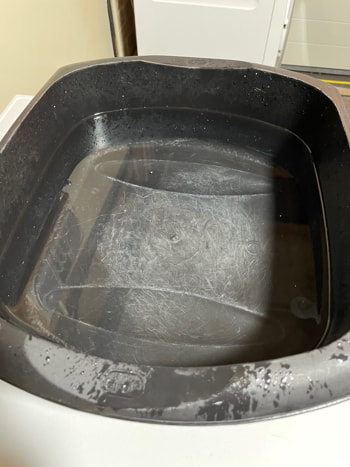
The photo above shows how much water ran from my hot tap before it actually became hot. In effect, this is a bowlful of cold water that would be wasted before any hot water arrives.
How much water is used in the wash?
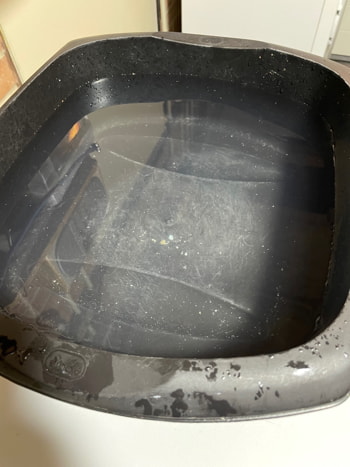
This photo shows how much water was used during the main wash cycle (Cottons 40°). It’s only slightly more than the amount of cold water wasted waiting for the hot tap to run hot.
Most washing machines use just under a bowlful of water for the main wash.
This means that if a machine were using both hot and cold fill, by the time it had filled to the required level, only a small amount of hot water — perhaps just a few cups — would actually enter the drum.
In my case, the machine would need to fill almost entirely from the hot supply just to get a brief splash of hot water at the very end.
Unless hot water reaches the machine within a few seconds, it simply won’t contribute anything meaningful to the wash.
There are additional inefficiencies too. Hot water sitting in pipework is wasted, and drawing fresh hot water from a cylinder causes the stored water to cool as it is replaced.
There is a common belief that using hot water is more economical, but in most cases this is not true.
Washing machines are not sophisticated enough to handle the wide variation in how hot water is delivered — especially when the delay before hot water arrives is unpredictable.
Related articles
For more detailed explanations and discussion, see:
Spares
Spares4Appliances is a spares company run by repair engineers who understand all about spare parts for appliances.
You’re wrong when you state,”the majority of households in the UK get their hot water supply from a hot water tank upstairs” the vast majority have combo boilers. Almost 55% giving almost instant hot water.
Thanks Clive. It was correct at the time of writing, and more importantly at the time that manufacturers made the decision to switch over to cold fill. I will rephrase that. However, having a combination boiler makes no difference to most people in relation to this issue, because they usually still take a long time to produce hot water, by which time the washing machine will have finished taking in water. If a combination boiler is very close to the washing machine, then this may not be such a problem.
As it happens, in every house I have ever lived in, there has been a hot water cylinder storing hot water. But after 17 years in my current house, we have just had the boiler replaced by a combination boiler. The boiler is in our loft, which admittedly is further away than most, but it actually takes slightly longer for hot water to run through our taps with the new combination boiler than it did with the old hot water cylinder.
It would be nice if manufacturers could state the maximum temp that their machine could take in on the COLD inlet – as I’m thinking of having an under-sink type boiler that pre-heats the water to 30C from my solar panel over say 15-40 mins.
The boiler would be on a solar diverter circuit, i.e. only heating with pure solar electric.
My washing machine would be on a slight delay to allow the water in the boiler to heat up.
Hi James. Tbh I think preheating the water has questionable value. If it’s free to heat the water up that’s not so bad. But modern washing machines and detergents are designed to work best when water is cold and slowly heats up. This is especially the case for biological detergents. So biological detergents in particular could have reduced effectiveness.
Also, washing machines tend to wash until the required temperature is reached, and then pump out the water, and move on to rinsing. If water is already 30 degrees when it starts, then any 30 degree wash cycle is likely to substantially reduce the wash time. 40 degree wash cycles could also cut the wash time substantially. This would be likely to adversely affect how well it washes the laundry.
I was musing on this exact thing when I woke up and this article explained it very clearly. I would just suggest a further “bowl test” with your combo boiler to show that difference.
Interesting your point about wash time (before rinse) being governed by the time it takes for the cold water to become hot, and not just a fixed time. Are you sure? Also is the rinse in hot or cold water?
I am contemplating installing a cylinder powered by solar (not PV) to preheat water for the combi, and to store solar heat as well as an immersion heater for excess PV/wind electricity. That might change the equation.
But the other point you make about”design of detergents” to work cold is interesting. The manufacturers don’t seem to emphasise incompatibility with “hot fill” machines – perhaps because, for the reasons you say, they are a myth.
Hello Tony. Thanks for your comment and your interesting points. With my combination boiler, it takes around the same time for any water that is remotely warm to enter the bowl under the test. So with either a hot water cylinder system, or a combination boiler, it would be utterly pointless for me to bother with a hot and cold fill washing machine.
Having said that, if my washing machine was in the kitchen, and the combination boiler was in the kitchen, then there would be some hot water getting in during the wash but still with a delay. But with a washing machine only using less than a bowl full of water, it is pointless being concerned with having a hot water supply – even if you mostly use 60° plus wash cycles. Most people used 30 or 40° washes, in which case hot water supply would be of no use. And in fact using hot and cold fill washing machine could be very counter-productive because a lot of hot water gets heated up but not used as it is drawn into the pipework only to just cool down and be wasted.
All washing machines rinse in cold water. I’ve heard an argument that using warmer water can be slightly more effective but I’m not sure if this is actually true. I think warmer water is more likely to excite detergent and create extra suds. This would give the impression that more detergent is being removed. But this could be totally false. Anyway, all washing machines I have ever known have always rinsed totally in cold water, and it seems to work fine if done correctly, with the right amount of water.
Wash times have always been governed by the time it takes for the water to heat up. The temperature of the water is constantly monitored. If the software detects that the temperature of the water is not increasing, it will abort with an error. So a washing machine is aware of the temperature at all times.
Back in the day, if I was testing a washing machine’s wash cycle (when they used to be hot and cold fill) I would turn off the cold water tap during the initial fill. This would get the wash water temperature off to a good head start, which cut the wash time down dramatically.
Washing machines historically have filled up with water and started to wash. They then continue to wash until the thermostat closes at the designated temperature. At that time, the washing machine would either instantly move onto the rinses, or it may be that they just wash for a short time longer.
If washing machines just used a set time period, the results would be pretty uneven and unpredictable. Modern washing machine detergents are designed to work at specific temperatures. So for example, if someone’s washing machine heating element was caked in limescale, their washing machine may never even reach 40° on a 40° wash cycle due to reduced heating efficiency. Also, in winter, the temperature of the cold water entering the washing machine would be many degrees lower than it is during summer. So you would get different wash results in summer to winter. It makes much more sense to ensure that the water temperature has reached the required level before moving onto the next stage. This is why I believe adding hot water to a cold fill washing machine can detrimentally affect its washing efficiency.
It’s always possible that they have changed how they work for some reason that I have not been aware of. But I can’t see of any advantage at all with washing for a set time period, with no knowledge of the temperature of the water.
Changing from hot and cold to just cold. What is the best way? Just turn off the hot supply or some other way?
Hi Richard. I have an article on the subject here what to do with the old hot water tap
Great article on why it’s a myth to think hot water supply works. It is easily going to increase energy bills because you’re going to have another pipe with heated hot water, just sat there