
Which uses more water a dishwasher or washing by hand?
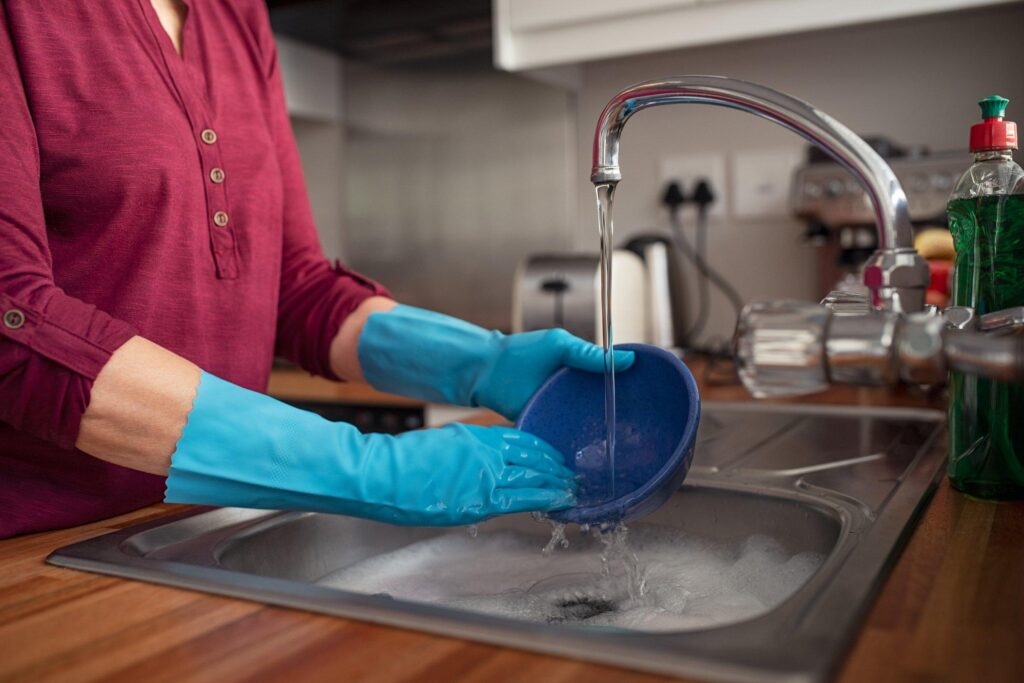

A dishwasher uses less water than hand washing – but only when compared against hand washing under a running hot tap. If dishes are washed efficiently in a basin without continuous rinsing, hand washing can actually use less water than a dishwasher cycle. For most households of three or more, a full dishwasher load on an eco programme is more economical overall. Hand washing is faster in elapsed time but ties up the person doing it; a dishwasher takes longer but runs unattended.
Does a dishwasher really save water?
Manufacturer marketing often claims a dishwasher saves 50 litres or more per load compared with hand washing. That figure is only accurate against one specific hand-washing method – rinsing each item under a continuously running hot tap.
Modern efficient dishwashers use around 9 to 12 litres of water per cycle on an eco programme. Whether that beats hand washing depends entirely on how the hand washing is done.
Efficient dishwasher per cycle
Hand washing under a running tap
Efficient hand washing in a basin
 Hand washing under a running tap
- Rinsing each item individually under a continuously running hot tap uses 40 to 60 litres for a typical load.
- Against this comparison, a dishwasher uses substantially less water and the manufacturers’ savings claims are credible.
- It’s also the most expensive way to wash dishes, since most of that water is being heated.
 Hand washing efficiently in a basin
- Washing in a bowl of hot soapy water and rinsing in a second bowl uses far less water.
- For a small load, efficient hand washing can use less water than a dishwasher cycle.
- Particularly relevant for one or two-person households who would otherwise run a half-empty machine.
The Advertising Standards Authority upheld a complaint against a dishwasher manufacturer’s water-saving claim on exactly this basis. The ruling noted that the claim did not make clear that, in some cases, washing by hand could be more water-efficient than using a dishwasher. Efficiency comparisons are only valid when the hand-washing method is specified.
Is a dishwasher cheaper to run than washing by hand?
A fully loaded dishwasher on an eco programme uses less energy than heating enough hot water for hand washing under a running tap. For a household of three or more that regularly fills the machine, research consistently shows the dishwasher is cheaper overall.
For one or two people who rarely fill the machine, the picture is less clear. A half-empty dishwasher is significantly less efficient per item than a full one, and the fixed cost of each cycle – water heating, motor, pump – is the same regardless of how loaded it is.
-
Always run a full load. The energy and water cost of a cycle is largely fixed regardless of how many items are inside. A half-empty machine is significantly less efficient per item than a full one. -
Use the eco or auto programme for everyday loads. Eco cycles use less water at lower temperatures over a longer cycle, which is more efficient than shorter high-temperature programmes for normally soiled dishes. -
Use intensive programmes only when needed. Heavily soiled pots and pans may justify a higher-temperature programme, but using the most powerful cycle for everything wastes water and energy unnecessarily. -
Skip pre-rinsing under the tap. Scraping plates is enough for any modern dishwasher. Pre-rinsing under a running tap can use more water than the cycle itself and removes any water-saving benefit.

A dishwasher’s running cost is heavily influenced by its energy efficiency rating. A modern A-rated machine can cost significantly less per cycle than a 10-year-old model. See our guide on the difference between energy ratings for how to read the labels properly.
Get more from your dishwasher
The right detergent and a properly maintained machine make the biggest difference to running costs and cleaning performance.
Is a dishwasher more hygienic than hand washing?
Yes, generally. Dishwashers wash at temperatures between 55 and 70 degrees, with a final rinse that can reach 70 degrees or higher on hotter programmes. Those temperatures are significantly more effective at killing bacteria and breaking down grease than the 40 to 45 degrees most people can comfortably hand wash at.
Dishwashers also dry dishes in a sealed environment rather than on a tea towel that may not itself be clean. For households with babies, anyone immunocompromised or just preparing a lot of raw meat or fish, the hygiene difference is meaningful.
Which is faster – dishwasher or hand washing?
Hand washing is faster in elapsed time. A typical load takes 15 to 30 minutes of continuous effort. A dishwasher cycle runs for 1 to 3 hours, with eco programmes at the longer end.
The relevant distinction is between elapsed time and active time. Loading and unloading a dishwasher takes 5 to 10 minutes of effort – the machine does the rest unattended. Hand washing requires continuous attention for the full duration.
| Method | Active time | Total elapsed time | Person tied up? |
|---|---|---|---|
| Dishwasher (eco) | 5 to 10 minutes | 2 to 3 hours | No – runs unattended |
| Dishwasher (auto) | 5 to 10 minutes | 1 to 2 hours | No – runs unattended |
| Hand washing | 15 to 30 minutes | 15 to 30 minutes | Yes – continuous effort |
When does hand washing actually beat a dishwasher?
The case for hand washing is stronger than manufacturer marketing suggests in a handful of specific situations. None of these mean a dishwasher is the wrong choice – just that the savings argument isn’t universal.

If you can’t realistically fill the machine even every other day, running half loads erodes the per-item efficiency advantage.

Two mugs and a plate don’t justify a full cycle. A quick rinse in a small basin uses a fraction of the water and energy.

Wooden boards, chef’s knives, cast iron pans, fine glassware and lead crystal should never go in a dishwasher – hand washing is the only safe option.
The full environmental footprint of dishwasher ownership is broader than the per-cycle comparison. Manufacturing, shipping and eventual disposal all carry environmental costs that don’t show up in running cost figures. Those factors only matter once – a well-built machine that lasts 12 to 15 years spreads them thin.
How can you make a dishwasher cheaper to run?
Even if a dishwasher beats hand washing on average, there’s a wide range between the most and least efficient way to use one. These habits keep running costs as low as possible.
-
Wait until it’s full. The single biggest factor in efficiency. If you genuinely can’t fill it, use the half-load setting only as a fallback – it doesn’t halve the cost.
-
Scrape, don’t rinse. Pre-rinsing under a running tap is the classic way to negate the water savings of using a dishwasher. Scraping plates straight into the bin is enough.
-
Use the eco programme as default. Longer cycle, lower temperature, less energy. Switch to an auto or intensive cycle only when the load justifies it.
-
Keep filters and spray arms clean. A dishwasher that isn’t cleaning properly is wasting every cycle. See our guide on why a dishwasher might not clean dishes properly.
-
Top up salt and rinse aid. Skipping either reduces cleaning performance, leaves residue and means more rewashing. The right dishwasher detergent also matters.
-
Consider a delay timer overnight. If you’re on an Economy 7 or time-of-use tariff, running the cycle during cheaper hours can cut the electricity cost noticeably. See our guide on appliances and Economy 7.

Dishwashers run on mains electricity and connect to mains water, and detergent capsules in particular are a known poisoning risk to small children and pets. Keep tablets and capsules out of reach and never leave the dispenser door open with detergent inside. Any repair involving the casing, wiring, pump, heater or door interlock should be carried out only by a qualified appliance engineer. If you’re unsure, book a qualified engineer rather than attempting a DIY fix.
Related guides
 Which Dishwasher Detergent Is Best?
Tablets, powder, gel and all-in-one pods compared on cleaning performance and cost per wash.
 Dishwasher Not Cleaning Dishes Properly
Why dishes come out dirty, cloudy or with residue – and how to fix the most common causes.
 Connecting a Dishwasher to Hot Water
Whether connecting a dishwasher to the hot supply saves energy and how to do it correctly.
 Understanding Energy Ratings
How the new energy labels work and what an A-rated dishwasher actually saves you.
Frequently asked questions
Does a dishwasher use less water than washing by hand?
Usually yes, compared to hand washing under a continuously running hot tap. An efficient dishwasher uses around 9 to 12 litres per cycle; hand washing under a running tap can use 40 to 60 litres. However, efficient hand washing in a basin uses far less – the Advertising Standards Authority upheld a complaint against a manufacturer’s water-saving claim on exactly that basis.
Is a dishwasher cheaper to run than washing by hand?
For a full load in a household of three or more, a dishwasher on an eco programme is typically cheaper than hand washing under a running tap. Savings are most significant when the machine is full and an efficient cycle is used. For smaller households that rarely fill the machine, the comparison is less clear-cut.
Is hand washing or using a dishwasher quicker?
Hand washing is faster in elapsed time – 15 to 30 minutes of continuous effort versus 1 to 3 hours for a dishwasher cycle. However, loading and unloading a dishwasher only takes 5 to 10 minutes of active time and the machine runs unattended, freeing up the person’s time during the cycle.
Should you pre-rinse dishes before putting them in a dishwasher?
No. Scraping food into the bin is enough for any modern dishwasher. Pre-rinsing under a running tap can use more water than the cycle itself and completely negates the water-saving advantage of using the machine. Detergents are designed to work on dishes that still have food residue on them.
Is a dishwasher more hygienic than hand washing?
Yes, generally. Dishwashers wash at 55 to 70 degrees – significantly hotter than the 40 to 45 degrees most people can hand wash at – which is more effective at killing bacteria and breaking down grease. Dishes also dry in a sealed environment rather than on a tea towel.
Can you put everything in a dishwasher?
No. Wooden chopping boards and utensils, chef’s knives, cast iron pans, lead crystal, fine glassware and items marked “hand wash only” should be washed by hand. The combination of heat, water pressure and harsh detergent damages them. Check the manufacturer’s guidance if you’re unsure about a specific item.
Dishwasher problems? Get expert help
From poor cleaning to leaks and error codes, our engineers can diagnose and fix dishwasher faults quickly.
8 Comments
Grouped into 8 comment threads.
0 replies Much Depends on whether the hand washer lets the water run the whole time or turns it on just to rinse? Appliance salesmen usually wil figure the hand washer will let it run the whole time while leaving to answer the phone and well you get the picture. Actually results like any statistic can vary highly and can be biasedly skewed to make anyone's point. I can wash up my wife's and mines dishes in less than five minutes even letting the water run is less than running a dishwasher for a whole cycle after all its not just water your using but electricity as well.
0 replies I'd NEVER do without my dishwasher. As for dishwasher detergents being harmful, they should be kept out of reach of children just like all household cleaning products. I use Fairy Platinum tablets and I've not noticed any damage on anything. Delicate glassware should always be washed on the coolest programme and lead crystal glass is not dishwasher-proof. Anything that is valuable or irreplaceable should never be cleaned in the dishwasher. As for baskets and tricky loading, I was lucky to discover my dishwasher has fold-down spikes and fold-down wavy glass supports before buying it, so I fold down the spikes or move up the glass supports when I don't need them. It's always worth checking your plate sizes will fit BEFORE buying and if the upper basket height is adjustable. If buying a dishwasher online, check to see if maximum plate diameter sizes are listed. As for saving water, I use my dishwasher when it's as full as possible and before owning one, I'd go through bowlfuls of water and replace the bowl of water when it discolours and the bubbles from the washing up liquid had gone. I sure used a lot more water when I washed up by hand! Hope that helps.
I’d NEVER do without my dishwasher. As for dishwasher detergents being harmful, they should be kept out of reach of children just like all household cleaning products. I use Fairy Platinum tablets and I’ve not noticed any damage on anything. Delicate glassware should always be washed on the coolest programme and lead crystal glass is not dishwasher-proof. Anything that is valuable or irreplaceable should never be cleaned in the dishwasher.
As for baskets and tricky loading, I was lucky to discover my dishwasher has fold-down spikes and fold-down wavy glass supports before buying it, so I fold down the spikes or move up the glass supports when I don’t need them. It’s always worth checking your plate sizes will fit BEFORE buying and if the upper basket height is adjustable. If buying a dishwasher online, check to see if maximum plate diameter sizes are listed.
As for saving water, I use my dishwasher when it’s as full as possible and before owning one, I’d go through bowlfuls of water and replace the bowl of water when it discolours and the bubbles from the washing up liquid had gone. I sure used a lot more water when I washed up by hand!
Hope that helps.
0 replies I agree with Paul about older dishwashers being superior; our Smeg PL310 (I think) circa 1990 would run rings around our new Bosch SMI50M05GB. The only thing the Bosch does slightly better is the drying part and that is all. Also the basket was better designed on the Smeg and we had no problems arranging the dishes etc; the Bosch on the other hand is a pain to load and requires constant moving around, right up until the day of the wash (we wash every alternate day, Mon, Weds etc for two people). I'm think that maybe people who eat fresh food and do not drink alcohol, are not whom Bosch had in mind. I suspect that the basket was designed for customers that have lots of wine glasses and child sized dishes and plates. Having said all that, it is good to have a dishwasher again after a six or seven year gap!
I agree with Paul about older dishwashers being superior; our Smeg PL310 (I think) circa 1990 would run rings around our new Bosch SMI50M05GB. The only thing the Bosch does slightly better is the drying part and that is all. Also the basket was better designed on the Smeg and we had no problems arranging the dishes etc; the Bosch on the other hand is a pain to load and requires constant moving around, right up until the day of the wash (we wash every alternate day, Mon, Weds etc for two people). I’m think that maybe people who eat fresh food and do not drink alcohol, are not whom Bosch had in mind. I suspect that the basket was designed for customers that have lots of wine glasses and child sized dishes and plates.
Having said all that, it is good to have a dishwasher again after a six or seven year gap!
0 replies The chemicals used to achieve the same result in a dishwasher are awful. The water jets are a pale substitute for the abrasive action of your hand a scrubber. They chemicals are so corrosive they will eventually corrode your glassware and the glazes on your crockery. I used to work as a lab technician for P&G and i really would not recommend them. - That said washing dishes is the worst house hold chore. Though i would use citric acid to clean the machine (they had their's for nearly over 10 years running several cycles a day; and the fancy fuzzy logic ones don't clean half as reliably as the older standard ones). Washing by hand is far safer and washing up liquid is not cancerous as has been suggested. You would need to take a child to casualty if it had a dishwasher tablet but unlikely if it got a bit soap foam in its mouth.
The chemicals used to achieve the same result in a dishwasher are awful. The water jets are a pale substitute for the abrasive action of your hand a scrubber. They chemicals are so corrosive they will eventually corrode your glassware and the glazes on your crockery. I used to work as a lab technician for P&G and i really would not recommend them. – That said washing dishes is the worst house hold chore. Though i would use citric acid to clean the machine (they had their’s for nearly over 10 years running several cycles a day; and the fancy fuzzy logic ones don’t clean half as reliably as the older standard ones). Washing by hand is far safer and washing up liquid is not cancerous as has been suggested. You would need to take a child to casualty if it had a dishwasher tablet but unlikely if it got a bit soap foam in its mouth.
0 replies Dishwashers are marvellous machines. They do a job that I dislike far more efficiently than I can and give me time to do more interesting things. One fact that no one seems to have mentioned is that breakages seem far less frequent. In my experience crockery and glass wear get broken during hand drying, by being dropped or simply coming apart. We hardly ever break anything now that it is all done by machine. True one has to load and empty them but one has to take washing up to the sink and put it away when it is done so what is the difference? Anyone who has room and can afford one should get one.
Dishwashers are marvellous machines. They do a job that I dislike far more efficiently than I can and give me time to do more interesting things. One fact that no one seems to have mentioned is that breakages seem far less frequent. In my experience crockery and glass wear get broken during hand drying, by being dropped or simply coming apart. We hardly ever break anything now that it is all done by machine. True one has to load and empty them but one has to take washing up to the sink and put it away when it is done so what is the difference?
Anyone who has room and can afford one should get one.
0 replies It's just a shame so many people in the UK don't have enough room for one.
It’s just a shame so many people in the UK don’t have enough room for one.
0 replies Today's dishwashers do save water, if people always load them to full capacity and select a suitable programme every time. In most cases, the economy programmes are fine. Very dirty loads need the longer and hotter programmes, but if the dishwasher is full to capacity and dishes are not rinsed under the tap first, then the dishwasher wins, including when you take into account the detergent being rinsed off properly, as Ian mentions in comment #2. The only time I'd ever rinse things before loading is to rinse off sauces which are likely to stain plastic items in the dishwasher, especially curry and ketchup, but any dark coloured sauce liable to stain plastic items. Rinsing these under the hot tap uses less water, as hot water breaks up the sauce remains quicker compared rinsing under the cold tap. The dishwasher keeps the kitchen tidy of dirty washing up - you just shut the door on it and the dirty items are out of sight instead of cluttering the kitchen sink and its surroundings. :)
Today’s dishwashers do save water, if people always load them to full capacity and select a suitable programme every time. In most cases, the economy programmes are fine. Very dirty loads need the longer and hotter programmes, but if the dishwasher is full to capacity and dishes are not rinsed under the tap first, then the dishwasher wins, including when you take into account the detergent being rinsed off properly, as Ian mentions in comment #2.
The only time I’d ever rinse things before loading is to rinse off sauces which are likely to stain plastic items in the dishwasher, especially curry and ketchup, but any dark coloured sauce liable to stain plastic items. Rinsing these under the hot tap uses less water, as hot water breaks up the sauce remains quicker compared rinsing under the cold tap.
The dishwasher keeps the kitchen tidy of dirty washing up – you just shut the door on it and the dirty items are out of sight instead of cluttering the kitchen sink and its surroundings. :)
0 replies Washing by hand takes FAR longer! We do two wash-ups per day and on average the total time spent is nearly two hours. The washing part does not take that long, probably fifteen to twenty minutes but the rinsing takes a LONG time. This also uses one heck of a lot of water to make sure there is no trace of washing-up liquid left on the dishes etc. Any liquid left on dishes and pans will end up in your food later, and constant digestion of such cancerous chemicals will cause you ill health in later years. Finally the drying part by tea towel is the quickest at around ten to fifteen minutes. We are not slow at washing up, just thorough; we are not 'dab washers' like many people we have witnessed on both TV and in real life.
Washing by hand takes FAR longer! We do two wash-ups per day and on average the total time spent is nearly two hours. The washing part does not take that long, probably fifteen to twenty minutes but the rinsing takes a LONG time. This also uses one heck of a lot of water to make sure there is no trace of washing-up liquid left on the dishes etc. Any liquid left on dishes and pans will end up in your food later, and constant digestion of such cancerous chemicals will cause you ill health in later years. Finally the drying part by tea towel is the quickest at around ten to fifteen minutes. We are not slow at washing up, just thorough; we are not ‘dab washers’ like many people we have witnessed on both TV and in real life.
Much Depends on whether the hand washer lets the water run the whole time or turns it on just to rinse?
Appliance salesmen usually wil figure the hand washer will let it run the whole time while leaving to answer the phone and well you get the picture.
Actually results like any statistic can vary highly and can be biasedly skewed to make anyone’s point.
I can wash up my wife’s and mines dishes in less than five minutes even letting the water run is less than running a dishwasher for a whole cycle after all its not just water your using but electricity as well.