
Can you connect a dishwasher to the hot water supply?
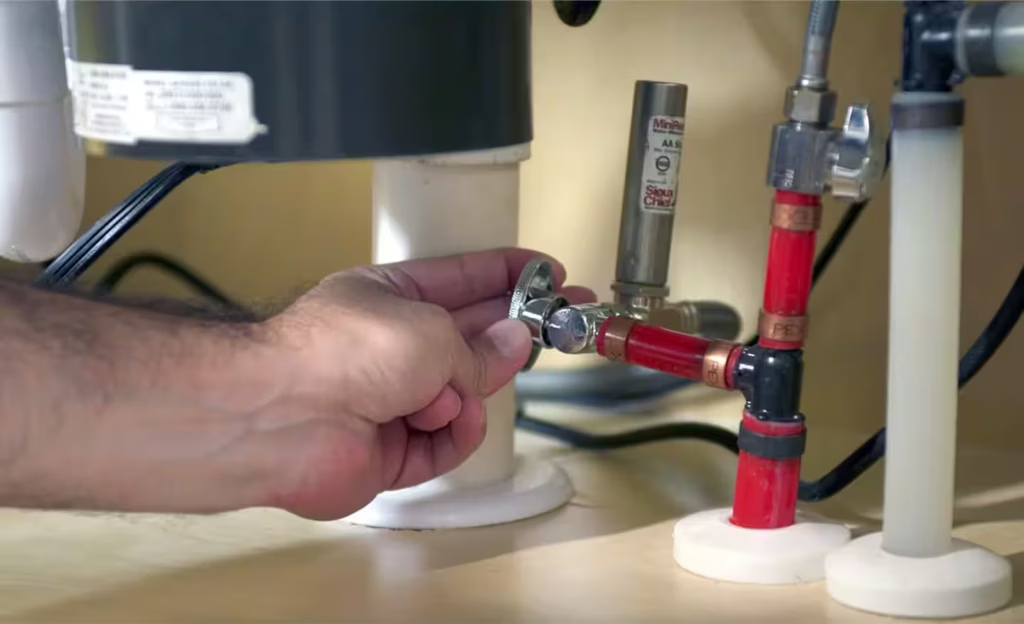

Most dishwashers are designed to connect to the cold water supply and heat water internally. Some can be connected to a hot supply, but only if the instruction manual specifically states this is permitted. Do not connect to hot water above 60 degrees – this can damage the filtration system. Always use a hot fill hose (red stripe) rather than a standard cold fill hose if connecting to hot water.
Whether a dishwasher can or should be connected to a hot water supply rather than cold is a question without a clear universal answer. Manufacturer guidance varies, there are both advantages and disadvantages, and several practical constraints apply.
The Default Position: Cold Fill
The large majority of dishwashers sold in the UK come supplied with a cold fill hose and instructions to connect to the cold water supply. Most are designed to heat water internally from cold to the required wash and rinse temperatures. This is the standard configuration and works correctly for the overwhelming majority of installations.
Some dishwashers can also be connected to a hot supply, but this is not universal. The instruction manual is the definitive reference – if it does not mention hot water connection as an option, the machine should be connected to cold only.
Pros and Cons of Connecting to Hot Water
 Potential advantages
- Can reduce electricity consumption – if the dishwasher no longer needs to heat water from cold to wash temperature, the element runs less. The actual saving depends on whether hot water in the property is generated more cheaply than the electricity the dishwasher would otherwise use
- Can reduce cycle time – if hot water reaches the machine quickly, the heating phase is shortened or eliminated
 Disadvantages and risks
- Water entering above 60 degrees can damage the dishwasher’s filtration system
- Hot water can bake food residue onto dishes before the cleaning agents have time to work on it, making some items harder to clean
- Lower programmes such as 50 degree cycles may be compromised if the incoming water is already at 60 degrees
- Hot water pressure is often lower than cold, particularly from a gravity-fed cylinder rather than a pressurised system
- Hot fill hoses are more prone to kinking – the hose goes soft when hot water passes through it and can restrict flow if under any physical strain at the back of the machine
- The energy saving only applies if hot water is cheaper to generate than the equivalent electricity – this depends entirely on the heating system in the property
Practical Requirements If Connecting to Hot Water
-
Confirm the machine supports hot water connection. Check the instruction manual before connecting to hot water. If the manual does not specifically mention this as an option, connect to cold only. -
Use a hot fill hose. Fill hoses are made in both hot and cold variants – hot hoses are typically marked with a red stripe or are red-coloured. Using a cold fill hose on a hot water connection is inadvisable as the hose material and fittings may not be rated for sustained hot water use. -
Ensure the hot water temperature does not exceed 60 degrees. The maximum inlet temperature for most dishwashers is 60 degrees. Check the boiler or cylinder thermostat setting – some properties have hot water set higher than this. Temperatures above 60 degrees entering the machine can damage the filtration system. -
Check the hot water pressure is adequate. If the hot water supply is fed by a gravity-fed cylinder rather than a pressurised combi boiler, the pressure may be insufficient for the dishwasher’s inlet valve to open correctly. A machine that fills slowly or incompletely can produce poor wash results and error codes. -
Ensure the hose can run without kinking. Route the hot fill hose without any tight bends or physical strain. Unlike a cold fill hose, a hot fill hose softens when hot water flows through it and will kink readily under stress, restricting water flow.
If the instruction manual is not available, download it using the model number on the machine’s door frame sticker. Links to official manual download pages for all major dishwasher brands are on our appliance user manuals page.
Related Guides
 Cold Fill Only Appliances
Why modern washing machines and dishwashers are predominantly cold fill – and the engineering reasons behind it.
 Dishwasher Not Cleaning Dishes Properly
How water temperature, spray arm blockages, and incorrect loading affect dishwasher cleaning results.
 Aqua Stop Hoses
What aqua stop hoses are, how they work, and whether they are worth using.
 Appliance User Manuals
Links to official manual download pages for all major UK appliance brands.
Frequently Asked Questions
Can I connect my dishwasher to the hot water supply?
Some dishwashers allow hot water connection – check the instruction manual to confirm whether your specific model supports it. If the manual does not mention this option, connect to cold only. Most dishwashers are designed to heat water internally from cold and work correctly connected to the cold supply as standard.
What is the maximum water temperature for a dishwasher hot fill connection?
Do not connect to water above 60 degrees. Most domestic hot water systems are set to 60 degrees, which is both the standard Legionella prevention temperature and the maximum safe inlet temperature for most dishwashers. If the boiler or cylinder is set higher, reduce it before connecting the dishwasher to the hot supply.
Does connecting a dishwasher to hot water save energy?
Potentially, but not automatically. The saving only applies if hot water in the property is generated more cheaply than the equivalent electricity the dishwasher element would use. For properties on gas central heating with an efficient boiler, there may be a small saving. For properties with off-peak or solar electricity, or electric immersion heating, the saving may be minimal or non-existent. The actual benefit depends on the specific energy tariffs and heating system.
49 Comments
Grouped into 41 comment threads.
0 replies We have a Belling Dishwasher model number BELFDW150, bought 2017, on a cold fill. We have solar water heating, which raises the temperature in the hot water tank. We have to heat the hot water tank on occasion, so we can have a lot of hot water. We have a plug-in electricity usage monitor which shows the dishwasher uses 27p of electricity on a 30 min cycle and 26p on the Eco cycle. We also have a washing machine with a hot and cold fill. When the hot water tank is hot, the normal cycle costs 9p. When we turn off the hot feed and use cold only, it costs 22p. I rang Belling today and was advised we can use a hot fill into our dishwasher model. Hope this helps. Many thanks for running this very helpful site.
0 replies Most home hot water cylinders are set to temps below 60C (55C is recommended to avoid water based bacteria surviving) , so dishwashers would suffer no harm. Unless you have the boiler constanting heating the water to the desired temp, its likely the hot water is much closer to mid 50C that whatever the tank cylinders thermostat is set to. Most eco settings on dishwashers is 50C. I would be very surprised if any solar thermal or even PV electric to cylinder heater would be the only source or heat and apart from the peak summer, heat the water anywhere close to 60C (unless you have a massive solar array). At dusk that solar heat is already dropping. Would most cold water often not come from attic tanks and in the daytime be heated anyway? Heating water to 50C+ or 40+(washing machines) not require large amounts of power. Hence we are all told to wash clothes at 30 (or less) and use the 50C eco setting on the dishwasher.
Most home hot water cylinders are set to temps below 60C (55C is recommended to avoid water based bacteria surviving) , so dishwashers would suffer no harm. Unless you have the boiler constanting heating the water to the desired temp, its likely the hot water is much closer to mid 50C that whatever the tank cylinders thermostat is set to. Most eco settings on dishwashers is 50C. I would be very surprised if any solar thermal or even PV electric to cylinder heater would be the only source or heat and apart from the peak summer, heat the water anywhere close to 60C (unless you have a massive solar array). At dusk that solar heat is already dropping. Would most cold water often not come from attic tanks and in the daytime be heated anyway? Heating water to 50C+ or 40+(washing machines) not require large amounts of power. Hence we are all told to wash clothes at 30 (or less) and use the 50C eco setting on the dishwasher.
0 replies I have noticed that some dishwasher manufactures are marketing their machines as suitable for warm water inlet up to 60C (one at 70C). We have solar panels and have a device that directs ANY surplus solar energy to the hot tank. For full benefit a large hot tank (which doesn't have to pressured) is needed. The only qualification seems to be that glass ware can become tarnished at higher temps - we use hand washing for these.
I have noticed that some dishwasher manufactures are marketing their machines as suitable for warm water inlet up to 60C (one at 70C). We have solar panels and have a device that directs ANY surplus solar energy to the hot tank. For full benefit a large hot tank (which doesn’t have to pressured) is needed. The only qualification seems to be that glass ware can become tarnished at higher temps – we use hand washing for these.
3 replies I thought I would state the reason for the cold water supply. The EU energy labelling scheme has caused this need for cold. It’s based in the fact that most people’s incoming cold water is a similar temperature. Hot water is produced by individual household with varying carbon footprints and as such would be impossible to provide a energy rating based on that, so cold water is used for the calculation purpose only, therefore forcing the machine to heat up water from cold. I have solar thermal at home and am about to connect the dishwasher to a 40deg C Feed. This will improve the efficiency of energy use as the temperature difference is less and it will use less electricity for the top up to 50 or 69 deg.
I thought I would state the reason for the cold water supply. The EU energy labelling scheme has caused this need for cold. It’s based in the fact that most people’s incoming cold water is a similar temperature. Hot water is produced by individual household with varying carbon footprints and as such would be impossible to provide a energy rating based on that, so cold water is used for the calculation purpose only, therefore forcing the machine to heat up water from cold.
I have solar thermal at home and am about to connect the dishwasher to a 40deg C Feed. This will improve the efficiency of energy use as the temperature difference is less and it will use less electricity for the top up to 50 or 69 deg.
Never heard of that Powerfader. It can’t really be true surely. I’ve heard that hot water can freeze quicker than cold water. Maybe that’s what you were thinking of?
UPDATE: Found some interesting articles, with some explanations of the phenomenon here https://www.google.com/search?client=firefox-b-d&q=hot+water+freezes+quicker+than+cold+water
0 replies I have a indesit dishwasher and brought a y fitting to fit my washing machine and dishwasher to the cold pipe feed , and its very annoying as the hot pipe feed valve is just above the cold one and the valve is in the way !!!!!! I have a combi boiler and would love to put the dishwasher into the hot feed pipe and then my issue is sorted in theory , but could I do this with a indesit dishwasher , as when I research it , it states and advice not to do it its very annoying to the point of no washing is getting done and a dishwasher that's sitting doing nothing . Please help thanks xx
I have a indesit dishwasher and brought a y fitting to fit my washing machine and dishwasher to the cold pipe feed , and its very annoying as the hot pipe feed valve is just above the cold one and the valve is in the way !!!!!! I have a combi boiler and would love to put the dishwasher into the hot feed pipe and then my issue is sorted in theory , but could I do this with a indesit dishwasher , as when I research it , it states and advice not to do it its very annoying to the point of no washing is getting done and a dishwasher that’s sitting doing nothing . Please help thanks xx
0 replies I'm not sure if this thread is still active: the water heater on my Zanussi dishwasher has given up and it only washed cold. Rather than scrap it and spend a small fortune on a new dishwasher I connected it to the old (and redundant) hot water feed for the washing machine that was close by, the water inlet temp is around the 60°C mark and it seems to be working fine. My hot water is heated in summer by off peak electricity and during the winter by a back boiler fitted to the woodburner, so hopefully I will see a saving in my fuel bills as well askance more having clean dishes.
I’m not sure if this thread is still active: the water heater on my Zanussi dishwasher has given up and it only washed cold. Rather than scrap it and spend a small fortune on a new dishwasher I connected it to the old (and redundant) hot water feed for the washing machine that was close by, the water inlet temp is around the 60°C mark and it seems to be working fine. My hot water is heated in summer by off peak electricity and during the winter by a back boiler fitted to the woodburner, so hopefully I will see a saving in my fuel bills as well askance more having clean dishes.
1 reply There's progress in the world!! Purchased basic Bosch Dishwasher. Can be fitted to hot water supply only. This is good for me because: No Mains gas Solar hot water Less than 2 litres draw off from hot water tank to dishwasher. Thermostatic water blender set to 55 deg C. Will test this during the summer and advise..
There’s progress in the world!! Purchased basic Bosch Dishwasher. Can be fitted to hot water supply only. This is good for me because:
No Mains gas
Solar hot water
Less than 2 litres draw off from hot water tank to dishwasher.
Thermostatic water blender set to 55 deg C.
Will test this during the summer and advise..
0 replies Reading the comments, it is of course dependant on situation. I would say if you have a new style modern combi boiler, and a newish machine, you should stick with cold fill, because that is how they are designed, and the efficiencies will work towards you. I have a friend who runs a solid fuel water heater and a hot water tank. The water is heated only when there is a fire of course, so it is not on demand when you turn on a hot tap like a it is with a combi, so he can end up with a tank of warm water that is slowly cooling down and not being used. Therefore in his situation it is more economical to use the hot water on the cold fill, because that water has already been heated once (your combi boiler heats the water when the machine asks for it). Otherwise his machine would be heating cold water while there is hot water standing around getting cold. The key is in how you heat your domestic water. If you have hot water on demand, usually a combi boiler - use cold fill If you heat your water some other means and store it, then using the hot water on the cold fill may be more economical. I worked in customer services and around 10 years ago this was a massive issue for customers. People were very very angry that their new washing machines only had a cold inlet, a large number of people demanded that we replace the machines with dual fill - which was not possible. Every manufacturer took this up across a very narrow span. It took a lot of effort to get the message across to the consumer. One day there may be a smart device to communicate between the machines and your combi boiler will deliver the exact amount of water at a precise temparature as demanded by your washer, and we'll be back to hot and cold fill machines again!
Reading the comments, it is of course dependant on situation.
I would say if you have a new style modern combi boiler, and a newish machine, you should stick with cold fill, because that is how they are designed, and the efficiencies will work towards you.
I have a friend who runs a solid fuel water heater and a hot water tank. The water is heated only when there is a fire of course, so it is not on demand when you turn on a hot tap like a it is with a combi, so he can end up with a tank of warm water that is slowly cooling down and not being used. Therefore in his situation it is more economical to use the hot water on the cold fill, because that water has already been heated once (your combi boiler heats the water when the machine asks for it). Otherwise his machine would be heating cold water while there is hot water standing around getting cold.
The key is in how you heat your domestic water.
If you have hot water on demand, usually a combi boiler – use cold fill
If you heat your water some other means and store it, then using the hot water on the cold fill may be more economical.
I worked in customer services and around 10 years ago this was a massive issue for customers. People were very very angry that their new washing machines only had a cold inlet, a large number of people demanded that we replace the machines with dual fill – which was not possible. Every manufacturer took this up across a very narrow span. It took a lot of effort to get the message across to the consumer.
One day there may be a smart device to communicate between the machines and your combi boiler will deliver the exact amount of water at a precise temparature as demanded by your washer, and we’ll be back to hot and cold fill machines again!
0 replies You will find all modern machines will be cold fill only. There is a very good reason for this and it has to do with overall energy use and efficiency in regards to the hot water. Basically, most modern domestic hot water systems are extremely efficient and can reach high temperatures. The washing machine or dishwasher is normally using the water at a lower temparature than the domestic boiler is heating it to. For instance, if your hot water boiler gets the water to 85 degrees, and the washing machine only needs to use it at 60 degrees, then you will be wasting energy. Your boiler has spent energy to heat the water up to 85 degrees, and then the washing machine is adding cold water to it to cool it down to 60 degrees. Therefore the new method is for each machine to heat its own water measured to the precise use. It is more economical for the machine to heat a small amount of water to the exact operating temparature, than for that temparature to be reached by your hot water boiler and then cooled down. There is no technical reason why you cannot attach a machine to a hot water pipe. The machine will use its internal thermometres to reach the correct temperature. Just be aware, that you may be burning money by heating water up in your boiler and then cooling it down in the machine. That is the basic rationale behind all dish and clothes washing machines being cold fill only.
You will find all modern machines will be cold fill only. There is a very good reason for this and it has to do with overall energy use and efficiency in regards to the hot water.
Basically, most modern domestic hot water systems are extremely efficient and can reach high temperatures. The washing machine or dishwasher is normally using the water at a lower temparature than the domestic boiler is heating it to.
For instance, if your hot water boiler gets the water to 85 degrees, and the washing machine only needs to use it at 60 degrees, then you will be wasting energy. Your boiler has spent energy to heat the water up to 85 degrees, and then the washing machine is adding cold water to it to cool it down to 60 degrees.
Therefore the new method is for each machine to heat its own water measured to the precise use. It is more economical for the machine to heat a small amount of water to the exact operating temparature, than for that temparature to be reached by your hot water boiler and then cooled down.
There is no technical reason why you cannot attach a machine to a hot water pipe. The machine will use its internal thermometres to reach the correct temperature. Just be aware, that you may be burning money by heating water up in your boiler and then cooling it down in the machine.
That is the basic rationale behind all dish and clothes washing machines being cold fill only.
0 replies I'm keeping my dishwasher connected to the hot water supply. It has never smelled inside since using the hot supply. No negative points at all. Yes, you will need to run the nearest hot tap before switching on the dishwasher to make sure it fills with the hot water - this takes about 1 minute and saves £££'s on the electric bill (provided the hot water is heated by anything other than electricity). I still give the dishwasher monthly cleans with Affresh dishwasher cleaner, using Affresh in the empty dishwasher on the hottest programme. A combination of a hot supply and monthly cleans with Affresh dishwasher cleaner must be keeping the internals spotless and avoiding expensive breakdowns from fat and food blockages. Yes I keep the filters clean, but they don't seem to get so dirty since having the hot water connection.
I’m keeping my dishwasher connected to the hot water supply. It has never smelled inside since using the hot supply. No negative points at all. Yes, you will need to run the nearest hot tap before switching on the dishwasher to make sure it fills with the hot water – this takes about 1 minute and saves £££’s on the electric bill (provided the hot water is heated by anything other than electricity).
I still give the dishwasher monthly cleans with Affresh dishwasher cleaner, using Affresh in the empty dishwasher on the hottest programme. A combination of a hot supply and monthly cleans with Affresh dishwasher cleaner must be keeping the internals spotless and avoiding expensive breakdowns from fat and food blockages. Yes I keep the filters clean, but they don’t seem to get so dirty since having the hot water connection.
Leave a comment
1 reply The reason why all hot water systems heat to 60C (higher in the case of some solar and solid fuel systems) is that 55C is generally accepted to be the killing temperature for Legionella bacteria in hot water systems. So for a tanked system, if the hot water in the tank reaches 60C at least once every 24hours and each hot outlet (tap) is run every 24hours there should be no legionella. I mention this because it would be very bad if your readers turn down their hot water thermostats to save gas/electricity. Legionella is ubiquitous in the environment so their system will become infected. In contrast hot water is dangerous at above 42C. But you need 50C at the kitchen tap to clean greasy dishes So their is a safety trade off. Hence thermostatic mixer valves at bath taps/showers or washing facilities where children/elderly/disabled wash (healthy adults have good enough reactions to stop themselves getting scalded. Check out the CIPHE for details on this issue. I have plumbed my dishwashers into hot supplies in my own houses and have noticed no detrimental effects on the dishwasher/dishes or hoses over many years. One solid fuel system I had used to generate HW at much hotter than 60C (I had problems with it boiling) and yet the standard cold fill hoses still seemed to survive OK. When I plumb dishwasher in for my customers who have non electric based HW systems I always tell them this and give them the option of HW fill. For gas/solid fuel/solar systems this affords a considerable saving over the life time of the appliance as electric heating at the appliance is more expensive per unit of heat. Non of my customers have noticed or complained of any detrimental effect caused by HW fill, over many years. This includes some commercial kitchens where the dishwasher hardly ever stops. The only disadvantage is that if you have a combi boiler or water heater it will keep firing up every time you turn on your dishwasher, but that's the sound of you saving money! I have not noticed any problems caused by low pressure HW supply to the dishwasher. In practise I think all dishwashers/washing machines etc should be duel fill. Further efficiencies could be produced by linking the devise to the HW cistern or boiler so that the devise "chooses" to use HW when it is available thereby using HW from the cheapest most environmentally friendly source. Regards Nick the Plumber
The reason why all hot water systems heat to 60C (higher in the case of some solar and solid fuel systems) is that 55C is generally accepted to be the killing temperature for Legionella bacteria in hot water systems. So for a tanked system, if the hot water in the tank reaches 60C at least once every 24hours and each hot outlet (tap) is run every 24hours there should be no legionella. I mention this because it would be very bad if your readers turn down their hot water thermostats to save gas/electricity. Legionella is ubiquitous in the environment so their system will become infected.
In contrast hot water is dangerous at above 42C. But you need 50C at the kitchen tap to clean greasy dishes So their is a safety trade off. Hence thermostatic mixer valves at bath taps/showers or washing facilities where children/elderly/disabled wash (healthy adults have good enough reactions to stop themselves getting scalded. Check out the CIPHE for details on this issue.
I have plumbed my dishwashers into hot supplies in my own houses and have noticed no detrimental effects on the dishwasher/dishes or hoses over many years. One solid fuel system I had used to generate HW at much hotter than 60C (I had problems with it boiling) and yet the standard cold fill hoses still seemed to survive OK.
When I plumb dishwasher in for my customers who have non electric based HW systems I always tell them this and give them the option of HW fill. For gas/solid fuel/solar systems this affords a considerable saving over the life time of the appliance as electric heating at the appliance is more expensive per unit of heat. Non of my customers have noticed or complained of any detrimental effect caused by HW fill, over many years. This includes some commercial kitchens where the dishwasher hardly ever stops. The only disadvantage is that if you have a combi boiler or water heater it will keep firing up every time you turn on your dishwasher, but that’s the sound of you saving money!
I have not noticed any problems caused by low pressure HW supply to the dishwasher.
In practise I think all dishwashers/washing machines etc should be duel fill. Further efficiencies could be produced by linking the devise to the HW cistern or boiler so that the devise “chooses” to use HW when it is available thereby using HW from the cheapest most environmentally friendly source.
Regards
Nick the Plumber
0 replies If you've ever looked in the bottom of the header tank that feeds the hot water supply you wouldn't use it in a dishwasher.Years of sediment plus what can get in if it's not covered properly,I've seen dead bats,mice and rats in them over the years. Direct feed from a heater is safe enough but hot water from a storage tank is to be avoided.
If you’ve ever looked in the bottom of the header tank that feeds the hot water supply you wouldn’t use it in a dishwasher.Years of sediment plus what can get in if it’s not covered properly,I’ve seen dead bats,mice and rats in them over the years.
Direct feed from a heater is safe enough but hot water from a storage tank is to be avoided.
0 replies I suspect dishwashers would add some cold to the main wash to cool it down before draining it out and rinsing. Maybe even pump some out, add cold, pump a bit more out and add a bit more to slowly reduce the temperature safely. Any dishwasher that cracked anything simply because it rinsed in cold water right after heating up the crockery wouldn't be ft for its purpose and could be returned under the Sale of Goods Act.
I suspect dishwashers would add some cold to the main wash to cool it down before draining it out and rinsing. Maybe even pump some out, add cold, pump a bit more out and add a bit more to slowly reduce the temperature safely. Any dishwasher that cracked anything simply because it rinsed in cold water right after heating up the crockery wouldn’t be ft for its purpose and could be returned under the Sale of Goods Act.
0 replies The trouble with cold-fill is that following the hot wash, fresh cold water can crack the glazing on crockery.
The trouble with cold-fill is that following the hot wash, fresh cold water can crack the glazing on crockery.
0 replies No, it's from the gas hot water system. One thing I will keep doing is running the dishwasher empty with a cleaner. I have seen Affresh dishwasher cleaner and it's meant to be the best available? I don't know the exact reasons why my dishwasher works much better on a hot supply and no longer smells bad, like it did on the cold water supply - even with an air freshener it still smelled, but it does work better now on the hot water supply. My guess is that the warm/hot water softens and removes most of the food debris on the dishes and in the dishwasher internals during the first warm rinse, and sends the muck down the drain. If, after reading these comments, you connect your dishwasher to the hot water supply, make sure the dirty dishes have a rinse in warm water before the main wash. If your dishwasher has them silly "auto" programmes which try to save water by not pre-rinsing, simply do the rinse-only (or whatever the name of the programme is called which just does a rinse), before you do the main wash with detergent. Also, run the nearest hot tap to draw-off the cooler water just before you put the dishwasher on, to ensure the hot water makes it to the dishwasher. Doing both will save electricity costs and stop the dishwasher smelling, although I would still recommend running a dishwasher cleaner through empty at least once every 2 months - or once every month if the dishwasher is used a lot.
No, it’s from the gas hot water system.
One thing I will keep doing is running the dishwasher empty with a cleaner. I have seen Affresh dishwasher cleaner and it’s meant to be the best available?
I don’t know the exact reasons why my dishwasher works much better on a hot supply and no longer smells bad, like it did on the cold water supply – even with an air freshener it still smelled, but it does work better now on the hot water supply. My guess is that the warm/hot water softens and removes most of the food debris on the dishes and in the dishwasher internals during the first warm rinse, and sends the muck down the drain.
If, after reading these comments, you connect your dishwasher to the hot water supply, make sure the dirty dishes have a rinse in warm water before the main wash. If your dishwasher has them silly “auto” programmes which try to save water by not pre-rinsing, simply do the rinse-only (or whatever the name of the programme is called which just does a rinse), before you do the main wash with detergent. Also, run the nearest hot tap to draw-off the cooler water just before you put the dishwasher on, to ensure the hot water makes it to the dishwasher. Doing both will save electricity costs and stop the dishwasher smelling, although I would still recommend running a dishwasher cleaner through empty at least once every 2 months – or once every month if the dishwasher is used a lot.
0 replies Thanks for that WMUser, is your hot water supply conventional or is it from solar panels?
Thanks for that WMUser, is your hot water supply conventional or is it from solar panels?
0 replies Yes it works! :) Give it a try and see if it works for you. It's definitely worth trying. Obviously every situation is different, but you won't know unless you try it for at least 6 weeks. My dishwasher has been on the hot supply since November 2012 and it no longer smells inside, as it did when plumbed into the cold water supply. My electricity usage is lower and things still come out spotless. Yes I run the kitchen hot tap (it's nearest the dishwasher) to run-off the cooler water, until the water runs hot - 60C, the maximum temperature recommended in the instruction book. Instead of wasting this hot water, I use it to clean the worktops and things that can't go in the dishwasher e.g. wooden chopping board. Then I use the "prerinse only" cycle on the dishwasher to remove most of the food debris, since the "auto" programmes on mine tend to use the same dirty pre-rinse water to wash the load. Once the rinse cycle is done, I put the dishwasher on an "auto" cycle. Since the hot water cools down on its way to the dishwasher and cools more when it's being sprayed around inside, the water is still warm enough to soften and remove almost all of the food debris on the dishes and it is probably doing the same in the internal components, pipes, hoses etc? As a result, the main wash and detergent has fewer debris to clean, so it can do a better job and keep the dishwasher cleaner inside. I would definitely recommend plumbing a dishwasher into the hot water supply and running the nearest hot tap to run off the cooler water. It sure works. I don't know why anyone would recommend against a hot water supply on a modern dishwasher?
Yes it works! :)
Give it a try and see if it works for you. It’s definitely worth trying. Obviously every situation is different, but you won’t know unless you try it for at least 6 weeks.
My dishwasher has been on the hot supply since November 2012 and it no longer smells inside, as it did when plumbed into the cold water supply. My electricity usage is lower and things still come out spotless.
Yes I run the kitchen hot tap (it’s nearest the dishwasher) to run-off the cooler water, until the water runs hot – 60C, the maximum temperature recommended in the instruction book. Instead of wasting this hot water, I use it to clean the worktops and things that can’t go in the dishwasher e.g. wooden chopping board. Then I use the “prerinse only” cycle on the dishwasher to remove most of the food debris, since the “auto” programmes on mine tend to use the same dirty pre-rinse water to wash the load. Once the rinse cycle is done, I put the dishwasher on an “auto” cycle.
Since the hot water cools down on its way to the dishwasher and cools more when it’s being sprayed around inside, the water is still warm enough to soften and remove almost all of the food debris on the dishes and it is probably doing the same in the internal components, pipes, hoses etc? As a result, the main wash and detergent has fewer debris to clean, so it can do a better job and keep the dishwasher cleaner inside.
I would definitely recommend plumbing a dishwasher into the hot water supply and running the nearest hot tap to run off the cooler water. It sure works. I don’t know why anyone would recommend against a hot water supply on a modern dishwasher?
0 replies Thermal shock = HOT items being sprayed with very COLD water and breaking or cracking. I'm sure all dishwashers have a way of preventing this thermal shock damage? I have never heard of a dishwasher causing thermal shock damage to the items being washed. A hot water connection would avoid hot items being sprayed with cold water. I'm hoping to have my dishwasher connected to the hot water supply soon, if the plumbing arrangements and new kitchen go as planned. Hopefully the hot water pressure will be enough to allow the dishwasher to fill. I will post back if I have it connected to the hot water supply and let you know the results.
Thermal shock = HOT items being sprayed with very COLD water and breaking or cracking. I’m sure all dishwashers have a way of preventing this thermal shock damage? I have never heard of a dishwasher causing thermal shock damage to the items being washed.
A hot water connection would avoid hot items being sprayed with cold water.
I’m hoping to have my dishwasher connected to the hot water supply soon, if the plumbing arrangements and new kitchen go as planned. Hopefully the hot water pressure will be enough to allow the dishwasher to fill. I will post back if I have it connected to the hot water supply and let you know the results.
0 replies Another reason for the use of a cold water supply in a dishwasher, is that certain models have a heat exchanger: namely the Bosch, Siemens and Neff models. The heat exchanger absorbs heat from the main wash and transfers it to a water storage matrix for the rinses. The idea being that less heat energy is wasted, the hot final rinse has a slight temperature advantage and that dishes are not subjected to thermal shock (cracking, shattering, etc. i.e. hot crockery, cold water). As others have commented, before year 2000, Hotpoint dishwasher models were manufactured by Bosch. Nowadays Indesit owns Hotpoint, so current Hotpoint machines are Indesits in disguise.
Another reason for the use of a cold water supply in a dishwasher, is that certain models have a heat exchanger: namely the Bosch, Siemens and Neff models.
The heat exchanger absorbs heat from the main wash and transfers it to a water storage matrix for the rinses. The idea being that less heat energy is wasted, the hot final rinse has a slight temperature advantage and that dishes are not subjected to thermal shock (cracking, shattering, etc. i.e. hot crockery, cold water).
As others have commented, before year 2000, Hotpoint dishwasher models were manufactured by Bosch. Nowadays Indesit owns Hotpoint, so current Hotpoint machines are Indesits in disguise.
0 replies Cold water takes longer than warm water to get hot. Just try it in a pan and time it. Huge difference.
Cold water takes longer than warm water to get hot. Just try it in a pan and time it. Huge difference.
0 replies Anonymous: I have heard that hot water will sometimes freeze faster than cold. It's a known phenomenon which even now is not fully understood. There are some theories about it here Mpemba effect: Why hot water can freeze faster than cold However, it's surely impossible for more energy to be needed to raise water from 30° to 40° than would be needed to raise it from 0 degrees.
Anonymous: I have heard that hot water will sometimes freeze faster than cold. It’s a known phenomenon which even now is not fully understood. There are some theories about it here Mpemba effect: Why hot water can freeze faster than cold
However, it’s surely impossible for more energy to be needed to raise water from 30° to 40° than would be needed to raise it from 0 degrees.
0 replies Actually, it would NOT save on electricity. Believe it or not, cold water can more quickly be brought up to temperature than can hot water, because it is temperature DIFFERENTIAL that makes the difference. The same is true in reverse, of course: HOT water will freeze faster than cold water. Try it
Actually, it would NOT save on electricity. Believe it or not, cold water can more quickly be brought up to temperature than can hot water, because it is temperature DIFFERENTIAL that makes the difference.
The same is true in reverse, of course: HOT water will freeze faster than cold water. Try it
0 replies As with hot-fill washing machines, the crux of the matter is thr price diffrence between gas-heated water and electricity-heated water. In the UK, it's 4-5 times the price to heat water using electricity than it is using gas! Given that most of the dishwasher running costs are incurred from heating the water, it really should be a no-brainer for the manufacturers to design products around this - if necessary having a cold and a hot input and mixing it using a temperature sensor. Obviously people without any cost benefit could use cold fill only...
As with hot-fill washing machines, the crux of the matter is thr price diffrence between gas-heated water and electricity-heated water. In the UK, it’s 4-5 times the price to heat water using electricity than it is using gas! Given that most of the dishwasher running costs are incurred from heating the water, it really should be a no-brainer for the manufacturers to design products around this – if necessary having a cold and a hot input and mixing it using a temperature sensor. Obviously people without any cost benefit could use cold fill only…
0 replies I have just had an Infinity instantaneous hot water heater fitted in my house on which I can set a water output temperature of 60 degrees. So, I thought why not plumb a hot line to the dishwasher, run off the standing cold water prior to each wash and wait for the electric bills to go down (we fill the dishwasher twice each day, and always set it on economy). However, your correspondence has inspired me to research alternatives: can I not use a cold detergent and use a cold wash: An American product called AJAX apparently will do just that. The secret ingredient is BLEACH! All I need to do is to disable the heater and internal water temperature sensor in my Hotpoint machine and hey presto! Article below which focused on the issue of bacteria which your articles have not considered : In the study scientists washed dishes that had been covered with cheese, eggs, milk and jelly. They also smeared the plates with E. coli and other bacteria that cause food-borne illnesses. They washed one batch of dishes in hot, soapy water and found it killed off nearly all the germs. However, they got the same result when they washed the same bacteria-laden dishes using cool water and dish soap with bleach. Researchers also found that dishes washed in soapy room-temperature water, rinsed, and then weakly sanitised with ammonium-based chemicals achieved FDA-acceptable results.
I have just had an Infinity instantaneous hot water heater fitted in my house on which I can set a water output temperature of 60 degrees. So, I thought why not plumb a hot line to the dishwasher, run off the standing cold water prior to each wash and wait for the electric bills to go down (we fill the dishwasher twice each day, and always set it on economy). However, your correspondence has inspired me to research alternatives: can I not use a cold detergent and use a cold wash: An American product called AJAX apparently will do just that. The secret ingredient is BLEACH!
All I need to do is to disable the heater and internal water temperature sensor in my Hotpoint machine and hey presto!
Article below which focused on the issue of bacteria which your articles have not considered :
In the study scientists washed dishes that had been covered with cheese, eggs, milk and jelly. They also smeared the plates with E. coli and other bacteria that cause food-borne illnesses. They washed one batch of dishes in hot, soapy water and found it killed off nearly all the germs. However, they got the same result when they washed the same bacteria-laden dishes using cool water and dish soap with bleach. Researchers also found that dishes washed in soapy room-temperature water, rinsed, and then weakly sanitised with ammonium-based chemicals achieved FDA-acceptable results.
0 replies It's been a while since I've visited this page. Warm/hot water removes more food debris and results in better cleaning compared to having to rewash dirty items either by hand or using the dishwasher again? In the latter case, it costs more than just electricity, when you take into account the cost of detergent, salt and rinse aid. Warm or hot water removes food debris quickly. Next time you have strongly coloured sauce that will stain plastic items in the dishwasher, simply rinse the sauce away with hot water and you will see it comes off very quickly; try it with cold water and it takes much longer and uses more water. If your dishwasher is connected to the hot water supply, you could run the hot tap nearest the dishwasher for about 20 seconds until it feels warm; this does not waste water in the long run - it saves having to rewash dirty items. Also consider that during the winter months that the cold water from the street mains will be MUCH colder compared to hot water cooling down inside the copper pipes indoors. Finally, the longevity of the dishwasher should be considered. If cold incoming water is not melting the grease and food debris, the dishwasher is more likely to break down much sooner. On the strength of Oliver's messages above, I wish I had a hot water pipe behind my dishwasher. Although I don't have any problems with its cleaning performance, I make sure I use Finish dishwasher cleaner regularly and check the filters, spray arms etc. I have noticed white grease around the bottom of the door seal - I don't like the thought of this grease build-up being elsewhere in the working parts! I'm assuming that the best results from using a hot/warm water fill would be achieved by using a programme with a pre-rinse before the main wash, along with a good quality detergent like Fairy Platinum?
It’s been a while since I’ve visited this page.
Warm/hot water removes more food debris and results in better cleaning compared to having to rewash dirty items either by hand or using the dishwasher again? In the latter case, it costs more than just electricity, when you take into account the cost of detergent, salt and rinse aid.
Warm or hot water removes food debris quickly. Next time you have strongly coloured sauce that will stain plastic items in the dishwasher, simply rinse the sauce away with hot water and you will see it comes off very quickly; try it with cold water and it takes much longer and uses more water. If your dishwasher is connected to the hot water supply, you could run the hot tap nearest the dishwasher for about 20 seconds until it feels warm; this does not waste water in the long run – it saves having to rewash dirty items. Also consider that during the winter months that the cold water from the street mains will be MUCH colder compared to hot water cooling down inside the copper pipes indoors.
Finally, the longevity of the dishwasher should be considered. If cold incoming water is not melting the grease and food debris, the dishwasher is more likely to break down much sooner. On the strength of Oliver’s messages above, I wish I had a hot water pipe behind my dishwasher. Although I don’t have any problems with its cleaning performance, I make sure I use Finish dishwasher cleaner regularly and check the filters, spray arms etc. I have noticed white grease around the bottom of the door seal – I don’t like the thought of this grease build-up being elsewhere in the working parts! I’m assuming that the best results from using a hot/warm water fill would be achieved by using a programme with a pre-rinse before the main wash, along with a good quality detergent like Fairy Platinum?
1 reply MIELE DISHWASHER MANUAL: "The dishwasher may be connected to a cold or hot water supply, max. 60 °C. We would only recommend connection to a hot water supply if it is economical. When connected to a hot water supply, all programme stages which would otherwise be carried out with cold water will be carried out with hot water, thus saving time and energy costs."
MIELE DISHWASHER MANUAL: “The dishwasher may be connected to a cold or hot water supply, max. 60 °C. We would only recommend connection to a hot water supply if it is economical. When connected to a hot water supply, all programme stages which would otherwise be carried out with cold water will be carried out with hot water, thus saving time and energy costs.”
Likely replying to Graham
Thanks Graham: The Miele manual makes a sweeping and misleading statement, which can’t be true generally. It may be more economical for the dishwasher in that the dishwasher may well use less electricity heating up the water, but they do not take into account the cost of heating the water up elsewhere, which may come from a cheaper source such as solar powered but it may come from an electrically heated immersion heater which costs exactly the same to heat as the dishwasher would plus there’d be an amount of wasted hot water left in the pipework.
The hot water might come from an inefficient old boiler cited two floors up with several metres of uninsulated copper pipework between them. In the latter case when the dishwasher had finished filling it would have drawn in several litres of hot water which would just sit in the pipework and go completely cold therefore wasting it. Also, the amount of water that the dishwasher draws into itself and the pipes may well be replaced in many people’s houses by cold water into the hot water cylinder therefore cooling down the rest of the water and triggering its heater to come on to raise the water back up to temperature.
Therefore the actual costs of using that water vary considerably from house to house and are in most cases difficult or impossible to work out. The whole point of an appliance heating up its own water is that in many cases it’s cheaper because it only heats up the exact amount of water the appliance needs.
Example:
If we imagine we want a cup of hot water to make a coffee, and we pour the exact amount of cold water required and the cup itself heats the water up. That’s got to be highly efficient. But what if we have a source of hot water already in the form of a big tea urn in the next room connected to a tap in the kitchen and connected to a constant cold water supply which replaces all water used?
If we fill the cup from this tap it’s cheaper because the water’s already been heated? But the problem is that the first half a dozen cups of water that come out are cold or at best warm because it was several hours since we last had a coffee and all the water in the pipes between the tea urn and the tap in the kitchen has cooled down. So we draw off several cups of cold and warm water and throw them down the sink. That’s the first waste which needs accounting for.
Then the hot water comes through ok and we fill our cup and have a nice hot coffee. The coffee cup didn’t need to heat any water so it’s more economical? For the cup yes! But after drawing all that water through we filled the pipework with boiling hot water again which is going to go cold quite quickly. Also, all the water we threw down the sink and the water that we used for the coffee is replaced in the tea urn by cold water from the plumbing, which in turn cools the water already heated in there and causes it to need to heat up a little more to bring it back up to temperature.
Which is the most efficient method? Surely it’s letting the cup heat up only the exact amount of water required.
That said, what if we had one of those new devices like the Tefal Quickup, which heats up only the water required for a coffee? In this case it’s cheaper (or maybe no different) to use this device to heat up one cup full. Or what if we had a tea urn in the same room heated by solar power? Then it would be cheaper to use that..
What it boils down to is that it’s wrong to say one method is cheaper than another as it depends entirely on the source of the hot water and circumstances. In some cases using existing hot water will be cheaper, and in others it will be more expensive.
0 replies Water connection mode is important for a dishwasher: * Cold water connection will use the least energy - the dishwasher heats its own water only for the parts of the cycle where hot water is needed, but the energy (in the form of electricity) generally costs more (unless you are on a time of use tariff, which is still unusual for households, and run the machine overnight). * If you have a gas or solar hot water system, models that can be connected to both hot and cold water will save carbon dioxide and operating costs, but models with dual connection are now rare. You will also save energy costs if you have an off peak electric hot water system. * A dishwasher connected only to hot water will use the most energy, although it may be more economical if you have off peak electric, solar or mains gas hot water.
Water connection mode is important for a dishwasher:
* Cold water connection will use the least energy – the dishwasher heats its own water only for the parts of the cycle where hot water is needed, but the energy (in the form of electricity) generally costs more (unless you are on a time of use tariff, which is still unusual for households, and run the machine overnight).
* If you have a gas or solar hot water system, models that can be connected to both hot and cold water will save carbon dioxide and operating costs, but models with dual connection are now rare. You will also save energy costs if you have an off peak electric hot water system.
* A dishwasher connected only to hot water will use the most energy, although it may be more economical if you have off peak electric, solar or mains gas hot water.
0 replies Absolutely, you can use hot water connection for your dishwasher. Many top brands like Miele, Asko or Bosh do not care if you connect their dishwasher to cold or hot water as long as hot water temperature is below 60 C. Using a warm/ hot water will reduce you electricity bill. All dishwashers have built in heating element and thermostat so they have to raise the temperature to 50, 60 or 75 C (depending on the chosen cycle). The dishwasher connected to hot water will use the minimal amount of electricity to heat water to the preset temperature. You do not need to be a rocket scientist to work out that heating a water from 50 C to 65 C is much faster than heating a water from let's say 17 C to 65 C. Think about the hot water already stored in you hot water boiler, do not waste the money heating the water again but this time for the different purposes. Some manufacturers of low quality dishwashers will recommend the cold water only because if you use a cold water connection the washing cycle will be longer and due to this the washing results might be a marginally better. The same rule applies for the washing machines. The environmentally consciousness people will use the hot water connection for their appliances.
Absolutely, you can use hot water connection for your dishwasher. Many top brands like Miele, Asko or Bosh do not care if you connect their dishwasher to cold or hot water as long as hot water temperature is below 60 C.
Using a warm/ hot water will reduce you electricity bill. All dishwashers have built in heating element and thermostat so they have to raise the temperature to 50, 60 or 75 C (depending on the chosen cycle). The dishwasher connected to hot water will use the minimal amount of electricity to heat water to the preset temperature. You do not need to be a rocket scientist to work out that heating a water from 50 C to 65 C is much faster than heating a water from let’s say 17 C to 65 C. Think about the hot water already stored in you hot water boiler, do not waste the money heating the water again but this time for the different purposes.
Some manufacturers of low quality dishwashers will recommend the cold water only because if you use a cold water connection the washing cycle will be longer and due to this the washing results might be a marginally better. The same rule applies for the washing machines.
The environmentally consciousness people will use the hot water connection for their appliances.
0 replies Warm or hot water rinses away food debris better than cold. I don't often rinse items before putting them into the dishwasher except for plates with curry sauce or any other food dye that will stain plastic items. I notice the stuff rinses off first time under the hot tap, as the temperature dissolves it at the same time as rinsing it away. I used to spend longer doing this under cold running water (which wastes time and water), but one day I discovered by chance that hot running water does the job instantly. If I have to rinse food from something, I use the hot tap every time. With the pre-rinse/pre-wash being performed in warm water, this gets rid of a lot more food debris than cold water, so there's less food to be cleaned off during the main wash phase, hence the better results I'm guessing? One thing I can't understand is why the water and detergent mix gets heated above 50C too quickly on the hotter washes, when it should be warm (not too hot) for the enzymes in the detergent to work properly? Above 50C, the enzymes in detergent get destroyed by the higher temperature. Maybe the warm incoming water dissolves the detergent quicker - especially tablet detergent, so it can be used for longer below 50C on hotter washes? Enzymes in detergents work best when the water is warm. I find my own dishwasher cleans fine at 45C and I don't often use the hotter programmes. Some items will need soaking or spraying with something like Fairy Power Spray to loosen stuck on food. For hot washes above 50C, why don't the dishwasher manufacturers consider keeping the main wash water at 45C for about 20 minutes, to allow the enzymes to work properly, before heating the water to the higher temperature - which destroys the enzymes? Regular readers of this website will know I strongly advocate using warm water in a washing machine to rinse off detergent better, as warm water both rinses and dissolves substances. Cold water is not very good at cleaning or rinsing anything.
Warm or hot water rinses away food debris better than cold. I don’t often rinse items before putting them into the dishwasher except for plates with curry sauce or any other food dye that will stain plastic items. I notice the stuff rinses off first time under the hot tap, as the temperature dissolves it at the same time as rinsing it away. I used to spend longer doing this under cold running water (which wastes time and water), but one day I discovered by chance that hot running water does the job instantly. If I have to rinse food from something, I use the hot tap every time.
With the pre-rinse/pre-wash being performed in warm water, this gets rid of a lot more food debris than cold water, so there’s less food to be cleaned off during the main wash phase, hence the better results I’m guessing?
One thing I can’t understand is why the water and detergent mix gets heated above 50C too quickly on the hotter washes, when it should be warm (not too hot) for the enzymes in the detergent to work properly? Above 50C, the enzymes in detergent get destroyed by the higher temperature. Maybe the warm incoming water dissolves the detergent quicker – especially tablet detergent, so it can be used for longer below 50C on hotter washes? Enzymes in detergents work best when the water is warm. I find my own dishwasher cleans fine at 45C and I don’t often use the hotter programmes. Some items will need soaking or spraying with something like Fairy Power Spray to loosen stuck on food. For hot washes above 50C, why don’t the dishwasher manufacturers consider keeping the main wash water at 45C for about 20 minutes, to allow the enzymes to work properly, before heating the water to the higher temperature – which destroys the enzymes?
Regular readers of this website will know I strongly advocate using warm water in a washing machine to rinse off detergent better, as warm water both rinses and dissolves substances. Cold water is not very good at cleaning or rinsing anything.
0 replies Hi Andy, Just an update on the Tecnik as it has been on hot water for 3 weeks now........ Things have improved beyond all recognition, in 3 weeks we have only had 3 dirty items, opposed to at least something every day when it was on cold water. The machine does not have a smell and nor has the old stale smell returned. Also we used to get red spots on the white plastic, not only have they all been removed but are not returning. The filters were spotless after a week, now they rarely need cleaning instead of the 2-3 times a week previously. There are no residues building up in the machine and all prevoius residue has been completely removed. The pots no longer smell of detergent, so it must be rinsing better as well. The outlet hose was also full of the red stuff, don't know if it has gone, but after Christmas I will disconnect it and have a look, I will post the result. All the above proves against what Tecnik (Bosch) say "We recommend a cold water supply..." It is just perfect on a hot supply, so it appears Bosch do not know what they are talking about, it was so bad on a cold supply I felt like throwing it down the tip, but now its great. All the best, Oliver. Ps. To you and everyone have a great Christmas and a Happy New Year!
Hi Andy,
Just an update on the Tecnik as it has been on hot water for 3 weeks now……..
Things have improved beyond all recognition, in 3 weeks we have only had 3 dirty items, opposed to at least something every day when it was on cold water. The machine does not have a smell and nor has the old stale smell returned. Also we used to get red spots on the white plastic, not only have they all been removed but are not returning. The filters were spotless after a week, now they rarely need cleaning instead of the 2-3 times a week previously. There are no residues building up in the machine and all prevoius residue has been completely removed. The pots no longer smell of detergent, so it must be rinsing better as well.
The outlet hose was also full of the red stuff, don’t know if it has gone, but after Christmas I will disconnect it and have a look, I will post the result.
All the above proves against what Tecnik (Bosch) say “We recommend a cold water supply…” It is just perfect on a hot supply, so it appears Bosch do not know what they are talking about, it was so bad on a cold supply I felt like throwing it down the tip, but now its great.
All the best,
Oliver.
Ps. To you and everyone have a great Christmas and a Happy New Year!
0 replies Years ago, we used to have a Hotpoint branded dishwasher that was manufactured by Bosch (according to Which?'s review of it). It was a really good machine - washed much better than my current Bosch dishwasher, although maybe in part down to the Sun dishwashing powder we used to use in it. I recall that you could buy a hot water kit for it - I don't know if this was just a heat resistant hose or what, as I never bought one, but the cost was over 30 quid! According to the Which review, the machine didn't wash as well with the hot kit fitted - this would have been because the machine had a dumb mechanical timer and feeding in hot water would have cut out the washing period while the water was heating up - resulting in a shortened & inadequate wash length.
Years ago, we used to have a Hotpoint branded dishwasher that was manufactured by Bosch (according to Which?’s review of it). It was a really good machine – washed much better than my current Bosch dishwasher, although maybe in part down to the Sun dishwashing powder we used to use in it. I recall that you could buy a hot water kit for it – I don’t know if this was just a heat resistant hose or what, as I never bought one, but the cost was over 30 quid! According to the Which review, the machine didn’t wash as well with the hot kit fitted – this would have been because the machine had a dumb mechanical timer and feeding in hot water would have cut out the washing period while the water was heating up – resulting in a shortened & inadequate wash length.
0 replies Hi Andy, I too agree that everyone is being treat like a child. We can come up with no logical reason why it recommends cold, with cold it didn't wash properly and blocked up the dishwasher. Perhaps that is the idea, so you have to buy replacement parts or buy a new machine due to grease blocking the heater, sump and drain pump? It now does wash properly using our hot (warm) supply, it has been very frustrating for four years having to hand wash because the dishwasher ( a labour saving device) couldn't get things clean. I put it on the hot supply Monday afternoon, it has done a load each day and everything has come out spotless and the machine is as clean as a whistle. I will never use a dishwasher on a cold supply again now I have experienced how much better they are on hot, if ever we have to buy another we shall make sure it will accept a hot supply. The hot water comes from the combi-boiler about 15 yards away, and it still takes in a full fill of hot each time its on, the only draw back is I have to run of the cold before the machine is initally put on, but its a hell of alot easier than hand washing all the pans, and still saves water in the long run. Another reason could be the usual environmental bo11ocks, every thing we do, what ever it is we get this environmental shyte rammed down our throats, we take no notice in this house, people need to make their own choices and understand why, not believe these idiots who came up with global warming. EnvironMENTAL..........you'd have to be to believe what they tell you!! IMHO of course! Oliver.
Hi Andy,
I too agree that everyone is being treat like a child. We can come up with no logical reason why it recommends cold, with cold it didn’t wash properly and blocked up the dishwasher. Perhaps that is the idea, so you have to buy replacement parts or buy a new machine due to grease blocking the heater, sump and drain pump? It now does wash properly using our hot (warm) supply, it has been very frustrating for four years having to hand wash because the dishwasher ( a labour saving device) couldn’t get things clean.
I put it on the hot supply Monday afternoon, it has done a load each day and everything has come out spotless and the machine is as clean as a whistle. I will never use a dishwasher on a cold supply again now I have experienced how much better they are on hot, if ever we have to buy another we shall make sure it will accept a hot supply.
The hot water comes from the combi-boiler about 15 yards away, and it still takes in a full fill of hot each time its on, the only draw back is I have to run of the cold before the machine is initally put on, but its a hell of alot easier than hand washing all the pans, and still saves water in the long run.
Another reason could be the usual environmental bo11ocks, every thing we do, what ever it is we get this environmental shyte rammed down our throats, we take no notice in this house, people need to make their own choices and understand why, not believe these idiots who came up with global warming.
EnvironMENTAL……….you’d have to be to believe what they tell you!! IMHO of course!
Oliver.
0 replies Very interesting Oliver. I hate it when people say things like you can use hot water but we recommend cold. WHY? They treat people like children too much. If someone tells me you can use hot water - but we recommend cold, I want them to say, "we recommend cold because ..." so I can make an informed decision.
Very interesting Oliver. I hate it when people say things like you can use hot water but we recommend cold. WHY? They treat people like children too much. If someone tells me you can use hot water – but we recommend cold, I want them to say, “we recommend cold because …” so I can make an informed decision.
0 replies Hi Andy and Dave, On the strength of what I have read on here and Daves experience I have put the crappy Tecnik on Hot fill only. Well the first thing I can say is it is not such a crappy Tecnik after all! It now does a pre-wash in hot water instead of cold, so there are no more grease blockages forming, the dishes are coming out spotless and the machine (now 4 years old or so) smells fresh. It has a regular monthly cleaning with Finish dishwasher cleaner, but still smelt, now on Hot fill the food is broken down from the off so nothing can vegitate inside the machine. As it is an economy version of a Bosch there is no intensive wash cycle, just a "Normal 65oC" and "Economy Wash 50oC". and the "Pre Rinse only". None of these use the heater in the pre wash, so it was cold, all the grease built up inside the machine and made it smell, and as the soiling was not being softened by a warm prewash, it used to get baked on by the hot main wash. Not any more, our hot water is about 40oC just the right temperature for a "biological prewash", the grease and proteins are broken down before the main wash can begin by the Finish powder which is biological, so no more dirty pans or hand washing either. The new programme sequence for a Normal wash is: Prewash (40oc incoming water temp.) Mainwash (65oC heated by machine) Rinse 1 (40oC incoming water temp.) Rinse 2 (40oc incoming water temp.) Final Rinse (70oC heated by machine) Drying. The new Economy wash sequence is: Prewash (40oC incoming water temp.) Mainwash (50oC heated by machine) Rinse 1 (40oC incoming water temp.) Final Rinse (65oC heated by machine) Drying. The Prewash only cycle is now 40oC but we rarely use it as the dishwasher is on once or twice a day. It is like having a new dishwasher, it actually does it job properly and in less time, it has gone from 2:30 to 2:10 for a normal wash. Haven't tried the economy wash yet but was the same length a normal. I was very wrong to be sceptical of this, the only problem was fitting a "Y" adaptor to the washing machines hot supply so they could both use hot water, but all works and no leaks. I have to say there are for me no negative points, only a hell of alot of positive ones, everything in every respect has improved dramatically! The manual for the machine says you can use Hot water upto 60oC (ours is never above 55oC or so but in the main about 40oC)but recommend cold - don't know why, the dishwasher was rubbish with cold water. It washes betterthan our previous machine now and equally as good as our old Bosch bought in 1988. All the best, Oliver.
Hi Andy and Dave,
On the strength of what I have read on here and Daves experience I have put the crappy Tecnik on Hot fill only. Well the first thing I can say is it is not such a crappy Tecnik after all! It now does a pre-wash in hot water instead of cold, so there are no more grease blockages forming, the dishes are coming out spotless and the machine (now 4 years old or so) smells fresh. It has a regular monthly cleaning with Finish dishwasher cleaner, but still smelt, now on Hot fill the food is broken down from the off so nothing can vegitate inside the machine.
As it is an economy version of a Bosch there is no intensive wash cycle, just a “Normal 65oC” and “Economy Wash 50oC”. and the “Pre Rinse only”. None of these use the heater in the pre wash, so it was cold, all the grease built up inside the machine and made it smell, and as the soiling was not being softened by a warm prewash, it used to get baked on by the hot main wash. Not any more, our hot water is about 40oC just the right temperature for a “biological prewash”, the grease and proteins are broken down before the main wash can begin by the Finish powder which is biological, so no more dirty pans or hand washing either.
The new programme sequence for a Normal wash is:
Prewash (40oc incoming water temp.)
Mainwash (65oC heated by machine)
Rinse 1 (40oC incoming water temp.)
Rinse 2 (40oc incoming water temp.)
Final Rinse (70oC heated by machine)
Drying.
The new Economy wash sequence is:
Prewash (40oC incoming water temp.)
Mainwash (50oC heated by machine)
Rinse 1 (40oC incoming water temp.)
Final Rinse (65oC heated by machine)
Drying.
The Prewash only cycle is now 40oC but we rarely use it as the dishwasher is on once or twice a day.
It is like having a new dishwasher, it actually does it job properly and in less time, it has gone from 2:30 to 2:10 for a normal wash. Haven’t tried the economy wash yet but was the same length a normal.
I was very wrong to be sceptical of this, the only problem was fitting a “Y” adaptor to the washing machines hot supply so they could both use hot water, but all works and no leaks. I have to say there are for me no negative points, only a hell of alot of positive ones, everything in every respect has improved dramatically!
The manual for the machine says you can use Hot water upto 60oC (ours is never above 55oC or so but in the main about 40oC)but recommend cold – don’t know why, the dishwasher was rubbish with cold water. It washes betterthan our previous machine now and equally as good as our old Bosch bought in 1988.
All the best,
Oliver.
0 replies You make a good point Expertcat. I use 3 in 1 tablets with good results but we don't use dishwasher salt or rinse aid.
You make a good point Expertcat. I use 3 in 1 tablets with good results but we don’t use dishwasher salt or rinse aid.
0 replies Did you know that most manufactuers dont recommend the tablets. As I have found out the consumers still put in salt and rinse agent and with the 5in1 tablets (which has them all in) and so the machine will generate excess foam which causes water friction inside the machine hence poor washing of dishes. The tablet idea is consumer led by the manufactuers of the detergent. Just think if the machine was made to take just tablets would the manufactuer of the appliance still put in rinse aid and salt regeneration units the answer would be no so in therory the appliances wouls become cheaper.
Did you know that most manufactuers dont recommend the tablets.
As I have found out the consumers still put in salt and rinse agent and with the 5in1 tablets (which has them all in) and so the machine will generate excess foam which causes water friction inside the machine hence poor washing of dishes.
The tablet idea is consumer led by the manufactuers of the detergent.
Just think if the machine was made to take just tablets would the manufactuer of the appliance still put in rinse aid and salt regeneration units the answer would be no so in therory the appliances wouls become cheaper.
1 reply Not been back to this page for ages and only just seen the comments re Ecover. I've got to say that I use ecover washing powder, Fabric Softener, Dishwasher Tablets and Rinse aid and they are all actually very impressive. The washing powder works far better than Persil or Fairy non bio ever did either in my old Hoover washer or in my new LG. I do have to use it sparingly though as it is very sudsy. The fabric softener is good, but I must admit that I am not a big fan of fabric softeners anyway, so I don't have a lot to judge against except Waitrose's own brand which I used to have before Ecover. I can't tell any difference between that and Ecover. For dishwashing I used to use Finish, but it Finished off all my glasses and some of my better crockery as it is so very abrasive. To be fair it does carry warnings that it may affect your dishes and glasses and many comparison web sites and reviews such as Which? also warn that most traditional dishwasher detergents can do this. The Ecover tablets work pretty well and my glassware is nice and shiny, rather than looking like it's been sprayed with a thin coating of PVA glue. The only thing that the Ecover tablets don't seem to deal with is baked on mincemeat when I make mince pies and they boil over onto the baking tray; but Finish never touched that either. A good old Brillo pad and a sink full of red hot water seems to be the only way to deal with that one. Ecover Rinse Aid looks, smells and seems to behave like Finish, Co-op's own brand and Waitrose's own brand to me. In fact it was because they all seemed the same that when I read in the Miele book that vinegar does the same job but is cheaper and kinder to the environment that I thought I'd try it, but I have to admit that it didn't seem to do such a good job. I've also had a free bottle of Miele's rinse Aid, which seemed to work fine but it looked just like tap water! Heaven knows what was in it. It's interesting to see the comments about Hotpoint and Bosch's relationship: in my old Bosch dishwasher instruction book I remember clearly that it stated that for service you had to ring Hotpoint, hence my assumption that it was Hotpoint doing the making. I also recall that I bought that dishwasher from the Co-Op and they had the identical machine in at a lower price with the Hotpoint badge on it and also their own brand which was also identical on the outside but inside had grey baskets not white. This was back in 1988 and that machine really was utter rubbish. It was the worst ever buy that I have made in terms of electrical appliances. In fairness it was a slimline model and I don't think that helped as I have heard many people say since then that slimline models don't tend to work as well as full size, but even allowing for that it was a bitter disappointment and I got shut after a very few years, going back to hand washing my pots for about a decade before getting a Hoover dishwasher in 2003, which proved to be very good at washing but very unreliable (what do you expect when it's a Candy in disguise - it even had Candy labels on the circulating pump and some of the electrical components in it) and then the Miele that I have now in 2007. The old Bosch-Point that I had also had provision for hot fill I recall. Of course back then I didn't have solar water heating but as it was going in a space where a washing machine had been I did connect it to hot water tap that was already there. The instructions for doing so consisted of telling you to undo the water inlet hose from the back of the machine, use long nosed pliers to pull out the strainer, then remove a small rubber pressure reducing device, put the strainer back and connect up. I did all those things but the machine would not operate as the hot water pressure was too low (back then I also had lead hot water pipes which were all furred up and had a very tiny bore!), so I had to put the rubber part back and use cold anyway. A colleague of mine at work has just moved into a new house and has room for a dishwasher now so he's been looking at them. He has a 12 year old Bosch washing machine that is still hot fill and he was horrified when he found that Bosch don't do hot fill dishwashers as such, but after referring him to this site he went and downloaded the instruction manuals for some Bosch dishwashers that he is considering and is now quite happy to find that they (apparently - I have not verified this myself) state that hot water fill is OK. He's very brand-loyal to Bosch so he was keen to get one of theirs if he could possibly use hot water.
Not been back to this page for ages and only just seen the comments re Ecover.
I’ve got to say that I use ecover washing powder, Fabric Softener, Dishwasher Tablets and Rinse aid and they are all actually very impressive.
The washing powder works far better than Persil or Fairy non bio ever did either in my old Hoover washer or in my new LG. I do have to use it sparingly though as it is very sudsy. The fabric softener is good, but I must admit that I am not a big fan of fabric softeners anyway, so I don’t have a lot to judge against except Waitrose’s own brand which I used to have before Ecover. I can’t tell any difference between that and Ecover.
For dishwashing I used to use Finish, but it Finished off all my glasses and some of my better crockery as it is so very abrasive. To be fair it does carry warnings that it may affect your dishes and glasses and many comparison web sites and reviews such as Which? also warn that most traditional dishwasher detergents can do this. The Ecover tablets work pretty well and my glassware is nice and shiny, rather than looking like it’s been sprayed with a thin coating of PVA glue. The only thing that the Ecover tablets don’t seem to deal with is baked on mincemeat when I make mince pies and they boil over onto the baking tray; but Finish never touched that either. A good old Brillo pad and a sink full of red hot water seems to be the only way to deal with that one.
Ecover Rinse Aid looks, smells and seems to behave like Finish, Co-op’s own brand and Waitrose’s own brand to me. In fact it was because they all seemed the same that when I read in the Miele book that vinegar does the same job but is cheaper and kinder to the environment that I thought I’d try it, but I have to admit that it didn’t seem to do such a good job. I’ve also had a free bottle of Miele’s rinse Aid, which seemed to work fine but it looked just like tap water! Heaven knows what was in it.
It’s interesting to see the comments about Hotpoint and Bosch’s relationship: in my old Bosch dishwasher instruction book I remember clearly that it stated that for service you had to ring Hotpoint, hence my assumption that it was Hotpoint doing the making. I also recall that I bought that dishwasher from the Co-Op and they had the identical machine in at a lower price with the Hotpoint badge on it and also their own brand which was also identical on the outside but inside had grey baskets not white. This was back in 1988 and that machine really was utter rubbish. It was the worst ever buy that I have made in terms of electrical appliances. In fairness it was a slimline model and I don’t think that helped as I have heard many people say since then that slimline models don’t tend to work as well as full size, but even allowing for that it was a bitter disappointment and I got shut after a very few years, going back to hand washing my pots for about a decade before getting a Hoover dishwasher in 2003, which proved to be very good at washing but very unreliable (what do you expect when it’s a Candy in disguise – it even had Candy labels on the circulating pump and some of the electrical components in it) and then the Miele that I have now in 2007.
The old Bosch-Point that I had also had provision for hot fill I recall. Of course back then I didn’t have solar water heating but as it was going in a space where a washing machine had been I did connect it to hot water tap that was already there. The instructions for doing so consisted of telling you to undo the water inlet hose from the back of the machine, use long nosed pliers to pull out the strainer, then remove a small rubber pressure reducing device, put the strainer back and connect up. I did all those things but the machine would not operate as the hot water pressure was too low (back then I also had lead hot water pipes which were all furred up and had a very tiny bore!), so I had to put the rubber part back and use cold anyway.
A colleague of mine at work has just moved into a new house and has room for a dishwasher now so he’s been looking at them. He has a 12 year old Bosch washing machine that is still hot fill and he was horrified when he found that Bosch don’t do hot fill dishwashers as such, but after referring him to this site he went and downloaded the instruction manuals for some Bosch dishwashers that he is considering and is now quite happy to find that they (apparently – I have not verified this myself) state that hot water fill is OK. He’s very brand-loyal to Bosch so he was keen to get one of theirs if he could possibly use hot water.
Likely replying to Dave
Hi Dave,
You can still connect a Bosch dishwasher to a hot water supply.
I have had no luck with Ecover at all, their laundry powder was rubbish from what I could tell, not even a tenth as good a Ariel bio powder or Persil bio powder.
We use Finish detergent, salt and rinse-aid and find they work a treat, like you say burn’t on food needs a helping hand, such as Fairy Power Spray, then everything comes out clean.
We had a Bosch slimline Dishwasher, funnily enough bought in 1988 (the year I was born), and it was excellent, it got everything clean, even with own brand crappy detergent. So maybe yours was a bad one!! It was far better than modern Bosch. I have a 15 year old Bosch washing machine and thats also excellent, shifts all stains and muck perfectly.
Oliver.
0 replies Andy, I know that, many many years ago Bosch did make dishwashers for Hotpoint, it is a hell of a long time ago though. This hasn't been the case for many years now, Merloni make everything for Merloni, not buying badged up machines like Hotpoint did. Regarding Ecover, useful as a snooze button on a smoke alarm IMHO!!! HTH, Oliver.
Andy,
I know that, many many years ago Bosch did make dishwashers for Hotpoint, it is a hell of a long time ago though. This hasn’t been the case for many years now, Merloni make everything for Merloni, not buying badged up machines like Hotpoint did.
Regarding Ecover, useful as a snooze button on a smoke alarm IMHO!!!
HTH,
Oliver.
1 reply I though Bosch made Hotpoint machines? 18 years ago Hotpoint made excellent machines, it is only recently mainly since the Merloni take over has the quality some what dropped, maybe now should be called "COLDBLUNT"!!! Also tried Ecover and found it to not be half as good as Finish, your experience is interesting to find that it works! Tried their laundry powder and had to rewash the entire load using my normal biological Ariel and a long 60 wash. Things did not even smell clean, and my work clothes came out asdirty as when they went in. So perhaps having a dishwasher connected to the hot supply is not such a bad thing provided the water is not too hot. Particulally if like you Dave you have a free hot water supply. We could do with free hot water, but cannot fit solar panels due to our house being a listed building. All the best, Oliver.
I though Bosch made Hotpoint machines?
18 years ago Hotpoint made excellent machines, it is only recently mainly since the Merloni take over has the quality some what dropped, maybe now should be called “COLDBLUNT”!!!
Also tried Ecover and found it to not be half as good as Finish, your experience is interesting to find that it works! Tried their laundry powder and had to rewash the entire load using my normal biological Ariel and a long 60 wash. Things did not even smell clean, and my work clothes came out asdirty as when they went in.
So perhaps having a dishwasher connected to the hot supply is not such a bad thing provided the water is not too hot. Particulally if like you Dave you have a free hot water supply. We could do with free hot water, but cannot fit solar panels due to our house being a listed building.
All the best,
Oliver.
Likely replying to Oliver Shaw
Oliver, Hotpoint are owned by the same company that makes Indesit. Bosch are made by the company that makes Siemens ( Who owns who? Who really makes your washing machine? )
Regarding Ecover detergent, they didn’t do too bad on Which? dishwasher detergent tests, “This Ecover tablet is the best dishwasher detergent we’ve tested which has ecological claims.”
0 replies Miele recommend using hot fill for their dishwashers and Hoover also recommended it for their (now discontinued) HD97 triple A rated model which was on sale in 2003 - 2007. I have a Miele which uses hot fill (and has done since new) - the wash time for a 75 degree "sensor wash" is 1h35 mins when the water going in is at 65 degrees; if I happen to have drawn a lot of hot recently and the cylinder has not recovered the wash time increases to about 1h55 / 2h when the water is around 30 degrees going in. Wash results using Ecover tablets and Ecover rinse aid are superb whatever the inlet temperature. I did try using vinegar instead of rinse aid, as recommended by Miele, for environmental reasons but I have to admit that the results for glasses were poorer. The pre rinse (which I rarely use - and Miele recommend NOT using unless your pots are very dirty and to be left for a long time, again for Environmental reasons) is hot of course, but I have never had any problems with anything being baked on. Indeed using the hot pre rinse seems to shift things better than my old Bosch dishwasher ever did on a cold rinse, although that was 18 years ago and at that time I understand the Bosch machines were made by Hotpoint, who we know are not especially highly rated. I would highly recommend hot fill for any dishwasher - it certainly saves vast amounts of money and time.
Miele recommend using hot fill for their dishwashers and Hoover also recommended it for their (now discontinued) HD97 triple A rated model which was on sale in 2003 – 2007.
I have a Miele which uses hot fill (and has done since new) – the wash time for a 75 degree “sensor wash” is 1h35 mins when the water going in is at 65 degrees; if I happen to have drawn a lot of hot recently and the cylinder has not recovered the wash time increases to about 1h55 / 2h when the water is around 30 degrees going in.
Wash results using Ecover tablets and Ecover rinse aid are superb whatever the inlet temperature. I did try using vinegar instead of rinse aid, as recommended by Miele, for environmental reasons but I have to admit that the results for glasses were poorer.
The pre rinse (which I rarely use – and Miele recommend NOT using unless your pots are very dirty and to be left for a long time, again for Environmental reasons) is hot of course, but I have never had any problems with anything being baked on. Indeed using the hot pre rinse seems to shift things better than my old Bosch dishwasher ever did on a cold rinse, although that was 18 years ago and at that time I understand the Bosch machines were made by Hotpoint, who we know are not especially highly rated.
I would highly recommend hot fill for any dishwasher – it certainly saves vast amounts of money and time.
0 replies Hi andy, Personally I feel it may be better connected to the cold supply, as you say the hot water will bake proteins on and shorten the wash cycle so results will be compromised! Our Tecnik (economy Bosch) says you can connect to a hot supply below 65 degrees, but do advise against it, also the economy 50 cycle would be rendered usless! And the pre rinse only cycle would be hot and bake foods on while waiting for a full load to collect. The fill hose situation, the cold ones are a plastic type material, but the hot ones should be a form of rubber. Our old Bosch dishwasher said if connecting to the hot supply, you need to send away for a special rubber fill pipe before doing so, but that was a long time ago. Whether there is any difference today I would not know. I have hot and cold (red and blue) fill hoses on my washing machine and they appear to be identical except for the colour! The difference in material me be internally though. The hot one may have a slightly larger bore for improved flow rate. Although my washing machine is connected to a cold supply using a "Y" adaptor. But the dishwasher is connected to a cold supply aswell, and the results aren't perfect, but I feel that may be the dishwasher being a cheap job opposed to anything else, we use a good quality detergent, Finish. HTH, Oliver.
Hi andy,
Personally I feel it may be better connected to the cold supply, as you say the hot water will bake proteins on and shorten the wash cycle so results will be compromised!
Our Tecnik (economy Bosch) says you can connect to a hot supply below 65 degrees, but do advise against it, also the economy 50 cycle would be rendered usless! And the pre rinse only cycle would be hot and bake foods on while waiting for a full load to collect.
The fill hose situation, the cold ones are a plastic type material, but the hot ones should be a form of rubber. Our old Bosch dishwasher said if connecting to the hot supply, you need to send away for a special rubber fill pipe before doing so, but that was a long time ago. Whether there is any difference today I would not know. I have hot and cold (red and blue) fill hoses on my washing machine and they appear to be identical except for the colour! The difference in material me be internally though. The hot one may have a slightly larger bore for improved flow rate. Although my washing machine is connected to a cold supply using a “Y” adaptor. But the dishwasher is connected to a cold supply aswell, and the results aren’t perfect, but I feel that may be the dishwasher being a cheap job opposed to anything else, we use a good quality detergent, Finish.
HTH,
Oliver.
We have a Belling Dishwasher model number BELFDW150, bought 2017, on a cold fill.
We have solar water heating, which raises the temperature in the hot water tank. We have to heat the hot water tank on occasion, so we can have a lot of hot water.
We have a plug-in electricity usage monitor which shows the dishwasher uses 27p of electricity on a 30 min cycle and 26p on the Eco cycle.
We also have a washing machine with a hot and cold fill. When the hot water tank is hot, the normal cycle costs 9p. When we turn off the hot feed and use cold only, it costs 22p.
I rang Belling today and was advised we can use a hot fill into our dishwasher model.
Hope this helps.
Many thanks for running this very helpful site.